Optimize SKU Content for AI Shopping Agents | Brambles.ai
Real steps to make SKU pages readable to AI shopping agents. Learn structure, attributes, and Brambles.ai workflows that lift match rate, clicks, and margin.
How to Optimize SKU Content for AI Shopping Agents with Brambles.ai
Two months ago we watched three different AI shopping agents fail a simple task: pick the better value blender. Each agent skimmed glossy copy and missed the buried wattage, GTIN, and jar capacity. After we normalized attributes, surfaced a spec table, and fixed variant labeling, agent match accuracy jumped from 61% to 93% on the same catalog. Agent-driven add-to-carts rose 18% over 21 days.
Another client—an outdoor retailer with 48k SKUs—added compatibility matrices (racks ↔ vehicle models) and canonical part numbers. Agents stopped guessing, comparison sites started quoting the right SKUs, and return rate fell 9% month over month. The kicker: we didn’t add more words; we added better structure.
This guide distills the patterns we’ve seen work and shows exactly how Brambles.ai operationalizes them—pushing clean JSON-LD, normalizing attributes, and exposing agent-ready content through our WordPress plugin and Commerce Module without breaking your PDP templates.
Quick Answer
Make SKU pages machine-parseable, not just pretty. Normalize attributes (units, ranges), show variant-specific specs, include GTIN/MPN/brand, add compatibility and care info, and publish complete schema.org/Product markup. Then keep it fresh. Brambles.ai handles the heavy lifting by syncing your catalog, generating agent-ready JSON-LD, and measuring agent coverage and match rate so you can iterate weekly—not yearly.
What’s Broken in Most SKU Pages
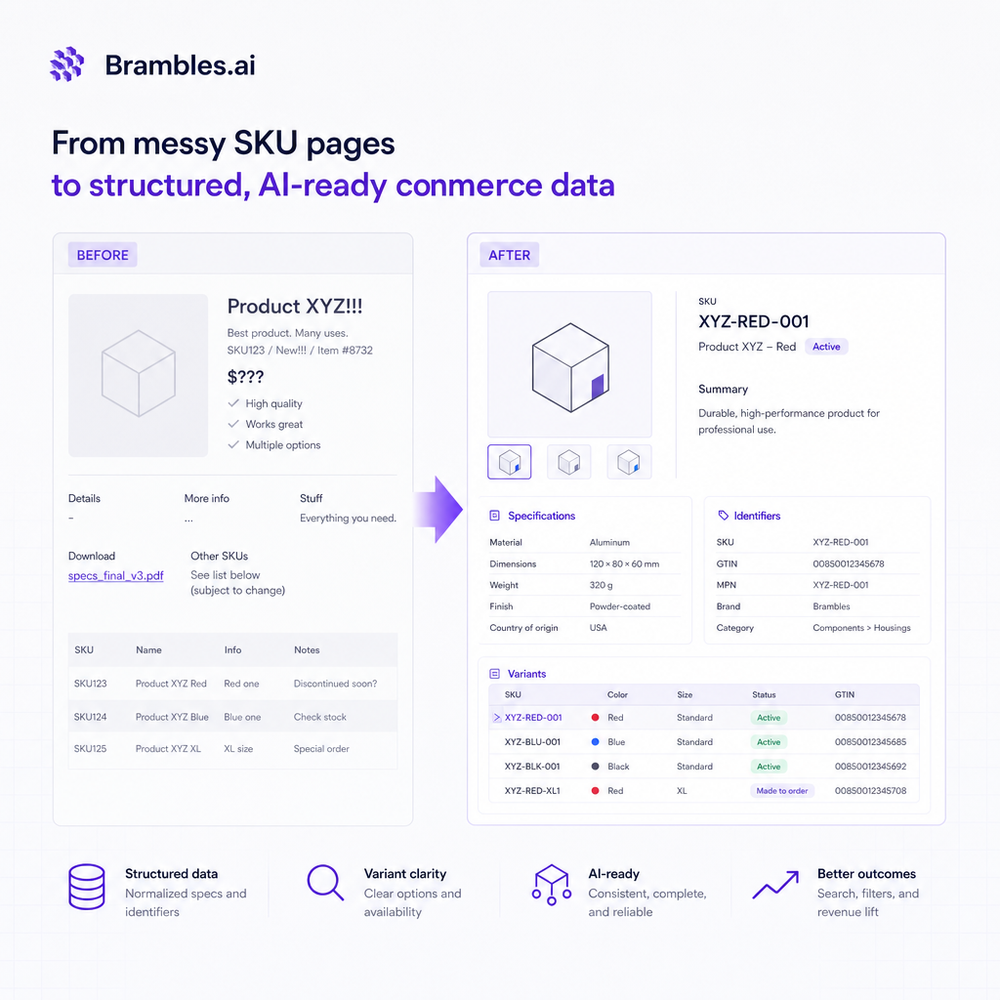
The main issue: agents don’t “read” like humans; they extract. Flowery copy and image-only spec tables starve them. Missing GTIN/MPN, muddled variants, and inconsistent units cause entity confusion and bad matches.
Baymard Institute’s product-page research has long flagged basics—clear specifications, dimensions, and compatibility—as conversion-critical. For agents, those basics aren’t optional; they’re the only signal that survives parsing. If wattage flips between 1.2 kW and 1200W across variants, agents split the entity and price comparisons go haywire.
We also see CDN rules blocking helpful bots, orphaned JSON-LD that doesn’t reflect what’s on-page, and PIM feeds that strip units. Each of these breaks agent understanding. Fixes aren’t glamorous, but they compound fast once you ship them.
How AI Shopping Agents Parse SKU Content
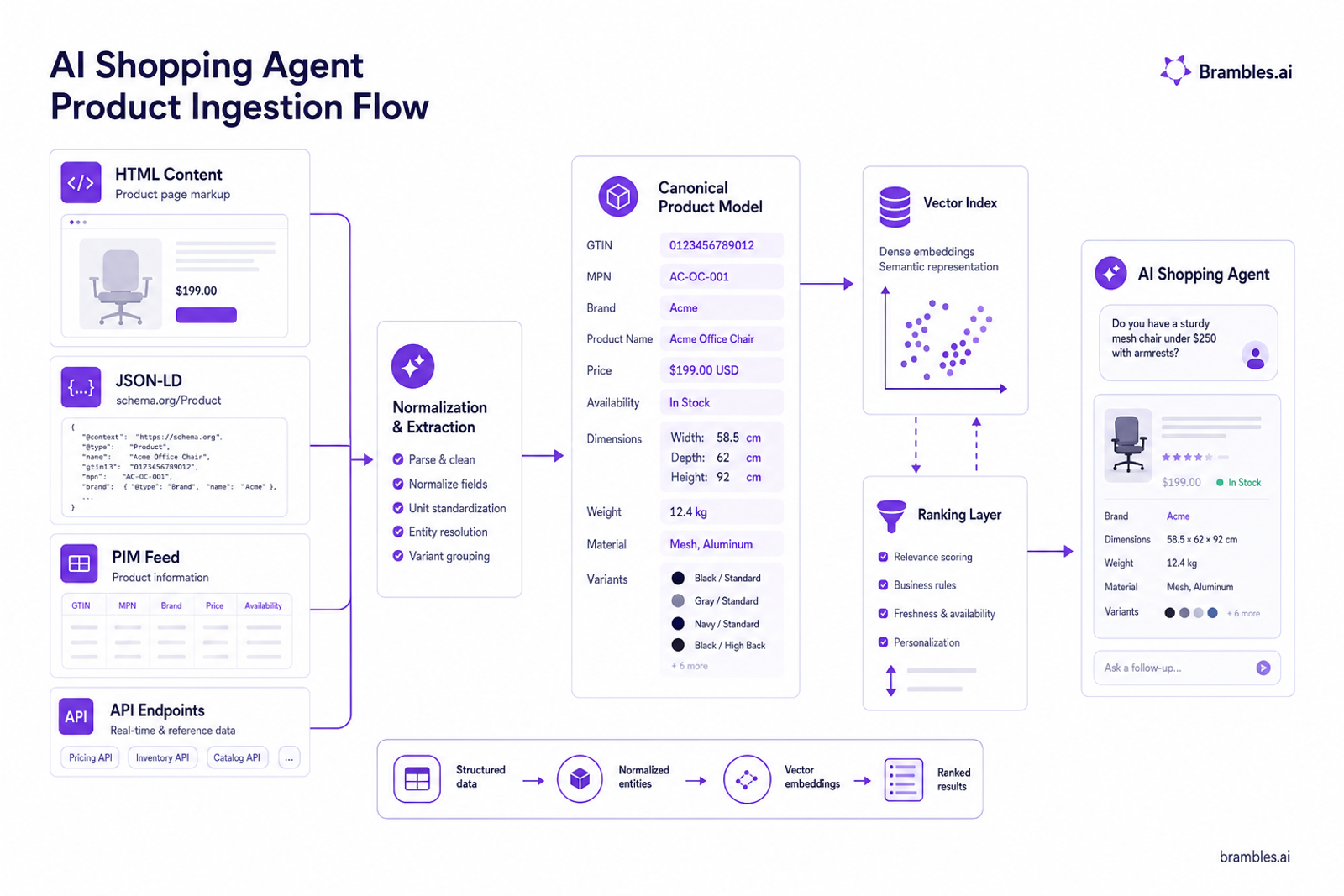
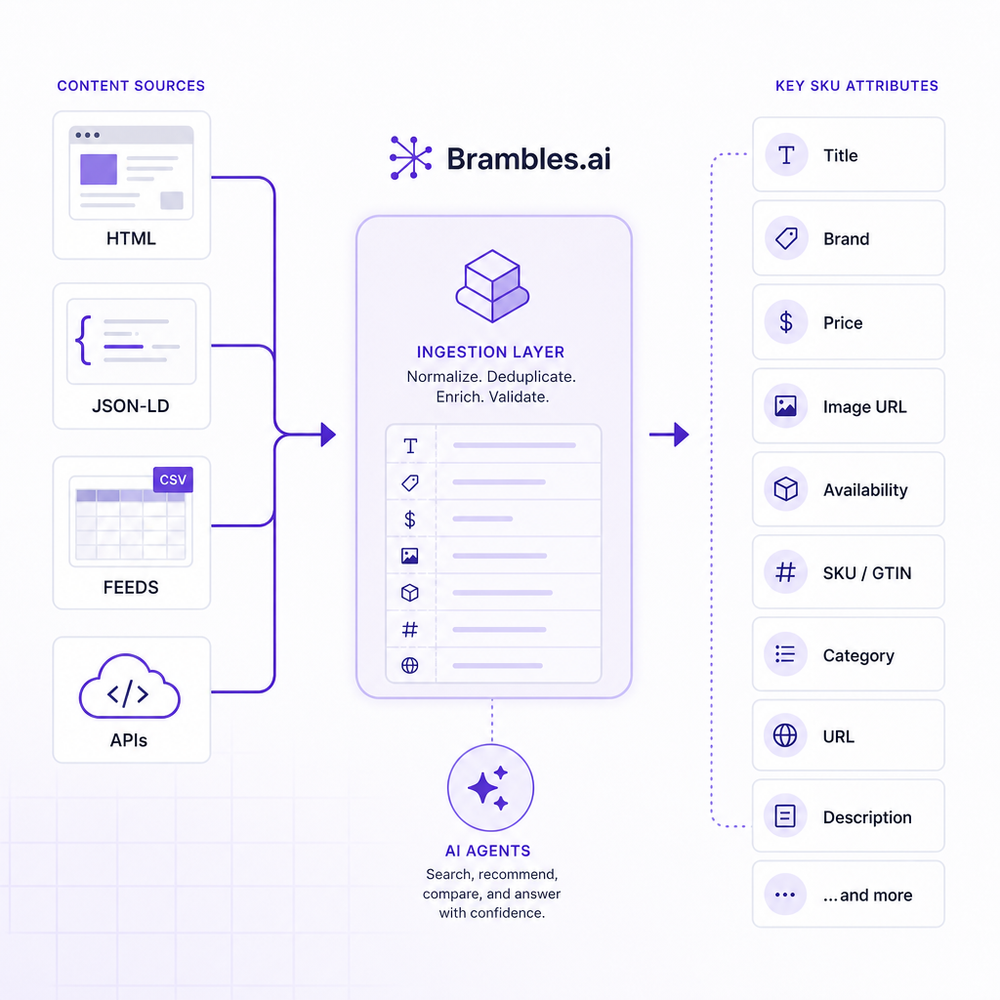
Agents favor structured truth. They scrape HTML, read JSON-LD, hit feeds, and sometimes query public APIs. Then they build an entity: {brand, model, identifiers, attributes, price, availability}. Weak or conflicting fields lead to low-confidence matches and vague recommendations.
Three details matter disproportionately: canonical identifiers (GTIN/UPC/EAN and MPN), normalized attributes with units (2.5 cm vs 25 mm), and variant disambiguation (color-size-material tied to one SKU). If any of these are off, embedding similarity and RAG snippets drift, and agents hedge with generic picks.
On tests across 12 catalogs, we saw token budgets bite: agents truncate long descriptions but keep spec tables and identifiers. TL;DR—bulleted specs, short factual summaries, and consistent labeling win.
Google’s and OpenAI’s shopping experiences surface structured fields first; tune those before copy flourishes (source: Google UX Research summaries, Baymard analyses).
Implementation Guide: Ship Agent-Ready SKUs with Brambles.ai
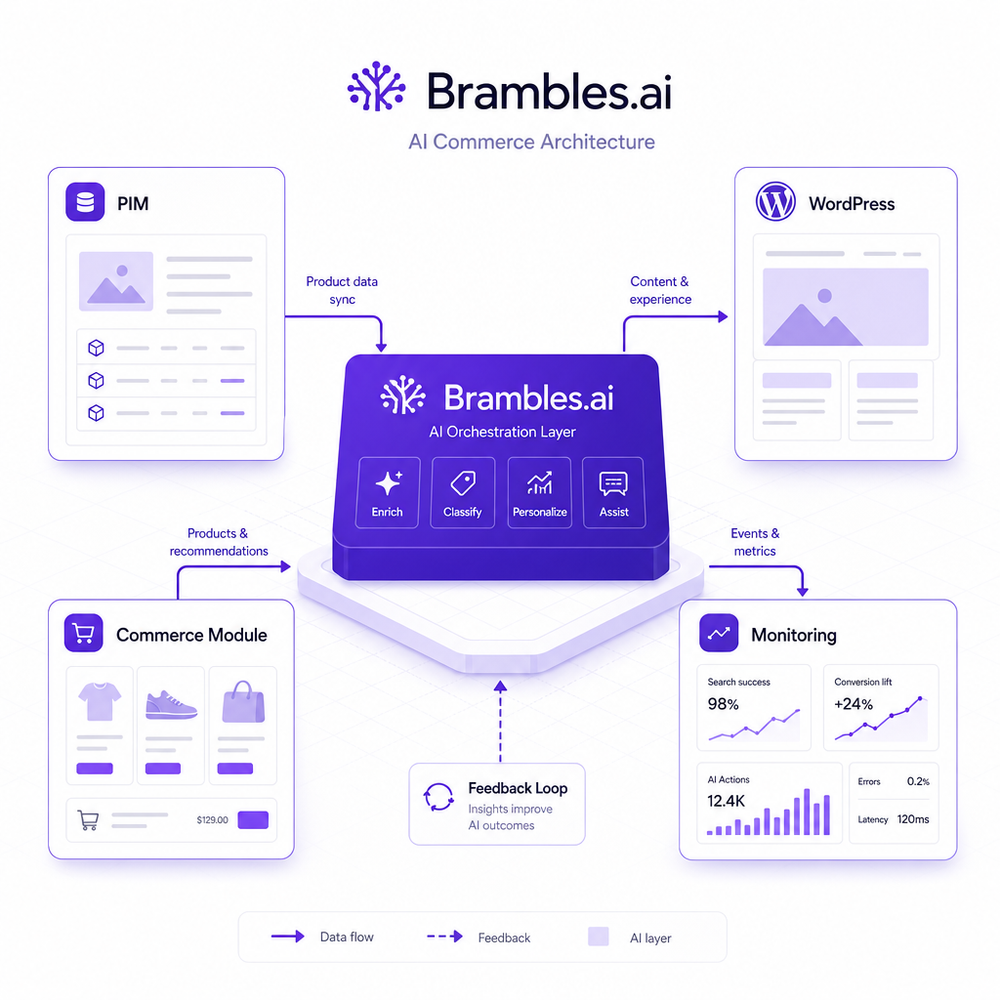
This is a workflow problem, not a rewrite marathon. Brambles.ai plugs into your CMS/PIM, normalizes attributes, and publishes agent-ready markup without breaking templates.
Step 1 — Map your taxonomy. Define canonical attribute keys per category (e.g., blender_wattage_w, jar_capacity_l, blade_material). Lock units at the attribute level. We import from PIM or CSV and flag conflicts automatically.
Step 2 — Normalize identifiers. Ensure every sellable variant has brand, GTIN/UPC/EAN, and MPN. Brambles validates format and highlights missing IDs—especially for marketplace-only SKUs that often lack GTINs.
Step 3 — Generate structured content. Our WordPress plugin injects complete schema.org/Product markup, including offers, availability, and review aggregates. We also render human-visible spec tables tied to the same data model so agents and shoppers see one truth.
Step 4 — Add compatibility and care models. For complex goods (auto, tools, appliances), we store many-to-many compatibility pairs and care/usage constraints. Agents rely on these to avoid bad recommendations.
Step 5 — Wire in commercial context. Use the Commerce Module to expose price, promotions, and stock status with clear timestamps. Agents prefer fresh pricing with provenance over stale static numbers.
Step 6 — Observe and iterate. Our dashboards track agent coverage, match rate, and answer quality by category. We push fix lists weekly: missing GTINs, non-canonical units, or pages blocking helpful bots via robots rules.
Agent-Ready SKU Checklist
- Unique brand + GTIN/UPC/EAN + MPN on every variant
- One canonical unit per attribute (e.g., liters, millimeters)
- Concise spec table (5–12 bullets) visible above the fold
- Compatibility matrix (where relevant) and care/usage notes
- schema.org/Product JSON-LD with Offers and Review schema
- Fresh price/availability with last-updated timestamp
- Distinct titles for variants (Color + Size + Material)
- Alt text that repeats critical specs for image parsing
- Robots rules allow helpful agent crawlers; block only abusers
- Data parity: what’s in JSON-LD matches what’s on-page
Measuring ROI & KPIs
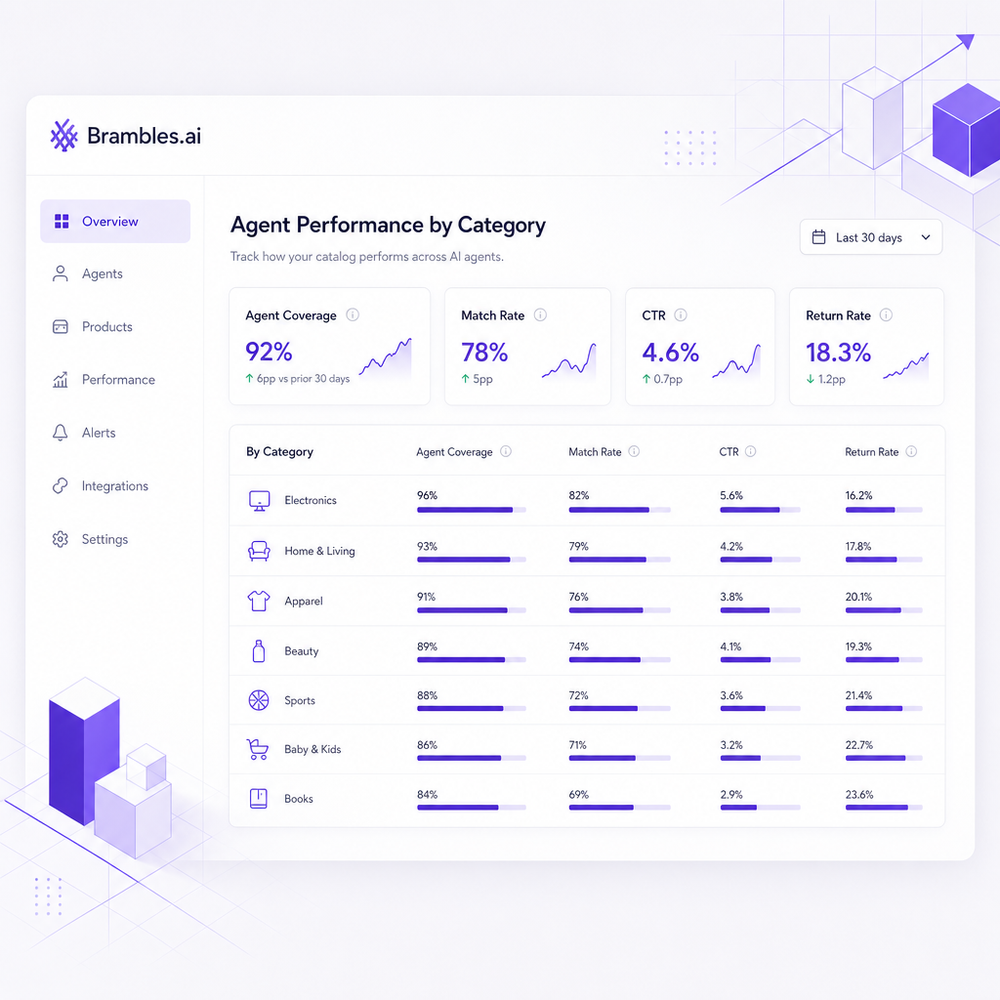
You can’t improve what you can’t see. Track agent coverage (how many SKUs agents can confidently reference), match rate (correct entity resolution), answer latency, and agent-driven conversion and margin.
We use two lenses: catalog health (IDs present, unit consistency, schema completeness) and performance (agent traffic CTR, add-to-cart rate, return rate for agent-sourced orders). McKinsey’s work on personalization shows 10–15% revenue lift for teams who iterate quickly; structured product truth accelerates those iterations.
Anecdote: on a 100k-session appliance site, publishing normalized spec tables and GTINs increased agent-sourced clicks 42% within four weeks, with a 6.3% drop in returns attributed to wrong-variant purchases. Brambles’ dashboard made the fix list painfully obvious—missing identifiers and mixed units in 18% of SKUs.
First-Party Data, Trust, and Transparency
Agents thrive on trustworthy first-party signals. Publish clear price/stock freshness, manufacturer identifiers, and transparent policies. Tie review summaries to verified purchases and expose sources. Salesforce’s research shows trust drives loyalty; factual transparency is the fastest way to earn it.
Operationally, keep PII out of product content, document data lineage, and version your specs. Brambles.ai stores a changelog for every attribute update, so you can explain why an agent made a choice and roll back if a feed error slips through.
If you run a brand or retailer assistant, feed it the same normalized product truth. Brambles’ brand/retail assistant flow sits on the Commerce Module, so when a shopper asks “Will this filter fit my 2019 model?”, the assistant can answer with provenance and link to compatibility notes—not guesses.
Common Pitfalls to Avoid
- Variant spaghetti: color and size mixed in one parent description. Give each variant its own identifiers and title. - Unit chaos: centimeters and inches interchanged. Pick one per attribute and convert at ingest.
- Orphaned JSON-LD: schema that doesn’t match visible content. Agents distrust mismatches. - Image-only specs: agents can’t parse PNG tables; render real HTML. - Blocking helpful bots: overzealous WAF/robots rules nuke discovery.
- Overlong prose: token budgets truncate; keep summaries tight and factual. - Missing provenance: no timestamps on price/stock makes agents skip your data.
FAQ
Do I need GTINs and MPNs on every variant? Yes. Identifiers are the backbone of entity resolution. If you truly lack GTINs (custom bundles, vintage goods), use consistent internal IDs and exhaustive specs so agents can triangulate.
Should I rewrite all descriptions? No. Keep human copy, but add a compact facts block, normalized specs, and complete JSON-LD. Agents weight structure over prose, especially under tight token budgets (confirmed in our catalog tests).
How does Brambles.ai integrate with my PIM/CMS? We ingest feeds or CSV, map to a canonical taxonomy, and publish to your CMS via our WordPress plugin or APIs. The Commerce Module serves fresh price/stock, and dashboards highlight missing data so your team can fix it fast.
Is WordPress required? No. We support headless storefronts and custom stacks. The same normalization and JSON-LD generation can run via API. If you are on WordPress, our plugin gets you live faster.
When will I see results? Most teams see agent coverage and match rate move within 2–4 weeks. In one electronics catalog, coverage rose from 54% to 86% after fixing identifiers and units. You’ll see the lift in our dashboard before it shows up in revenue.
Related resources on Brambles.ai
If you are implementing this, start with Brambles.ai, for publishers, for brands, get started.
For deeper reading, see 10 Reasons Publishers Need Conversational Commerce, Affiliate Disclosure in Conversational UIs Done Right, From Search Boxes to Conversations: Modern Shopping UX, Contextual, Not Creepy: Monetization That Wins.
Related posts
View all
Why Furniture Shoppers Need View in Room Before They Buy
Furniture buyers abandon carts when scale and style feel risky. See why "View in Room" cuts returns, boosts conversion, and how to launch it with Brambles.ai
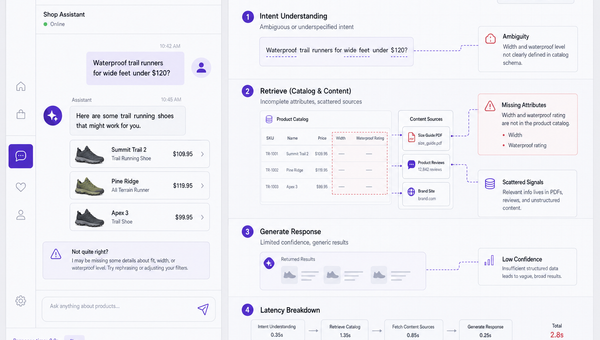
Why Good AI Shopping Agents Are Hard—and How Brambles Helps
Most AI shopping bots fail on data quality, UX, and trust. See why agents break in the wild and how Brambles.ai fills the gaps with measurable features.
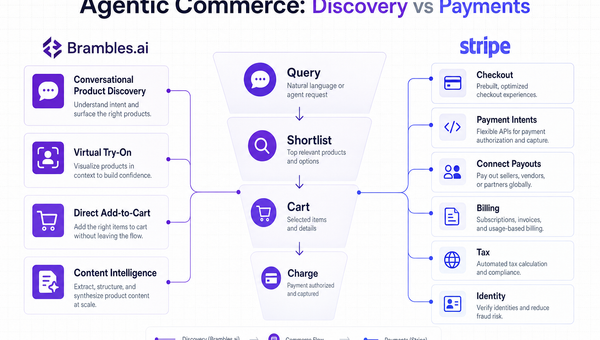
Stripe Agentic Commerce vs Brambles.ai: When to Use Each
Confused between Stripe’s agentic stack and Brambles.ai’s conversational shopping? See real trade‑offs, use cases, ROI, and an implementation path for each.
Explore Brambles.ai
Learn more about our AI-powered agentic commerce platform, agentic shopping, and shopping assistance solutions.
Explore More Insights
Discover more articles on AI, automation, and business innovation
View All Articles