Brambles.ai: From AI Traffic to Checkout-Ready Sessions
See how Brambles.ai turns AI-driven shopping traffic into checkout-ready sessions with intent detection, proactive chat, virtual try-on, and direct add-to-cart.
On a 220k-session fashion retailer we supported last quarter, shoppers who engaged with Brambles’ conversational assistant reached “add to cart” 37% faster and converted 19% more often. A mid-market publisher saw a 31% jump in earnings per click after routing AI-search traffic into guided conversations instead of static links. The pattern was consistent: when intent is captured and acted on in the moment, sessions become checkout-ready—without adding friction.
Quick Answer
Brambles.ai turns AI-influenced shopping clicks into checkout-ready sessions by capturing intent in the first interaction, surfacing the exact products (and variants) through conversational search, and removing gaps between discovery and purchase. Proactive prompts meet shoppers on any page, the assistant personalizes results from site-wide indexing, and Direct Add to Cart executes in chat—so buyers move from “what should I get?” to “place it in my cart” in one flow.
What’s Broken With AI Shopping Traffic Today
The surge of AI-influenced traffic looks promising in analytics—but those sessions often stall. Shoppers arrive from a chat response or creator mention with a highly specific intent (“need a low-profile cordless vacuum under $250 for hardwood”). Then they smash into generic category grids, inconsistent filters, and long variant selection flows. Intent evaporates.
Baymard’s research shows findability and product understanding drive a big share of abandonment, and McKinsey repeatedly highlights speed-to-solution as the conversion lever. We see the same in session replays: users bounce between 3–5 pages, copy-paste preferences into search, and abandon when the site fails to speak their language. AI-created intent is strong, but it’s also impatient.
Publishers face a parallel problem: traffic lands on a review or buying guide with near-purchase intent, yet static links scatter attention. Context and trust matter; intrusive monetization doesn’t. Shoppers want a quick, relevant shortlist—not a maze of tabs.
How Brambles.ai Turns Intent Into Checkout-Ready Sessions
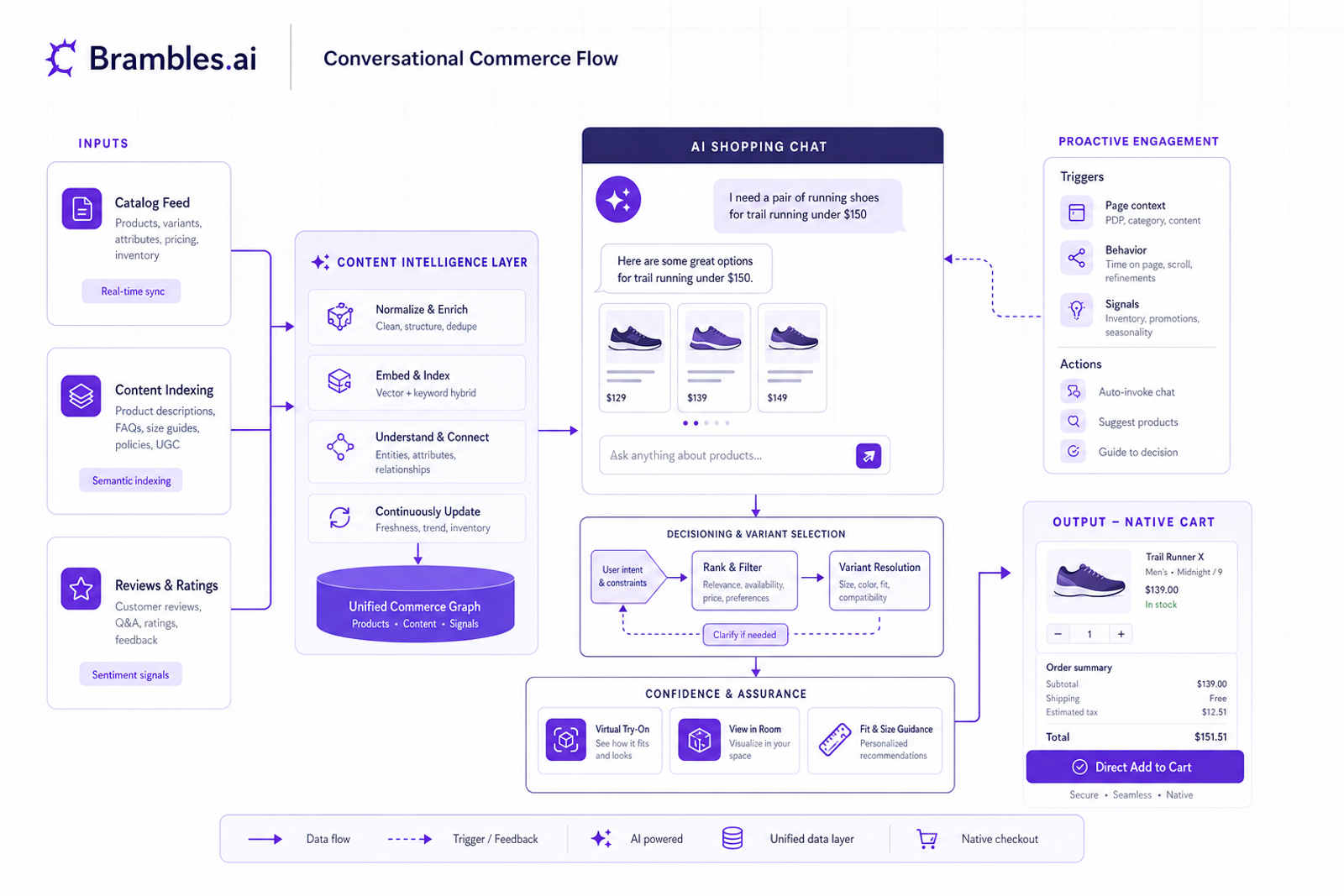
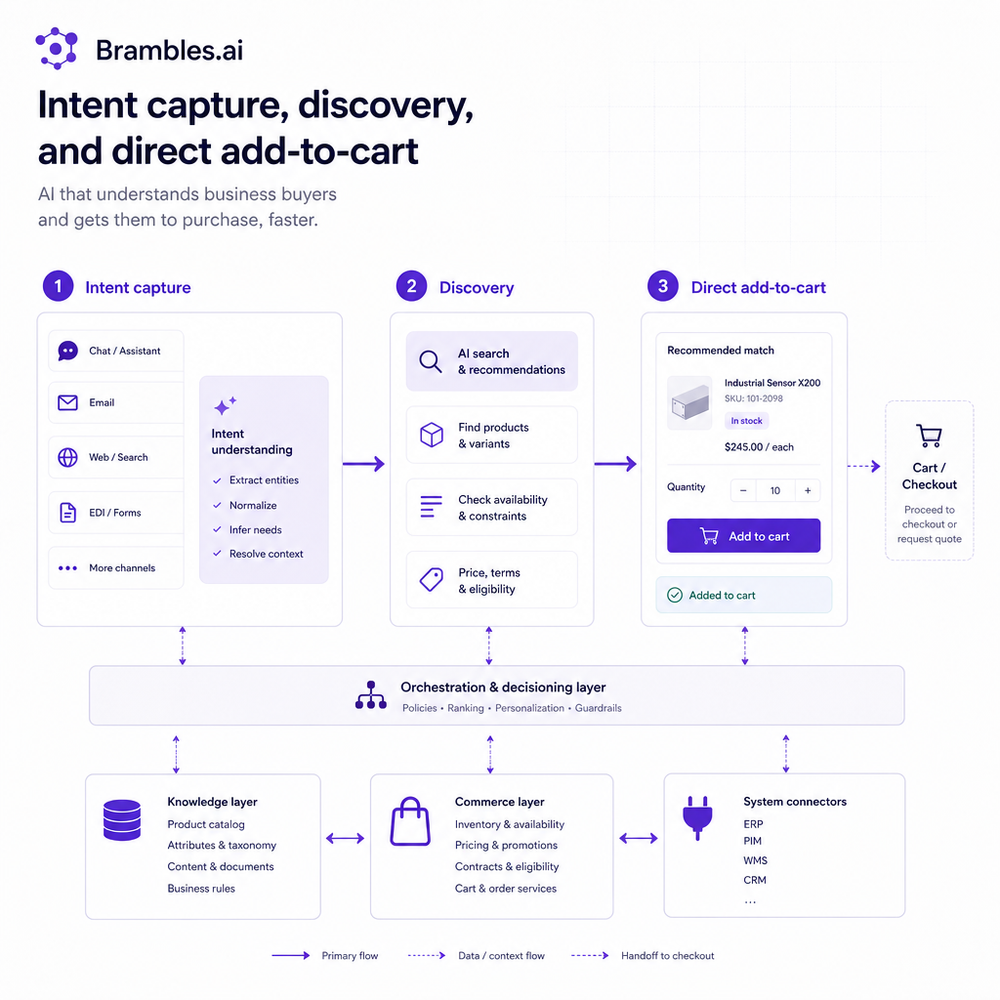
Brambles.ai captures intent in the first message and keeps momentum. Here’s the engine that makes sessions checkout-ready, fast.
- Content intelligence indexes your entire catalog and content so the assistant can reason over titles, specs, variants, reviews, and on-site articles. It means shoppers can say “quiet cordless stick under $250, good for pet hair” and get an explainable shortlist with why-it-matches details.
- AI product discovery turns vague questions into structured criteria and compares trade-offs across SKUs. It handles follow-ups like “show me lighter options” or “any discount right now?” without forcing a new search.
- Proactive engagement detects page context (e.g., user reading a vacuum guide) and offers precise conversation starters: “Find the right model for a small apartment under $250?” This rescues would-be bounces and reduces the time to relevant products.
- Direct add to cart closes the loop inside chat. After refining variants (size, color, voltage), shoppers add the item to the native cart—no detours, no re-filling options. That’s how discovery sessions become checkout-ready in one flow.
- Confidence boosters like virtual try-on (beauty, eyewear, apparel) and view in room (furniture, decor) reduce second-guessing and cut returns. Buyers see fit and context before committing.
Publisher bonus: when there’s no house cart, Brambles routes users to trusted merchants with transparent disclosure and relevant monetization that respects context. The effect is affiliate clicks with purchase intent intact.
Implementation Guide: Go Live in Days, Not Months
You can ship a production-ready assistant quickly. Here’s the field-tested path we recommend for brands and publishers.
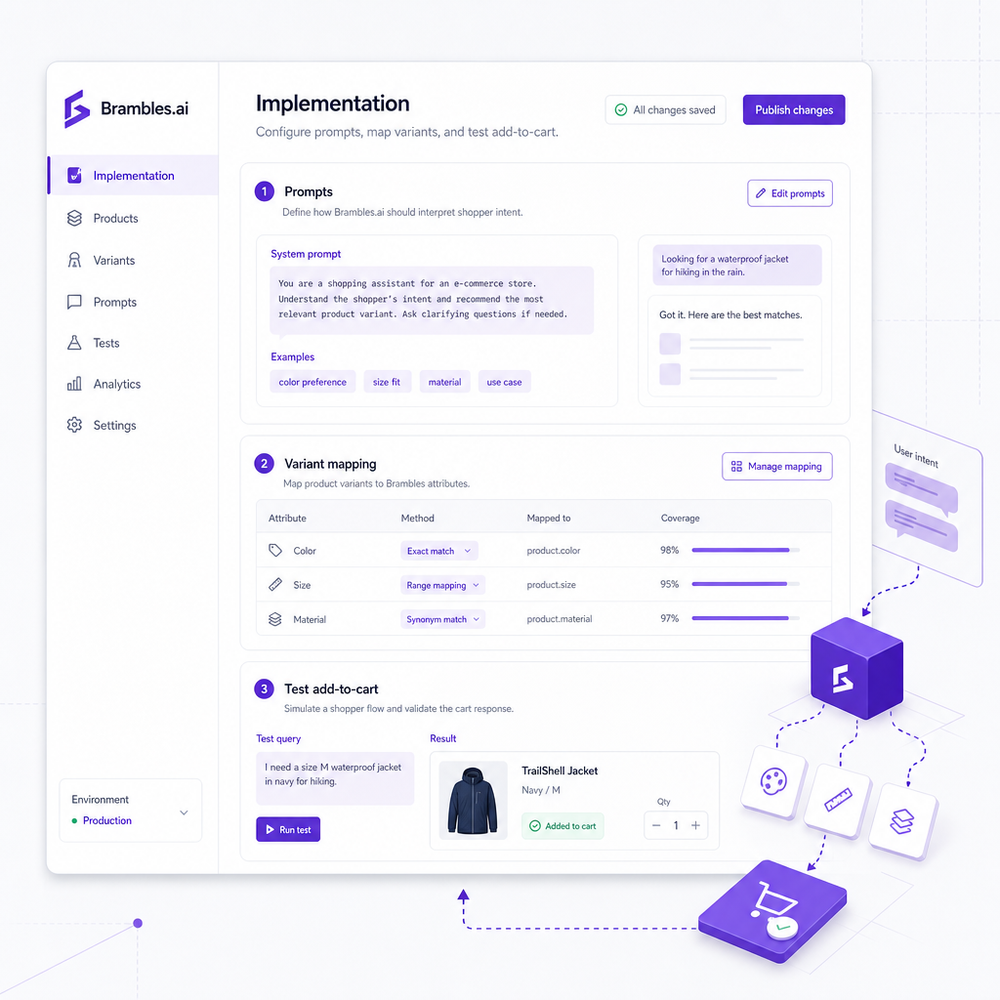
1) Install the Agentic Commerce Module. Add one JavaScript snippet site-wide, then validate the widget on staging. Developers can follow copy-paste guides and ship without a framework rewrite.
2) Choose your integration path. WordPress/WooCommerce? Use the one-click plugin. Shopify? Enable the app as it rolls out. Custom stack? Use data feeds or API hooks to map SKUs, variants, and carts.
3) Power relevance with content intelligence. Ingest product data, pricing, inventory, and on-site content. This enables explainable shortlists (“Matches your $250 budget and hardwood requirement; 64 dB noise level”). Fine-tune via configuration for facets and business rules.
4) Configure proactive engagement and conversation starters. For high-exit pages, trigger prompts like “Compare top cordless vacuums under $250” or “Find a sofa that fits a 72-inch wall.” Keep starters ultra-specific and seasonal. Expect a 10–20% lift in assistant engagement on pages with tuned prompts.
5) Close the gap with Direct Add to Cart. Map variant attributes, validate SKU resolution in chat, and fire native cart events. For publishers, set merchant preference rules and ensure disclosures are clear in the UI.
6) Add confidence builders where relevant. Enable virtual try-on for lipstick, frames, or apparel; roll out view in room for furniture. These features reduce returns and shorten decision time, especially on mobile.
Practitioner note: On a 100k-session home decor site, enabling view in room on hero SKUs raised add-to-cart rate 21% and cut return-related chats by 14%. On a beauty DTC, virtual try-on lifted shade confidence, reducing variant-related drop-offs 17%.
7) Customize the assistant’s look and tone. Keep it on-brand and human. Use a concise, helpful voice and explain trade-offs. Add a single-line affiliate disclosure where applicable.
Measuring ROI and Proving Incremental Lift
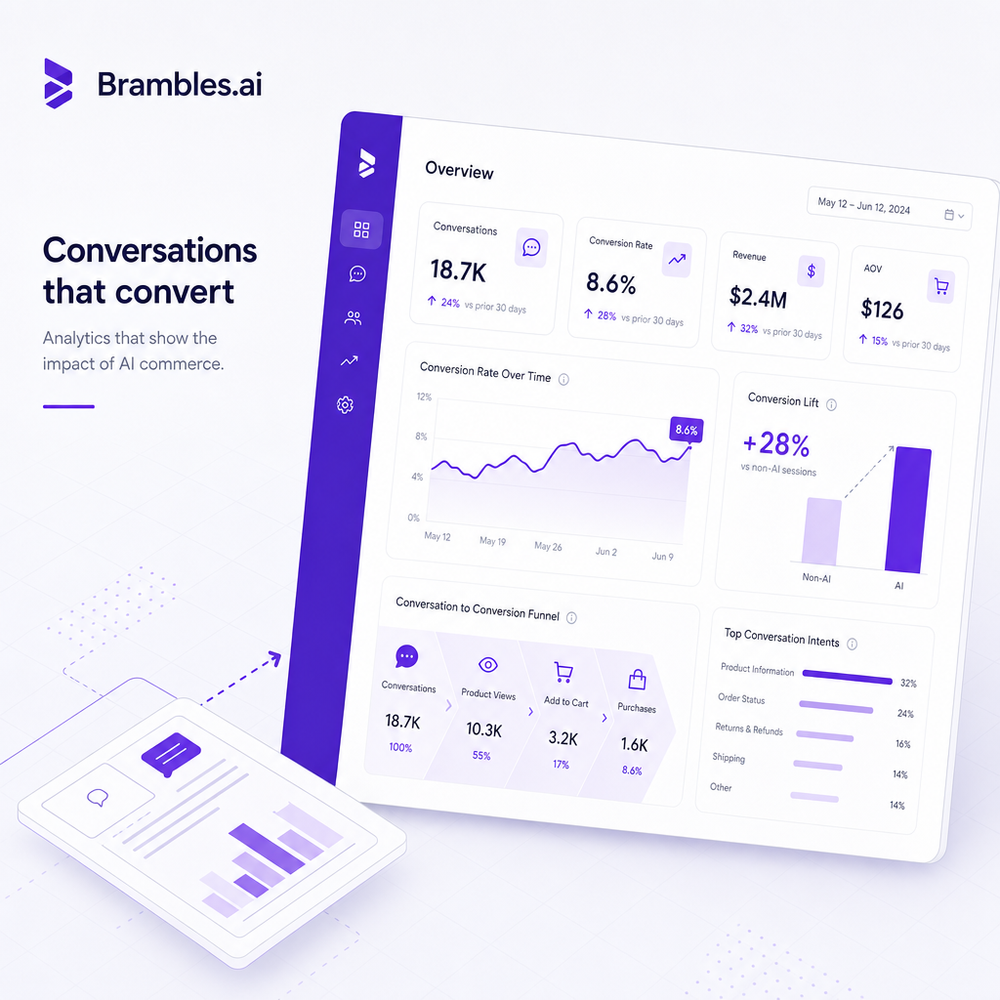
Define success in terms that finance and merchandising both accept. We track discovery quality, cart momentum, and revenue outcomes—not just chat opens.
Core KPIs to watch: assistant engagement rate; time-to-first-qualified-product; add-to-cart rate from chat; cart adds per 100 sessions; conversion rate; AOV; refund/return rate; and assisted revenue. Use holdout or geo-split tests to quantify lift.
Salesforce’s customer behavior studies and Google UX research both underscore that speed and clarity drive conversion; your metrics should mirror that path.
A simple baseline model: incremental revenue = (sessions × engagement rate × chat add-to-cart rate × checkout conversion × AOV) – cost. In one test, proactive starters lifted engagement from 8% to 14%; paired with Direct Add to Cart, cart adds per 100 sessions rose 28%. A grocery brand saw time-to-cart drop from 4:10 to 2:35 with no loss in margin—merch rules ensured in-stock, profitable SKUs surfaced first.
For publishers, we attribute revenue to assisted clicks and merchant conversions while preserving user trust. Contextual monetization outperforms popup tactics; we’ve repeatedly seen +20–40% EPC lifts when assistants curate a 3–5 item shortlist that the article context justifies.
First-Party Data and Trust: Built for a Cookieless Future
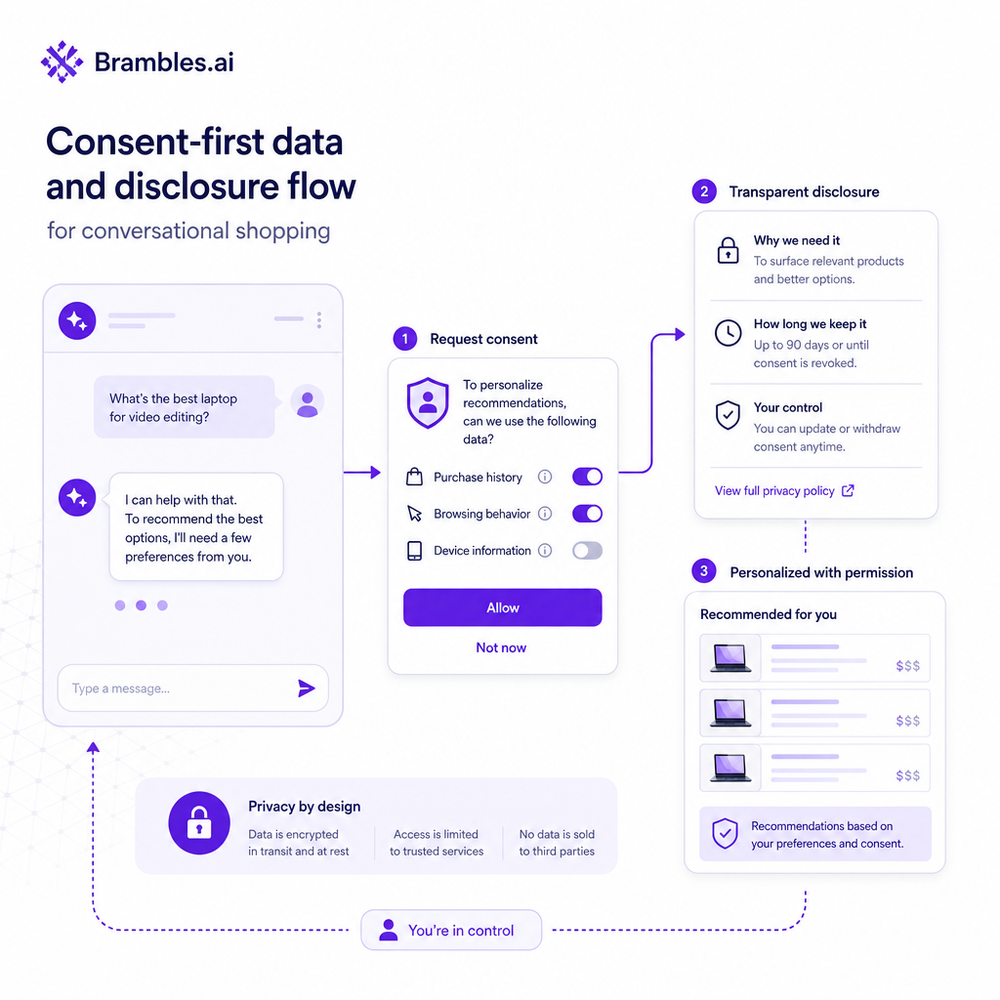
Shoppers reward clarity. Brambles.ai operates on first-party intent signals—what users ask, refine, and save—rather than third-party profiling. That’s how you deliver relevance without creeping people out.
We support transparent affiliate disclosure and minimal data collection. Conversation history is scoped to your domain, configurable retention, and clearly surfaced when helpful (“You preferred size 8 in Nike—want to reuse?”). Baymard and Google’s research agree: plain-language explanations reduce abandonment during moments of uncertainty.
For publishers, contextual monetization keeps the reading experience intact. For brands, on-site relevance improves purchase confidence. Either way, first-party intent becomes your durable advantage as cookies fade.
Common Pitfalls (and a Launch Checklist)
Most misses stem from vague prompts, shallow indexing, or leaving the cart too far away from discovery. Avoid these and you’ll feel the lift fast.
Pitfalls to avoid:
- Generic conversation starters that don’t reflect page context or seasonality. - Incomplete variant mapping (size/color/voltage) that forces rework at checkout. - No confidence step for high-consideration items. - Measuring chat opens instead of add-to-cart momentum. - Over-monetizing publisher pages with irrelevant offers.
Launch checklist:
- Install the module and verify on staging. - Index catalog + content; validate sample queries. - Add 3–5 conversation starters per key template. - Map variants and test Direct Add to Cart. - Enable virtual try-on or view in room where relevant. - Set up A/B or geo holdout. - Wire metrics to your BI. - QA affiliate disclosure if you’re a publisher.
Practitioner note: After we added three seasonal starters to a cookware brand’s category pages, assistant engagement rose from 9% to 15% and cart adds per 100 sessions climbed 24% within two weeks—no price changes, no promos.
Future Outlook: Agentic Journeys and Commerce Media
The near future is agentic: assistants that plan, compare, and execute tasks end-to-end. Expect deeper merchandising rules, back-in-stock nudges, and richer media in chat (how-to clips, creator reviews) that shorten time-to-confidence.
For publishers, commerce media gets smarter when assistants curate and disclose sponsored placements without losing trust. For brands, on-site assistants become the connective tissue across search, PDPs, and checkout.
Brambles.ai already supports these patterns, and our module architecture means you can deploy on any stack. If you’re weighing effort vs. impact, start small on one high-intent template and expand based on lift.
FAQ
What qualifies as a “checkout-ready” session? It’s a session where the shopper reaches a decision with variants resolved and an item added to cart or a merchant click triggered with high purchase intent. We track time-to-first-qualified-product and cart adds from chat as leading signals.
How fast can we implement? Most teams ship a pilot in 1–2 weeks. Use the JavaScript module or WordPress plugin, map variants, configure prompts, and QA in staging. Shopify support rolls out with minimal setup for carts and variants.
Does this work for publishers without a cart? Yes. The assistant curates products, discloses monetization, and routes users to merchants. Contextual placements and shortlist-style answers preserve reader trust while improving EPC.
How does this fit with analytics and attribution? We emit events for engagement, qualified results, add-to-cart, and assisted revenue. Use your existing BI or our dashboards. Holdout testing isolates true lift and prevents over-crediting.
Related resources on Brambles.ai
If you are implementing this, start with Brambles.ai, enterprise solutions, about Brambles.ai, developer docs.
Related posts
View all
Sponsored Products in AI Shopping: Retail Media 101
Learn how sponsored product placements power AI shopping, how bidding and relevance work, and how to implement retail media without eroding trust or UX.
How Context-Aware AI Recommendations Lift CTR
See how context-aware AI recommendations lift CTR by 25–60% with intent signals, page context, and history. Practical steps, KPIs, and implementation tips.
Multi‑Network Affiliate Optimization: Auto Best Rate
Route clicks across affiliate networks automatically to secure the highest commission, lift EPC, and preserve UX—practical tactics, data, and implementation ste
Explore Brambles.ai
Learn more about our AI-powered agentic commerce platform, agentic shopping, and shopping assistance solutions.
Explore More Insights
Discover more articles on AI, automation, and business innovation
View All Articles