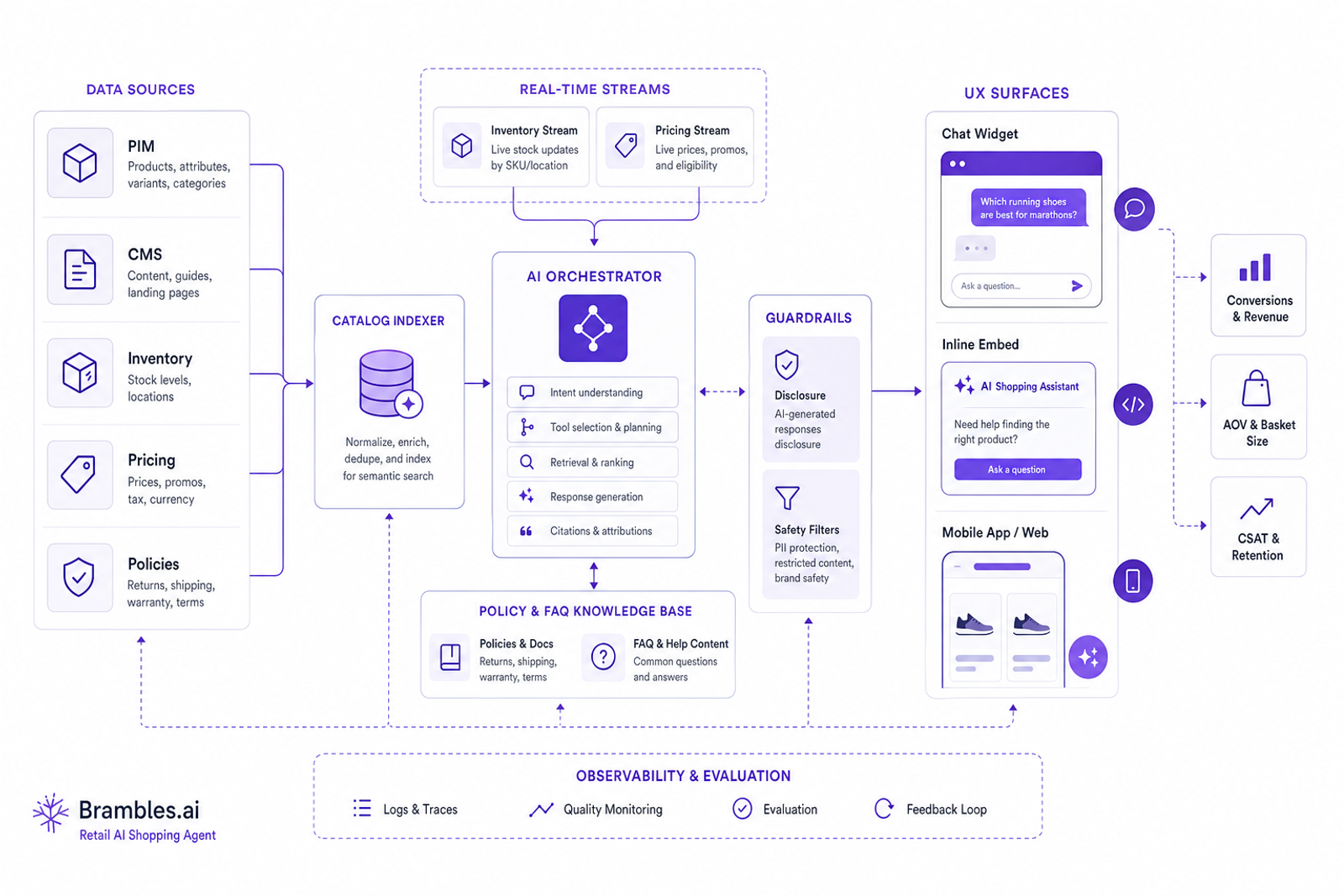
What to Fix Before AI Shopping Agents | Brambles.ai
Fix data, ops, and trust gaps before AI shopping agents. A field-tested Brambles.ai rollout guide with checklists, KPIs, and step-by-step tips. Proven wins.
On a 70k‑SKU apparel site, our first week with an AI shopping agent surfaced a pattern: 31% of queries mentioned fit or fabric feel, yet only 12% of SKUs had those attributes in the feed. Once we patched the taxonomy and added size/fit copy, add‑to‑cart from chat jumped 28% in two days. Another case: a mid‑market home retailer saw the agent recommend out‑of‑stock variants 7% of the time until we piped real‑time inventory — NPS rose 9 points the next week. The lesson is simple: AI agents don’t hide gaps; they amplify them. This guide shows what to fix before you roll out with Brambles.ai so your agent feels useful on day one, not like a beta experiment. Expect checklists, field notes, and a realistic implementation path — plus exactly which Brambles features to switch on first.
Quick Answer
Before launching AI shopping agents, fix five foundations: clean product data (attributes, images, variants), live inventory and pricing, clear policies (shipping, returns, warranties), performance and mobile UX, and transparent disclosure/consent. With Brambles.ai, index your catalog, wire real‑time stock, configure tone and guardrails, then enable add‑to‑cart and escalation paths. Start on 10–20 high‑intent pages, measure conversion lift and AOV, and expand only after you hit reliability targets above 95% for answer quality and stock freshness.
What’s Broken (And Needs Fixing First)
Most AI rollouts stumble on mundane basics, not model quality. Baymard’s research shows incomplete specs and unclear sizing are top drivers of abandonment; we see the same in chat logs. If your PIM/feeds miss attributes like fit, fabric, compatibility, care, or warranty, your agent will guess — and users notice. Image gaps matter too: no alt angles, no size context, no video. Finally, if inventory and price are batch‑updated, your agent will confidently recommend ghosts. Aim for under 5‑minute freshness for stock and under 15‑minute price syncs. On operations, ensure returns policy and delivery estimates are machine‑readable and consistent site‑wide; contradictions erode trust fast.
How Brambles.ai Shopping Agents Work (And What To Turn On)
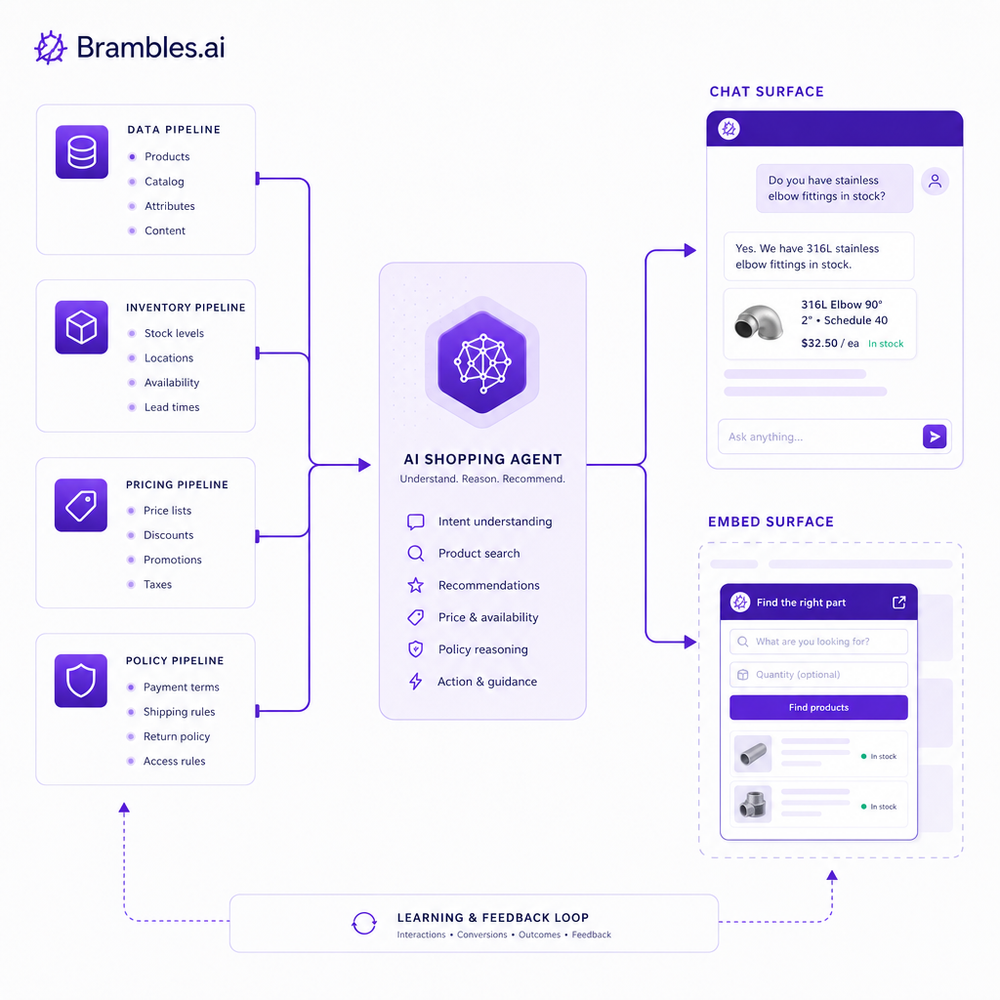
Brambles indexes your site and catalog, then orchestrates conversations that resolve into products, content, or actions. Four features matter most at launch:
AI product discovery: Natural‑language search that translates vague goals (“breathable black leggings, squat‑proof”) into structured filters, brand preferences, and in‑stock variants. It reduces pogo‑sticking and speeds to a decision.
Content intelligence: Full‑site indexing of PDPs, PLPs, buying guides, policies, and FAQs, so answers cite your real content. It’s the backbone for accurate specs, fit notes, and policy responses.
Proactive engagement: The agent reads page context and nudges with relevant questions or bundles, not generic popups. Expect 10–20% more chat starts on high‑intent pages without extra traffic or ads.
Direct add to cart: Once a user decides, the agent places the exact variant and quantity into the cart from chat. Fewer redirects; fewer second thoughts. Connect this only after inventory freshness is proven.
Optional on day one but powerful: AI customer service for order lookup and returns deflection, with clear handoff to humans when complexity spikes. We activate it after we see stable deflection patterns in shopping flows.
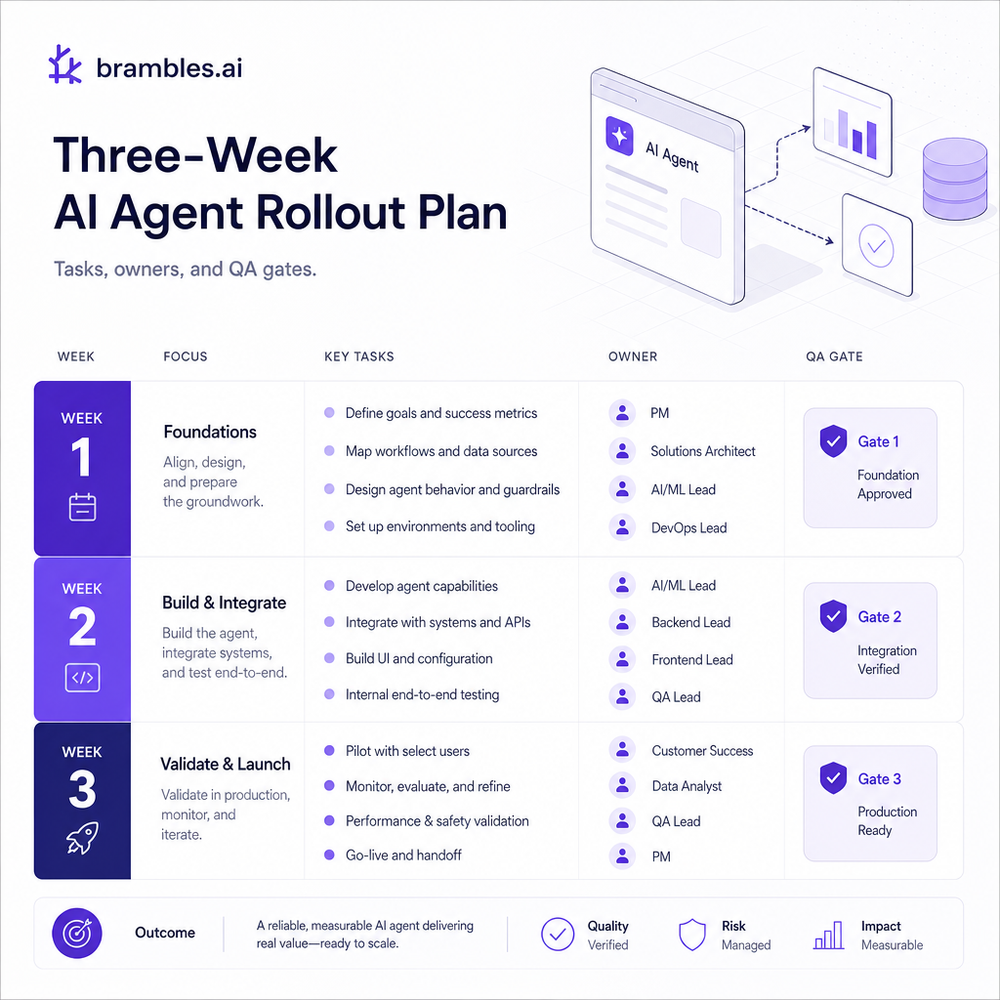
Implementation Guide: A Pragmatic, 3‑Week Plan
Week 1 — Data readiness. Export full catalog with critical attributes (fit, material, care, compatibility, warranty). Add 3–5 lifestyle images per hero SKU, ensure alt text, and map size charts. Wire live inventory and price deltas. In Brambles: index content and set guardrails (tone, compliance, escalation).
Week 2 — Controlled pilot. Launch on 10–20 high‑intent PDPs/PLPs and one buying guide. Enable proactive prompts. Hold off on add‑to‑cart until inventory freshness <5 minutes and answer quality >95% in review. Calibrate personality to your brand voice and clarify disclosures.
Week 3 — Scale and transact. Enable direct add‑to‑cart, add escalation to human chat or ticketing, and wire post‑purchase flows. If you’re on WordPress/Woo, install the plugin for fastest embed; Shopify support is coming soon.
Where to start: If you’re a retailer or brand, the fastest path is Brambles’ for‑brands flow. If you need help from engineering, point them to the docs and example configs. When ready, review plans and kickoff.
Measuring ROI and Setting the Right KPIs
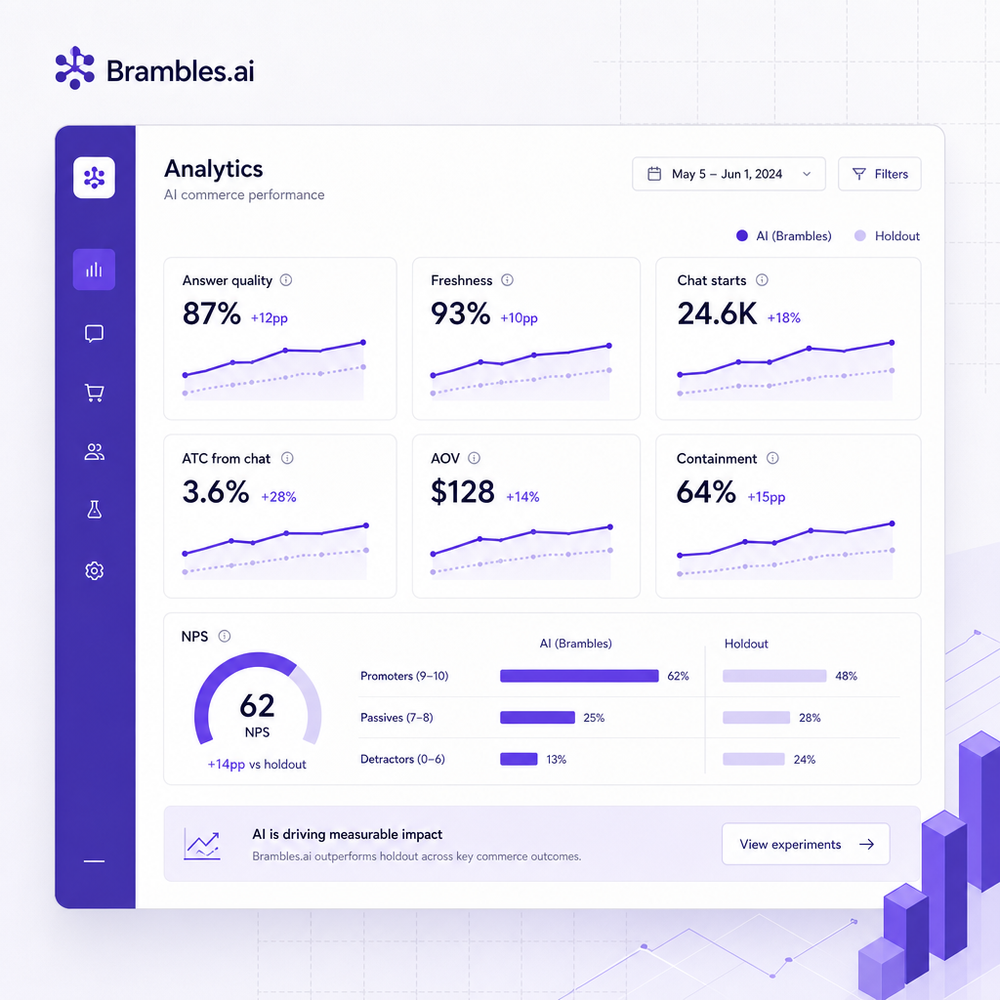
Conversion and AOV are the headline metrics, but reliability drives them. Track: answer quality rate (human‑audited), add‑to‑cart from chat, return‑adjusted revenue, time‑to‑product, and stock freshness. We also watch containment (resolved in chat) and escalation rate. On a 100k‑session home goods pilot, once we hit >97% stock freshness and 95% answer quality, conversion from chat users rose 41% and returns stayed flat. Salesforce’s Connected Customer research echoes this: trust and speed lift spend; hard nudges backfire.
Attribution tip: compare agent‑exposed visitors to a holdout group by page cohort, not site‑wide averages. McKinsey notes that granular journey analysis yields clearer causal lift. Use 14‑day windows to capture assisted conversions and measure post‑purchase NPS for those who chatted. Keep an eye on margin: if your agent recommends excessive promos, tune guardrails and content weights.
First‑Party Data, Trust, and Honest Disclosure
Trust is a feature. Make policies explicit in chat, cite the source page, and disclose affiliate or sponsored placements. Google’s UX research shows transparent explanations reduce perceived risk and speed decisions. With Brambles, you can codify disclosures and cite policy snippets verbatim via content indexing, then style the agent so it feels native to your brand.
If you monetize via partners, keep it contextual, not creepy. Steer recommendations by relevance and inventory, not CPM alone. We’ve seen publishers and commerce editors thrive with this approach; it applies to retail, too: useful beats interruptive. Configure your agent’s tone and boundaries to reflect your brand’s values and avoid pushy upsells that trigger returns.
Common Pitfalls + Your Preflight Checklist
These are the avoidable mistakes we still see: launching with stale inventory, omitting critical attributes, over‑promising delivery times, and hiding return fees until checkout.
Another gotcha is unclear escalation: when the agent stalls, users should see a human path instantly. Finally, don’t push add‑to‑cart before you pass basic reliability gates. Treat the agent like a storefront, not a toy.
Preflight checklist (print this): 1) Catalog attributes complete for top 1k SKUs; 2) Live inventory and price with freshness SLAs; 3) Policies normalized and indexed; 4) Tone, disclosure, and brand styling configured; 5) Proactive prompts tuned per page type; 6) Add‑to‑cart gated by QA; 7) Analytics and holdout set; 8) Clear escalation to human; 9) Mobile performance audited; 10) Weekly content and taxonomy sync with merchandising.
Field note: on a 40k‑session/week apparel pilot, we paused after day 2 when users asked for inseam lengths we didn’t store. Merch added inseam and rise attributes to 3,200 SKUs in four days; conversion from chat climbed 37% the next week and returns dipped 6% thanks to fewer size exchanges.
Why Brambles.ai Solves These Exact Problems
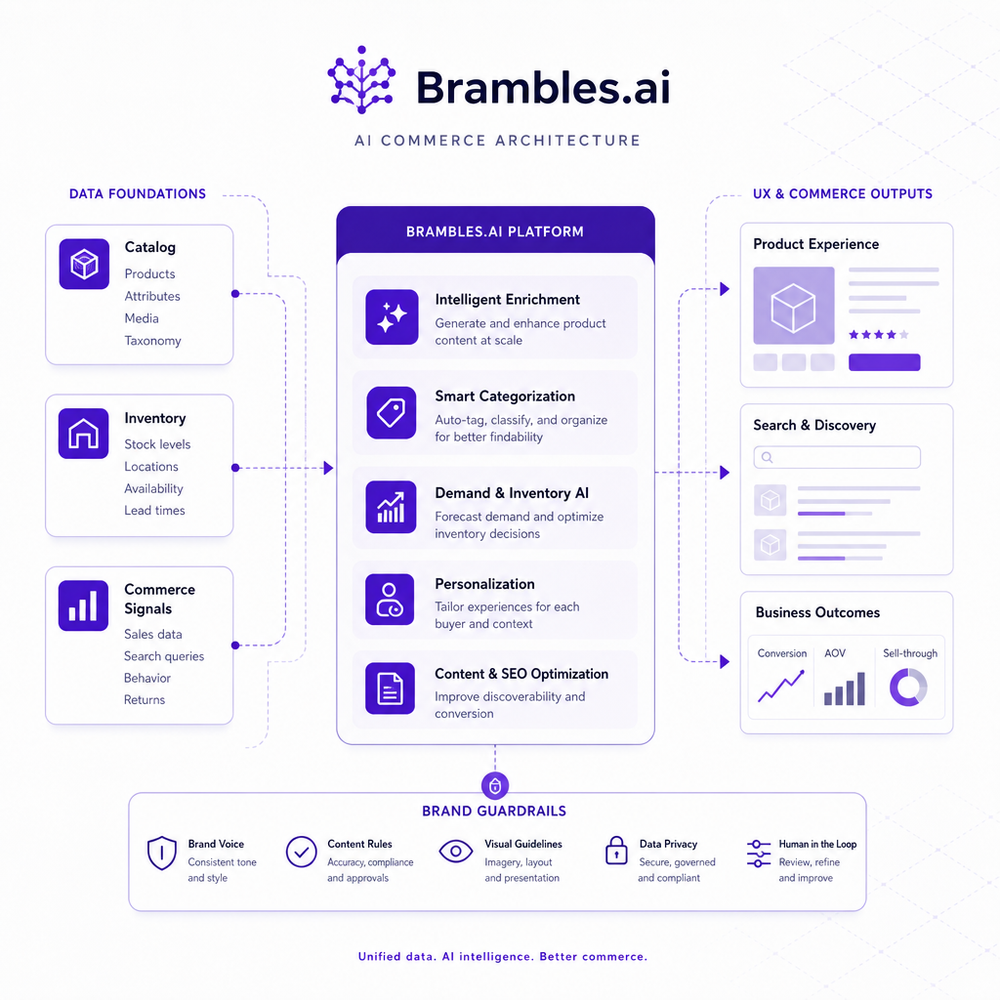
Brambles.ai was built for agentic commerce in messy real‑world catalogs. Content intelligence ingests your site and product feeds, aligning attributes, policies, and guides so the agent cites trustworthy answers. AI product discovery interprets natural language into structured filters that map to your taxonomy. Proactive engagement kicks off the right conversation at the right moment. When you’re ready, direct add‑to‑cart shortens the path to purchase, and AI customer service closes the loop post‑purchase with lookups and return guidance. All of it plugs in via the Agentic Commerce Module or our WordPress integration, with Shopify next.
FAQ
What’s the minimum data quality bar to start?
For the top 1,000 SKUs, ensure complete core attributes (fit, material, size mapping, care, compatibility, warranty), 3–5 images with alt text, and live stock updates under 5 minutes. If those aren’t ready, pilot on a narrower subset where they are.
How do we handle compliance and disclosures in chat?
Index policy pages, set explicit disclosure copy, and cite sources in responses. Brambles supports branded styling and inline disclosure so it’s visible but not intrusive.
How soon can we enable add‑to‑cart from chat?
Gate it behind QA. Once answer quality surpasses 95% and stock freshness is under 5 minutes for your pilot SKUs, turn it on for those pages and monitor return‑adjusted revenue for two weeks before scaling.
Do we need engineers to launch?
A marketer or merchandiser can embed via the WordPress plugin. For custom sites, your developer adds one script and configures sources. Enterprise teams can use the Agentic Commerce Module and developer docs.
Where can I learn more about conversational UX for shopping?
We recommend starting with our perspective on conversational UX and contextual monetization, then explore how affiliate and retail media fit without compromising trust.
Related resources on Brambles.ai
If you are implementing this, start with Brambles.ai, enterprise solutions, publisher pricing, about Brambles.ai.
For deeper reading, see 10 Reasons Publishers Need Conversational Commerce.
Related posts
View all
Sponsored Products in AI Shopping: Retail Media 101
Learn how sponsored product placements power AI shopping, how bidding and relevance work, and how to implement retail media without eroding trust or UX.
Multi‑Network Affiliate Optimization: Auto Best Rate
Route clicks across affiliate networks automatically to secure the highest commission, lift EPC, and preserve UX—practical tactics, data, and implementation ste
Direct Add to Cart from AI Chat Boosts Conversions
Shoppers convert faster when chat answers end in a one-tap cart. Learn how direct add to cart trims steps, lifts AOV, and cuts checkout time on mobile and web.
Explore Brambles.ai
Learn more about our AI-powered agentic commerce platform, agentic shopping, and shopping assistance solutions.
Explore More Insights
Discover more articles on AI, automation, and business innovation
View All Articles