What Is AI Shopping? A Plain-English Guide with Brambles.ai
AI shopping turns product search into natural conversations that convert. Learn how it works, key KPIs, common pitfalls, and how Brambles.ai implements it fast.
What Is AI Shopping? A Plain-English Guide with Brambles.ai
Three weeks after launching a conversational shopping assistant on a 100K-SKU home goods site, we saw something we didn’t expect: customers stopped rage-tapping filters.
The top request wasn’t “blender” but “quiet blender for a small apartment under $80.” Add-to-cart from search rose 31% and zero-result searches fell by half. The lesson: when shoppers can ask for what they actually mean, they move faster and buy more.
Publishers saw a similar shift. On a gear review article, we embedded shoppable answers that pulled in-stock products aligned to the editorial picks. Scroll depth stayed the same, but clicks to merchants jumped 28% and readers stopped bouncing to Google to rephrase queries. That’s AI shopping in practice—not hype, just cleaner paths from intent to item.
Quick Answer
AI shopping is product discovery Shoppers describe needs (“carry-on under 7 lbs, fits overhead on Delta”) and the assistant interprets constraints, searches structured product data, and returns precise, in-stock options with reasons. Done right, it reduces filter-hopping, cuts zero results, and boosts conversion. Brambles.ai implements this with guardrailed language models, vector search over product catalogs, and fast UI components for brands and publishers.
What’s Broken in Today’s Product Discovery
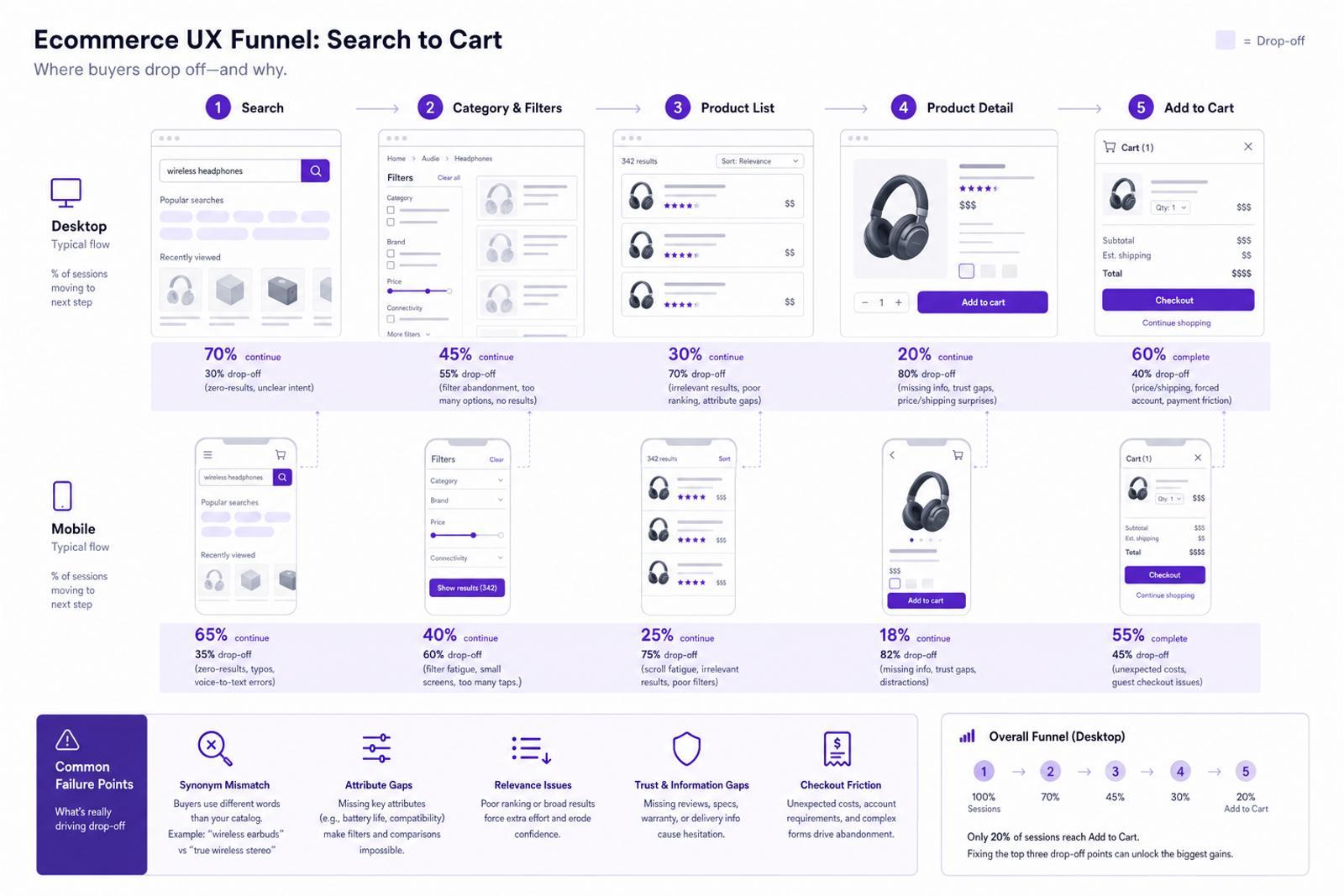
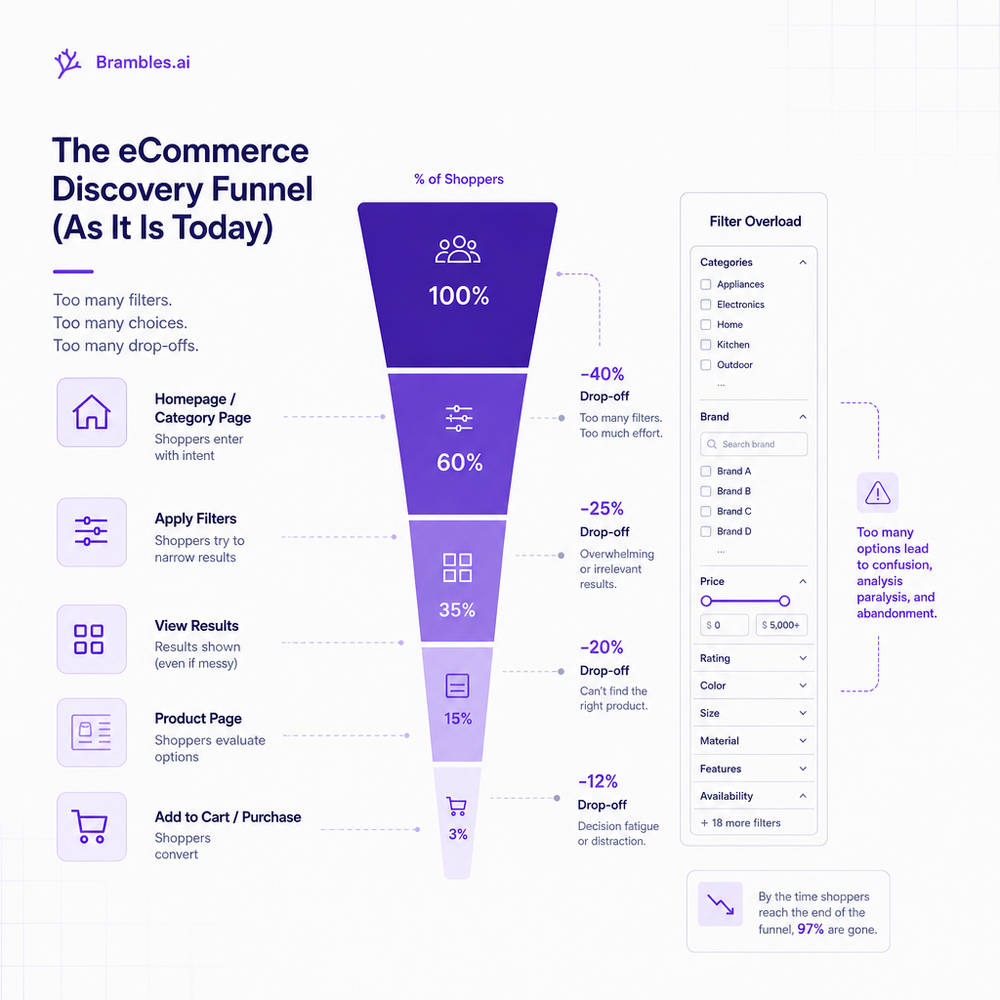
Most retail sites still assume shoppers think in categories and filters. They don’t. They think in outcomes: “quiet,” “pet-safe,” “fits in carry-on,” “for a 10x12 room.” Traditional search struggles with these multi-constraint, plain-English intents, which leads to pogo-sticking between filters, tabs, and search engines.
UX research from Baymard has chronicled how e-commerce search often mishandles synonyms, attributes, and compatibility, pushing users into dead ends. Google’s research on complex, multi-intent queries echoes this: people combine goals, constraints, and context in one breath. When sites can’t parse that breath, abandonment creeps in.
Anecdote: a mid-market fashion retailer we advised had 12 size-related filters across categories, yet 38% of internal search exits came from size-related queries. After we indexed normalized size attributes and enabled conversational refinement (“show me similar in petite 4”), search exits dropped 19% in two weeks.
How AI Shopping Actually Works
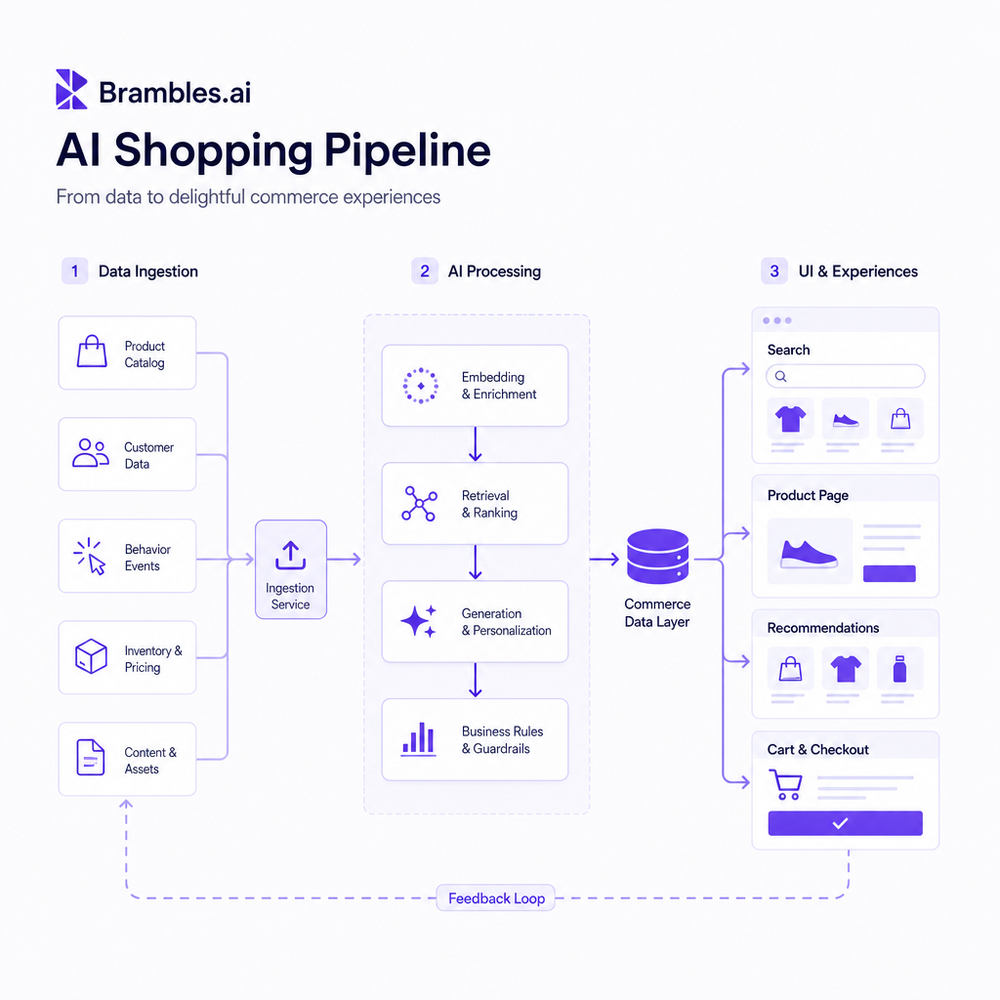
At its core, AI shopping pairs structured product data with natural-language reasoning. The workflow looks like this:
1) Normalize product data. Clean titles, specs, sizes, ingredients, compatibility, and availability. Map to a consistent schema (think color → “navy,” “midnight” → “blue”). 2) Build semantic retrieval.
Create vector embeddings over product attributes and text so “quiet blender” finds low-dB models even if “quiet” isn’t in the title. 3) Add constraint-aware reasoning.
Apply rules for price, inventory, shipping, compatibility, and brand exclusions so answers stay trustworthy. 4) Re-rank for user context. Relevance, popularity, margin, and stock get blended to present the “best viable” set, not just the closest text match.
5) Explain the picks. Short, verifiable reasons (“72 dB, 3.2 lbs, 24-month warranty”) increase trust and clicks.
Brambles.ai does this with retrieval-augmented generation (RAG) over your catalog, a policy engine for budget and availability guardrails, and UI components for site search, embedded shoppable modules, and chat-like assistants. It plugs into feeds (Shopify, BigCommerce, Google Merchant Center) and respects your merchandising rules by default.
Implementation Guide: Launch AI Shopping with Brambles.ai
The fastest wins come from solving discovery for one high-intent surface, then expanding. Here’s a pragmatic, battle-tested rollout plan using Brambles.ai.
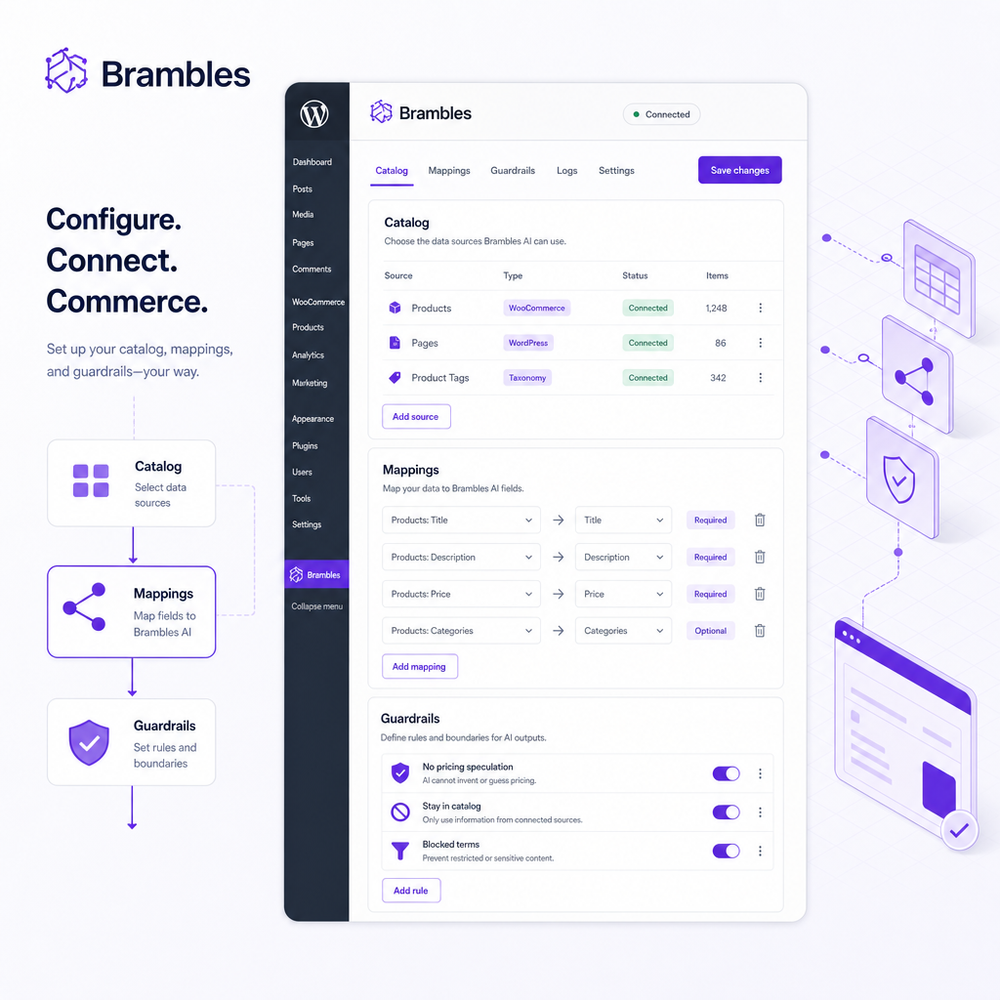
Step 1 — Connect your catalog. Use our WordPress plugin or drop a JS snippet. Sync products from Shopify, CSV, or Google Merchant Center. Map critical attributes: price, size, color, category, compatibility, and stock status.
Step 2 — Define guardrails. Set price caps (e.g., “under $80”), exclude brands, and require in-stock items. Guardrails prevent hallucinations and keep answers shoppable.
Step 3 — Launch one experience. For retailers, start with on-site AI shopping on category pages. For publishers, embed shoppable answer modules inside evergreen guides to monetize without cluttering UX.
Step 4 — QA with intent lists. Test real questions from support tickets and internal search logs: “fits under airline seat,” “for hardwood floors with pets,” “gluten-free, kid-safe.” Validate explanations cite specific attributes and are reproducible.
Step 5 — Measure and expand. Prove lift on one surface, then extend to email, on-site search, and shoppable editorial. Our brand/retail assistant flow also supports store associate usage for guided selling in-store.
Checklist before you go live:
- Attribute coverage: price, availability, sizes, materials, compatibility, returns policy
- Guardrails on: budget, in-stock only, region, brand exclusions
- Latency under 1.2s P95 for suggestions
- “No answer” fallback to filters and curated collections
- Analytics wired: discovery rate, assisted revenue, zero-result rate
Anecdote: a consumer electronics marketplace piloting Brambles.ai on search saw a 42% lift in “first-page find” rate and a 12% AOV increase after we added reasons (“supports Wi‑Fi 6E, 4-year warranty”). The only change beyond the assistant? Better attribute mapping for wireless standards.
Measuring ROI and the KPIs That Matter
If it doesn’t move a KPI, it’s just a demo. Anchor your evaluation on discovery and conversion quality, then expand to revenue attribution and experience health.
Core KPIs to track:
- Discovery rate: % of assistant sessions that produce at least one viable product
- Add-to-cart from AI flows; assisted conversion rate
- Average order value (AOV) and margin mix
- Zero-result rate and search refinement rate
- Time-to-product (from query to first product click)
- Latency P95 for answers; abandonment during wait
- Opt-in rate for follow-ups (if you request consent)
Method to prove lift:
- Before/after on a single category with seasonally stable demand
- A/B test assistant vs. enhanced traditional search
- Holdouts for returning users to isolate novelty effects
- Attribute audits to confirm explanations are grounded in catalog facts
McKinsey’s work on personalization consistently shows double-digit revenue lift when relevance increases; we’ve seen the same when AI shopping reduces zero-result searches and shortens decision time.
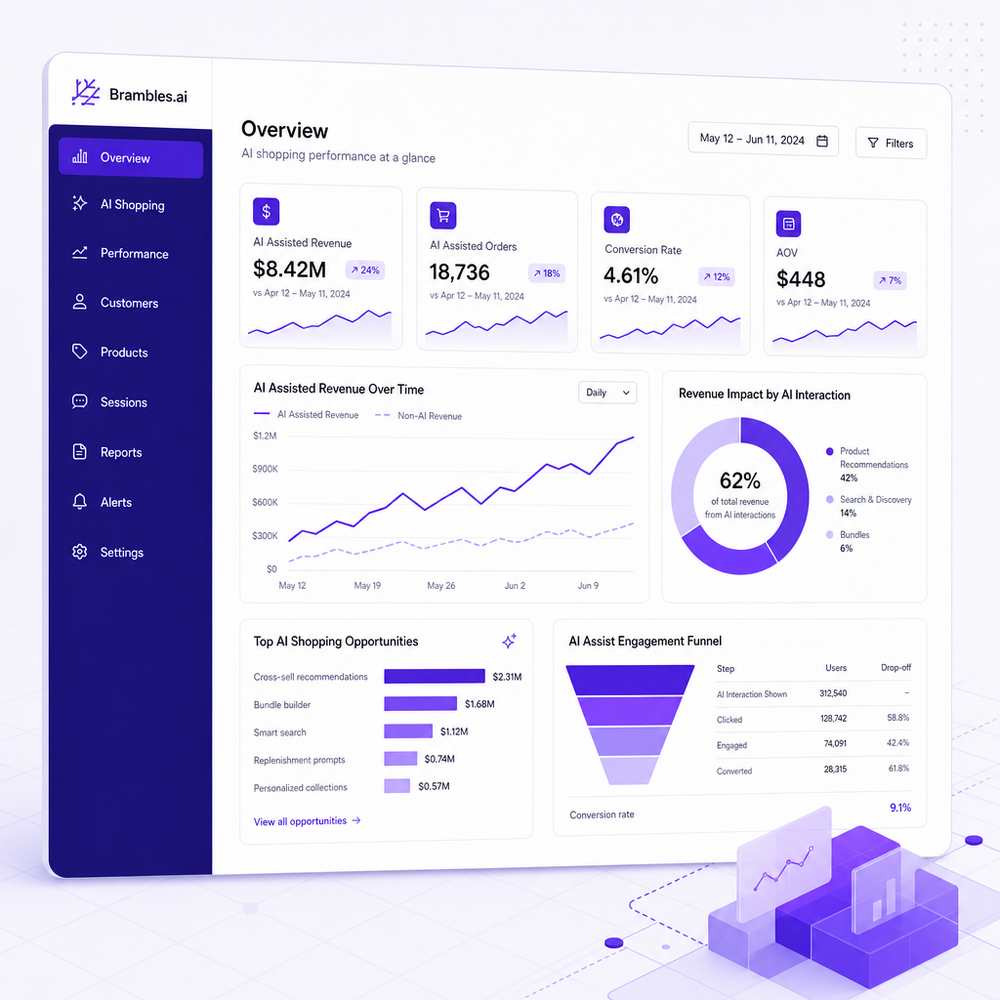
In Brambles.ai, the analytics view breaks out discovery rate, assisted revenue, and zero-result trends by page type and category. You can segment by device, traffic source, and logged-in state to catch hidden drag on mobile or SEO landers.
First-Party Data, Consent, and Trust
You don’t need to know someone’s birthday to recommend a dishwasher. First-party behavioral data paired with explicit, lightweight preferences is enough—if you earn consent and explain the value.
Practical playbook:
- Progressive disclosure: ask only when value is immediate (“save size and price range for next time?”)
- Clear controls: editable preferences panel and one-click opt-out
- Data minimization: store just the attributes used for recommendations
- Transparent explanations: show which attributes drove each pick
Salesforce’s Connected Customer research highlights how transparency correlates with loyalty; our tests show explanation snippets increase product clicks by 8–15%.
Brambles.ai keeps recommendation logic grounded in your catalog and policies, supports consent prompts out of the box, and integrates with your CDP to avoid data silos. For publishers, that means monetization without invasive tracking; for brands, it means compliant personalization that respects stock and returns policies.
Common Pitfalls and How to Avoid Them
The most common failures aren’t model issues—they’re data and guardrail issues. Fix those first, then tune copy and UI.
- Attribute gaps create wrong answers. Audit critical specs per category and backfill from manufacturer data. - No inventory awareness leads to frustration. Enforce in-stock constraints and regional availability. - Overly creative answers.
Use a policy engine with hard stops (budget, banned brands, medical claims) and prefer extractive explanations. - Slow responses. Keep retrieval local to region and cache frequent intents; aim for sub-1.2s P95. - Black-box rankings.
Expose reason codes (“meets <80 dB, 24-month warranty”) to build trust and debug quickly.
Anecdote: a lifestyle publisher saw a spike in reader complaints about “sold out” picks. Once we enabled inventory sync and set a 24-hour freshness SLA, outbound merchant clicks rose 21% and complaints disappeared within a week.
Future Outlook: Multimodal, Store-Aware, and Agentic
Visual cues matter. Expect assistants that accept a photo of your living room and return rugs that match tone and fit constraints. Store-aware models will check local inventory for pickup or same-day delivery. Agentic flows will handle multi-step tasks like “compare two models, hold the cheaper one in my cart, and alert me if the price drops by 10%.”
Brambles.ai is building toward these with multimodal retrieval and agent-safe guardrails so the assistant can act without overshooting its remit. The north star remains the same: reduce buyer effort while preserving trust and control for retailers and publishers.
FAQ
What’s the difference between AI shopping and a basic chatbot?
AI shopping integrates structured product data, constraints like price and stock, and ranked results with explanations. A basic chatbot answers FAQs but can’t reliably find viable, in-stock items that match complex intents.
How long does implementation take?
For most catalogs under 200K SKUs, a first surface (site search or a shoppable module) can go live in 2–4 weeks with Brambles.ai. The pacing factor is attribute mapping and inventory sync, not model work.
What data do we need?
Titles, descriptions, normalized attributes (size, color, materials, compatibility), price, and availability. Optional enrichments like noise level, energy rating, or fit notes meaningfully improve results. We don’t need PII to recommend products.
How much does it cost?
Brambles.ai offers usage-based pricing with tiers aligned to session volume and features like analytics and Commerce Module. Start small, prove lift, then scale as value accrues.
Can publishers use AI shopping without compromising editorial?
Yes. Use shoppable modules that honor editorial picks, require in-stock items, and add transparent reasons. This lifts monetization while preserving reader trust.
Related resources on Brambles.ai
If you are implementing this, start with Brambles.ai, for publishers, for brands, get started.
For deeper reading, see 10 Reasons Publishers Need Conversational Commerce, Affiliate Disclosure in Conversational UIs Done Right, Contextual, Not Creepy: Monetization That Wins, From Search Boxes to Conversations: Modern Shopping UX.
Related posts
View all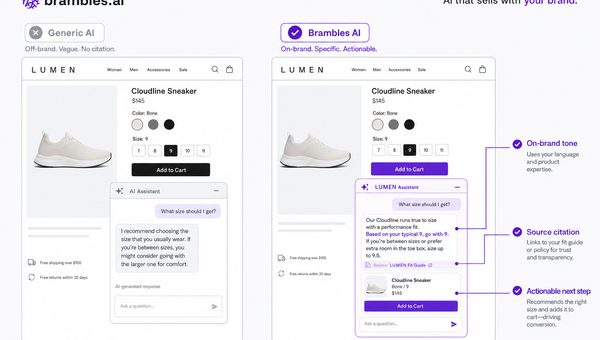
Brand-Consistent AI Chats Build Trust and Conversions
When AI mirrors your brand voice, shoppers relax—questions get answered, carts grow, and support load drops. Learn the playbook to align tone, trust, and ROI.
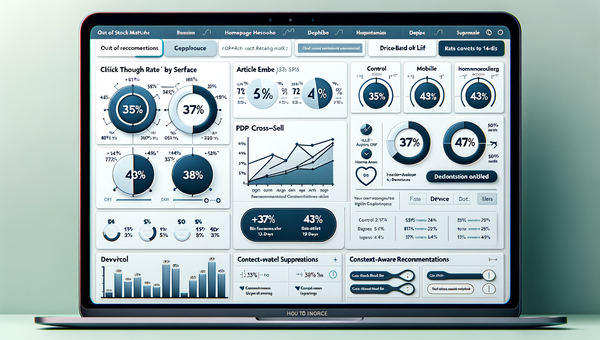
How Context-Aware AI Recommendations Lift CTR
See how context-aware AI recommendations lift CTR by 25–60% with intent signals, page context, and history. Practical steps, KPIs, and implementation tips.

Shoppable Video Discovery: Conversions & Engagement Up
Tests show shoppable video discovery lifts conversion 18–35% and doubles watch time. See the UX patterns, KPIs, and how to deploy it quickly with Brambles.ai.
Explore Brambles.ai
Learn more about our AI-powered agentic commerce platform, agentic shopping, and shopping assistance solutions.
Explore More Insights
Discover more articles on AI, automation, and business innovation
View All Articles