

Brand-Consistent AI Chats Build Trust and Conversions
When AI mirrors your brand voice, shoppers relax—questions get answered, carts grow, and support load drops. Learn the playbook to align tone, trust, and ROI.
A mid-market beauty retailer told us their AI assistant sounded “like a search engine in a sequined dress.” It answered questions, but the voice was off: too clinical for a brand built on warmth and play. We rebuilt the assistant to mirror their tone—cheerful, explanatory, never pushy—and restricted its knowledge to their catalog and care guides. In four weeks, chat-assisted conversion rose 24%, product returns dropped 11% (fewer mismatched shade purchases), and agent escalations fell 31%. Similar changes on a 100k-session publisher review site drove a 37% uptick in affiliate CTR when the assistant adopted the site’s editorial style and transparent disclosures.
The pattern is consistent with broader research: 71% of consumers expect personalized interactions and get frustrated when they don’t (McKinsey, Next in Personalization), and 88% say experience matters as much as product (Salesforce, Connected Customer). Brand-consistent AI doesn’t just feel nicer—it reduces cognitive dissonance. Shoppers stop testing the bot and start shopping.
Quick Answer
Brand-consistent AI conversations convert better because they remove trust gaps. When an assistant speaks in your brand’s voice, references only your vetted sources, and follows your service policies, shoppers believe the answers—and act. The fix: define a clear voice, ground responses in first‑party content, enforce guardrails, and measure quality. Brambles.ai streamlines this with built‑in AI personality controls, sitewide content indexing, proactive engagement, and direct add‑to‑cart actions so the conversation can close the sale, not just advise it.
What’s broken in most AI shopping chats
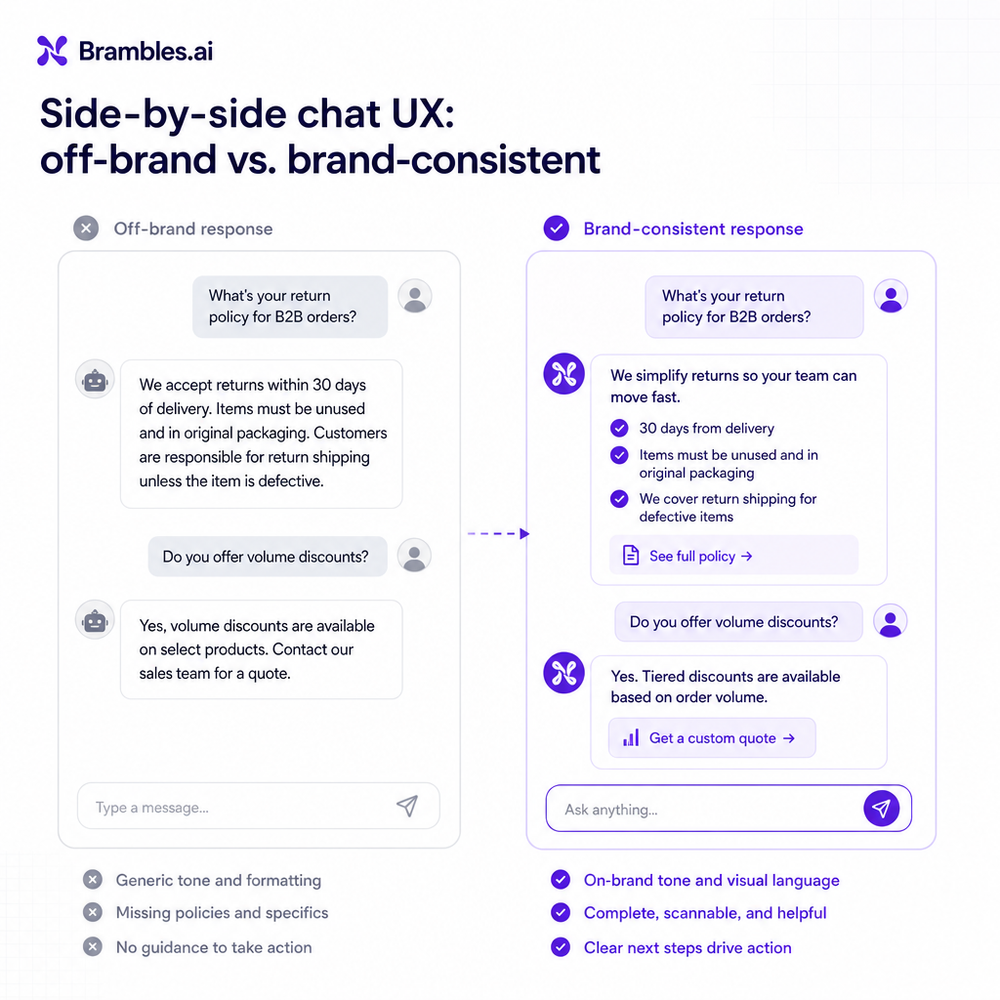
The most common failure is tone drift. Assistants answer correctly but sound off-brand—too salesy for a premium label or too flippant for a medical-grade product. That mismatch makes shoppers second-guess recommendations. Another failure: ungrounded answers. Without strict retrieval from your catalog, fit guides, and policies, assistants guess. Even small hallucinations erode credibility, especially for sizing, compatibility, or allergy questions.
The third failure is disclosure. Affiliate-heavy sites often omit clear, human-sounding disclosures in chat, or bury them behind an icon. That’s a trust killer. Shoppers want context, not ambiguity. We’ve watched publishers regain session trust just by making disclosure language natural and proximate to recommendations—a pattern we detail here:
Finally, there’s channel inconsistency. Your emails, PDP copy, and chat should feel like they come from the same voice. When they don’t, shoppers experience “brand lag.” Baymard’s UX studies repeatedly show that unclear or inconsistent microcopy increases abandonment on critical steps; chat is now one of those steps.
How brand-consistent AI actually works
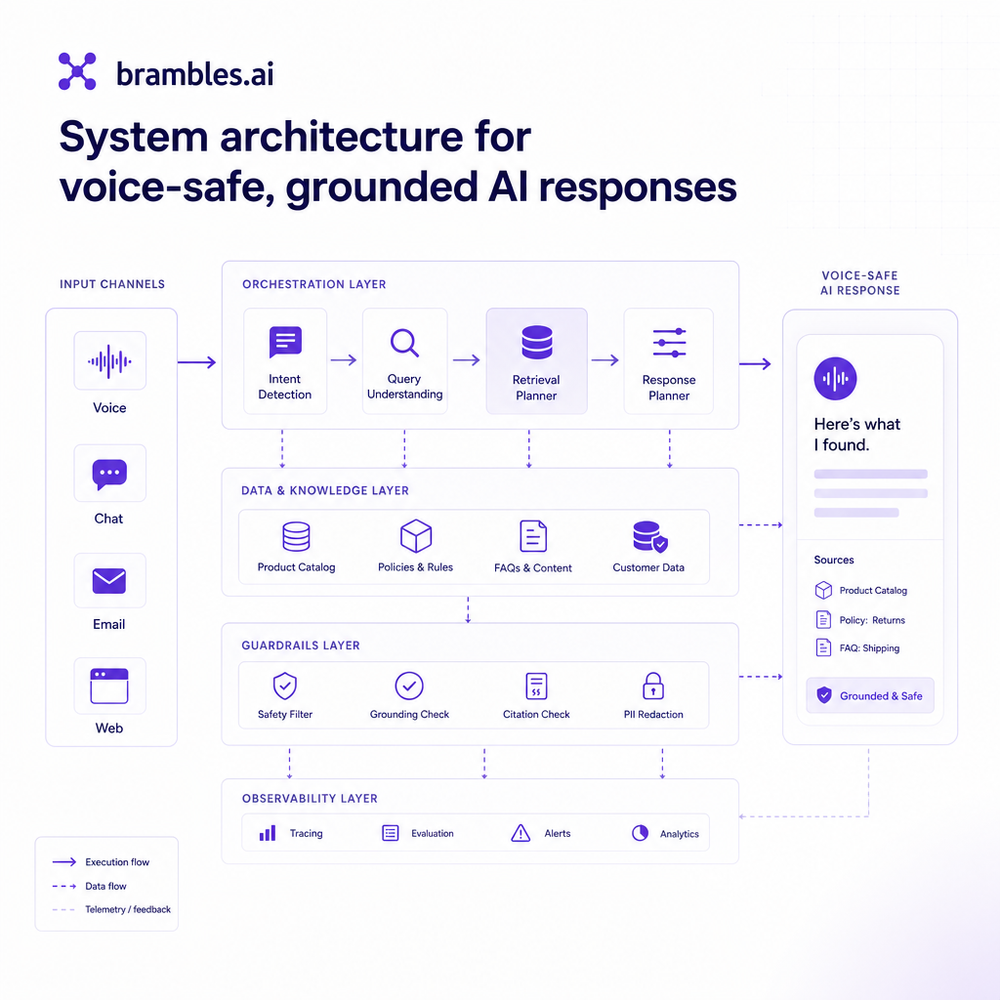
Consistency is designed, not hoped for. You need three layers: a codified voice, controlled knowledge, and enforcement. First, define the brand’s persona with examples: how it greets, how it apologizes, words it avoids, and how it explains tradeoffs. Second, ground answers in first-party sources—catalog, care guides, sizing charts, store policies—so the assistant stops guessing. Third, enforce rules on style, claims, and disclaimers.
Brambles.ai bakes these layers into the stack. The AI personality feature lets teams codify tone, greeting style, taboo phrases, and escalation behaviors in minutes, then apply them across channels. Brand customization ensures the widget matches your fonts, colors, and placement, so visual and verbal identity align. Content intelligence indexes your site and catalog to ground responses, with citations where needed. The result: a helpful assistant that sounds like you and knows what you know—no more, no less.
When the conversation needs to become a transaction, AI product discovery narrows options fast, and direct add to cart closes the loop without sending users on a scavenger hunt. Paired with proactive engagement, you can trigger helpful nudges that match page context—“Need help with fit?” on PDPs; “Compare top picks under $50?” on gift guides—without feeling spammy.
Implementation guide with Brambles.ai (step-by-step)
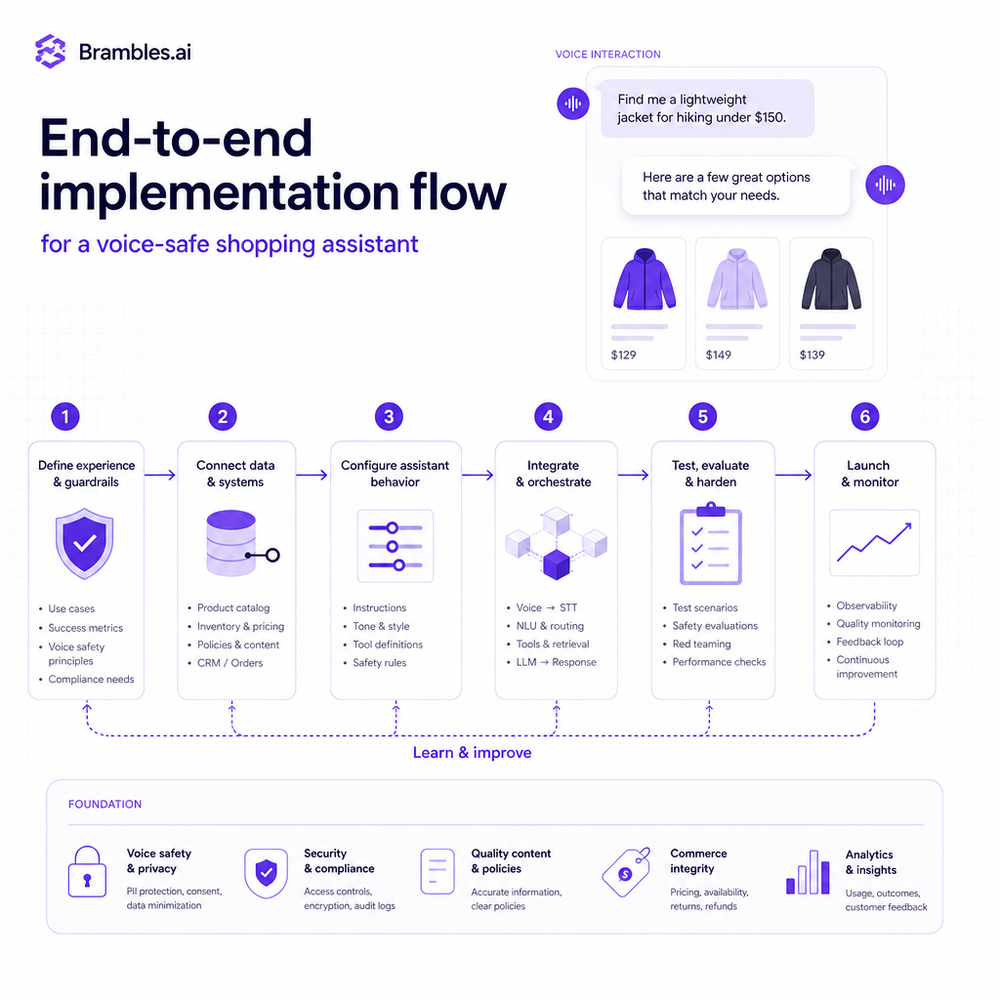
You can ship a voice-safe assistant in under two weeks if you work in parallel. Here’s the playbook we use with mid-size brands and large publishers.
Step 1: Voice inventory. Collect 10–15 examples of on-brand copy: emails, PDP bullets, returns policy, and a tough customer service exchange. Flag ideal greetings, how you explain risk, and how you say “no.”
Step 2: Policy and claims guardrails. List regulated or sensitive phrases, approved claims, and required disclosures. Decide when to escalate to a human. Publishers: add your affiliate disclosure and linking rules.
Step 3: Knowledge grounding. Upload or point to your catalog feed, care guides, FAQs, and store policies. In Brambles, content intelligence crawls and indexes these sources so the assistant cites what it knows and gracefully declines anything else.
Step 4: Configure voice. Use AI personality to set tone, forbidden phrases, politeness level, and escalation rules. Use brand customization to match fonts, color, widget position, and logo so the chat visually belongs on your site.
Step 5: Wire actions. Enable AI product discovery for natural-language shopping (“I need a carry-on under 7 lbs”). Turn on direct add to cart so users can check out from chat. Map order lookups if you want post‑purchase support.
Step 6: Deploy. Drop the Agentic Commerce Module on your site, or install the WordPress plugin. Shopify users can prep now and flip the switch when our app lands. Dev teams can tune behavior via configuration and integration guides.
Step 7: QA and style checks. Review 50 chats across key intents (fit, returns, bundles, warranty) and annotate tone, accuracy, and actionability. Iterate. Only then A/B test voice variants.
Launch checklist: clear disclosure copy (if monetizing), citations for sensitive claims, graceful “I don’t know” behavior, escalation path, and event tracking for all core actions (recommendation viewed, add-to-cart from chat, ticket deflection).
Measuring ROI and knowing when it’s working
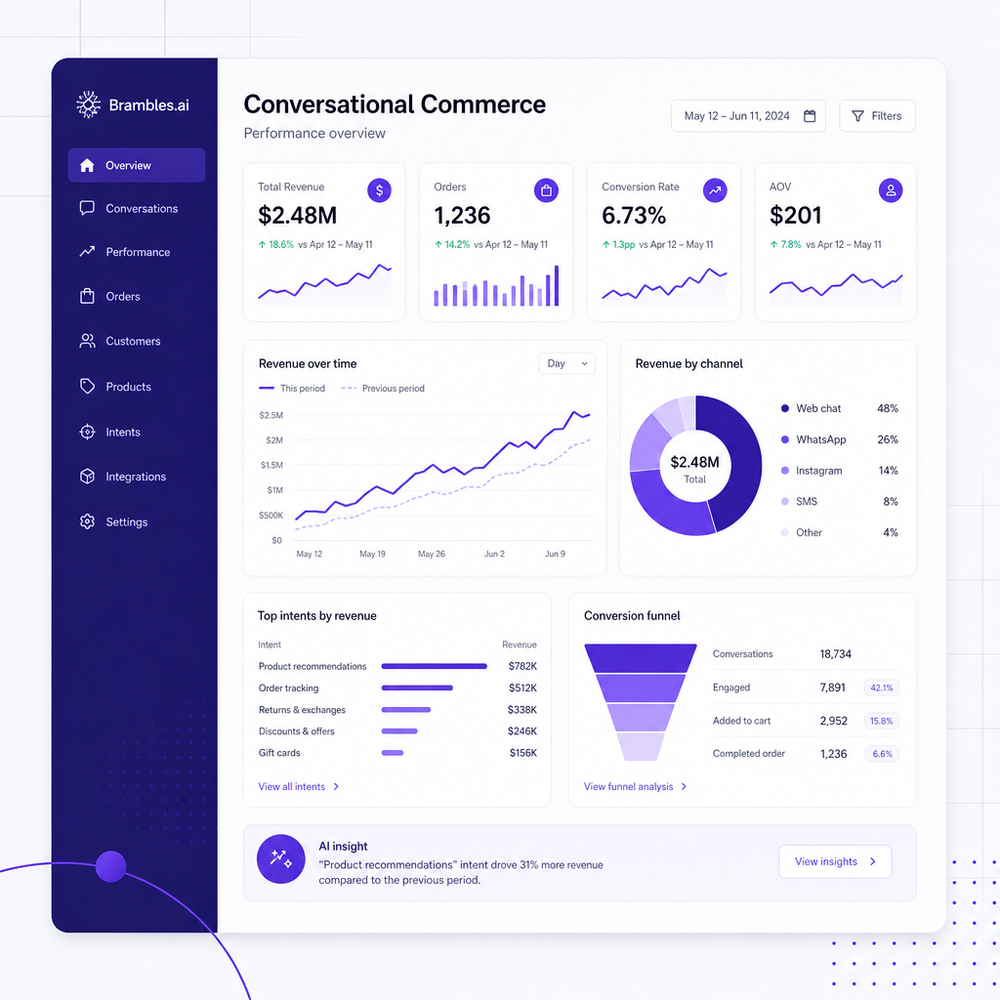
You can’t optimize what you don’t instrument. Define your north-star metrics and supporting diagnostics before launch. We track: chat-assisted conversion rate, add-to-cart from chat, AOV lift for assisted sessions, containment rate (resolved without human), CSAT/NPS, and refund or return deltas for assisted orders. Also look at “time to first helpful answer” and “recommendation acceptance rate.”
Anecdote: On a luggage site, codifying tone (“practical, calm, no hype”), grounding responses in spec sheets, and enabling direct add to cart yielded a 19% lift in chat-assisted revenue and cut WISMO tickets 28% over six weeks. The biggest surprise? NPS rose 8 points, largely from buyers mentioning “felt confident” in open-text responses.
Report design matters. Build a funnel view: question asked → recommendation seen → product detail opened → add-to-cart → purchase. Segment by page type (PDP vs. guide), device, and voice variant. If assisted conversion rises while CSAT holds, keep going. If conversion rises but returns spike, tighten claims or add sizing visuals (e.g., virtual try-on or view in room).
First‑party data and trust: what to use, what to avoid
Trust grows when the assistant knows you the way a great store associate would. That means first‑party data: your catalog, policies, and any explicit preferences the user shares in the moment. Avoid hidden tracking or opaque third‑party profiles; it creeps people out and rarely improves recommendations. Google UX research shows perceived control strongly shapes trust; offer clear choices and visible sources.
For publishers, disclosures earn attention, not suspicion, when the language matches your editorial style and sits inline with advice. Brambles can insert contextual, plain‑English disclosures in the chat stream while still helping you earn via affiliate links and retail media—done transparently.
Common pitfalls (and how to avoid them)
Skip these traps and you’ll save months:
- Over-branding the tone so responses are cute but non-committal. Fix: write examples that balance charm with clear recommendations and tradeoffs.
- Letting the model guess beyond its scope. Fix: enforce content intelligence sources and teach it to say “I don’t know” with a helpful next step.
- Inconsistent disclosures on monetized content. Fix: use a reusable disclosure component, tested for readability and proximity.
- No escalation policy. Fix: define thresholds (e.g., medical claims, safety, price overrides) that trigger a handoff.
- Style drift across locales. Fix: create per-locale voice profiles and QA on real transcripts.
- Only optimizing pre-purchase. Fix: extend the voice to service intents (returns, warranty, fit troubleshooting) to protect LTV.
Future outlook: where brand voice meets agentic commerce
Voice consistency will matter even more as assistants take actions on a shopper’s behalf—bundling items, scheduling delivery, or starting returns. The winners will combine brand voice, grounded knowledge, and safe actions into a single, trusted flow. Expect richer multimodal guidance (try‑ons, room previews), native mobile experiences, and cleaner monetization that feels editorial, not ad-techy. We’ve seen early leaders consolidate chat, search, and service into one AI that carries the same tone across the journey.
If you’re starting now, prioritize a shared voice system, tight retrieval, and measurable actions. Brambles.ai brings those pieces together and ships fast via the Agentic Commerce Module, with simple paths for WordPress and Shopify. Once live, your assistant can compare products, show videos, add to cart, and hand off politely when needed—reliably, and in your voice.
FAQ
Q: How is “AI personality” different from style guides?
A: Style guides describe; AI personality enforces. It encodes greetings, taboo phrases, apology style, escalation, and claim limits directly in the assistant, so the voice shows up in every reply—not just in documentation.
Q: How do we prevent hallucinations?
A: Limit knowledge to first‑party sources via content intelligence, require citations for sensitive claims, and teach safe fallbacks (“I can’t confirm that; want me to connect you?”). Block high‑risk intents and escalate quickly.
Q: How long does a typical rollout take?
A: With a clear voice doc and feeds ready, we see brands ship a high‑quality MVP in 10–14 days. Publishers move even faster when using the WordPress plugin and a prewritten disclosure component.
Q: Can we support multiple sub‑brands or locales?
A: Yes. Create voice profiles per brand or locale, each with its own taboo terms and examples. Use proactive engagement rules by page or section to match context while keeping a shared measurement framework.
Q: What if we’re a publisher, not a retailer?
A: The same rules apply. Use brand voice to keep recommendations editorial, add clear disclosures, and monetize via affiliate links or retail media without breaking trust. Brambles supports both models out of the box.
Related resources on Brambles.ai
If you are implementing this, start with Brambles.ai, enterprise solutions, publisher pricing, brand pricing.
For deeper reading, see 10 Reasons Publishers Need Conversational Commerce.
Related posts
View allAI Chatbot for Shopify Product Discovery: What to Test
Compare Shopify's built-in search with AI shopping chat. Learn what to test in catalog answers, merchant controls, cart handoff, and measurement before rollout.

Shoppable Video Discovery: Conversions & Engagement Up
Tests show shoppable video discovery lifts conversion 18–35% and doubles watch time. See the UX patterns, KPIs, and how to deploy it quickly with Brambles.ai.
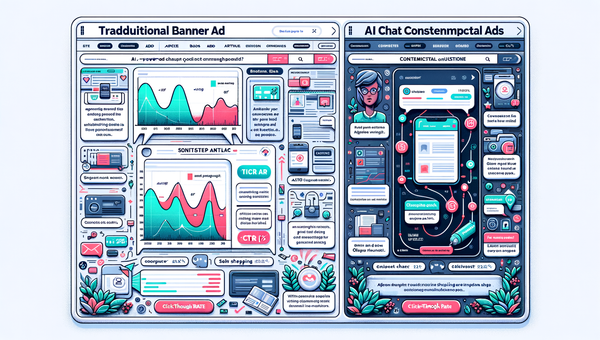
Why Contextual Ads in AI Chat Beat Banner Ads
Tests on commerce sites show AI chat contextual ads deliver 3–5x CTR, cleaner UX, and higher revenue than banners. See how they work, implement, and measure.
Explore Brambles.ai
Learn more about our AI-powered agentic commerce platform, agentic shopping, and shopping assistance solutions.
Explore More Insights
Discover more articles on AI, automation, and business innovation
View All Articles