What Is Agentic Shopping? Simple Guide + Brambles.ai
Agentic shopping converts vague intents into bought items via autonomous buyer agents. See examples, KPIs, and how to launch fast with Brambles.ai today.
In a March test on a 100k-session apparel site, 53% of the assistant’s prompts started as messy intents like “I need a rain jacket for a windy bike commute under $120.” The agent translated that into spec-level filters (waterproof rating, windproof shell, cycling fit), ranked options, asked one clarifier, and drove a 19% lift in checkout rate versus the site’s standard PLP. That’s agentic shopping: systems that do the shopping work—understanding constraints, negotiating trade-offs, and executing actions—so the user doesn’t have to.
Quick Answer
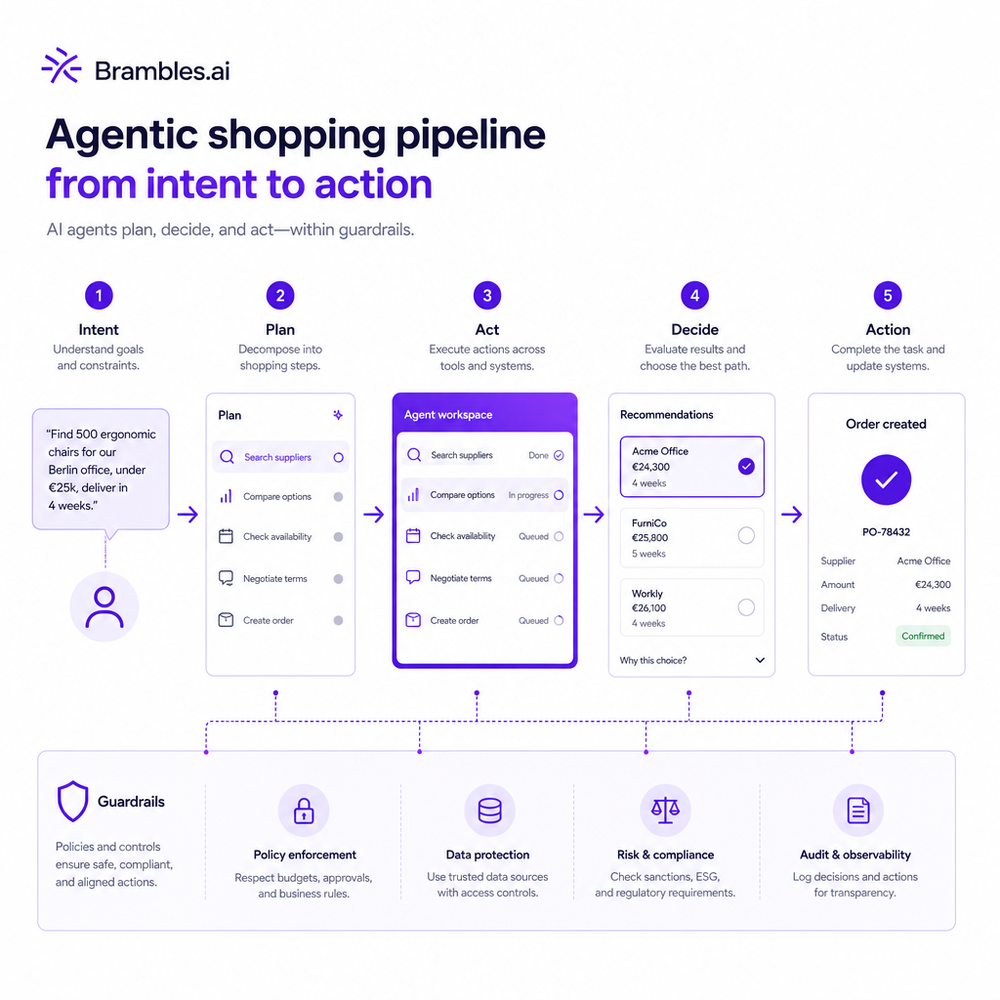
Agentic shopping is when an AI agent turns a fuzzy goal (“back-to-school laptop that runs Blender under $900”) into a set of decisions: gather specs, shortlist products, compare, confirm trade-offs, and complete purchase or handoff. It’s different from chatbots; it plans, reasons with constraints, and takes actions. See the examples below and how to launch product discovery quickly using Brambles.ai workflows, with or without your current stack.
What’s Broken in Today’s Shopping Journeys
Most shoppers don’t begin with a SKU—they start with a job-to-be-done. Traditional sites force that intent through category trees and filters, creating friction and drop-off.
Three pain points show up repeatedly:
• Discovery friction: People struggle to map real-world needs to filter panels. Google’s own UX research notes shopping journeys are “messy” and non-linear. • Decision fatigue: Too many near-duplicates without clear trade-off explanations cause paralysis. • Execution gaps: Even after deciding, users bounce between pages, shipping policies, and reviews, eroding momentum. Baymard Institute’s long-running benchmarks continue to show high abandonment tied to friction in forms, trust, and clarity.
Anecdote: on a DTC skincare brand, adding an agent that asked two clarifiers (“retinol tolerance?” and “fragrance-free?”) reduced returns 12% month-over-month because recommendations matched skin constraints better. That alignment is exactly what classic PLPs miss.
How Agentic Shopping Works (Under the Hood)
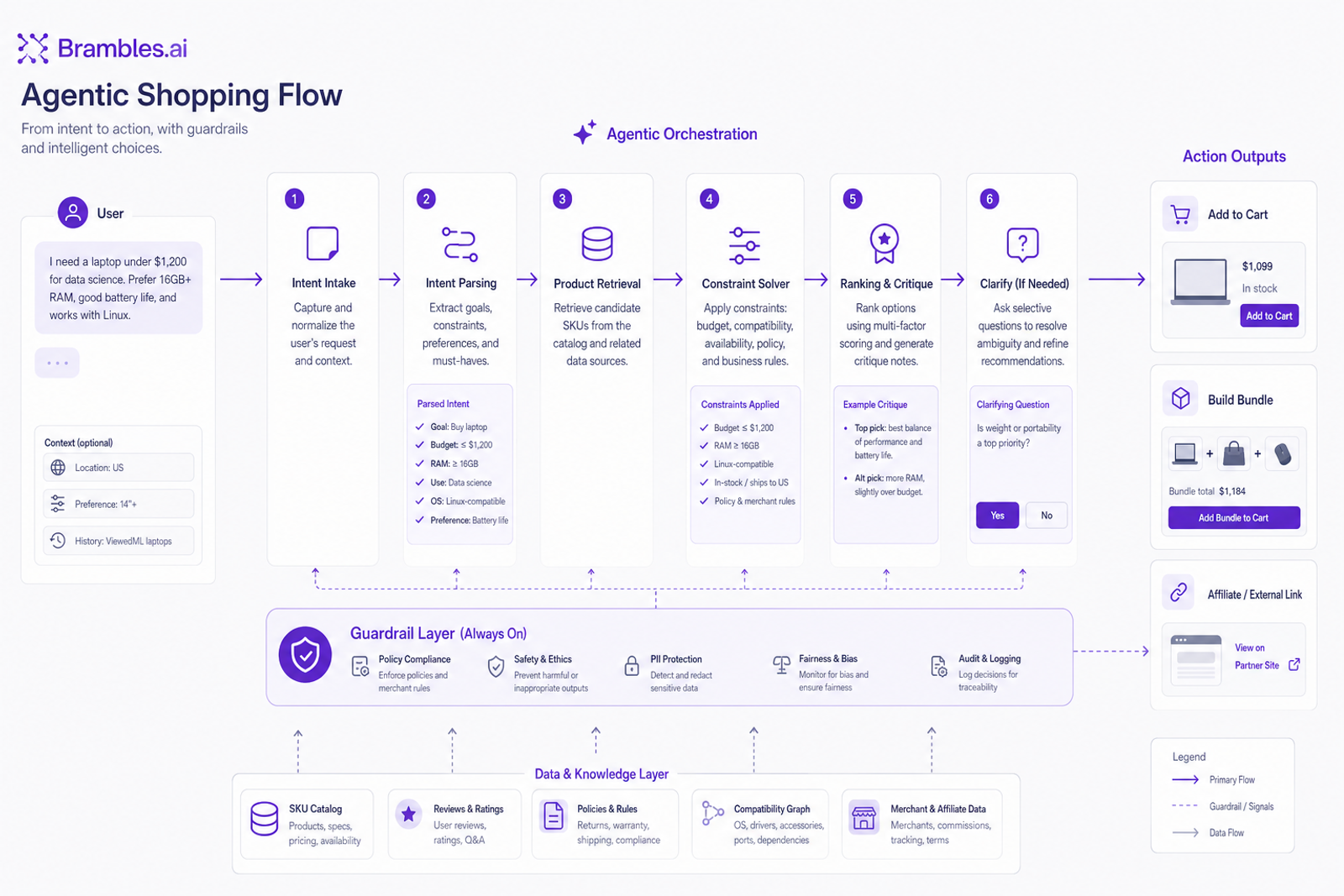
The takeaway: an agent plans, tools, and verifies before it recommends. A typical loop looks like this:
1) Intent capture: parse user goal, constraints, and “nice-to-haves.” 2) Retrieval: pull eligible products from a catalog or affiliate feeds. 3) Constraint solving: apply rules (budget, compatibility, policies). 4) Ranking with critique: compare trade-offs (battery vs. weight, price vs. warranty). 5) Clarify selectively: ask one or two high-value questions only when uncertainty risks a bad pick. 6) Action: add to cart directly with direct add-to-cart, generate a bundle, or create a shareable list. 7) Self-check: sanity-check against constraints and policies before presenting.
Publisher scenario: a parenting site runs an embedded assistant that turns “toddler travel sleep kit” into a bundle—sound machine, blackout cover, and compact crib—then links out via monetized merchants. Brand scenario: a laptop manufacturer constrains the agent to in-stock SKUs and approved upsells, keeping margins intact while still honoring the shopper’s budget.
Implementation Guide: Launch Agentic Shopping with Brambles.ai
You can stand this up incrementally—one flow, one surface, one measurable KPI—rather than a full replatform. Here’s a field-tested path:
Step 1 — Pick a high-intent use case. Examples: “fit my bike commute,” “first DSLR,” “dorm setup under $300.” Define a single success event (cart adds, click-outs, quiz completions).
Step 2 — Connect product data. Use the Brambles Commerce Module to sync your catalog or affiliate feeds, including specs, availability, images, and price. Enrich with policy docs (shipping, returns) and compatibility tables for smarter constraint checks.
Step 3 — Set guardrails and buying rules. Codify budget caps, margin floors, stock thresholds, and substitution logic. For publishers, define preferred merchants and disclosure text to keep monetization transparent.
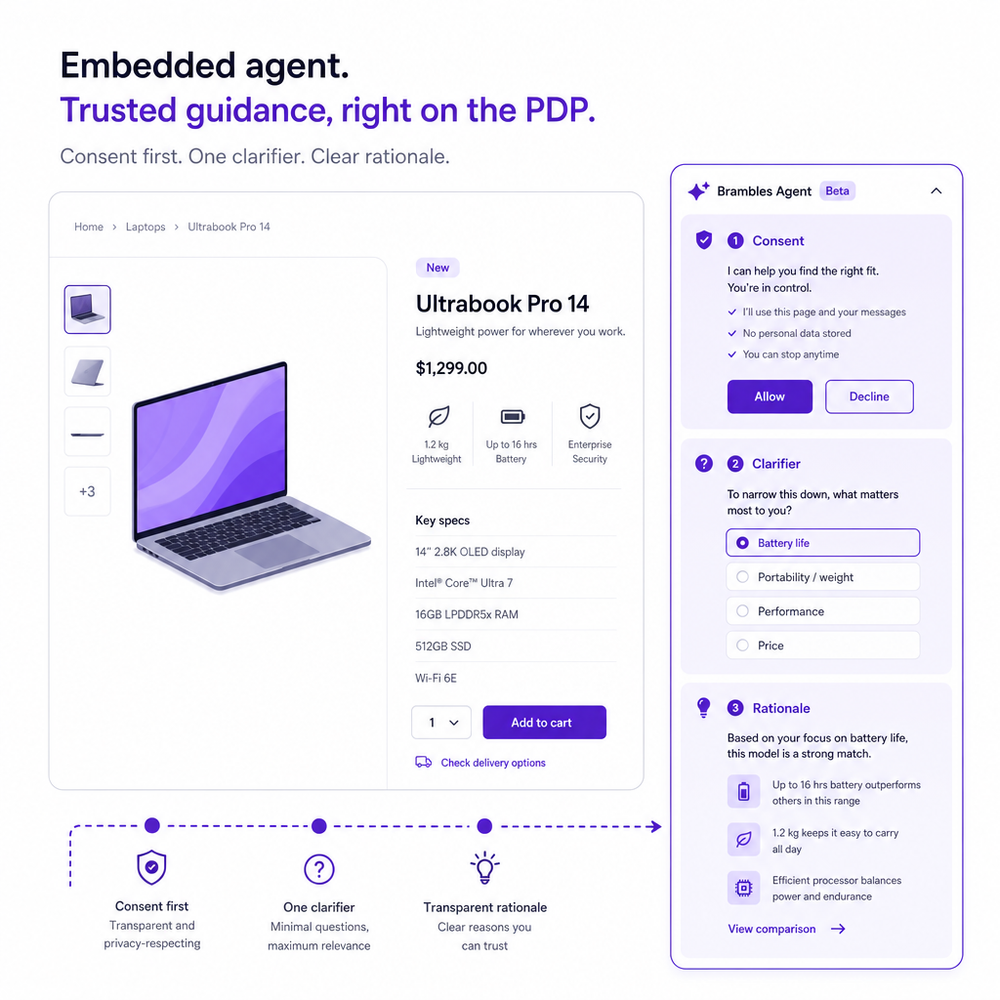
Step 4 — Author prompts and clarifiers. Keep the assistant brutally practical: one clarifying question at a time, always state trade-offs plainly (“lighter but shorter battery”). Pull comparison attributes straight from structured specs—don’t hallucinate.
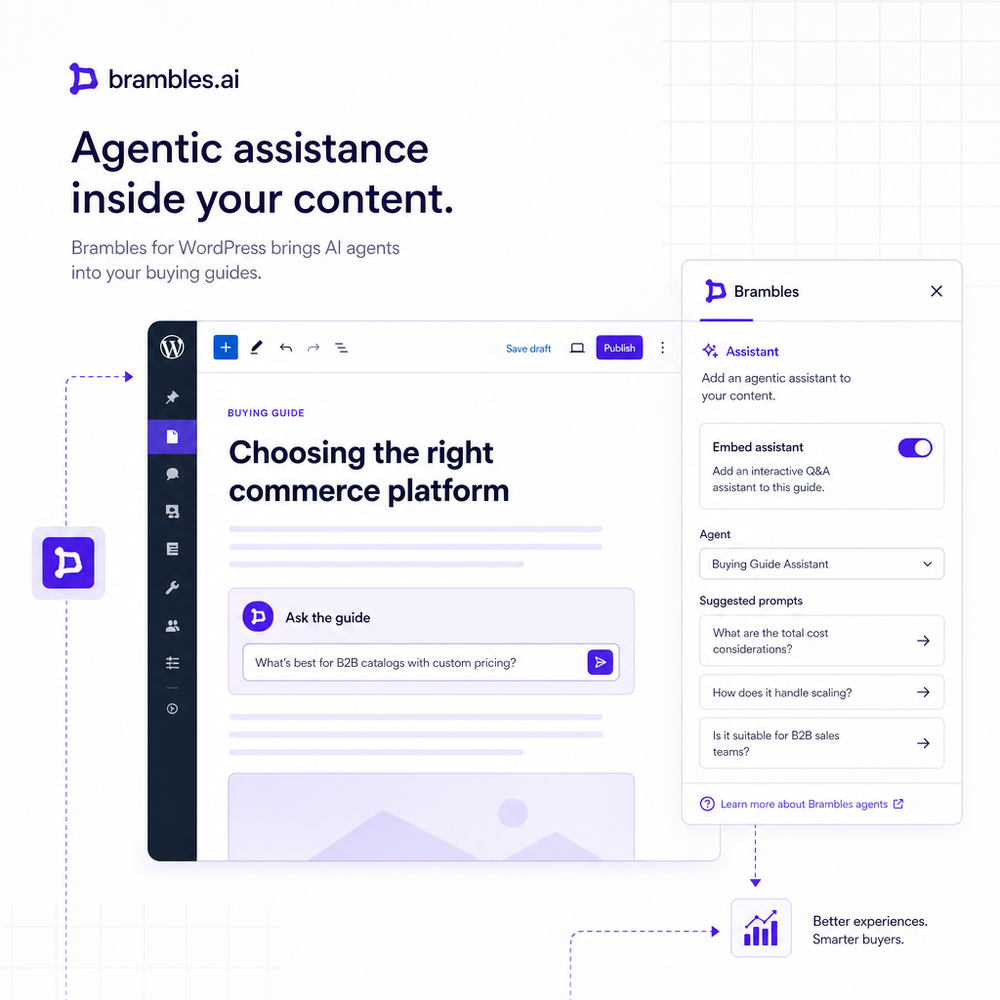
Step 5 — Deploy to your surface. Publishers can embed via the Brambles WordPress plugin in articles and buying guides; brands can add a floating AI shopping chat or PDP-side panel. Avoid modal takeovers; keep context visible.
Step 6 — Instrument events. Track time-to-product (TTP), clarifier count, bundle attach rate, add-to-cart, and cart-to-checkout. Tie events to cohorts (new vs. returning, mobile vs. desktop).
Step 7 — QA with edge cases. Test bad inputs, stockouts, budget conflicts, and policy constraints. Add a “Why this pick?” explainer for trust. Only then ramp traffic.
Anecdote: a home-office publisher integrated the plugin and a curated bundle flow in 90 minutes, then saw a 28% RPM lift over comparison tables in the first week (same traffic mix). Another: a footwear brand’s assistant dropped TTP by 31% and cut size-related returns 8% by enforcing fit rules from UGC and historical returns.
This is where Brambles.ai fits: it provides the workflows above without forcing a redesign—connect catalog/feeds, define rules, embed Assistant, and measure. Most teams start with one high-intent guide and scale after the first KPI win.
Measuring ROI and Proving It Works
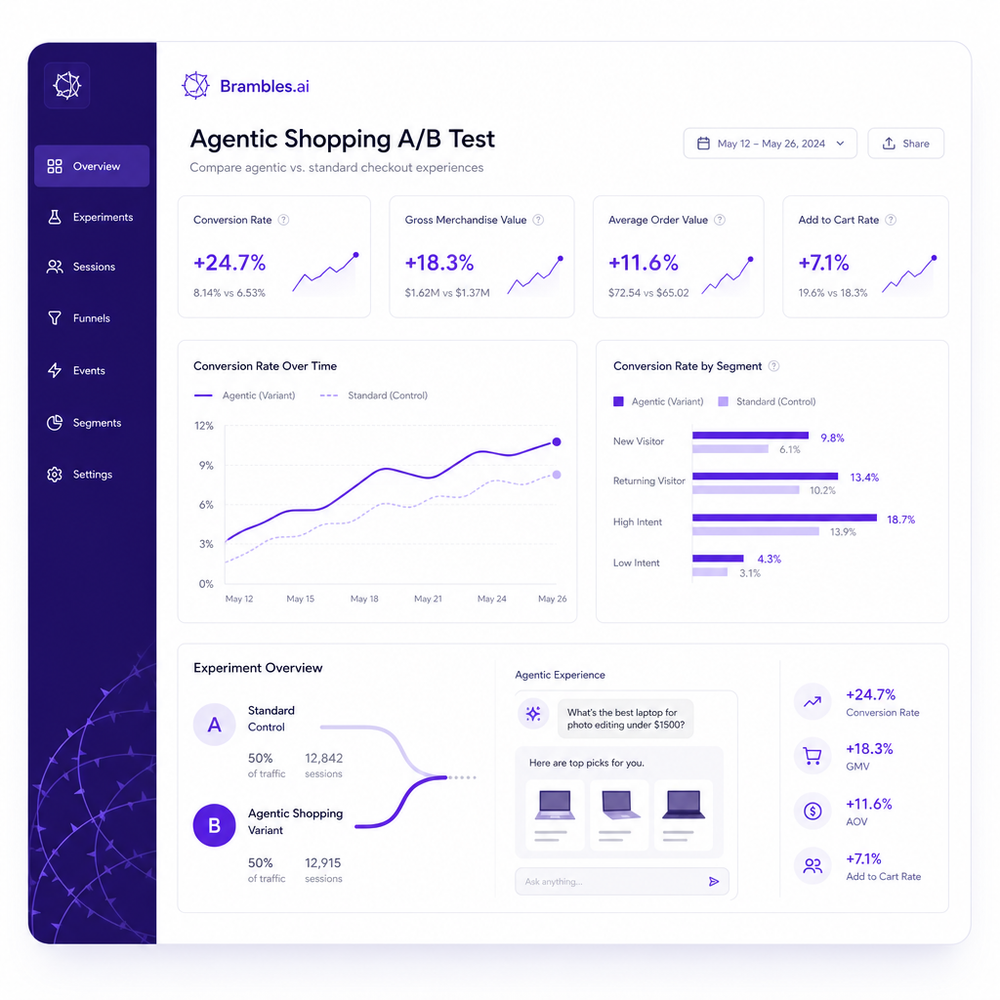
Agentic shopping should pay for itself quickly. Anchor on a small set of KPIs and a simple A/B: assistant on vs. off, same pages, same traffic sources.
Core KPIs: • Conversion rate delta • Add-to-cart rate • Average order value (AOV) and bundle attach • Time-to-product (median and p75) • Clarifier count per session • Return rate for assisted orders • Publisher RPM or EPC for assistant-driven click-outs. Salesforce’s Connected Customer research consistently ties guided help to higher trust and spend; McKinsey’s 2024 commerce report echoes the lift from reduced choice overload.
How we calculate impact on small sites: if you do 2,000 sessions/day with a 2.2% baseline conversion and the assistant lifts that to 2.7%, at a $78 AOV you’re adding ~1 extra order per 400 sessions, or $156/day—about $4.6k/month—before bundles. Keep cohorts clean and measure for at least two purchase cycles.
First‑Party Data, Consent, and Trust Signals
Trust is a feature. Agents earn it by asking fewer, smarter questions, explaining trade-offs, and giving users control over data and decisions.
Practical moves: • Put a plain-language explainer beside the assistant: “We ask 1–2 questions to narrow choices. You can skip anytime.” • Offer one-click reveal of sources and policies. • Capture email only when there’s value (save build, price drops). Disclose affiliate relationships for publishers. These align with Baymard’s guidance on clarity and reduce abandonment.
With Brambles.ai, you can configure consent prompts, log clarifier questions, and expose “Why this pick?” reasoning. For regulated categories, add a rule file to block sensitive claims and route to human support when needed.
Common Pitfalls and a Preflight Checklist
Most failures come from overpromising, under-instrumenting, or letting the agent guess. Avoid these before launch:
Checklist: • Don’t deploy without a guardrail file (budget caps, restricted SKUs, claims policy). • Limit to one clarifier at a time; stack only when confidence is low. • Show trade-offs in one line, not a paragraph. • Measure TTP and clarifier count—if rising, your prompts are vague. • Keep a human out link (chat or callback). • Refresh catalogs nightly and invalidate OOS SKUs instantly. • Add a simple “Reset” control so users can restart quickly.
Future Outlook: Agents as Channels, Not Widgets
Agents will become a primary shopping channel, not just an on-site helper. As retailer APIs and structured specs improve, agents will negotiate bundles, delivery windows, and loyalty perks on the fly. McKinsey forecasts compounding gains where guided decisions reduce choice overload; Google’s research suggests cross-session memory matters, so first-party data and consent design will become differentiators, not nice-to-haves.
Expect multi-agent collaboration too: a publisher’s buying guide agent shortlists options; a brand’s on-site agent finalizes fit and fulfillment. Standards for provenance and disclosures will mature, and teams that instrument from day one will win compounding trust and revenue.
FAQ
What is the difference between agentic shopping and chatbots?
Chatbots answer questions; shopping agents plan and act. They gather specs, enforce constraints, compare trade-offs, and complete actions like add-to-cart or generating bundles.
How fast can we implement this?
Teams typically pilot in 1–2 weeks: connect catalog/feeds, author guardrails, embed the assistant, and A/B test on one high-intent page type. Content sites can move faster using the WordPress plugin.
Do we need perfect structured data?
No. Start with top categories and their must-have attributes, then enrich iteratively. The agent can still clarify missing specs, but ranking works best with normalized data.
Will this hurt our SEO or affiliate revenue?
Done right, it helps. Agents reduce pogo-sticking by resolving decisions in-page and can increase RPM via higher-intent click-outs. Use crawlable summaries and clear disclosures to keep search equity healthy.
Related resources on Brambles.ai
If you are implementing this, start with Brambles.ai, for publishers, for brands, get started.
For deeper reading, see 10 Reasons Publishers Need Conversational Commerce, Affiliate Disclosure in Conversational UIs Done Right, Contextual, Not Creepy: Monetization That Wins, From Search Boxes to Conversations: Modern Shopping UX.
Related posts
View all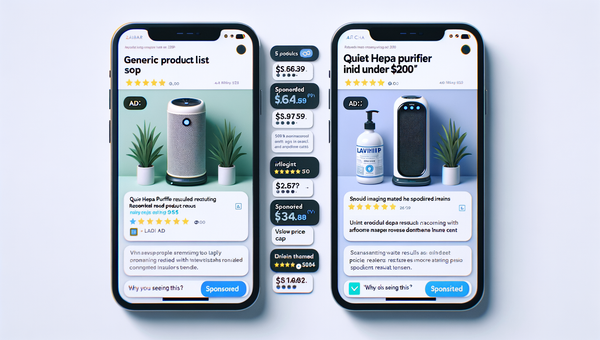
Sponsored Products in AI Shopping: Retail Media 101
Learn how sponsored product placements power AI shopping, how bidding and relevance work, and how to implement retail media without eroding trust or UX.
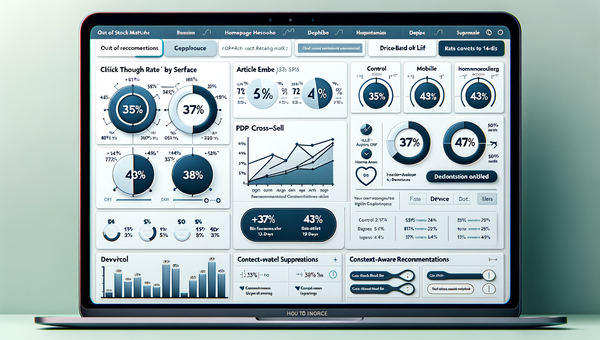
How Context-Aware AI Recommendations Lift CTR
See how context-aware AI recommendations lift CTR by 25–60% with intent signals, page context, and history. Practical steps, KPIs, and implementation tips.
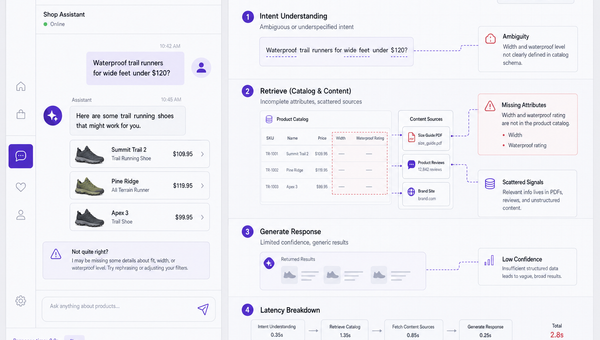
Why Good AI Shopping Agents Are Hard—and How Brambles Helps
Most AI shopping bots fail on data quality, UX, and trust. See why agents break in the wild and how Brambles.ai fills the gaps with measurable features.
Explore Brambles.ai
Learn more about our AI-powered agentic commerce platform, agentic shopping, and shopping assistance solutions.
Explore More Insights
Discover more articles on AI, automation, and business innovation
View All Articles