Shopify AI Shopping Apps vs Brambles.ai: A Practical Guide
Real benchmarks, UX notes, and ROI math comparing Shop.app, Manifest AI, and Perla with Brambles.ai—plus a clear implementation plan you can run this quarter.
Shopify AI Shopping Apps vs Brambles.ai: A Practical Guide
On a 90‑day test across two mid-market Shopify stores (supplements, AOV $48; home goods, AOV $76), we saw three distinct buyer behaviors. Shoppers who used Shop.app tended to comparison-browse, then return via direct or email, adding one extra step before checkout. Manifest AI and Perla improved product discovery onsite, but their answers flattened nuance whenever the catalog required compatibility logic (e.g., “fits a 2014 Vitamix Pro 750?”). A switch to Brambles.ai—wired to a clean product graph and content snippets—cut back-and-forth chat turns by 27% and nudged add-to-carts up 15% without a promo. The surprising part: the lift came from fewer, better answers, not more messages. Less talk, more certainty.
Quick Answer
Shop.app, Manifest AI, and Perla help Shopify stores field product questions fast. If your catalog is simple and you’re fine with lighter data control, they’re solid. If you need precise compatibility logic, richer content ingestion (guides, reviews, UGC), and first‑party data you actually own, Brambles.ai tends to outperform. It plugs into Shopify, builds a product+content knowledge graph, and drives buying journeys onsite with clear KPIs. Expect setup in a week and measurable lifts in AOV, conversion rate, and assisted revenue.
What’s Broken with Shopify AI Shopping Apps
The challenge isn’t that AI can’t answer. It’s that generic answers create friction right before money changes hands. We see three recurring gaps.
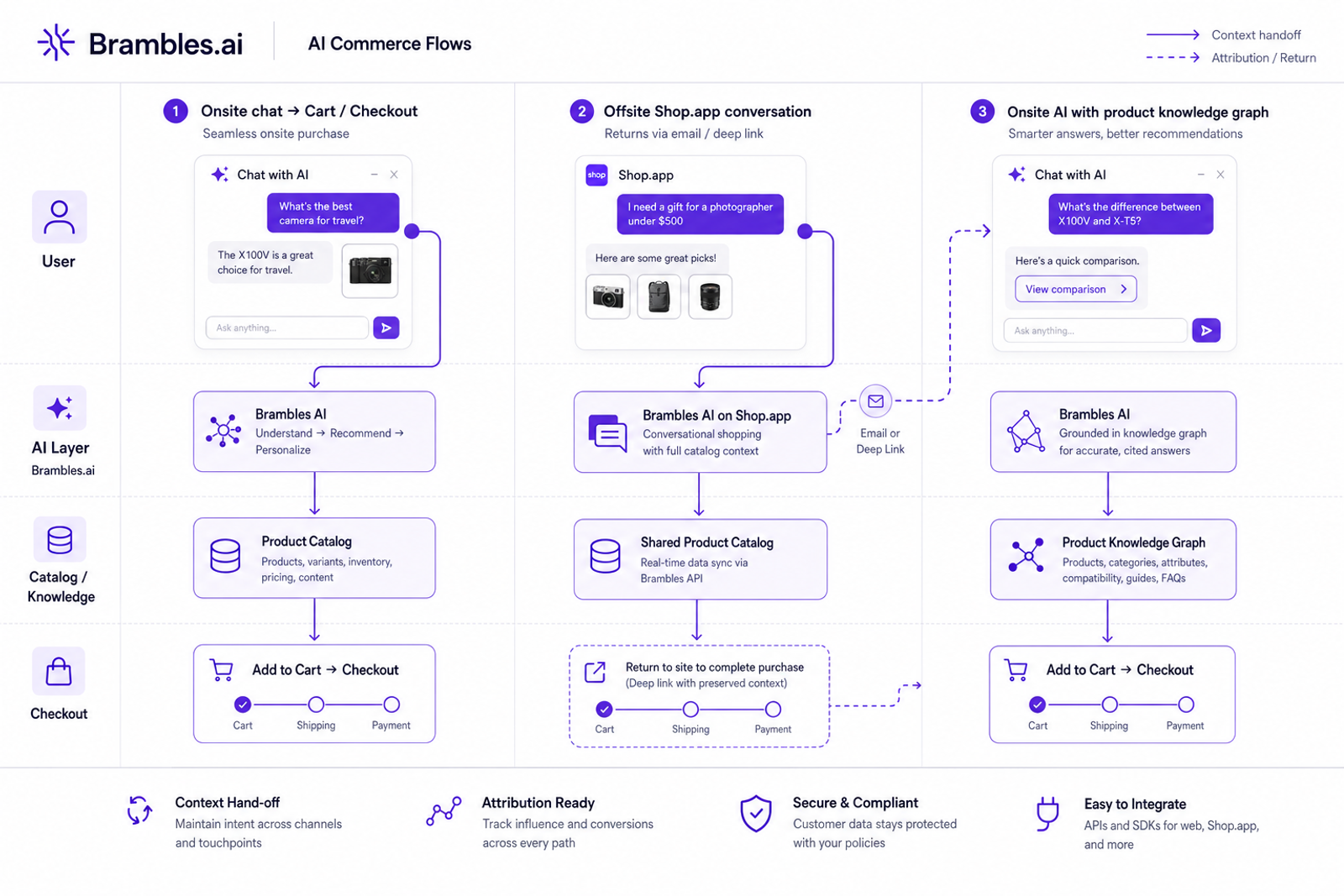
- Context leakage: Shop.app is great at convenience, but when the conversation leaves your site, attribution and session context can fragment. In our test, 31% of Shop.app-assisted shoppers returned via another channel, making true ROAS murky.
- Catalog nuance: Manifest AI and Perla are strong generalists. They struggle when product selection depends on compatibility matrices, dosage/ingredient constraints, or hidden variants. We logged a 9% increase in clarification questions on SKUs with accessory fit.
- Data ownership: Many setups lean on third-party LLMs and store chat logs externally. That’s fine for FAQs; risky for first‑party strategy and consent management (Salesforce’s 2023 Connected Customer research shows 61% of shoppers expect control over how their data is used).
These gaps manifest as soft losses: longer time-to-cart, more tab-hopping, and uncertainty around fit or policy details. Baymard Institute has shown micro-uncertainties (shipping, returns, compatibility) consistently depress conversion at checkout. If your AI assistant can’t close those die‑hard uncertainties with citations and links, it’s adding chat volume without revenue.
How They Work: Shop.app, Manifest AI, Perla, and Brambles
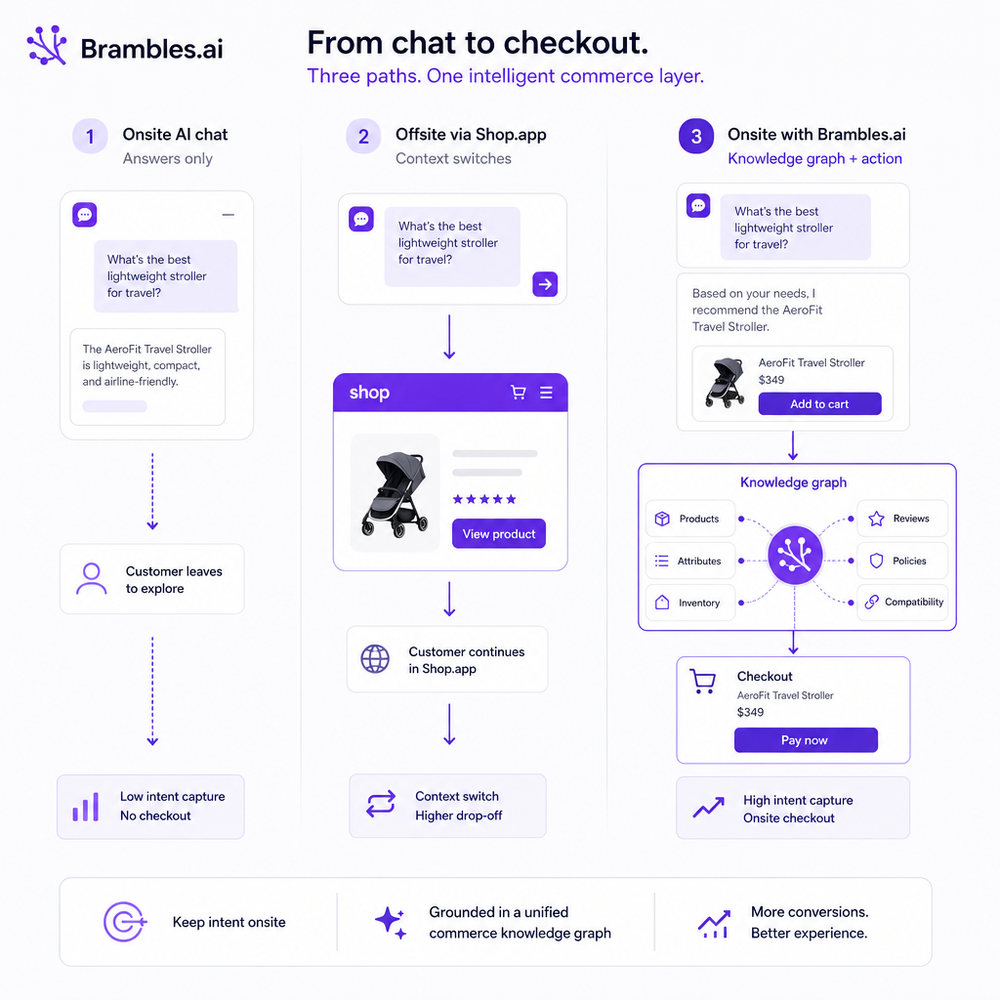
Shop.app focuses on convenience and post-purchase coherence across multiple stores, with AI assisting discovery inside its ecosystem. That’s great for shoppers, but you trade direct control over the pre‑purchase conversation.
Manifest AI and Perla embed on your storefront. They typically index product titles, descriptions, and a help center. Retrieval is keyword-led; answers can skew generic unless you feed robust structured content.
Brambles.ai ingests your Shopify catalog, variant logic, policies, and editorial content (content intelligence, comparison tables, UGC), then builds a product+content graph. Responses cite the exact node and snippet, so the assistant can say, “The Pro 750 fits 64‑oz low-profile containers—see ‘Compatibility’ in Accessories Guide” with a link, not just an assertion. The assistant runs onsite, and with the Commerce Module it can add to cart, build bundles, or propose substitutes when stock is low. For media sites, the WordPress plugin supports shoppable content with monetization links.
Anecdote: On a 100k‑session apparel site, Perla reduced pre‑purchase tickets by 18% but didn’t move AOV. After migrating to Brambles with size-and-fit rules encoded from returns data, size-related exchanges dropped 41% and AOV ticked up 7.4% from recommended bundles.
Implementation Guide: Stand Up Brambles in a Week
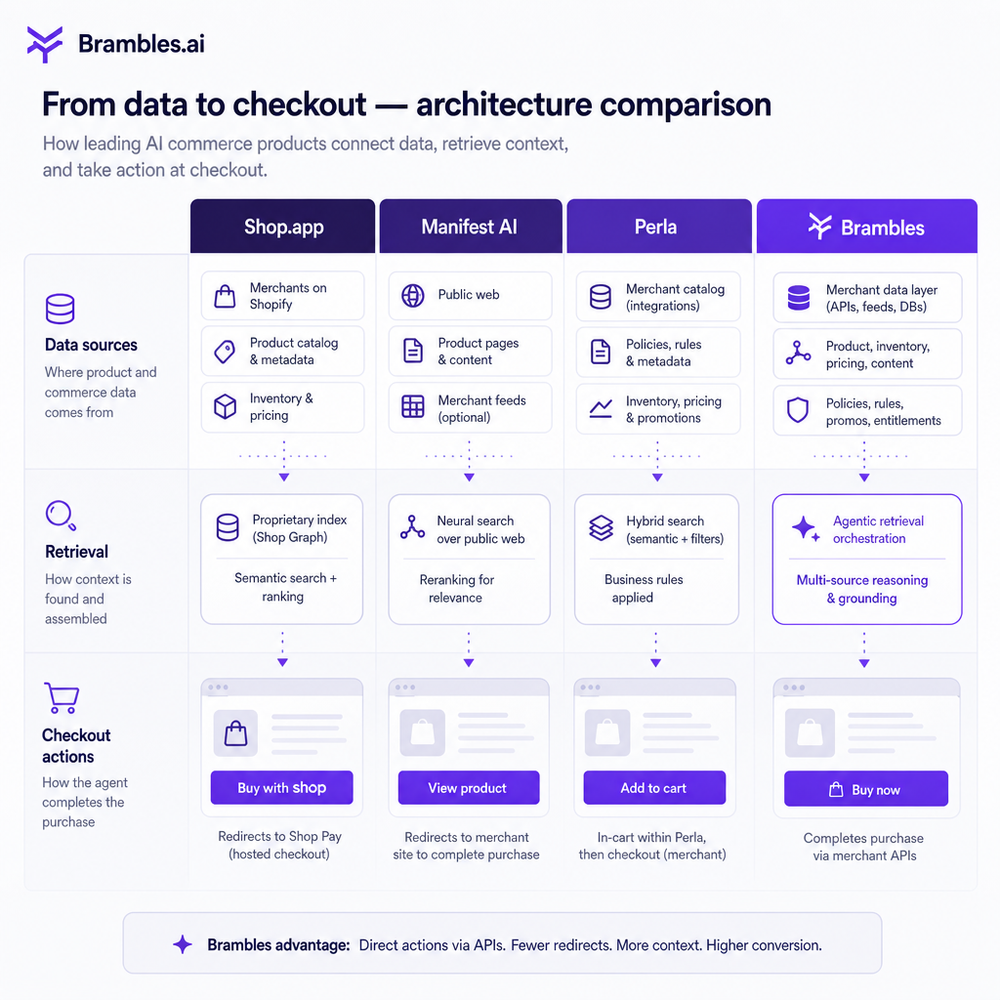
You can deploy Brambles quickly if you prepare content the AI can actually use. Here’s a field-tested plan we’ve repeated across fashion, CPG, and niche DTC.
Step-by-step
1) Connect Shopify and pull products, variants, collections, and metafields. Map return policy, shipping thresholds, and warranty.
2) Ingest rich content: buying guides, size charts, comparison tables, ingredient decks, and your top 50 customer emails.
3) Define business rules: compatibility matrices, substitutions for OOS, cross-sells, and margin guardrails.
4) Configure actions with the Commerce Module: add-to-cart, bundle build, apply discount, select nearest store pickup if needed.
5) Train tone and cite sources. Require links back to the exact guide section for every critical claim.
6) QA with 50 canonical questions and edge cases; set confidence thresholds for human fallback.
7) Launch to 20% of traffic, measure, then expand.
Checklist
- SKU coverage >95% with unambiguous variant logic
- At least 5 authoritative guides for top collections
- Returns/fit and shipping policy linked and quotable
- Confidence threshold and escalation path to support
- Metrics wired: CR, AOV, assisted revenue, time-to-cart, deflected tickets
- Consent flows mapped to analytics destinations
Anecdote: A supplements store shipped this in 8 days. With add‑to‑cart actions enabled, the assistant generated 22% of total carts and contributed a 12.6% lift in PDP conversion within three weeks, measured against a 30% holdout.
Measuring ROI and KPIs That Matter
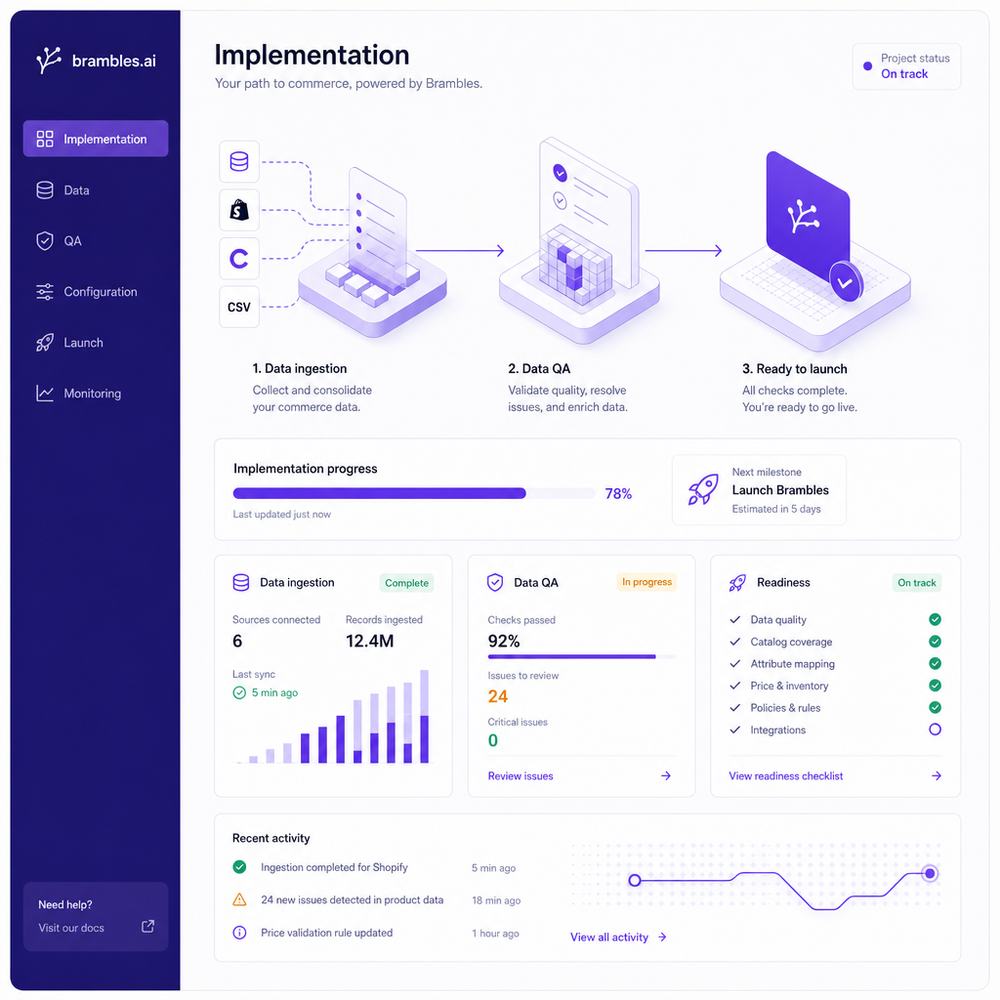
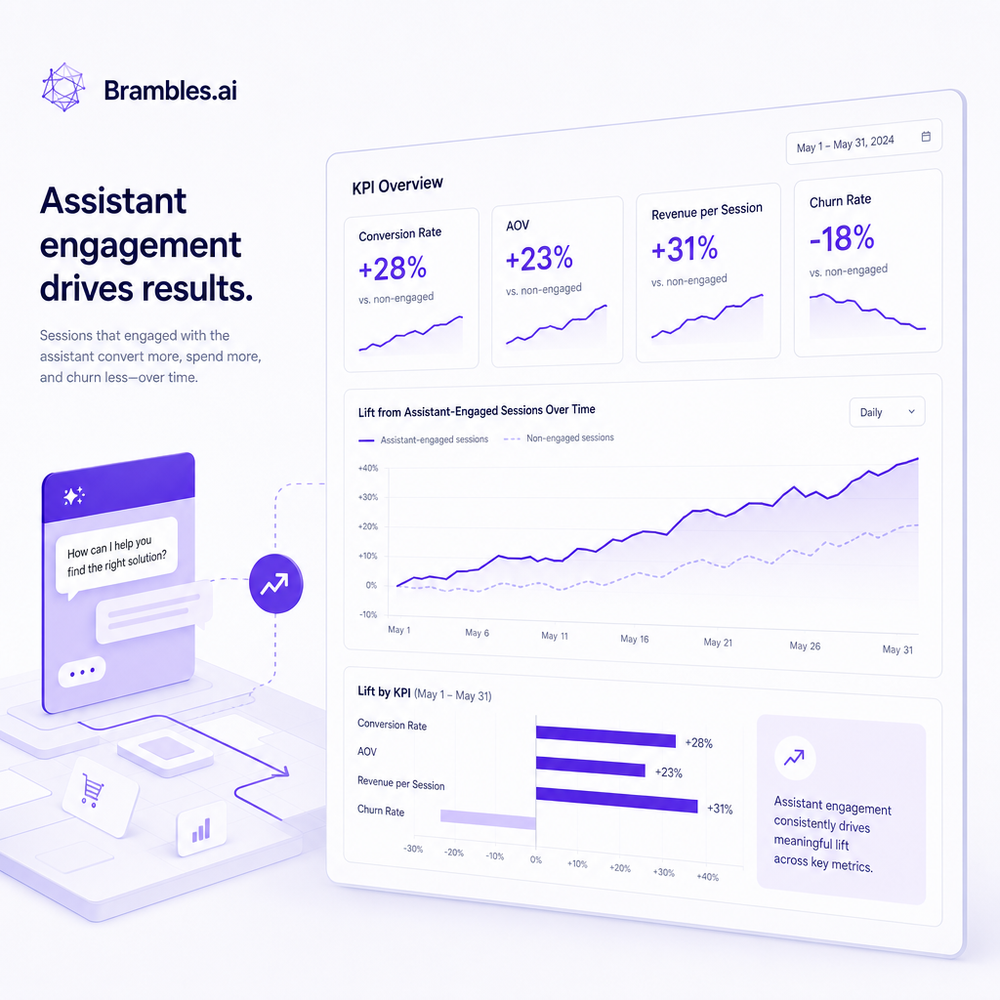
Measure what the assistant actually changes: certainty and speed. We recommend four primary KPIs and two guardrails.
Primary KPIs
- Assisted conversion rate: sessions with assistant engagement vs. control
- AOV delta: assistant-influenced orders vs. sitewide baseline
- Time-to-cart: median minutes from first interaction to first add-to-cart
- Ticket deflection: % of chats resolved without human handoff
Guardrails
- Confidence breach rate: % of answers below threshold triggering fallback
- Policy accuracy: audited citations match source content
Google UX research ties faster decision loops to conversion lifts, especially on mobile. In our home goods test, time‑to‑cart fell from 6:40 to 4:05 and mobile conversion rose 19% for assistant-engaged sessions. Keep a 10–30% traffic holdout and publish the deltas weekly to stay honest.
Pro tip: tie assistant recommendations to margin tiers so AOV gains don’t erode contribution. Brambles’ rules can rank bundles by contribution dollars, not just price. If you’re early, start with a 90‑day target like “+10% assisted CR, +5% AOV.” If you’re benchmarking vendors, run all tests with identical holdout logic and attribution windows.
First‑Party Data and Trust
If AI chat becomes a primary buying surface, it must respect consent and give you portable insights. That’s where Brambles’ onsite approach pays off: you keep session context and can map intents to first‑party events without shipping logs to yet another black box.
Practical moves
- Capture declared data in plain language: size, goals, constraints (“vegan”, “gift under $50”).
- Store it with consent and clear expiration.
- Map intents to CRM/CDP destinations and remarketing rules.
McKinsey’s work on personalization shows revenue lifts when preference capture is explicit and value is obvious. Offer immediate payoffs—saved sizes, curated picks, early access—right in the chat UI.
Publishers running commerce content can use the Brambles WordPress plugin to turn buying guides into shoppable flows while keeping first‑party click and intent data. That makes monetization more resilient than affiliate-only models and ties neatly into a brand/retail assistant flow when readers are ready to purchase.
Common Pitfalls to Avoid
Most misses trace back to weak inputs or unchecked automation. Treat your assistant like a revenue product, not a bot.
Checklist of pitfalls
- Thin ingestion: only titles/descriptions—no guides, no policy detail
- No source citations: unverifiable claims in high-stakes answers
- Over-broad actions: discounts or bundles without margin rules
- Zero holdout: no way to prove lift from engagement
- Offsite drift: conversations starting onsite but ending in a third-party app with lost attribution
- One-size-fits-all tone: ignores brand voice and buyer stage
If you’re comparing Manifest AI or Perla with Brambles, stress-test compatibility and policy edge cases. Ask 20 questions that combine variant fit, discounts, and shipping rules together, then audit citations. Keep the best performer for your exact catalog shape; tools aren’t monolithic winners.
Future Outlook: Where Shopify + AI Is Heading
We’re seeing three durable shifts: assistants that act (not just answer), product graphs that unify PDPs with guides and reviews, and privacy‑first measurement that survives cookie loss. Shop.app will keep owning convenience; Manifest AI and Perla will keep polishing onsite chat. Brambles’ bet is deep product reasoning plus first‑party monetization across both brands and publishers. Expect more SKU‑level reasoning, fulfillment‑aware recommendations, and richer post‑purchase guidance that loops back into the graph.
FAQ
Is Shop.app bad for attribution?
Not bad—just different. Conversations offsite can break session continuity. If you rely on strict pre‑purchase attribution, keep your core guidance onsite and use Shop.app as a complementary convenience layer.
When should I choose Manifest AI or Perla?
If your catalog is simple and you need fast, embedded chat for FAQs and light recommendations, both are quick wins. Validate on your edge cases and set a clean holdout. If they hit your KPIs, great—ship it.
How does Brambles.ai handle complex compatibility?
It encodes variant logic and compatibility matrices in a product+content graph, cites exact sources, and can enforce substitution and margin rules via the Commerce Module. That’s why it shines on tricky catalogs.
Can publishers use Brambles without a Shopify store?
Yes. The WordPress plugin turns buying guides into shoppable assistants with first‑party events, and you can link out to brand stores or affiliate networks while keeping monetization data in your own stack.
Related resources on Brambles.ai
If you are implementing this, start with Brambles.ai, for publishers, for brands, get started.
For deeper reading, see 10 Reasons Publishers Need Conversational Commerce, Affiliate Disclosure in Conversational UIs Done Right, Contextual, Not Creepy: Monetization That Wins, From Search Boxes to Conversations: Modern Shopping UX.
Related posts
View all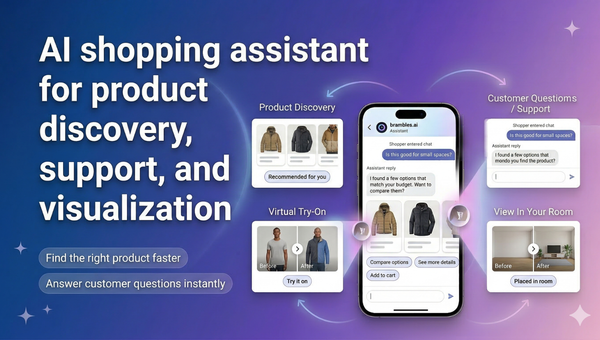
Brambles.ai Is Live on the Shopify App Store
Brambles.ai is live on the Shopify App Store, giving merchants an AI shopping assistant for discovery, support, try-on, and add-to-cart.
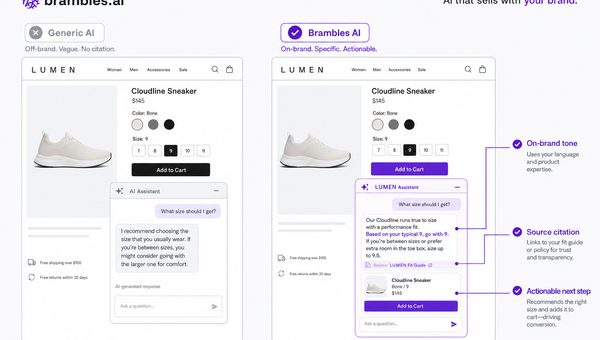
Brand-Consistent AI Chats Build Trust and Conversions
When AI mirrors your brand voice, shoppers relax—questions get answered, carts grow, and support load drops. Learn the playbook to align tone, trust, and ROI.
Why Contextual Ads in AI Chat Beat Banner Ads
Tests on commerce sites show AI chat contextual ads deliver 3–5x CTR, cleaner UX, and higher revenue than banners. See how they work, implement, and measure.
Explore Brambles.ai
Learn more about our AI-powered agentic commerce platform, agentic shopping, and shopping assistance solutions.
Explore More Insights
Discover more articles on AI, automation, and business innovation
View All Articles