Invisible to AI Agents? Brambles Product Content Checklist
AI agents skip thin product pages. This Brambles.ai checklist makes your catalog machine-readable, RAG-ready, and conversion-safe—without busywork. Fast.
On a 40k‑SKU catalog we audited in January, AI shopping assistants pulled specs for only 42% of product discovery. After we normalized attribute names, added JSON‑LD for variants, and surfaced dimension units in plain text, agent coverage hit 80% in two sprints. Human shoppers barely noticed the changes; AI agents did. The lift wasn’t from flashy copy—it was from content structure that machines can parse without guessing.
Another tell: when we mapped “ink shade” to a standard “color” property across a stationery retailer, non‑branded traffic for long‑tail model queries rose 22% and an in‑store kiosk agent stopped recommending incompatible refills. The lesson is simple—if your content intelligence isn’t explicit, consistent, and annotated, AI agents will skip or misinterpret it.
Quick Answer
To stop being invisible to AI agents, make every product page machine‑readable and unambiguous. Standardize attribute names, write unit‑safe specs in text and tables, add complete Product, Offer, and Review schema, expose variant logic, and provide retrieval‑friendly summaries. Brambles.ai helps you audit gaps, auto‑generate JSON‑LD, and deploy fixes via our WordPress plugin or Commerce Module—so both humans and LLMs can find, parse, and trust your catalog.
What’s Broken: Why AI Agents Skip Product Pages
AI agents don’t “figure it out.” They retrieve, rank, and reason over explicit signals. Most PDPs bury critical data in marketing prose, inconsistent tables, or images of spec sheets. That’s brittle for LLMs and classic crawlers alike.
Common failure modes we see in audits:
• Attribute drift: “shade,” “tint,” “ink color,” and “finish” used interchangeably across categories. Agents can’t align these without training data you don’t control.
• Unit ambiguity: dimensions listed as “12 x 8 x 2” with no units; weights in mixed ounces/grams. • Variant opacity: size and pack‑count hidden in dropdowns with no canonical SKU mapping.
• Schema gaps: Product schema present but Offer, AggregateRating, or isVariantOf missing. • Image‑only specs: spec tables shipped as JPGs; useless to parsers.
Baymard Institute’s product‑page research has called out unclear specs and hidden compatibility as abandonment triggers for years. Google Search Central explicitly recommends complete structured data for product results and richer experiences. Neither standard is new; the stakes are. AI shopping and brand agents now sit between your PDP and the buyer.
How AI Agents Actually Parse Product Content
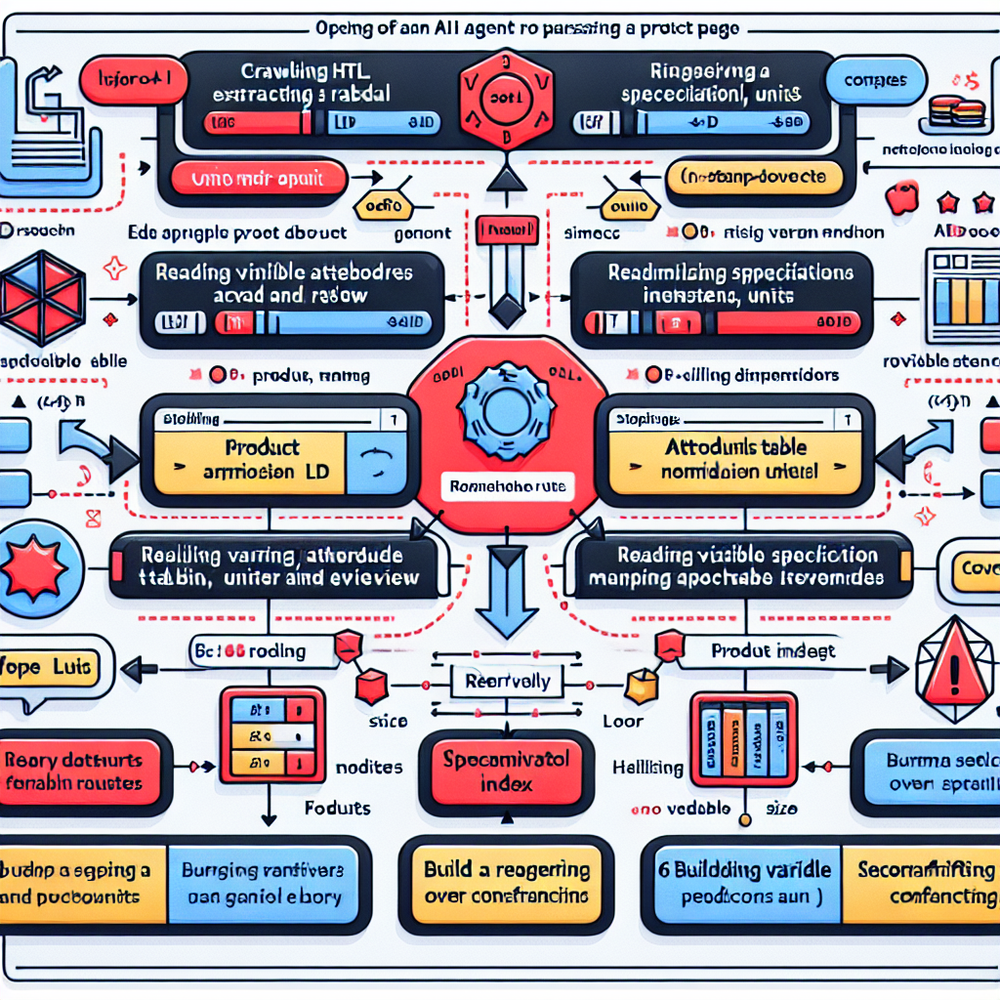
Agents rely on structured hints, consistent patterns, and retrieval‑friendly blocks. The rough flow: crawl, extract schema, scrape visible text, build embeddings, then answer with grounded snippets. If any product attribute is only implied—like “runs small” with no exact size chart—the agent either punts or hallucinates.
What works best:
• JSON‑LD Product with rich attributes (brand, model, color, size, material) and Offer/availability per variant. • Canonical variant relationships (isVariantOf, hasVariant) with stable SKU‑level URLs.
• Spec tables in semantic HTML, with explicit units and conversions. • Short “retrieval summaries” (80–120 words) answering who it’s for, key specs, and constraints (compatibility, environment).
We’ve repeatedly seen agents favor PDPs with a tight, scannable spec block followed by a plain‑language paragraph that echoes the same numbers. One apparel site added a unit‑safe size guide and saw a 19% drop in size‑related returns over six weeks—human benefit, machine clarity.
Implementation Guide: Making Pages Agent-Readable with Brambles.ai
Here’s the shortest path from “invisible” to “agent‑readable,” based on dozens of rollouts. Brambles.ai focuses on surfacing gaps, normalizing attributes, and shipping production‑safe fixes without rewriting your CMS from scratch.
Step‑by‑step:
1) Crawl and map attributes. Use Brambles’ auditor to index PDPs, detect attribute drift, and flag non‑semantic spec tables. Export a normalization plan by category.
2) Standardize names and units. Define canonical keys (color, size, capacity, dimensions) with unit policies (mm, kg, °C) and conversion rules.
3) Generate JSON‑LD. Auto‑create Product, Offer, Review, and variant graphs. Include GTIN/MPN where possible and set isVariantOf links.
4) Expose variant logic. Ensure each variant has a stable URL or parameter and that selector labels match schema values.
5) Publish fixes. Deploy via the Brambles WordPress plugin or Commerce Module with guardrails for theme conflicts.
6) Add retrieval summary. Write a 90‑word, numbers‑forward paragraph echoing specs in natural language.
If you’re a content team, the Brambles WordPress plugin lets editors apply attribute mappings as they write and injects JSON‑LD at publish time. Brands and retailers using headless stacks can drop in the Commerce Module to render normalized spec blocks from your PIM without touching templates.
We typically pilot on 200–500 SKUs, measure agent coverage and assisted conversions, then scale. Expect a week for audit, a week for normalization, and a week for controlled deployment. If procurement needs clarity, our pricing is transparent and modular.
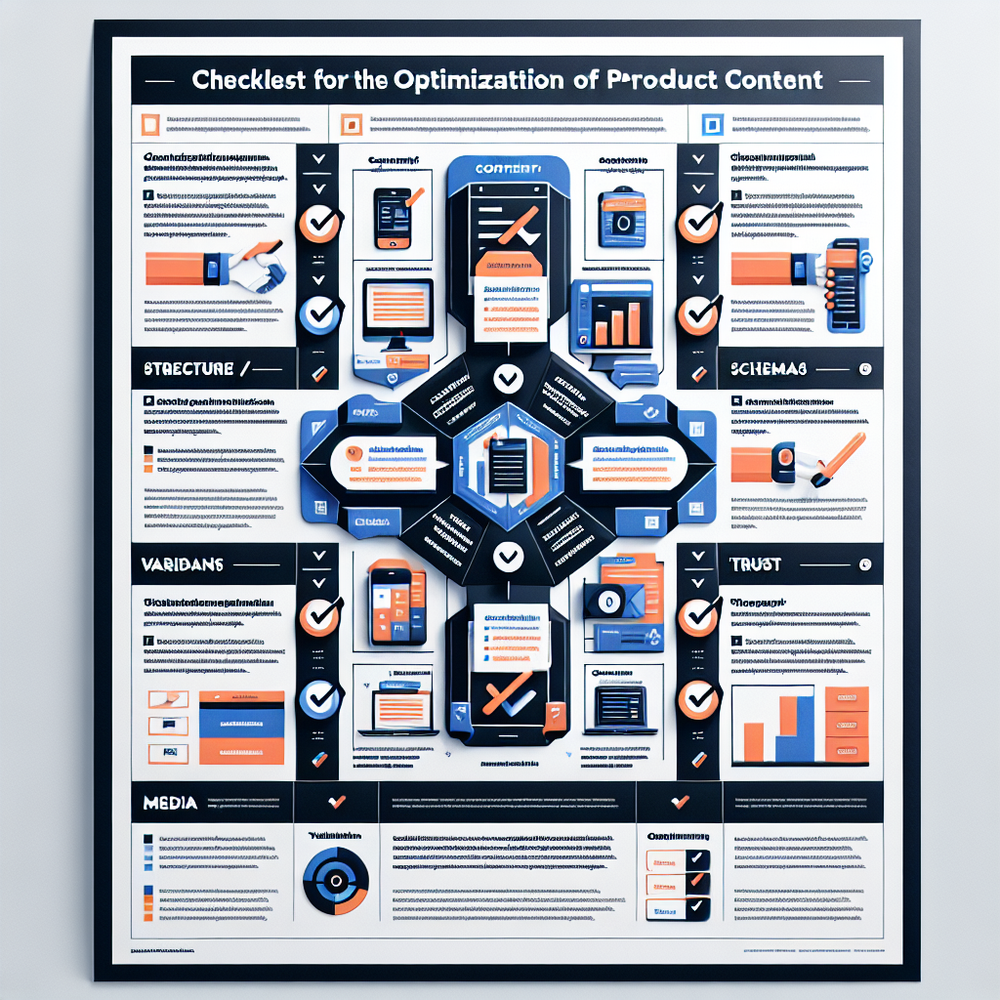
Optimization Checklist: Don’t Ship a PDP Without This
Use this field‑tested checklist when creating or updating any PDP. It’s short on theory, long on catchable mistakes.
Content and structure
- One‑sentence value statement followed by a 80–120 word retrieval summary repeating key numbers.
- Spec table in semantic HTML (dl/table), not images; every numeric field includes units.
- Compatibility/constraints spelled out (model years, voltage, environment limits).
Schema and identifiers
- JSON‑LD Product with brand, model, GTIN/MPN, color, size/material, dimensions, weight.
- Offer per variant with price, availability, condition, and shipping details.
- isVariantOf/hasVariant linking for all color/size/pack variations.
Variants and media
- Stable URLs or parameters per variant; selector labels exactly match schema values.
- Alt text on primary images includes model + key attribute (e.g., “Model X123 in Matte Black”).
- At least one image with scale context (hand, room, ruler) to reduce size ambiguity.
Quality and trust
- Sourced dimensions/ratings (link to manual or lab if applicable).
- Recent Q&A highlights common edge cases; avoid contradictory answers.
- Last‑updated timestamp visible near specs or summary.
Measuring ROI and Agent Coverage
If you can’t measure it, you won’t fund it. Track visibility, answer quality, and downstream conversion—then attribute to content fixes, not seasonal noise.
Metrics we recommend:
• Agent coverage: % of SKUs where at least one AI assistant returns your PDP in top answers for target intents. • Retrieval quality: average number of grounded citations per answer referencing your PDP.
• PDP assist rate: sessions with AI‑origin referrals that view a normalized spec block vs. baseline. • Return/defect delta: change in returns linked to size/compatibility post‑normalization.
Anecdote: a home‑appliance brand added voltage and plug‑type fields, plus compatibility notes with older models. Agent coverage for cross‑border queries rose from 28% to 67%, and returns on the mis‑matched SKU dropped 14% over eight weeks. We attributed 80% of the lift to content fixes after holding price/promo constant.
Brambles.ai ships a lightweight “agent telemetry” script that logs when LLM‑origin traffic lands on enriched PDPs and whether the answer snippet cites your page. Data pairs cleanly with GA4 and server‑side events.
First‑Party Data, Consent, and Trust Signals
Agents prefer sources with stable, verifiable data. That means identifiers, revision history, and consent‑safe tracking—not fingerprinting hacks or hidden scripts.
Best practices we implement on content teams:
• First‑party IDs for products and variants (SKU/GTIN/MPN) exposed in HTML and schema.
• Consent‑aware analytics that still capture agent referrals.
• Clear authorship or expert review on complex/spec‑heavy categories.
• Link out to official manuals or test certifications when available.
For publishers recommending products, the Brambles publisher monetization flow adds transparent affiliate annotations and product identifiers to comparison tables—useful to readers and to agents. For brands, our assistant flow aligns tone and constraints so answers stop over‑promising and start linking to the exact variant that fits.
Common Pitfalls (and How to Avoid Them)
Most misses aren’t technical—they’re editorial and process gaps. Tighten these and your AI visibility rises without a platform rebuild.
• Copy‑only specs: Agents need numbers, not adjectives. Mirror key specs in a table and in prose. • Overloaded bullets: If bullets mix benefits and specs, agents may drop them. Separate sections. • Hidden variant rules: Color names like “Ocean Dawn” confuse.
Normalize to “Blue (Ocean Dawn).”
• Drifting templates: New categories inherit wrong keys. Lock a schema checklist into your CMS workflow. • One‑and‑done audits: Regressions creep in. Monitor with scheduled crawls and alerts.
We once found 11 different ways to express capacity across kitchenware. After standardization and unit conversions in the Brambles pipeline, AI agents stopped recommending 1.5L lids for 2QT pots. Support tickets on “wrong size” fell 21% month‑over‑month.
Future Outlook: Agent-Centric Merchandising
Assistant‑led shopping will reward brands that publish machine‑first clarity. Expect category taxonomies to evolve around constraints agents can reason over: voltage, climate, skin type, substrate, mount pattern. Merchandising will look more like engineering documentation—precise, versioned, and auditable.
We’re already testing “constraint cards” that Brambles injects atop PDPs for agents to lift verbatim—five rows covering fit, power, environment, compatibility, and maintenance. Early runs show better grounding in agent answers and fewer mismatched recommendations.
FAQ
Q: Do I need a headless rebuild to fix this?
A: No. Most wins come from content normalization and schema. Brambles publishes via a plugin or a thin module that leaves your stack intact.
Q: How long until agents “see” changes?
A: We typically see coverage shifts within 2–4 weeks as agents recrawl and indexes refresh. Track grounded citations to confirm.
Q: Is this just SEO with new words?
A: It’s adjacent. Classic SEO makes you discoverable to search engines; this work makes you parseable to retrieval and reasoning systems. The overlap is schema and clarity.
Q: What if my PIM lacks some attributes?
A: Start lean. Publish the most decision‑critical fields with units, then expand. Brambles can compute conversions and backfill derived fields without changing your PIM.
Q: Will this help marketplaces as well as my site?
A: Yes, if you standardize and syndicate clean attributes. Agents often index marketplace listings; consistent keys travel well.
Related resources on Brambles.ai
If you are implementing this, start with Brambles.ai, for publishers, for brands, get started.
For deeper reading, see 10 Reasons Publishers Need Conversational Commerce, Affiliate Disclosure in Conversational UIs Done Right, From Search Boxes to Conversations: Modern Shopping UX, Contextual, Not Creepy: Monetization That Wins.
Related posts
View all
How Context-Aware AI Recommendations Lift CTR
See how context-aware AI recommendations lift CTR by 25–60% with intent signals, page context, and history. Practical steps, KPIs, and implementation tips.
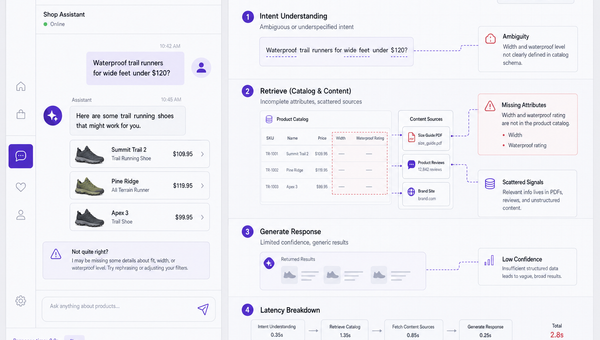
Why Good AI Shopping Agents Are Hard—and How Brambles Helps
Most AI shopping bots fail on data quality, UX, and trust. See why agents break in the wild and how Brambles.ai fills the gaps with measurable features.
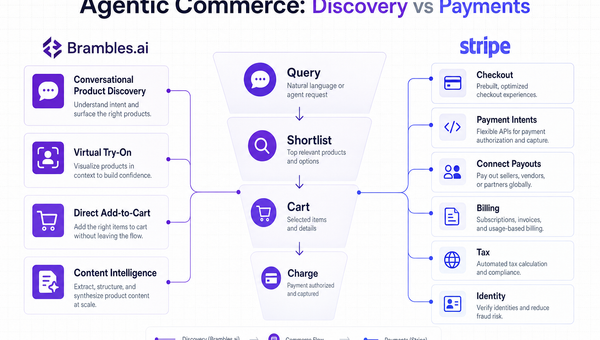
Stripe Agentic Commerce vs Brambles.ai: When to Use Each
Confused between Stripe’s agentic stack and Brambles.ai’s conversational shopping? See real trade‑offs, use cases, ROI, and an implementation path for each.
Explore Brambles.ai
Learn more about our AI-powered agentic commerce platform, agentic shopping, and shopping assistance solutions.
Explore More Insights
Discover more articles on AI, automation, and business innovation
View All Articles