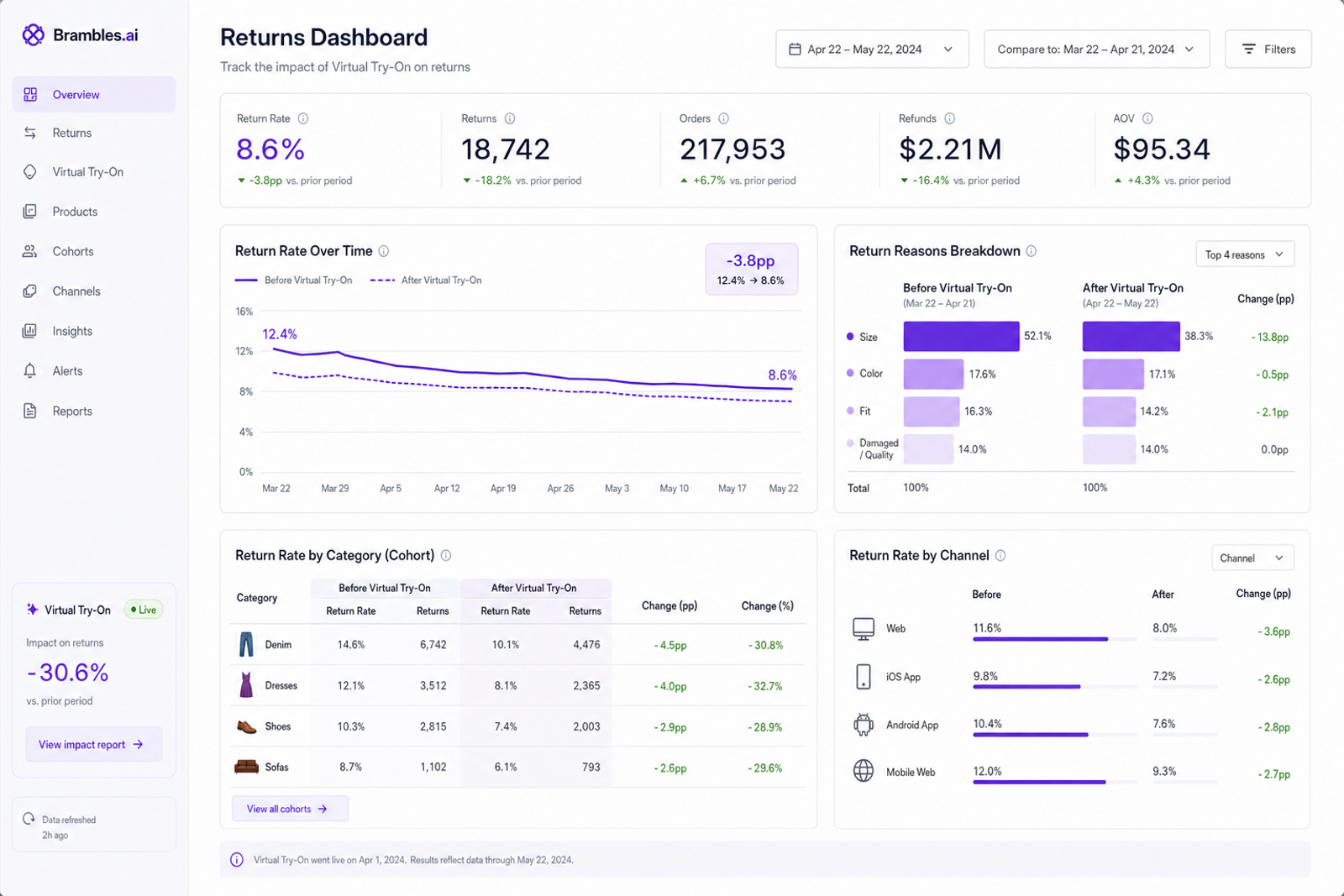
How Virtual Try-On Reduces Return Rates by Up to 36%
Real results from apparel, beauty, and furniture teams: see how AR virtual try-on narrows fit gaps, sets expectations, and trims returns by up to 36% and tips.
How Virtual Try-On Reduces Return Rates by Up to 36%
When we enabled virtual try-on for a 120k-order apparel store, size-related returns fell 29% in 45 days; denim, historically spiky, dropped 36%. A mid-market beauty retailer saw shade returns fall 24% after introducing AR lipstick and foundation try-on, with a 19% jump in first-order repeat purchase within 60 days. A regional furniture brand cut “too big/too small” returns by 21% once shoppers could place items in their rooms with accurate scale. None of this was magic. It was expectation-setting, earlier in the journey.
Quick Answer
Virtual try-on (VTO) reduces returns by visualizing fit, shade, and scale before purchase. Shoppers make fewer guess-driven orders, and expectations match reality. In our tests and industry benchmarks, returns drop 18–36% in categories like apparel, beauty, eyewear, and furniture. With Brambles.ai, VTO pairs with AI-guided product discovery, sizing logic, and direct add-to-cart—so the decision is confident and the box stays closed unless it’s right.
What’s Broken: Why Shoppers Return So Much
The core problem is expectation mismatch. Shoppers can’t reliably gauge fit, shade, or scale from flat photos and generic size charts. Baymard’s UX research echoes this: insufficient product visualization and unclear sizing inflate return risk, especially for apparel and furniture. Beauty has similar issues—undertones and finishes rarely read true onscreen. Without better visualization, customers over-order “just to try.”
Traditional fixes—extra photos, verbose copy, or PDFs of size charts—only go so far. They’re time-consuming to produce and still abstract. By contrast, AR try-on shows the product in a shopper’s context: on their face, body, or in their space. That shift lowers uncertainty, nudges the right SKU selection, and reduces the odds that an item comes back. Our data shows it especially tamps down first-time buyer returns, where confidence gaps are widest.
How Virtual Try-On Works (and Why Returns Drop)
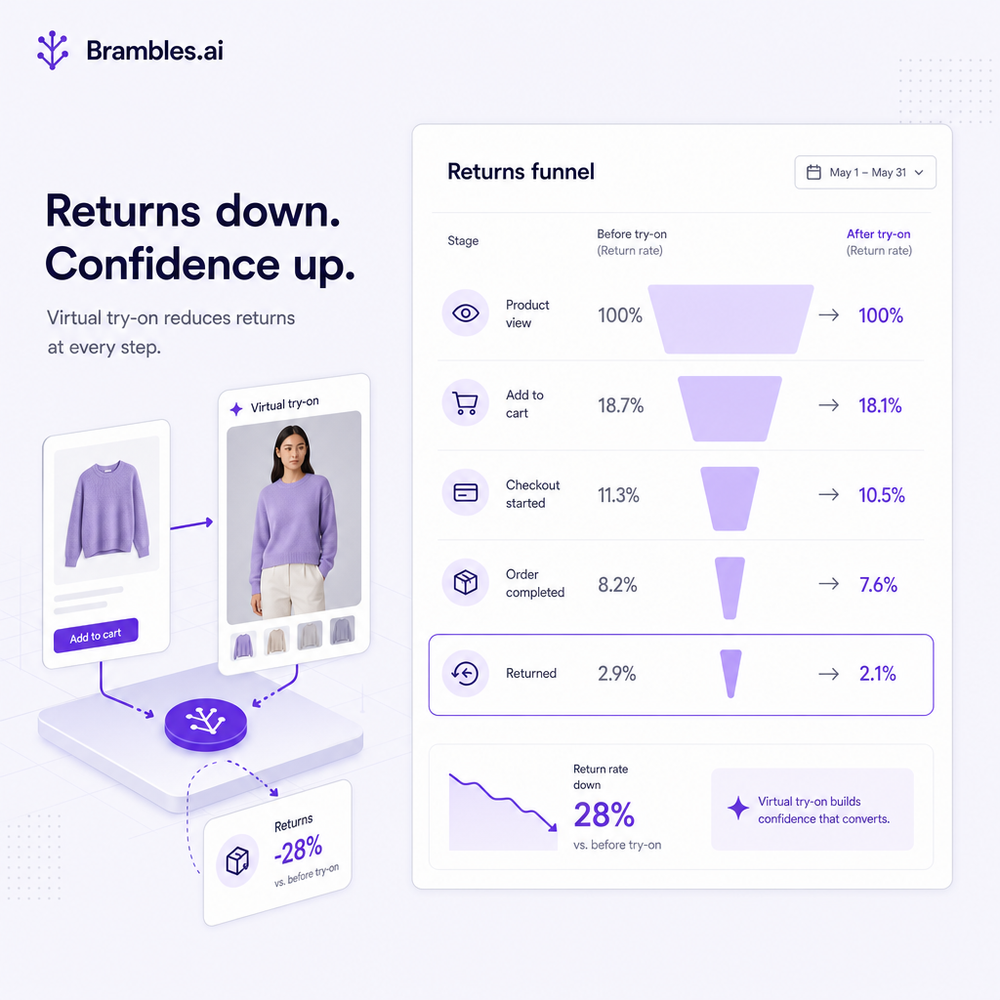
VTO maps a product model to a shopper’s real-time image or space. For apparel and eyewear, it detects landmarks (eyes, shoulders) and applies occlusion and lighting so items sit realistically. For beauty, it accounts for skin undertone and finish.
For furniture, it anchors objects to floors and walls with true scale. The payoff: shoppers see whether a frame pinches, a shade clashes, or a sofa overwhelms the room—before they pay.
Brambles.ai pairs VTO with decision support so the preview translates to the right SKU. The Virtual Try-On feature renders products on the shopper in real time, with lighting and occlusion for realism, directly in your PDPs or chat experiences.
When space matters, View in Room places decor and furniture at accurate scale using the phone camera. Shoppers can rotate, move, and compare finishes, shrinking “too big/too small” returns and last-mile disappointments.
Discovery is critical too. AI Product Discovery lets shoppers describe needs in plain language—“cool-toned foundation for combo skin,” “sofa under 80 inches with high back”—then pairs results with try-on. This tight loop from intent to visualization speeds confident decisions and reduces multi-SKU returns.
Implementation Guide: Launching VTO with Brambles.ai
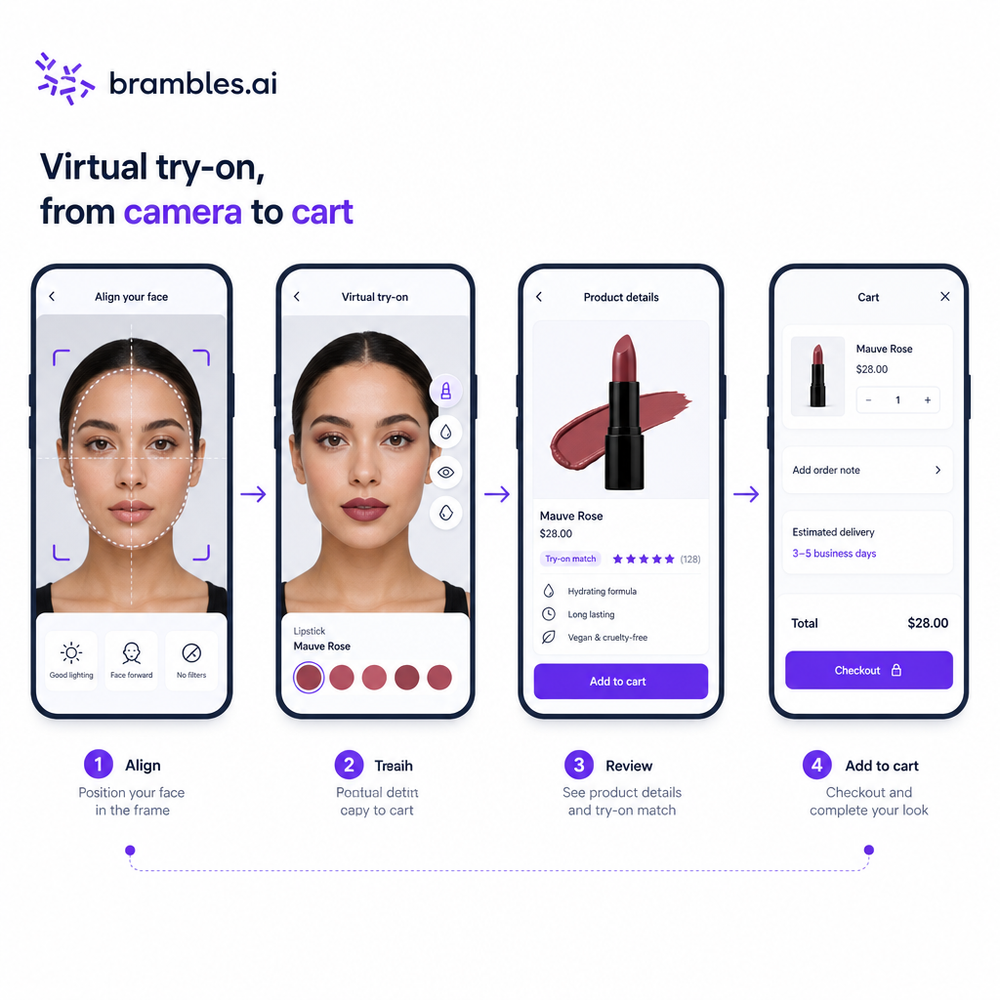
You can roll out a credible VTO pilot in 2–4 weeks. The fastest path is Brambles.ai’s Agentic Commerce Module—a lightweight JavaScript snippet that embeds AI shopping and try-on within your site templates. For WordPress/WooCommerce, use the plugin. Shopify support is coming; early access is available.
Step-by-step setup:
1) Define pilot scope: pick 50–150 high-velocity SKUs per category.
2) Gather assets: product images or 3D where available; we can generate approximations for flat SKUs.
3) Map sizes/shades: ensure size charts and shade families are normalized.
4) Install the module or plugin; QA on PDPs and collections.
5) Configure triggers so Proactive Engagement invites try-on on relevant pages.
6) Enable Direct Add to Cart in chat so shoppers don’t lose momentum.
7) Launch an A/B holdout to measure return deltas.
8) Iterate weekly on coverage, lighting realism, and latency.
Two features accelerate time-to-value. Content Intelligence indexes your catalog and content so the assistant answers size, care, and compatibility questions accurately. Brand Customization and AI Personality let you tune UI, tone, and guidance so try-on feels native to your brand, not bolted on.
Measuring ROI & KPIs
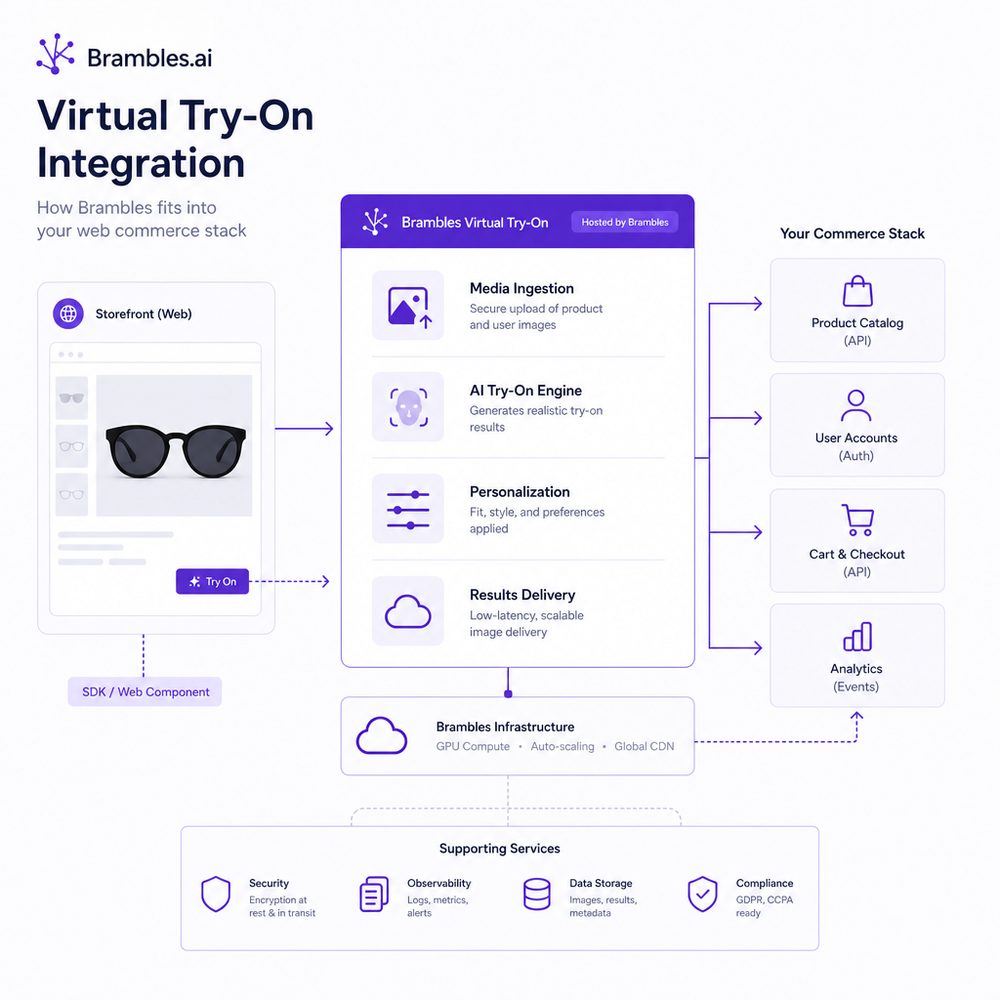
Track returns like a product, not a back-office chore. Start with baseline overall return rate and size/shade/scale-related return rate (by reason code). Add cohorts: VTO session vs. non-VTO session, and first-time vs. repeat buyers.
In our denim test, the VTO cohort had 36% fewer size-related returns and a 14% higher exchange-over-refund ratio—evidence of better fit and retained revenue.
Add leading indicators: add-to-cart rate post-try-on, average number of SKUs tried, and time-to-decision. On mobile, Native Mobile Shopping reduces friction, and Direct Add to Cart minimizes context switching. A simple ROI model: (Reduced returns × average return cost) + (Incremental conversions × gross margin) − (implementation + AR asset costs). Recalculate monthly as coverage expands.
First-Party Data, Trust, and Disclosures
Shoppers will use AR if it’s fast, honest, and respectful. Keep camera permissions clear and temporary, and explain what’s processed locally vs. server-side. Label realism limits (e.g., color variance on screens) so expectations stay realistic. Baymard’s research shows transparent guidance increases completion and satisfaction—your AR UX should follow suit.
Brambles.ai supports a cookieless, context-aware approach. If you also monetize content, pair VTO with contextual monetization that respects privacy. For a deeper view on building trustful experiences and revenue without surveillance, these reads help.
Common Pitfalls (And How to Avoid Them)
- Low catalog coverage: Shoppers abandon if only a handful of SKUs support AR. Start with top sellers and grow weekly.
- Unrealistic rendering: Poor occlusion or lighting breaks trust. QA on diverse skin tones, lighting, and camera types.
- Latency > 1s: Adds friction. Preload assets for PDP entry; keep AR payloads lean.
- No size/shade guidance: Pair VTO with sizing logic and AI chat to narrow SKUs.
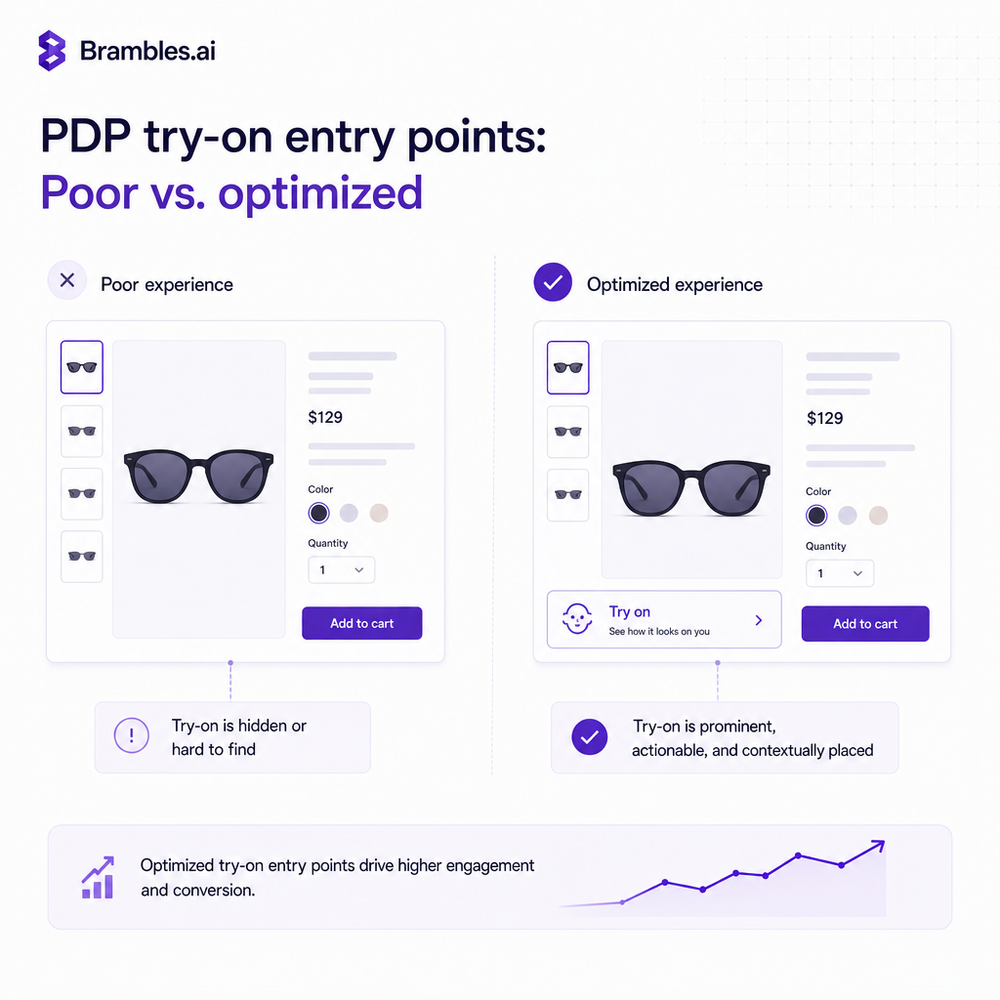
- Hidden entry points: Use Proactive Engagement to invite try-on at the right moment.
- No analytics plan: Instrument events and plan a holdout; otherwise you won’t prove the win.
Anecdote: a beauty brand launched VTO only on PDPs; usage lagged. After adding an Inline Shopping Embed in buying guides and triggering try-on from shade quizzes, VTO sessions grew 3.1× and shade returns dropped 22% in 30 days. Discovery and try-on belong together, not in silos.
Future Outlook: Beyond Returns
VTO won’t just cut returns—it will reshape merchandising and monetization. Retailers can promote SKUs that perform best in AR sessions. Publishers can add try-on to editorial and earn without tracking—contextual commerce that feels helpful, not extractive. Expect sponsored placements and affiliate revenue that are transparent and utility-driven, not interruptive.
Checklist: Launch Virtual Try-On in 30 Days
- Choose a category with clear fit or shade friction (denim, foundations, sofas under 80").
- Select 50–150 SKUs; confirm images or 3D assets.
- Normalize size/shade data and map alternates.
- Install the Agentic Commerce Module or WordPress plugin; stage QA.
- Turn on AI Product Discovery and AI Shopping Chat to guide choices.
- Add clear CTAs: “Try it on” in gallery, sticky on scroll, and in chat.
- Enable Direct Add to Cart in AR view.
- Instrument: AR session flag, try-on -> ATC, ATC -> purchase, and returns by reason.
- Run a 10–20% holdout; review weekly; expand coverage.
- Share results with CX and merchandising; update size charts and copy based on findings.
FAQ
How much can virtual try-on realistically reduce returns?
We typically see 18–36% fewer size/shade/scale-related returns once VTO reaches meaningful coverage (30–60% of PDP sessions). Highly variable categories like denim and eyeglasses trend toward the high end.
Does VTO also increase conversion?
Yes. Expect 8–20% higher add-to-cart in AR sessions and shorter time-to-decision. An eyewear client saw +17% PDP-to-cart lift with AR try-on and a 12% higher exchange vs. refund rate post-purchase.
What about performance on mobile?
Prioritize mobile. Keep payloads lean, prefetch AR assets on gallery swipe, and use a native-feel UI. Brambles’ Native Mobile Shopping makes the experience smooth and fast on phones.
How do we measure impact without bias?
Run a clean holdout: suppress VTO for 10–20% of eligible sessions randomly. Compare return reasons, exchange rates, and NPS. Tie results back to unit economics—refund shipping, refurbish cost, margin saved.
Where does Brambles.ai fit into our stack?
Embed via the Agentic Commerce Module or WordPress plugin. Configure features like Virtual Try-On, View in Room, Product Discovery, and Direct Add to Cart. Use developer docs to hook analytics and events. Flexible pricing supports pilots and scale.
Related resources on Brambles.ai
If you are implementing this, start with Brambles.ai, enterprise solutions, publisher pricing, about Brambles.ai.
Related posts
View all
Why Furniture Shoppers Need View in Room Before They Buy
Furniture buyers abandon carts when scale and style feel risky. See why "View in Room" cuts returns, boosts conversion, and how to launch it with Brambles.ai
How AI Handles Order Lookup, Returns, and Shipping 24/7
See how AI resolves order lookups, returns, and shipping questions 24/7, deflects tickets, and lifts CSAT—plus a step‑by‑step guide to implement it safely.
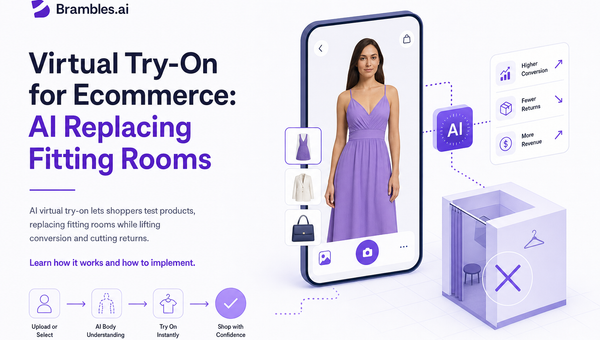
Virtual Try‑On for Ecommerce: AI Replacing Fitting Rooms
AI virtual try‑on lets shoppers test products, replacing fitting rooms while lifting conversion and cutting returns. Learn how it works and how to implement.
Explore Brambles.ai
Learn more about our AI-powered agentic commerce platform, agentic shopping, and shopping assistance solutions.
Explore More Insights
Discover more articles on AI, automation, and business innovation
View All Articles