How to Monetize Your Blog With AI (2025 Guide)
Real tactics, tools, and metrics to turn blog traffic into revenue with AI. Step-by-step setup, KPIs, and pitfalls—tested on sites from 50k to 1M sessions.
How to Monetize Your Blog With AI (2025 Guide)
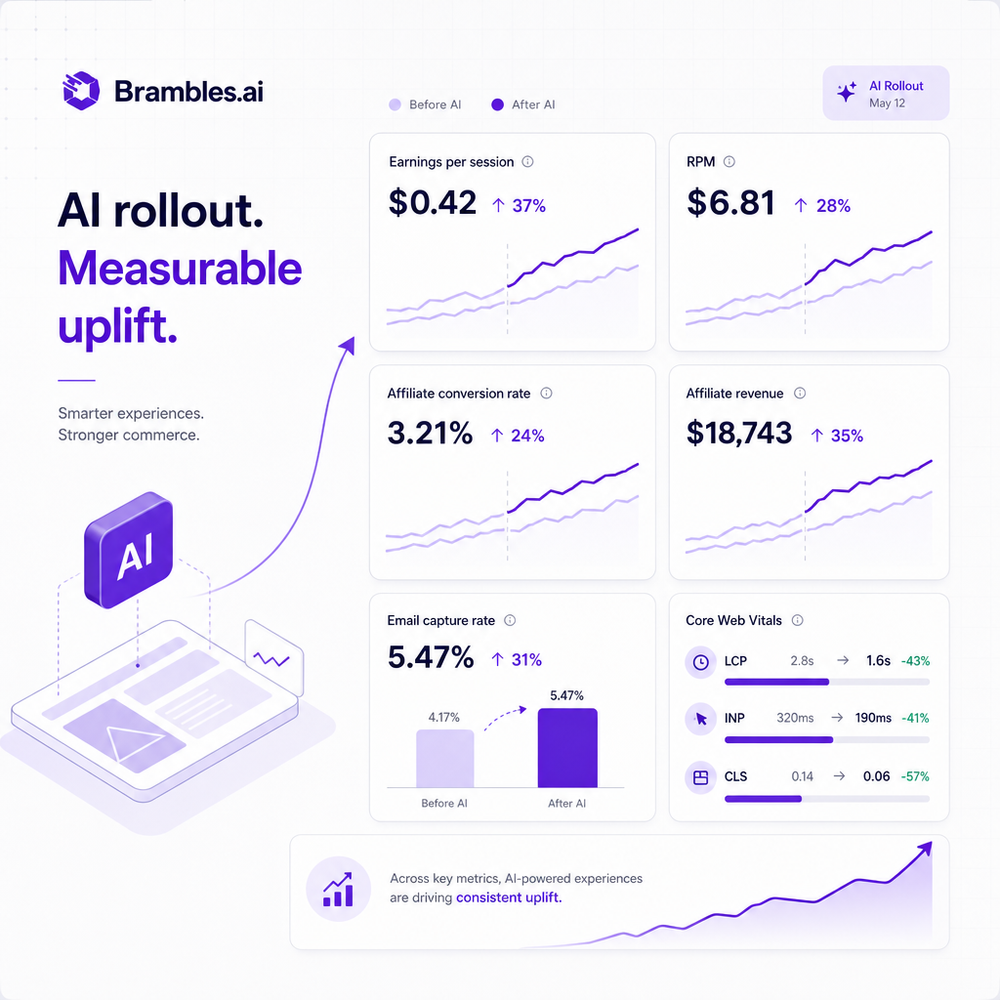
Four weeks after replacing static sidebars with AI-matched product cards, a parenting blog (220k monthly sessions) lifted earnings per session by 37% and cut bounce on commercial-intent posts by 12%. The change wasn’t magical; it was mechanical: intent detection on each post, real-time product matching, and throttled ad density so the page felt helpful rather than hungry. On a home décor site (100k sessions), shifting CTAs based on scroll-depth signals raised RPM by 22% without adding a single new placement. The pattern is consistent across niches: AI that reads the page and the reader—then adjusts which monetization units appear—beats static monetization every time.
What’s Broken in Blog Monetization
Most blogs rely on a patchwork: hard-coded affiliate widgets, a generic ad stack, and an email form that’s the same for every visitor. Three issues keep revenue capped. First, poor relevance: banner blindness is real, but so is “context blindness.” The product or offer often doesn’t match the post’s micro-intent (e.g., “how to fix” vs. “what to buy”). Second, stale operations: inventory changes, affiliate revenue opportunities, and content updates lag—so recommended items go out of stock or underpay. Third, latency and clutter: every extra script drags down Core Web Vitals, and slower pages convert worse. Google/Deloitte observed that improving mobile site speed by just 0.1 seconds correlated with higher conversion rates for retail and travel brands. Add privacy changes (ITP, ATT) and you have less third-party data to target with, more need to get targeting right with first-party context. The result: lots of traffic, middling RPM, and readers who don’t feel understood.
How AI Monetization Actually Works
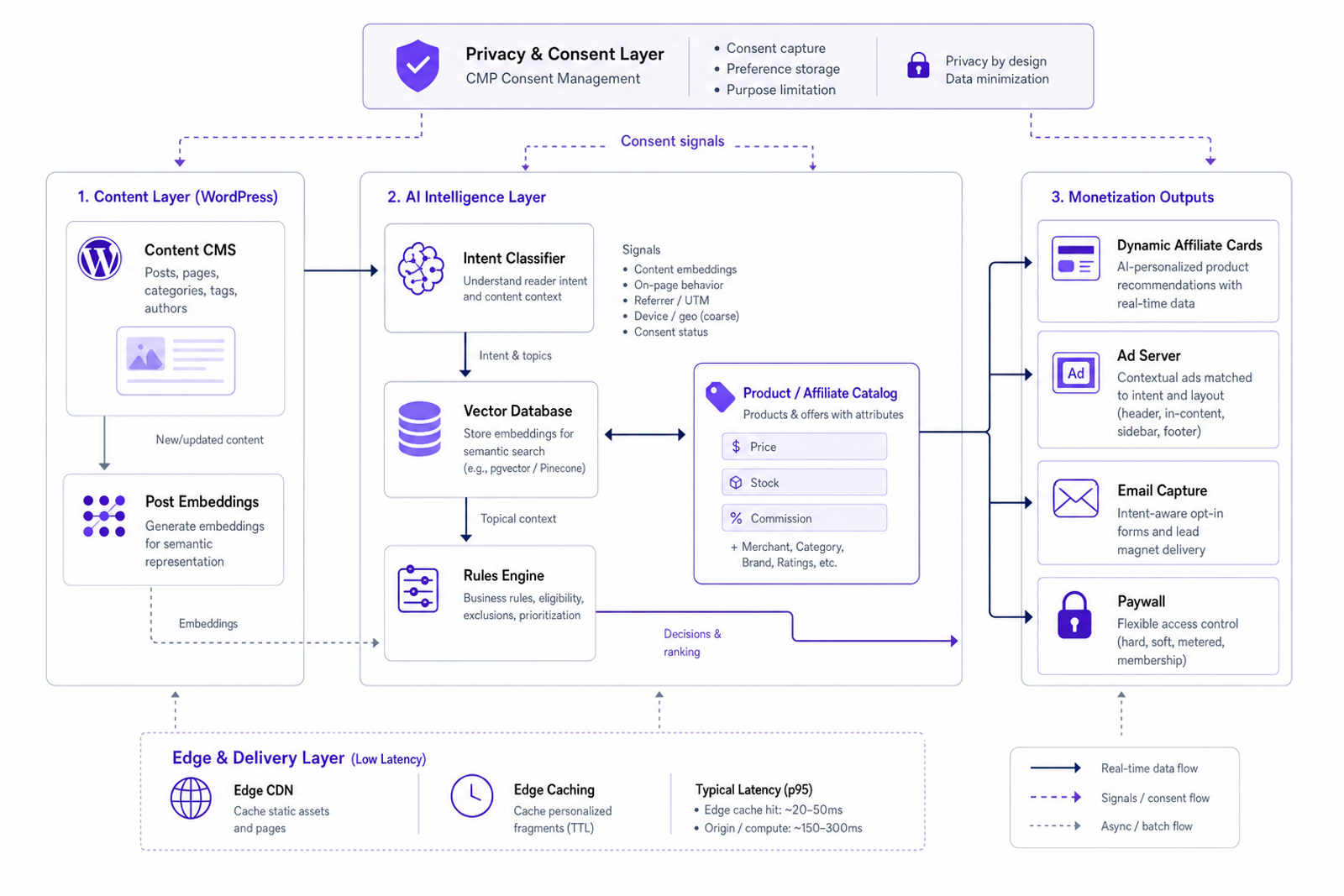
The high-performers run a lightweight stack that translates content and behavior into monetization decisions. Here’s the gist:
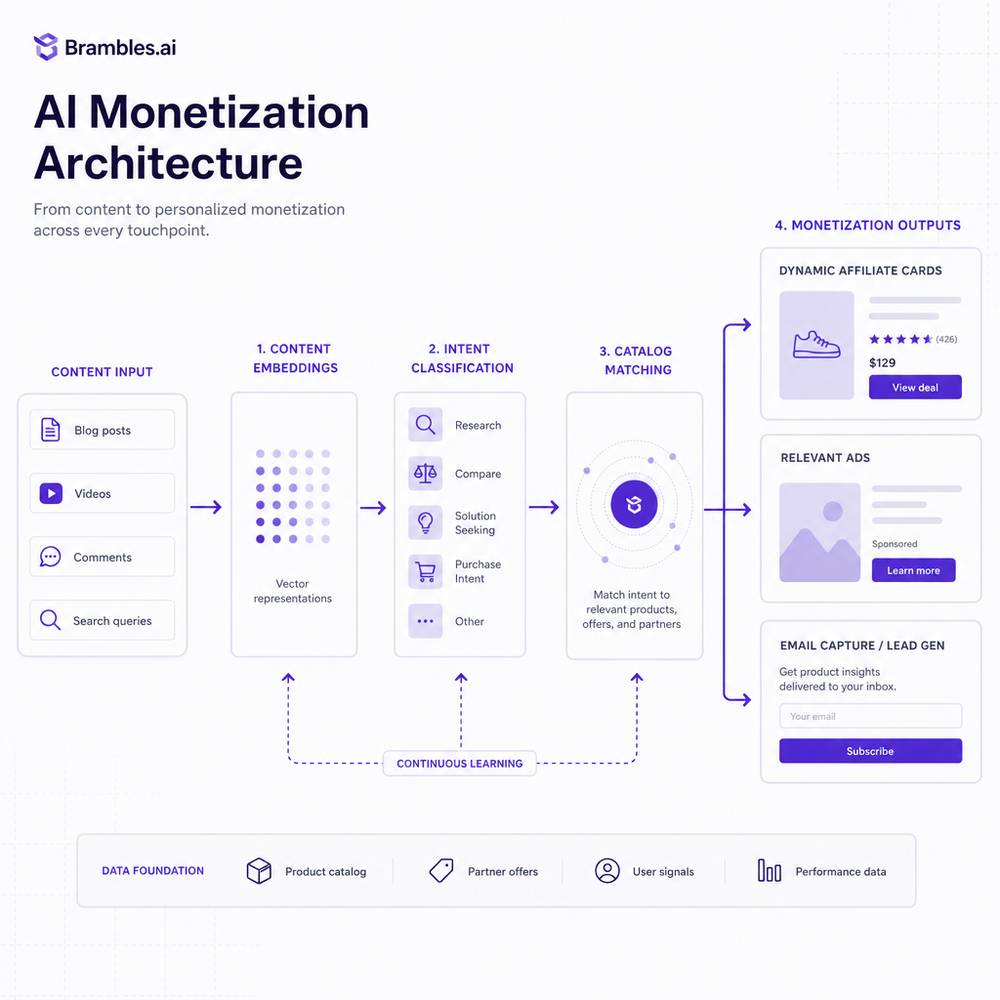
- content intelligence: Each post is embedded (vectorized) and tagged with commercial intent levels (informational, solution-seeking, product-ready). A small classifier handles this cheaply and fast.
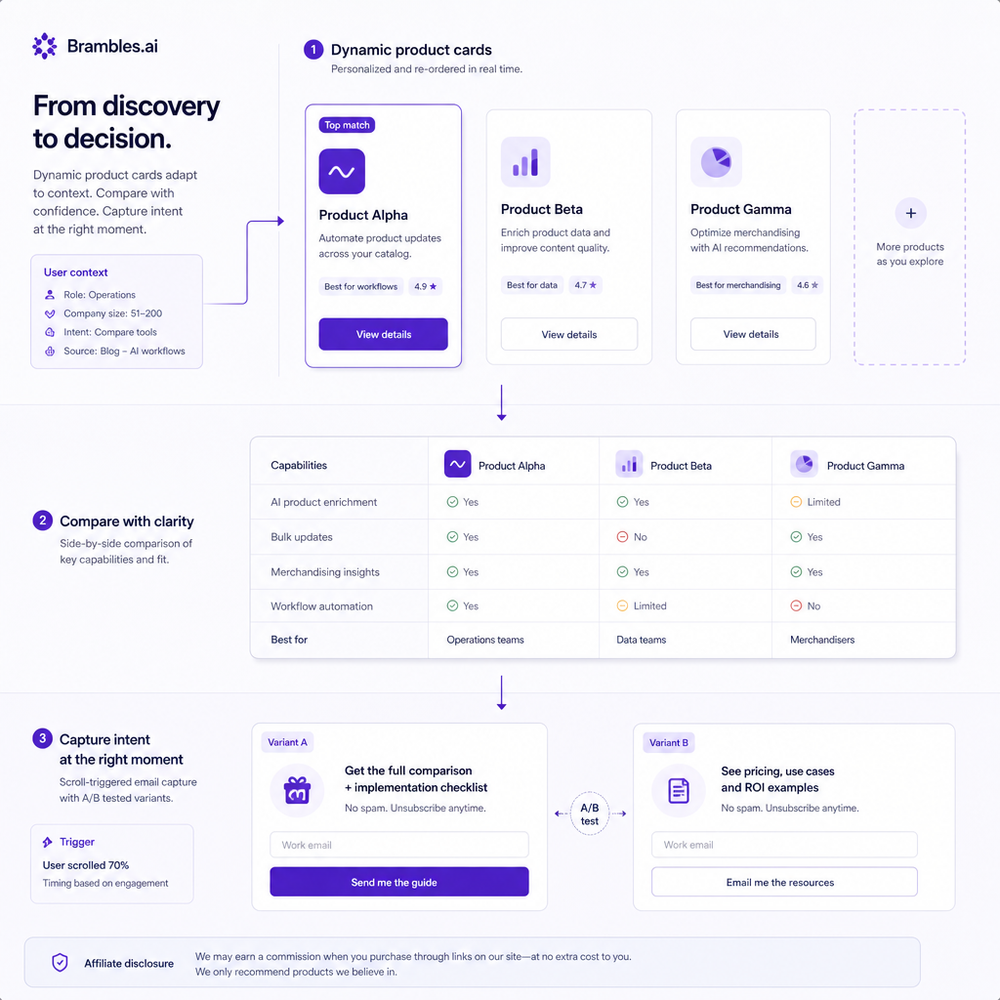
- Offer matching: A catalog (your own products, affiliates, or services) is normalized with attributes—brand, price, stock, commission, merchant rating. A similarity search pairs the post’s intent with the product discovery options.
- Placement logic: A rules engine chooses formats—inline shopping embed, comparison tables, sponsor disclosures, or email capture—based on reader signals (scroll depth, time on page, device), not just page template.
- Yield balancing: If ads are strong on a page (high viewability, decent CPM), the system scales affiliate units down; if ad CPMs are weak, it leans into higher-intent affiliate blocks.
- Feedback loop: Post-click revenue feeds the model so it prefers offers that convert on your audience, not just “industry bests.” McKinsey’s research on personalization links targeted experiences to 10–15% revenue lift; the same principle applies to contextual monetization.
Implementation Guide: From Zero to Revenue
Start with baselines. Export the last 60 days: sessions, RPM (ad + affiliate), earnings per session (EPS), affiliate CTR and conversion rate, email capture rate, LCP/CLS. Tag your top 50 posts with a simple intent label by hand; you’ll use this as truth data for your classifier.
1) Instrumentation: Add event tracking (clicks on affiliate cards, table rows, and email forms) with GA4. Capture post ID, category, and intent label in events.
2) Catalog: Build or import a product/offer catalog. Normalize fields: title, URL, network, commission, EAN/SKU, price, stock, merchant rating. Keep a daily job that retires out-of-stock items.
3) Model the intent: A lightweight text-classifier (even a fine-tuned small model) can assign intent per post. Confidence under a threshold? Default to informational placements.
4) Placement rules: Start with two to three slots: one inline card after paragraph 3, one comparison table near the bottom, and a soft email capture that triggers at 60% scroll for informational posts.
5) A/B testing: Test density, not just copy. On one site, reducing ad slots by 18% improved CLS and boosted affiliate conversions by 12% because the content became readable again.
6) Iterate weekly: Replace any product with under 0.4% click-to-sale conversion; raise bids (or switch networks) for high performers.
If you’re on WordPress, you can streamline setup with the following resources.
Measuring ROI & KPIs That Actually Matter
Monetization lives or dies on measurement. Track these weekly:
- EPS (earnings per session): total revenue ÷ sessions. This is the north star because it blends ads, affiliates, and subscriptions.
- Affiliate RPM and CTR: revenue per 1,000 sessions; CTR pinpoints offer and placement relevance.
- Conversion rate and AOV: tie revenue to specific product cards or tables to prevent credit leaks.
- Viewability and ad density: high viewability with restrained density wins. If viewability dips below ~60%, investigate layout and lazy-loading.
- Email capture rate: visitors who subscribe and return often monetize 2–3x better in six months.
- Core Web Vitals: LCP under 2.5s on mobile correlates with stronger engagement; Google UX Research consistently ties speed to conversion. The Google/Deloitte study found a 0.1s improvement associated with higher conversion rates.
Anecdote: A niche finance blog rewrote its lead magnet in three segment variants (beginner, advanced, credit repair) using AI-assisted copy. Sign-ups rose 58% and subscriber-driven revenue per session went up 26% over eight weeks.
First-Party Data, Trust, and Compliance
AI doesn’t replace trust; it depends on it. Build your stack around first-party data and clear disclosures.
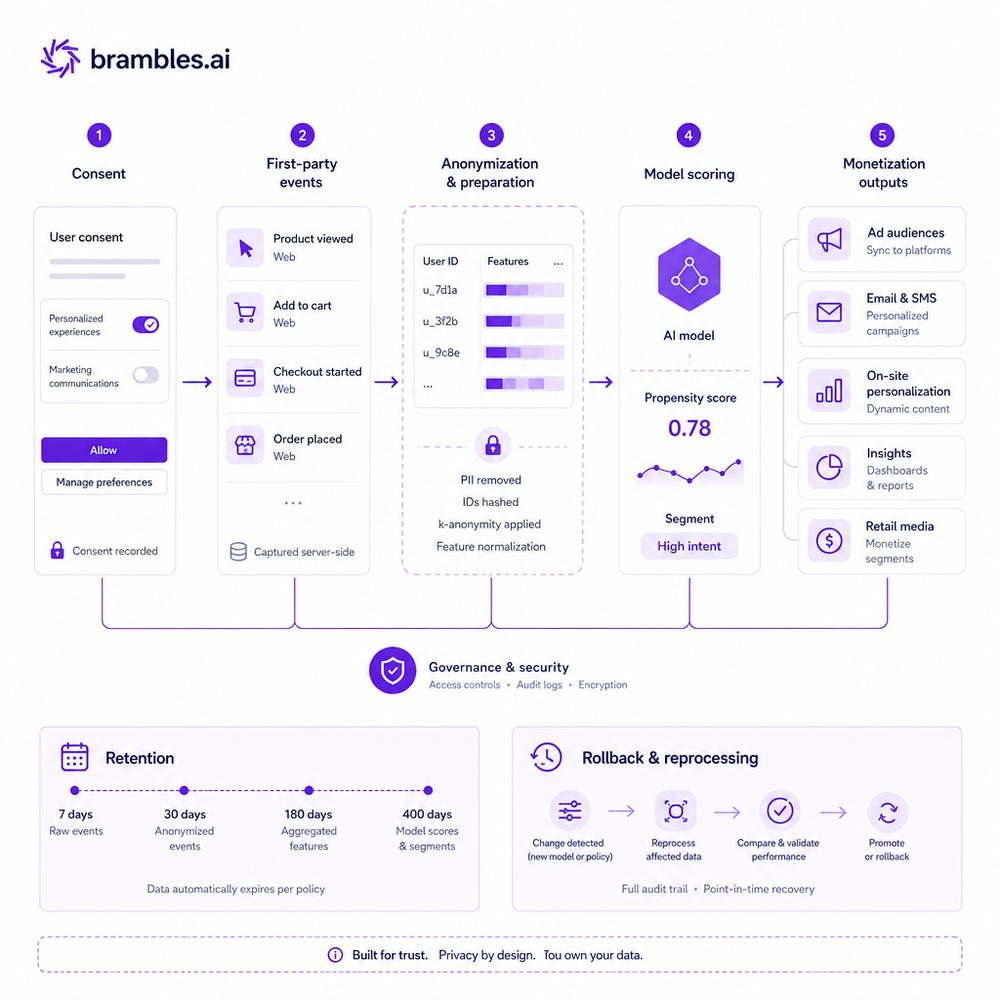
- Consent and CMP: Respect consent mode and store preferences server-side. Trigger only allowed tags and personalize with contextual (non-identifying) signals when consent is limited.
- Transparent affiliate disclosures: Put disclosures near the first monetized unit and again in the footer. This improves trust—and clicks.
- First-party behavior store: Keep a lightweight table keyed by hashed user ID or session to track onsite actions (scroll, clicks). Avoid stitching across domains unless you have explicit consent.
- Data minimization: Pass only what’s necessary into your models (post ID, on-page events, product attributes). You don’t need PII to be relevant.
- Security and governance: Version your offer catalog, log model decisions (which rule, which offer), and keep a rollback plan.
Baymard Institute’s research on form UX shows that each excess field hurts completion rates; for email capture, ask for just email at first. Salesforce’s Connected Customer reports emphasize that most users expect brands to understand needs without being creepy—contextual personalization hits that balance.
Common Pitfalls (and Fast Fixes)
- Over-automation: Blindly swapping in AI-written roundup blurbs tanks credibility and affiliate conversion. Keep human editorial control and require merchant/source citations in prompts.
- Latency creep: Stacking scripts from multiple affiliate networks ruins LCP. Server-render product cards and lazy-load images; prefetch affiliate redirects.
- Wrong incentives: Optimizing for clicks instead of EPS leads to tabloid placements that don’t convert. Tie tests to revenue, not vanity CTR.
- Stale catalogs: Out-of-stock items kill trust. Run nightly validation and auto-swap with close alternatives.
- Mobile neglect: If your comparison table isn’t tap-friendly with sticky headers on small screens, users won’t interact.
- Compliance gaps: Mark affiliate links rel="sponsored" and nofollow. Include clear sponsorship labels for paid placements.
One more anecdote: On a tech how-to blog, moving the first monetized unit below the first image improved time-to-first-meaningful-paragraph and raised EPS by 14% because readers weren’t bounced by clutter up top.
Future Outlook: Prepare for 2025’s Shifts
Search is changing, but the core monetization playbook holds: be the best answer and pair it with the right offer at the right moment. Generative results will compress some top-of-funnel traffic while deep, intent-rich content keeps compounding. Expect more zero-click SERPs—so design on-site journeys with embedded answers plus contextual monetization rather than relying on pageview volume alone. AI agents will increasingly follow links and parse structured data; keeping merchant offers normalized with schema and feeds will matter more. Memberships and micro-payments will get simpler; a paywall that appears only when an article’s intent is low-commercial but high-effort to produce can add durable revenue without hurting SEO. Keep investing in first-party models trained on your readers’ behavior, not generic web data. The blogs that win will feel tailored, fast, and honest—and their monetization will feel like service, not interruption.
Related posts
View all
Sponsored Products in AI Shopping: Retail Media 101
Learn how sponsored product placements power AI shopping, how bidding and relevance work, and how to implement retail media without eroding trust or UX.
Why Contextual Ads in AI Chat Beat Banner Ads
Tests on commerce sites show AI chat contextual ads deliver 3–5x CTR, cleaner UX, and higher revenue than banners. See how they work, implement, and measure.
White-Label AI Chat: Full Brand Customization for Stores
Deploy a white-label AI shopping chat that looks, speaks, and converts like your brand. See setup steps, KPIs, pitfalls, and how Brambles.ai handles it E2E.
Explore Brambles.ai
Learn more about our AI-powered agentic commerce platform, agentic shopping, and shopping assistance solutions.
Explore More Insights
Discover more articles on AI, automation, and business innovation
View All Articles