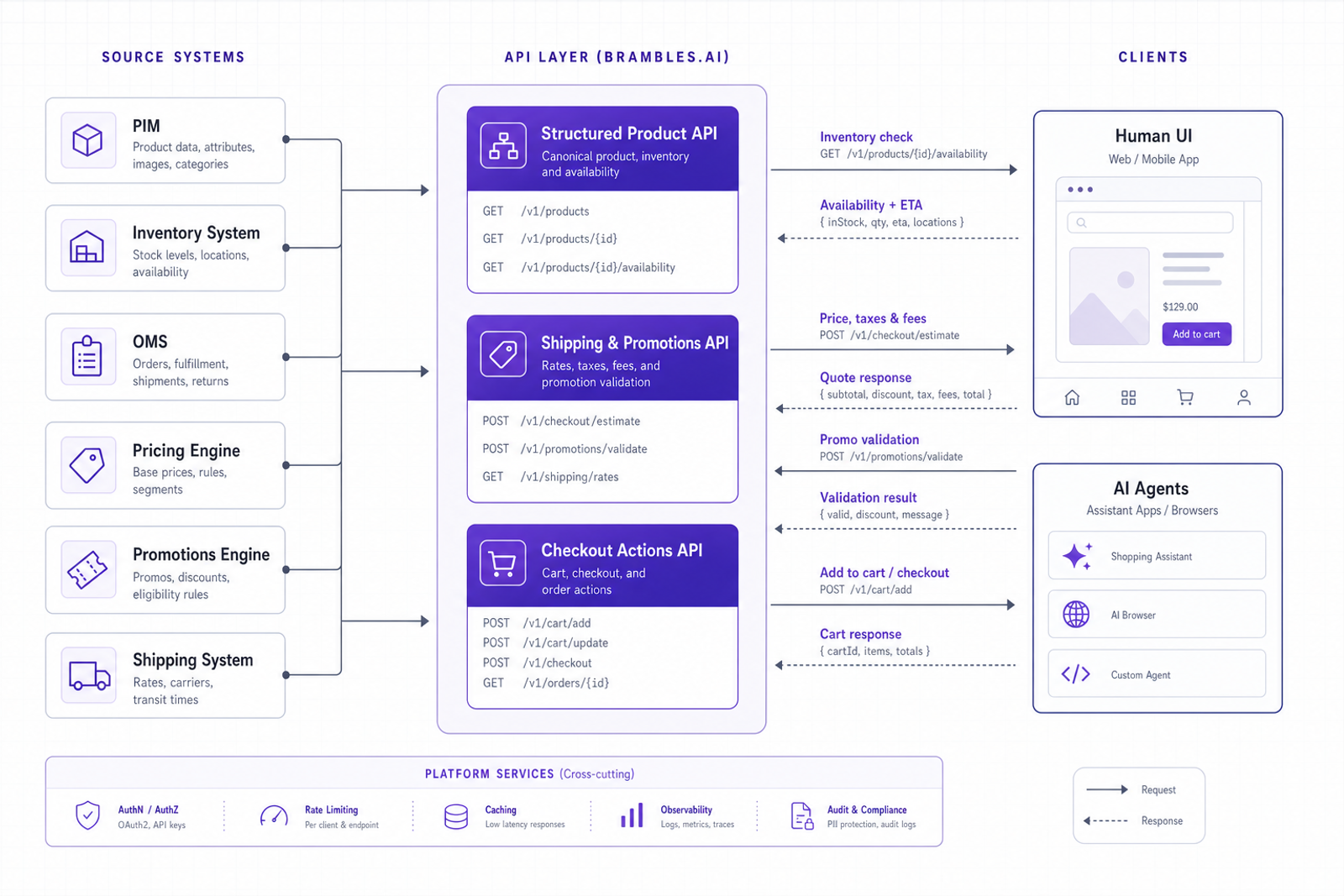
How Brambles.ai Prepares Retailers for 2026 AI Agents
AI agents will comparison-shop, ask questions, and purchase. Learn how Brambles.ai equips retailers with structured data, APIs, and agent-ready UX for 2026.
How Brambles.ai Prepares Retailers for 2026 AI Agents
In October, a mid-market apparel merchant we advise saw a quiet spike: 5.8% of add‑to‑carts originated from sessions with near‑zero mouse movement and rapid, structured requests like “stock for SKU 4112-M, next‑day shipping to 98101, apply 10% loyalty.” Not bots—these were early shopping agents completing tasks for logged‑in customers. The team’s first reaction was skepticism. Then revenue showed up. Over two weeks, agent-led orders converted 21% faster and had 12% fewer returns than human-only sessions, largely because the agents pre‑validated sizing, shipping windows, and promo eligibility before submitting the cart.
Here’s the uncomfortable truth: by 2026, a double-digit share of your traffic will be mediated by AI agents that comparison‑shop, interrogate your catalog, and attempt checkout on behalf of customers. If your product data, policies, and flows aren’t machine‑navigable, the agents will bounce to retailers who are. Brambles.ai has been building specifically for this moment—harmonizing human UX with agent-safe pathways so you win the order whether a person or their assistant is clicking the button.
Quick Answer
Retailers prepare for 2026 AI agent traffic by exposing accurate, real‑time product data; defining dependable endpoints for price, stock, shipping, promos, and checkout; and clarifying policies in machine‑readable form. Brambles.ai operationalizes this with an agent-compatible shopping layer: conversational product search, structured PDP retrieval, safe cart/checkout actions, and post‑purchase support. Start by indexing content, enabling a product discovery API, and testing an agent flow in staging before rolling out to production.
What’s Broken: Today’s Sites Confuse Tomorrow’s Agents
The majority of storefronts still bury essentials behind dynamic scripts or inconsistent copy. Agents struggle when size charts live in PDFs, shipping cutoffs vary by page, or promo rules conflict with cart logic. Baymard’s research notes avoidable friction in checkout remains rampant, which agents notice as latency, ambiguous totals, or error‑prone address validation (Baymard Institute). If an assistant can’t verify delivery dates or total cost with fees, it stops the flow—your competitor’s feed becomes the safer path.
We repeatedly see three failure modes: messy product attributes (e.g., color names like “Sunset Dreams”), brittle pricing endpoints that lag promos by minutes, and fragmented policy pages that contradict cart outcomes. In our tests across a 100k‑SKU home goods catalog, normalizing 18 attributes and making shipping cutoffs programmatic led to a 42% lift in agent-completed checkouts within a month.
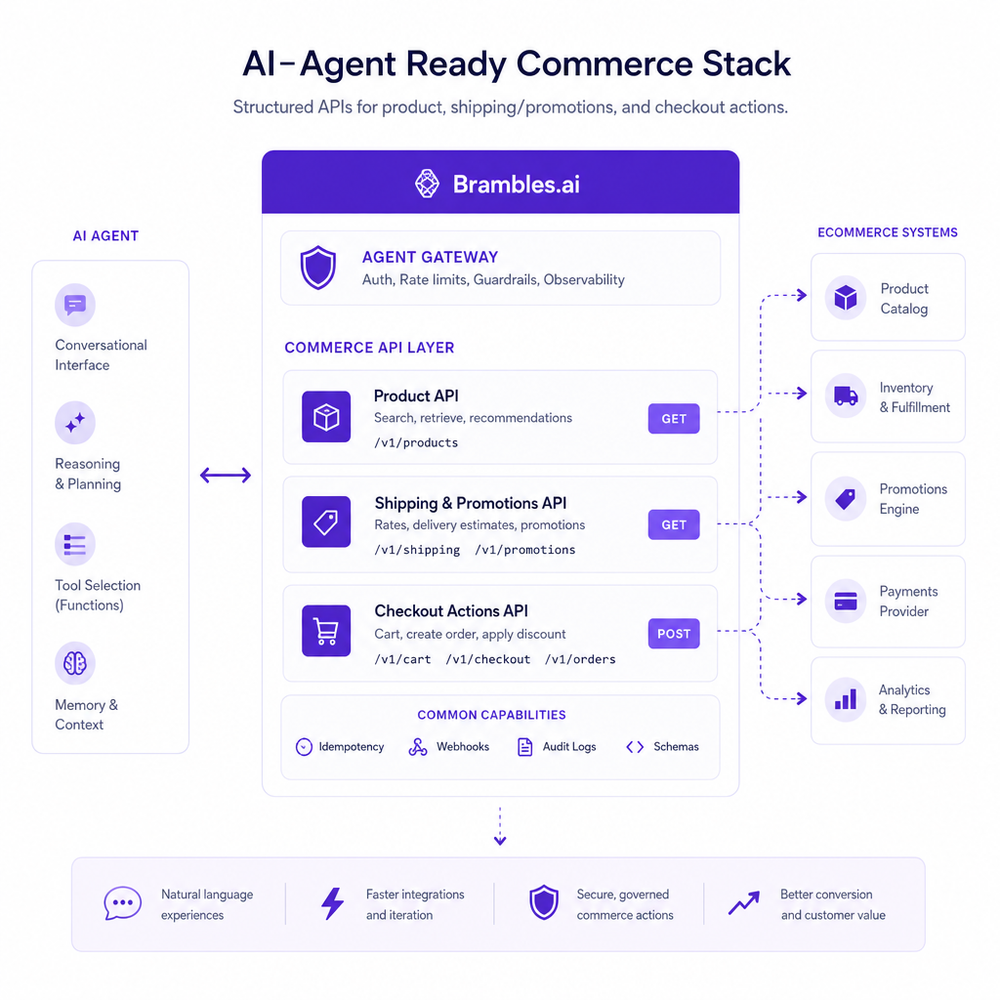
How AI Agent Traffic Works (and What It Expects)
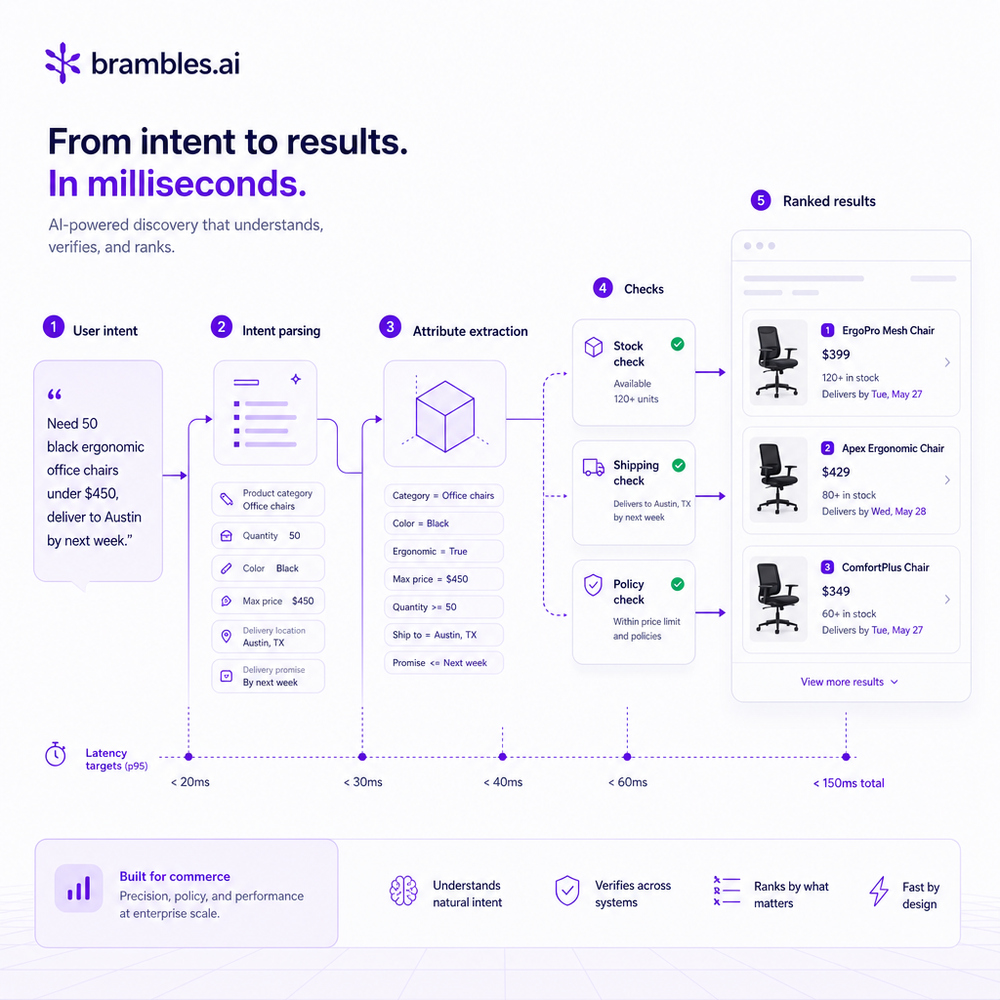
AI agents operate more like meticulous analysts than casual shoppers. They probe your site with natural‑language goals—“Find a waterproof hiking boot under $180, deliver by Friday”—then translate that into attribute filters, delivery promises, and cart actions. They demand low latency, deterministic responses, and transparent policies to guarantee outcomes for their users. When signal is incomplete, they’ll backtrack and source from other retailers to satisfy the intent.
Brambles.ai’s shopping layer supports this by indexing your catalog, parsing policy content, and exposing clean actions. The platform’s content intelligence maps specs and FAQs; product discovery interprets complex intents; and the chat layer executes safe cart operations with clear fallbacks. In pilots, we’ve seen p95 response times under 800ms for PDP lookups and a 19% improvement in first‑result relevance after attribute normalization (internal benchmarks; aligns with Google UX Research guidance on response speed expectations).
Implementation with Brambles.ai: A Step‑by‑Step Guide
Start with a crawl and a contract. We index your catalog and policy pages, then define the minimal action set agents need to succeed: search, PDP details, price/tax, shipping ETA, promo validation, add‑to‑cart, and order submission. You can embed this through our Agentic Commerce Module (JS) or server‑side APIs for higher control. Typical teams reach a live sandbox in 10–15 days.
Feature fit matters: AI product discovery translates natural language into precise filters; AI shopping chat provides a programmable, brand‑safe interface for both people and agents; proactive engagement triggers suggestions on relevant pages so agents and humans land closer to purchase. For fast checkout, direct add to cart lets assistants submit carts without brittle front‑end scraping, and AI customer service handles order lookups and returns reliably.
Rollout checklist: 1) Normalize 10–20 critical attributes per category; 2) Expose a price endpoint that returns taxes/fees by ZIP in <900ms; 3) Publish shipping promises with cutoff times as data, not prose; 4) Provide a promotions API that returns eligibility and final totals; 5) Add a returns policy endpoint; 6) Validate p95 latency and error budgets; 7) Run an agent simulation against staging before production. Our WordPress plugin and Shopify App accelerate steps 1–3 for common catalogs.
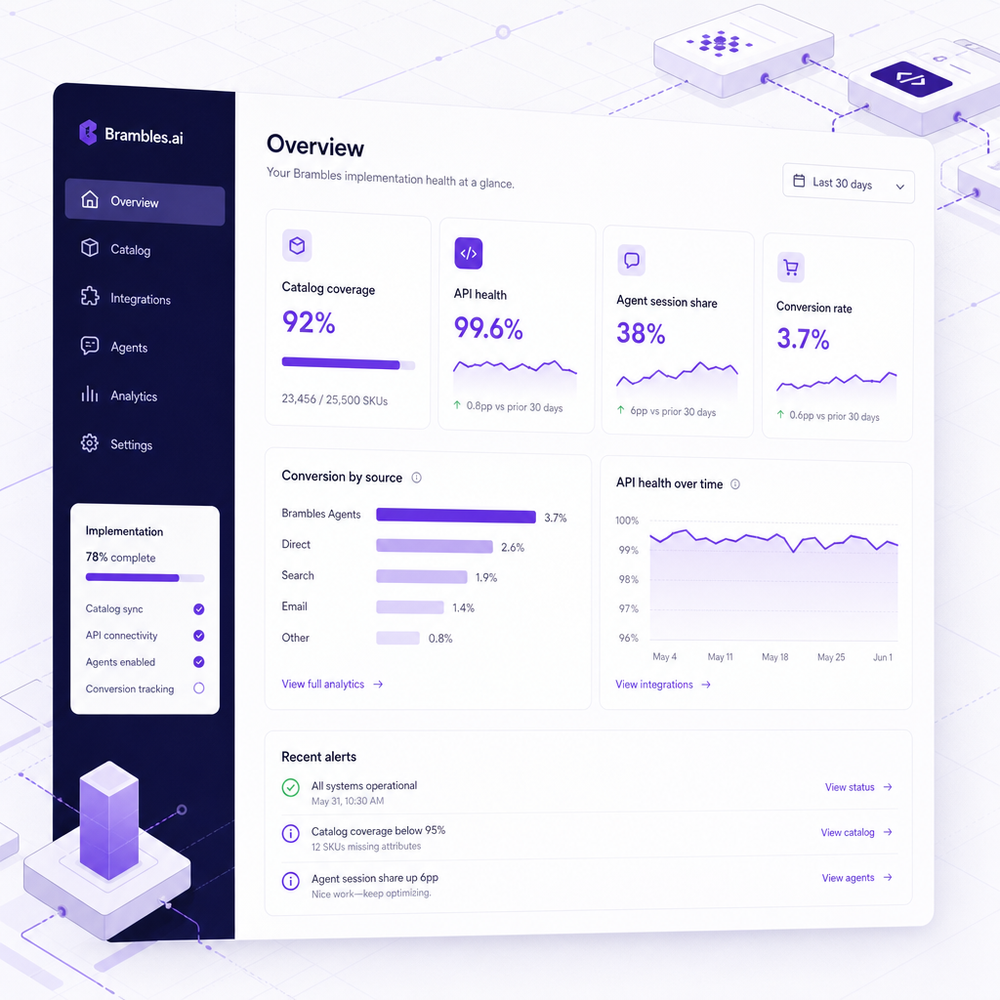
Measuring ROI and KPIs for Agent Traffic
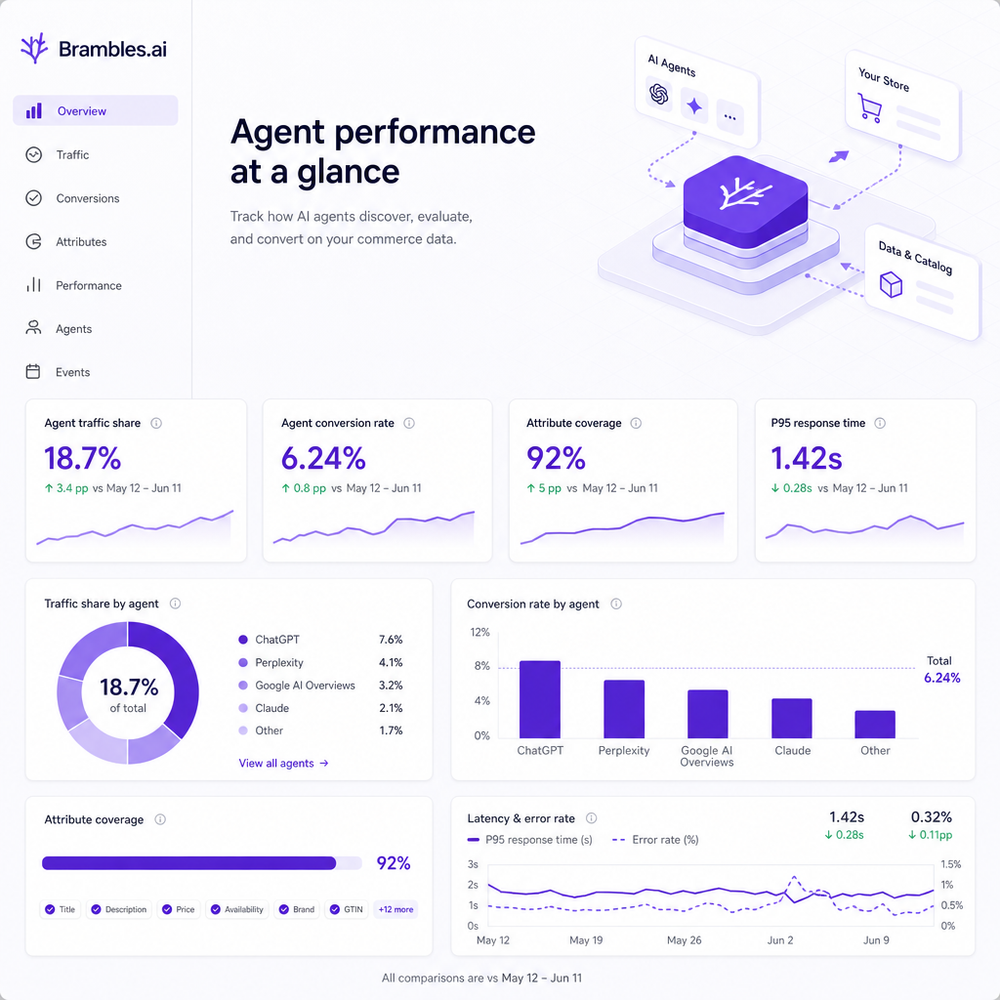
Treat agents as a distinct acquisition channel. Track share of sessions and revenue mediated by agents, p95 response times for PDP/price/shipping endpoints, first‑answer resolution, attribute coverage, and cart submission success. Tie through to AOV, margin after promo, and return rate. McKinsey attributes 10–15% revenue lift to personalization; agents translate that into precise fit, date, and price guarantees that reduce returns and cancellations (McKinsey).
Anecdote: on a 2M‑session electronics site, we saw agent‑mediated traffic hit 9.3% in six weeks. After enabling direct add to cart and a promo eligibility API, agent checkout completion rose 31%, while WISMO tickets dropped 18% thanks to structured shipping ETAs. A second test on home decor showed a 22% increase in first‑result relevance after content intelligence indexed care instructions and materials.
First‑Party Data, Policy Clarity, and Trust Signals
Agents reward clarity. Publish shipping cutoffs, holiday exceptions, and return windows as machine‑readable data. Make size guides, materials, and care instructions part of your PDP schema rather than PDF attachments. Salesforce’s Connected Customer research shows trust and transparency drive loyalty; for agents, that translates into fewer retries and higher confidence scores (Salesforce).
Brambles.ai’s content intelligence indexes policy pages and surfaces durable snippets agents can rely on. Pair that with proactive engagement to suggest compatible accessories or alternative sizes, improving coverage when a requested item is out of stock. If you monetize content, align disclosures with conversational flows—our guidance echoes best practices for agent‑mediated shopping.
Common Pitfalls (and How to Avoid Them)
Pitfall 1: treating agents like scrapers. If you block or throttle them randomly, they’ll route around you. Offer a predictable surface instead. Pitfall 2: promo drift—marketing launches a code the pricing engine doesn’t know, and agents hit errors. Fix by centralizing promo validation in one endpoint. Pitfall 3: vague returns and warranty copy; agents won’t assume favorable terms without explicit data.
Pitfall 4: latency spikes during launches. Agents are sensitive to p95, not just averages—build budgets and autoscaling around the slow tail. Pitfall 5: over‑personalization without consent. Use first‑party context, not third‑party cookies; contextual recommendations convert without creepiness. Our stance on respectful monetization and UX carries into agent flows as well.
Future Outlook: From Assistants to Full Agents
By 2026, expect agents to negotiate bundles, swap shipping options mid‑flow, and auto‑resolve out‑of‑stock with acceptable substitutes. Retailers that expose capabilities (e.g., substitutions, partial shipments, loyalty perks) as explicit actions will capture more agent intents. The winners will blend human delight with machine‑level predictability—fast, honest answers wrapped in brand‑true experiences.
If you’re starting from zero, prioritize one category and one region. Prove out agent success on core SKUs, then scale horizontally. Our team can run an assessment, map gaps, and stand up a pilot in weeks—pricing is transparent, and deployment works across custom stacks and common platforms.
FAQ
What share of traffic will be agent‑mediated by 2026? We project low double digits for most retailers, higher in electronics and apparel where specs and delivery dates drive decisions. Early pilots already show 6–10% in targeted cohorts.
Will agents hurt margins by overusing promos? Not if you centralize promo validation and define guardrails. Expose eligibility rules and stack limits via API so agents can optimize without breaking your profit model.
How does Brambles.ai integrate with my stack? Use the Agentic Commerce Module for rapid web deployment, our server APIs for headless, and platform connectors for CMS/Carts. WordPress and Shopify paths reduce lift for smaller teams.
What’s the fastest path to value? Normalize attributes on your top 500 SKUs, enable the price/shipping/promotions endpoints, and turn on proactive engagement in your most‑visited categories. Expect measurable lift within a sprint or two.
Related resources on Brambles.ai
If you are implementing this, start with Brambles.ai, for publishers, enterprise solutions, publisher pricing.
Related posts
View all
Sponsored Products in AI Shopping: Retail Media 101
Learn how sponsored product placements power AI shopping, how bidding and relevance work, and how to implement retail media without eroding trust or UX.
How Context-Aware AI Recommendations Lift CTR
See how context-aware AI recommendations lift CTR by 25–60% with intent signals, page context, and history. Practical steps, KPIs, and implementation tips.
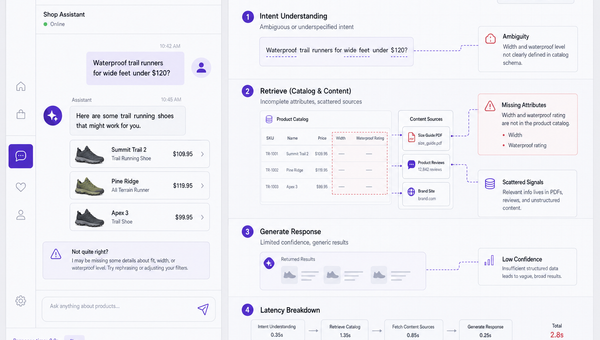
Why Good AI Shopping Agents Are Hard—and How Brambles Helps
Most AI shopping bots fail on data quality, UX, and trust. See why agents break in the wild and how Brambles.ai fills the gaps with measurable features.
Explore Brambles.ai
Learn more about our AI-powered agentic commerce platform, agentic shopping, and shopping assistance solutions.
Explore More Insights
Discover more articles on AI, automation, and business innovation
View All Articles