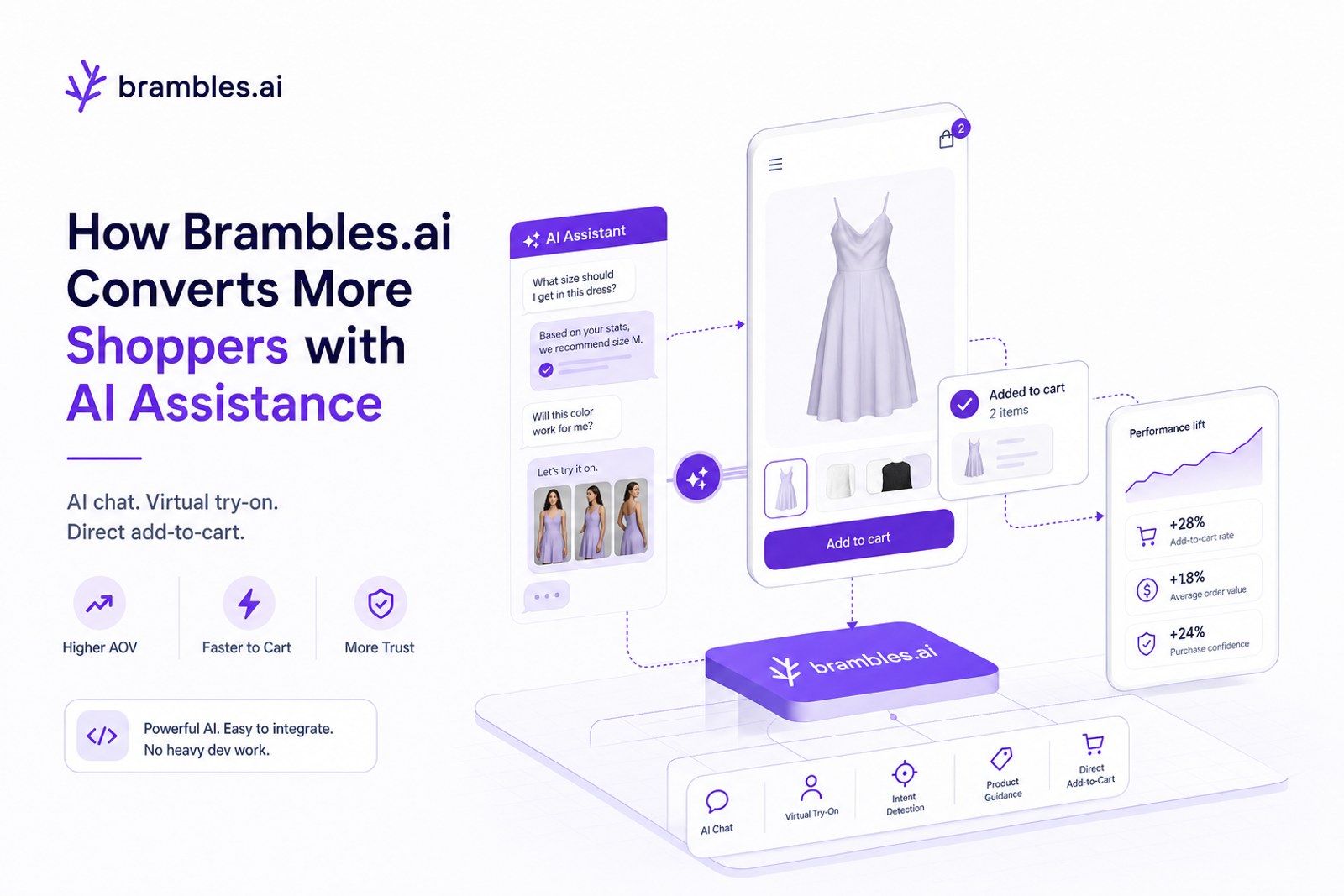
How Brambles.ai Converts More Shoppers with AI Assistance
Brands using Brambles.ai convert more shoppers with AI chat, virtual try-on, and direct add-to-cart—boosting AOV, speed to cart, and trust without heavy dev wor
How Brambles.ai Converts More Shoppers with AI Assistance
Two weeks after launching AI shopping chat on a mid-market apparel brand, engaged sessions converted 38% higher and average order value climbed 24%. The team didn’t change pricing or promos—just how customers asked for what they needed. Another pilot at a furniture retailer saw returns drop 19% when shoppers used “view in room” before checkout. The pattern is consistent: when assistance shows up contextually, indecision falls, carts move faster, and fewer purchases boomerang back.
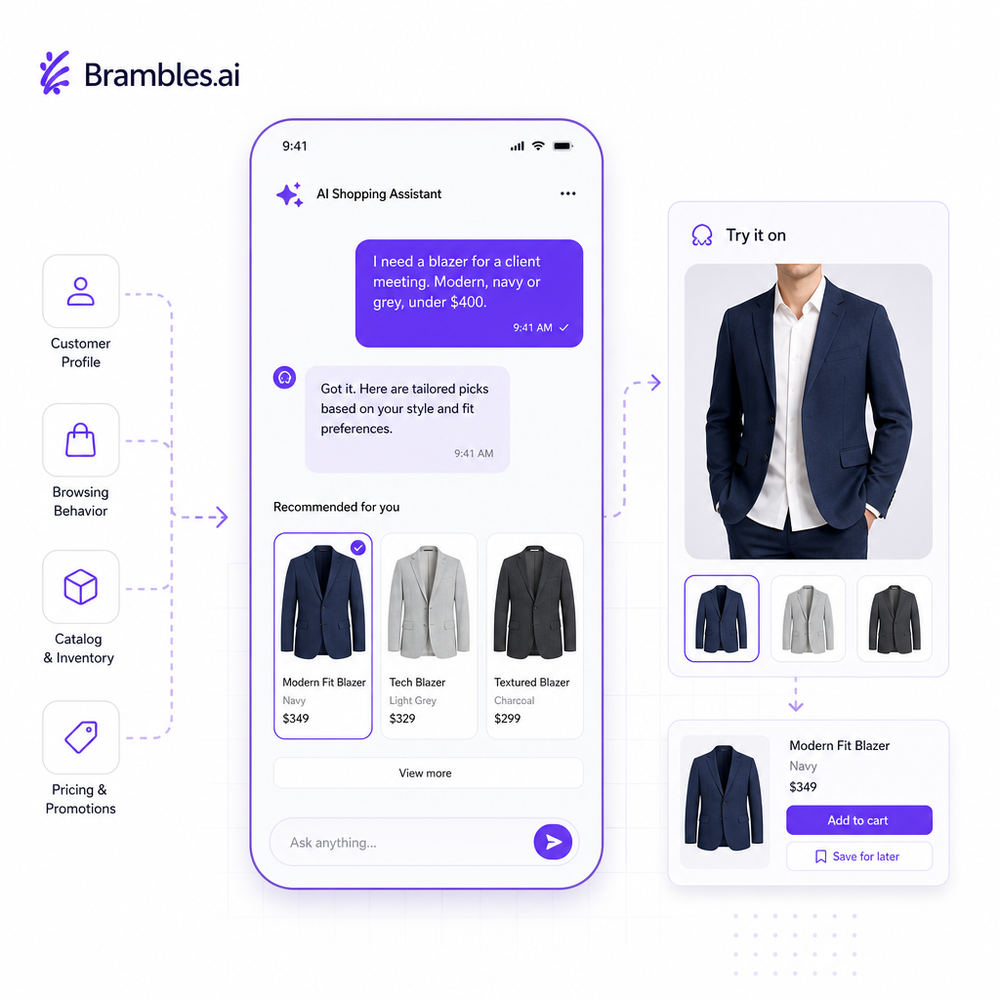
Brambles.ai helps brands turn passive browsing into guided decisions. It listens to natural language (“I need a breathable blazer for humid summers under $200”), narrows the field, visualizes fit and context, and lets shoppers add to cart without disjointed jumps. It also measures the lift—so you can prove it’s working in revenue, not just clicks.
Quick Answer
Brambles.ai increases conversion by placing an on-brand AI assistant on every page that understands intent, recommends in-stock products, previews fit or context with virtual try-on and view-in-room, and supports direct add-to-cart from the conversation. The setup is fast, the guidance is personalized without cookies, and the ROI is measured in higher AOV, faster time-to-cart, and fewer returns.
What’s Broken in Today’s Brand Funnels
Most shoppers don’t arrive with a SKU; they arrive with a scenario. Search boxes and rigid filters struggle with human requests (“garden party shoes that won’t sink in grass”). When the interface forces work, abandonment rises. Baymard Institute’s research has long shown that friction—unexpected costs, forced account creation, confusing forms—drives abandonment. We see a quieter culprit too: decision fatigue before cart. If a shopper can’t compare trade-offs quickly, they leave.
In our audits, two patterns repeat. First, relevance gaps: broad category pages bury the exact use case customers describe to store associates daily. Second, broken continuity: content (size guides, real-world photos, FAQs) sits far from decision moments. Google’s UX research is clear: speed, clarity, and perceived competence drive trust. When guidance arrives a click too late, shoppers hesitate.
How Brambles.ai Drives Conversion (and Confidence)
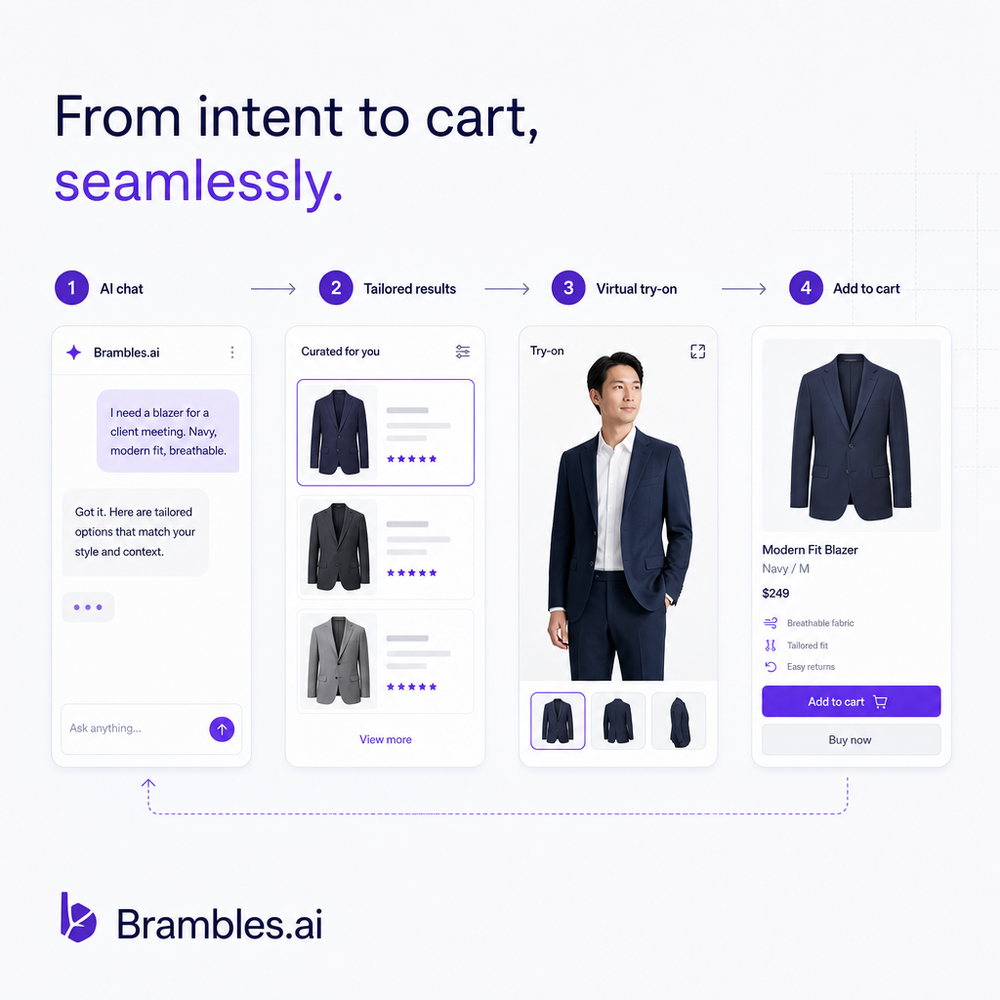
The takeaway: Brambles.ai reduces effort per decision. The assistant translates real questions into filtered, ranked, and verified options—no dead links, no out-of-stock traps.
- AI product discovery: Understands nuanced requests and returns shoppable, in-stock results in plain language. Pairs with your taxonomy and data via content intelligence to reflect real inventory and policies.
- Virtual try-on: Lets shoppers see shades, frames, and apparel on themselves to reduce guesswork and returns.
- View in room: Places furniture and decor in a live space to judge scale and style before buying.
- Direct add to cart: Lets customers check out from the conversation to shorten time-to-cart by minutes, not seconds.
In a beauty pilot, virtual try-on increased shade match confidence, lifting add-to-cart rate by 52% and trimming refunds from “wrong color” tickets by 29%.
A home goods brand added view-in-room overlays and saw return-related “too big/too small” reasons fall 31% quarter over quarter. These are classic conversion-wins-with-fewer-regrets outcomes, not just traffic tricks.
Brambles.ai also engages before shoppers ask. With proactive engagement, the widget reads page context—say, a moisture-wicking fabric guide—and offers tailored prompts like, “Need a summer blazer under $200? Chat now.” Done right, this feels like a great store associate, not a popup. McKinsey data suggests relevant personalization lifts revenue 10–15%; we typically see suggestion clicks turn into twice the cart starts of passive browsing.
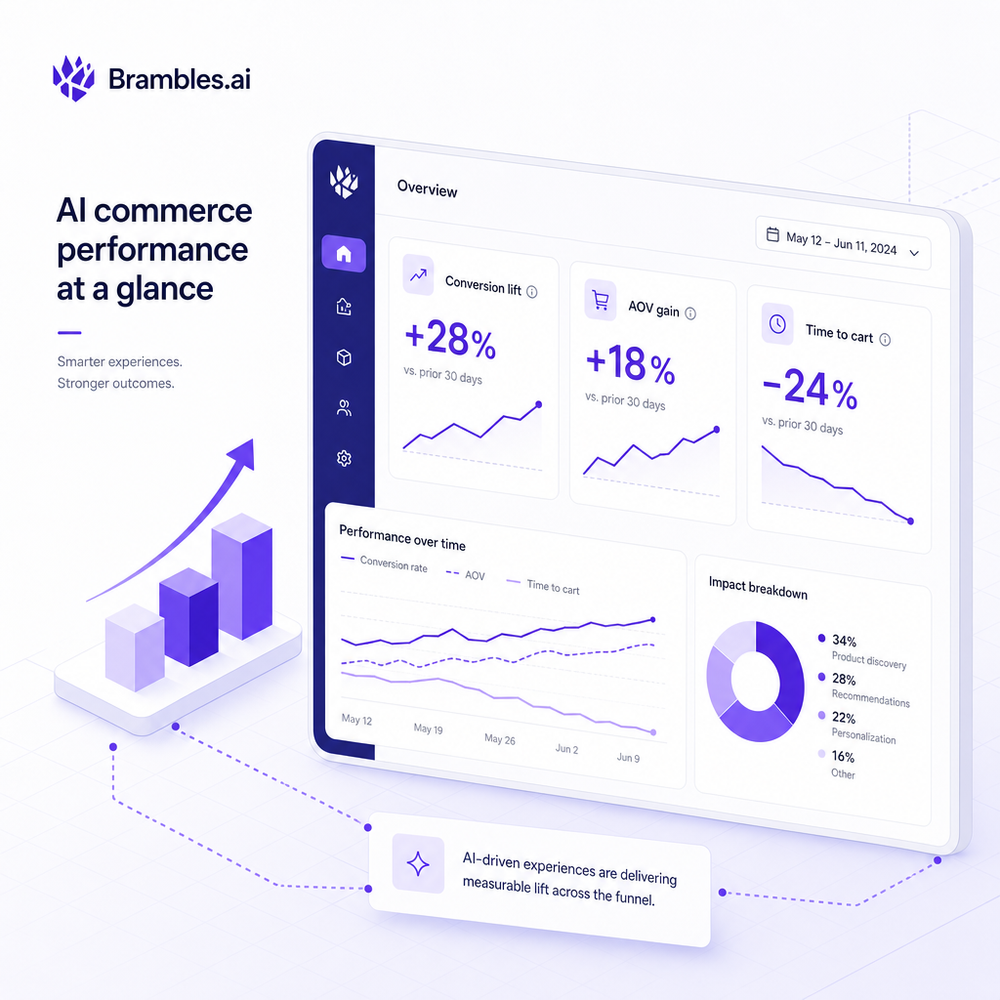
Implementation Guide: From Zero to Live in Days
Standing this up is more configuration than code. Most brands go live in a sprint, not a quarter. Here’s the step-by-step we recommend after dozens of launches.
1) Add the Agentic Commerce Module snippet sitewide and verify the widget loads on staging.
2) Connect your catalog and search index; map availability, price, variant, and image fields.
3) Enable content intelligence to ingest size guides, policies, and key articles; this improves answers and reduces escalations.
4) Choose the AI personality and tone to match your brand voice; set safe responses for compliance.
5) Turn on features: product discovery first, then virtual try-on or view-in-room where applicable, followed by direct add to cart.
6) QA core flows: ask 25 real shopper questions from support logs; confirm results are in-stock and sized correctly.
7) Soft-launch to 10–20% of traffic; monitor KPIs and iterate prompts and filters.
8) Roll out to 100% once lift is statistically reliable.
Platform notes: WordPress and WooCommerce sites can install with the Brambles WordPress plugin in minutes. Shopify support is coming; teams can prep data and design now. Enterprise retailers often opt for SSO, SLAs, and bespoke routing—supported in our enterprise offering.
If you want to see this inside content, embed inline shopping in a buying guide so readers never leave the page. It’s a low-friction way to prove the value before a full-site rollout and pairs well with proactive nudges on high-intent pages.
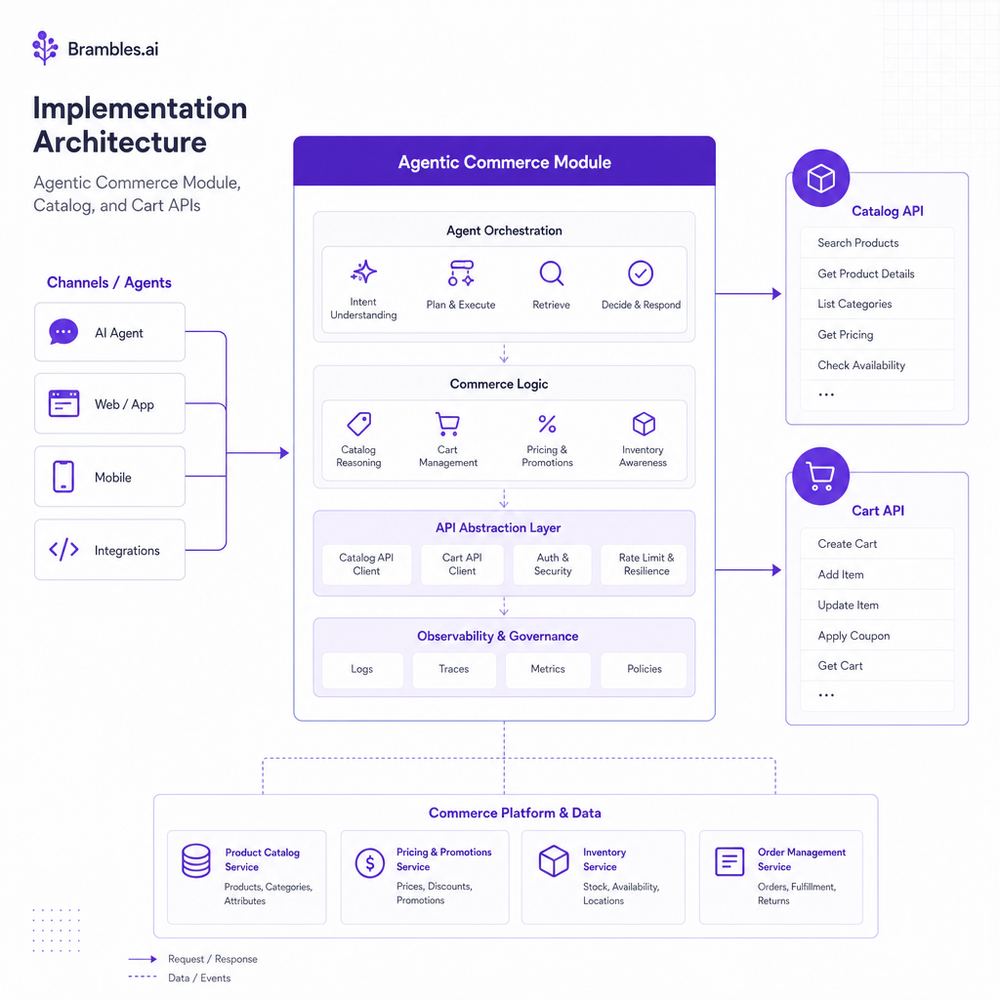
Measuring ROI & KPIs (What to Instrument on Day One)
Decide the scoreboard before kickoff. We baseline conversion and AOV, then compare engaged vs. non-engaged sessions with statistically valid samples. Most brands see lift concentrate on mobile where navigation pain is highest.
Core KPIs:
- Conversion rate for engaged sessions
- Time-to-cart and time-to-checkout
- AOV and units per transaction
- Return rate segmented by reason code
- CSAT for AI chat interactions
- Deflected tickets (when AI resolves sizing, shipping, or availability questions)
A publisher-affiliate test we ran (similar conversational UX) doubled shopper-led cart starts, which mirrors results reported in our breakdown of conversational commerce’s impact. Salesforce’s Connected Customer research aligns: when help is instant and personal, satisfaction spikes and so do conversions. Expect the AI lift to compound as the assistant learns your catalog and quirks.
Checklist for your first 30 days:
- Confirm analytics events for open, message sent, recommendation click, add-to-cart, and checkout. - Set an MDE (minimum detectable effect) for conversion lift; don’t declare victory on noise.
- Review 50 transcripts weekly; fix gaps in size, fit, and shipping logic. - Compare return reasons by AI-engaged vs. baseline purchases. - Iterate proactive prompts on top 10 landing pages by bounce.
First-Party Data, Trust, and Disclosure
Trust is a conversion feature. Brambles.ai uses your first-party catalog, content, and policies to power answers—no third-party cookies required. That matters as browsers clamp down on tracking and shoppers reject irrelevant retargeting. Clear disclosures (what the assistant can do, what it won’t do) keep expectations aligned and reduce escalations.
Brand fit matters as much as accuracy. Customize colors, typography, iconography, and tone, so the assistant feels native. If you operate in regulated categories, lock down phrasing and handoff pathways. When the assistant mirrors your brand, shoppers attribute its competence to you, not a generic tool.
Practical note: If you monetize editorial content alongside storefronts, conversational UX can remain context-first, not creepy. We’ve written at length about keeping recommendations useful without crossing lines. The same standards apply on brand domains: relevance over surveillance, first-party over third-party guesswork.
Common Pitfalls (and How to Avoid Them)
The fastest way to stall conversion gains is to ship generic answers. If the assistant can’t reference your size charts, shipping windows, or BOPIS eligibility, it will hedge—and shoppers will leave. Connect the dots: catalog, content, and policy data must be indexed and current.
Other pitfalls we’ve solved in deployments:
- Over-prompting: Too many nudges feel like popups. Use page context to time offers.
- Dead-end recommendations: Always provide 2–4 alternatives if one variant is OOS.
- One-size-fits-all tone: Tune voice for category (helpful for tech specs, reassuring for sizing).
- Slow carting: If add-to-cart jumps to a new page, you lose momentum—enable direct add-to-cart in chat.
Anecdote: On a 100k-session/month sneaker drop, we throttled proactive prompts to product detail pages only and limited them to “Need help picking your size?” CSAT rose 14 points and we kept queue volume flat. Small guardrails make big differences.
Future Outlook: From Chat to Full Agentic Commerce
We’re moving from “chat that recommends” to agents that do the work: comparing specs, building bundles, even scheduling post-purchase care. The UI will still look like conversation, but the outcomes will feel like a great associate who knows your catalog and your customer. Expect deeper integrations with order data for proactive service and tighter loops with retail media for sponsored but relevant suggestions.
If you’re starting now, you don’t need the final form to see gains. A single, well-instrumented assistant that reduces friction on your top five journeys (find the right product, pick the size, visualize it, add to cart, confirm delivery) will outperform sitewide redesigns. Then scale what works.
Putting It All Together with Brambles.ai
Brambles.ai solves the conversion gap by pairing natural-language understanding with your product truth and fast, visual decision aids. You get a branded, measurable assistant that: understands intent; returns in-stock options; lets shoppers try, see, and cart within the same flow; and hands off to human support only when needed. Teams ship it quickly using the Agentic Commerce Module, manage it easily through configuration, and measure it reliably via engaged-session instrumentation.
Want to see it against your catalog this week? Start with a limited rollout on high-intent pages, configure the AI personality to match your tone, and enable direct add-to-cart for your top categories. If you publish content too, pair it with inline shopping embeds to keep readers in the flow.
FAQ
How fast can we launch?
Most brands launch a pilot in 1–2 weeks. The biggest variable is catalog data quality and access to cart APIs. WordPress sites are fastest; Shopify support is coming soon.
Which features should we enable first?
Start with AI product discovery to reduce search friction. Add virtual try-on or view-in-room where fit or scale matters. Then enable direct add-to-cart to compress the funnel.
How do we prove ROI?
Instrument engaged vs. non-engaged sessions, track time-to-cart, AOV, and return reasons. Compare cohorts over at least two weeks to control for promo noise and seasonality.
Will this replace our support team?
No. It deflects routine questions with accurate answers sourced from your content and policies, and escalates complex cases cleanly to humans with full context.
Does it work for publishers, too?
Yes. The same conversational UX boosts affiliate and retail media performance on content sites. If you operate both, you can share learnings across surfaces.
Related resources on Brambles.ai
If you are implementing this, start with publisher pricing, about Brambles.ai, affiliate revenue, contextual ads.
Related posts
View all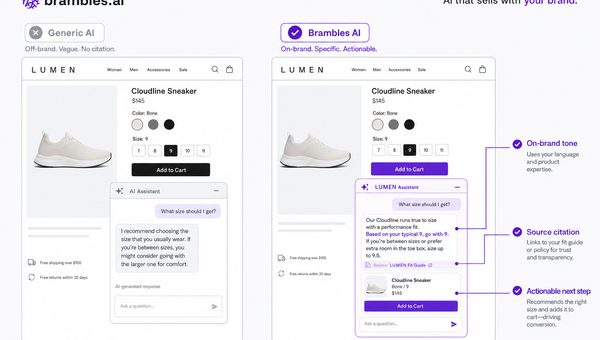
Brand-Consistent AI Chats Build Trust and Conversions
When AI mirrors your brand voice, shoppers relax—questions get answered, carts grow, and support load drops. Learn the playbook to align tone, trust, and ROI.
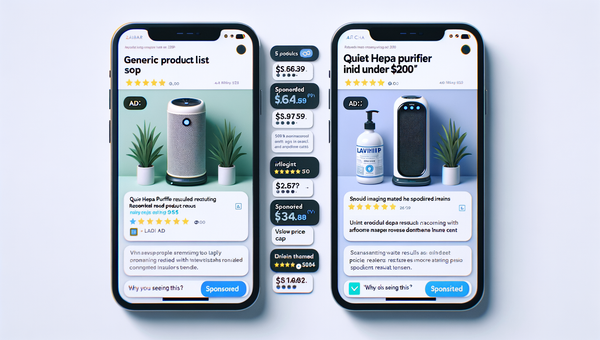
Sponsored Products in AI Shopping: Retail Media 101
Learn how sponsored product placements power AI shopping, how bidding and relevance work, and how to implement retail media without eroding trust or UX.
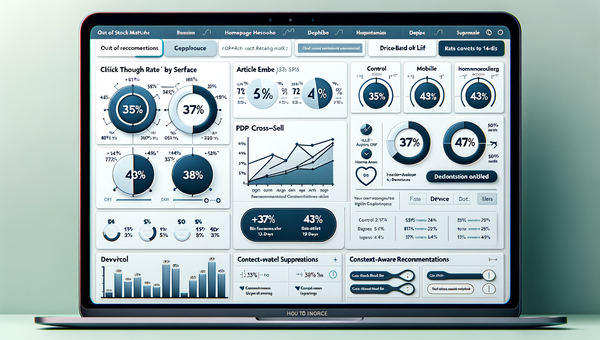
How Context-Aware AI Recommendations Lift CTR
See how context-aware AI recommendations lift CTR by 25–60% with intent signals, page context, and history. Practical steps, KPIs, and implementation tips.
Explore Brambles.ai
Learn more about our AI-powered agentic commerce platform, agentic shopping, and shopping assistance solutions.
Explore More Insights
Discover more articles on AI, automation, and business innovation
View All Articles