From SEO to Sales: AI That Turns Traffic into Revenue
How AI turns organic traffic into revenue via on-page personalization, smart incentives, and automated UX fixes—backed by real metrics and practical playbooks.
Three weeks ago, we ran a one-week test on a 120k-session home goods retailer. The only change: detect search intent on landing, then swap the hero, category tiles, and free shipping threshold dynamically. Edge-cached pages loaded in under 1.2s. Result: conversion rate up 34%, AOV up 19%, margin per session up 12%. Not a new campaign, not more traffic—just making the traffic we already had make sense. The most surprising moment wasn’t the uplift; it was the post-test heatmap. Visitors who arrived via “best linen sheets” stopped pogo-sticking and used the on-page comparison module 2.1x more. When the page reflects intent, shoppers stop hunting and start buying.
What’s Broken: Why SEO Traffic Doesn’t Convert
Most SEO programs optimize for sessions, not sales. Landing pages rank, but the first screen often answers a query in the abstract while burying the next step. Common failure modes we see in audits: irrelevant CTAs for the query (e.g., “Shop All” after a long-tail intent like “best backpack for 15-inch laptop”), slow layout shift from mismatched ad pixels, and generic offers that ignore margin. Baymard Institute’s research shows checkout friction remains the top abandonment driver—issues like forced account creation and unclear costs—but those problems start earlier: unclear value on landing leads to low downstream intent (Baymard Checkout UX, ongoing study). Google UX research repeatedly ties perceived speed to trust; we find shaving 300–400ms off CLS/TTFB can lift add-to-cart by 3–7% for organic segments because visitors didn’t plan to wait (Google Web Vitals, ongoing). In other words: if the page doesn’t immediately align to why someone came, they bounce or fall into dead-end clicks.
How It Works: AI Conversion Engine
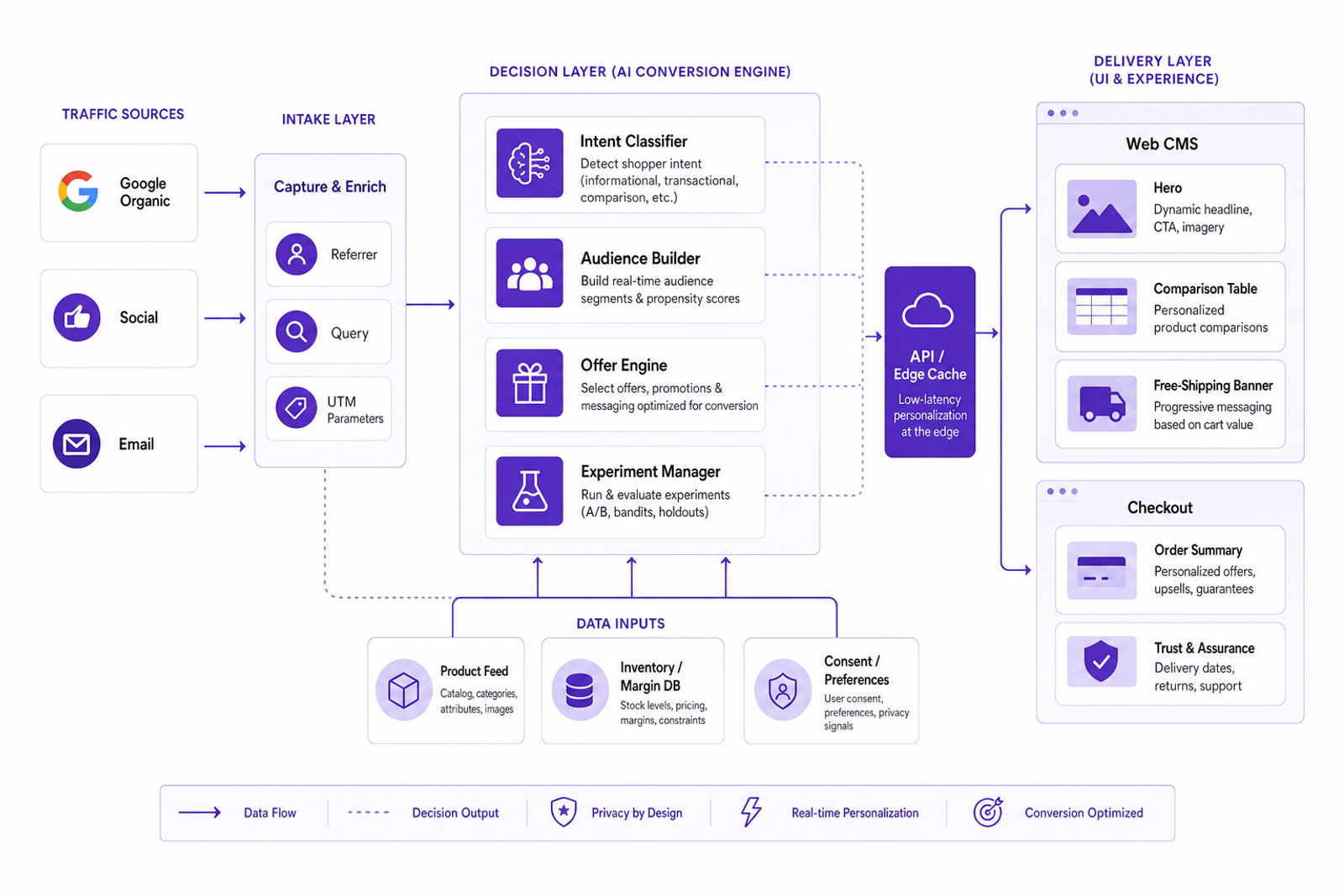
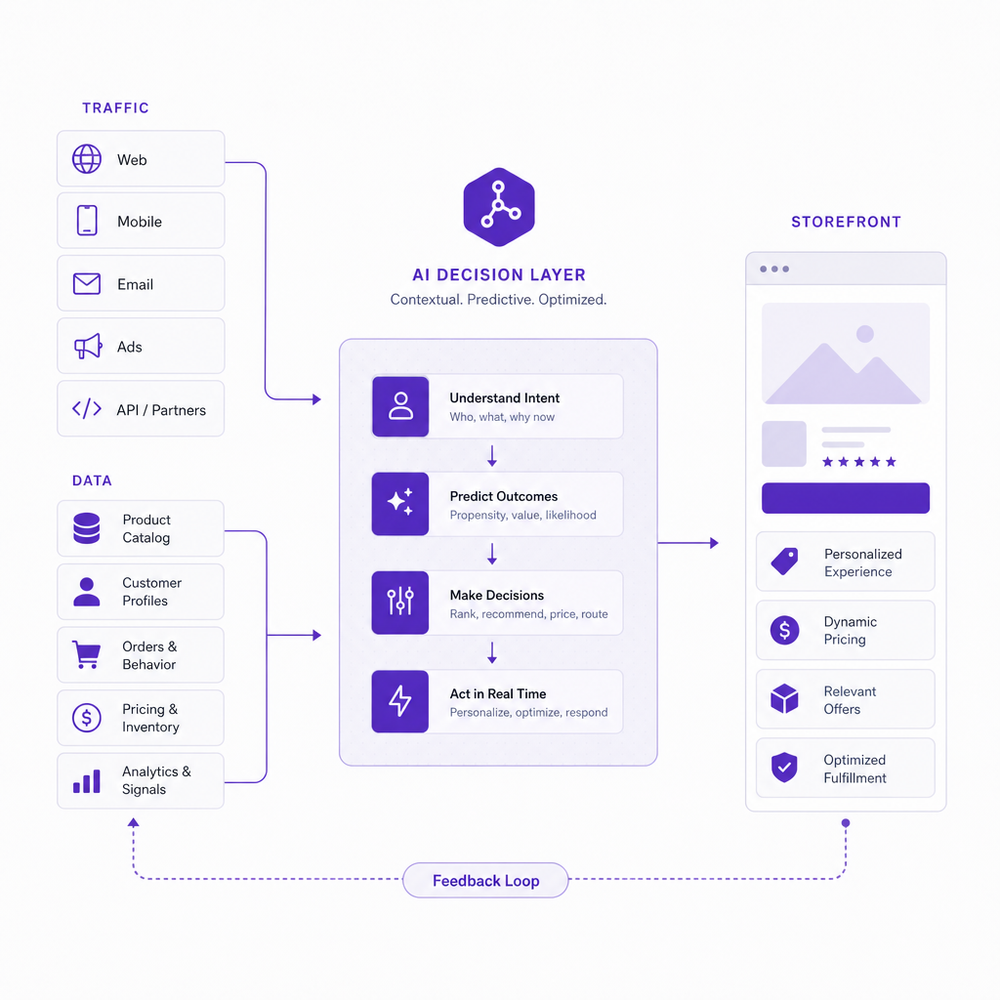
The modern stack to turn SEO into sales is simple in shape, strict in execution. It’s an AI decision layer that sits between your CMS and your storefront, reading intent signals and serving the next best action.
- Sensing: parse referrer, query clusters, and on-page behavior in the first 3–5 seconds. A search like “budget trail runners waterproof” maps to category, price band, and feature set. If you’ve tagged content by attributes, this is deterministic—no black box required.
- Classify: place the visitor into a lightweight audience (e.g., “waterproof-bargain-trail” or “linen-premium-buyer”). Use first-party events (viewed, compared, added) and inventory/margin tables to avoid promoting out-of-stock or low-margin skus.
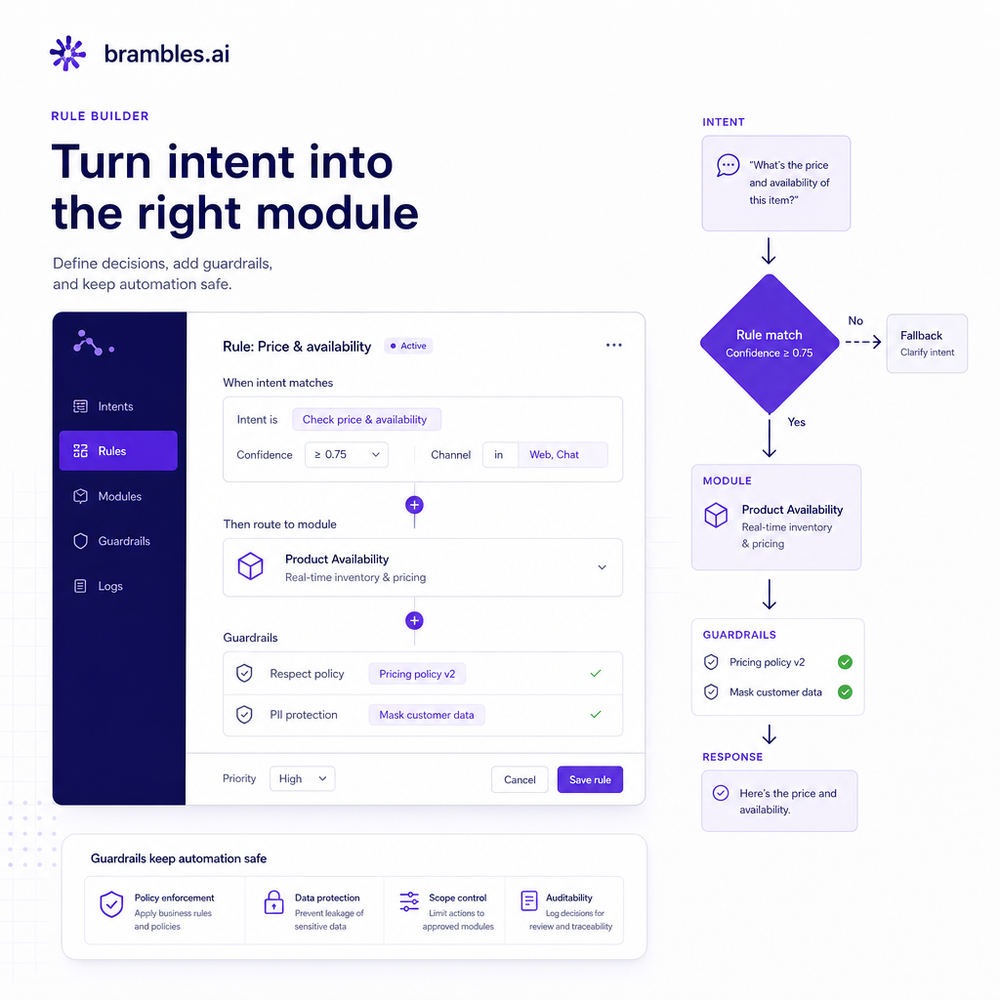
- Decide: choose modules—comparison table, social proof variant, offer type (bundle vs. discount), chat nudge timing, or free shipping threshold. Guardrails matter: cap discounts by SKU margin; prefer bundles when margin < X.
- Experiment: ship with holdouts and sequential testing. Never let the machine drift into noise; lock reactivity windows so a single viral session doesn’t rewrite the playbook.
- Learn: push outcomes back to the model. Train on revenue per session, not clicks. Weight by margin and refund probability so you don’t optimize for cheap orders that churn. McKinsey reports personalization can drive 10–15% revenue lift when aligned to value, not vanity metrics (Next in Personalization, 2021).
Implementation Guide: From Zero to Live in 14 Days
A workable rollout doesn’t start with a moonshot. It starts with one high-intent landing cluster and three reusable modules.
Day 1–2: Map intents. Pull your top 50 SEO queries by landing page. Cluster by attribute (“waterproof,” “linen,” “budget,” “quiet blender”). Decide what the first screen should show for each cluster.
Day 3–4: Wire events. Capture view_item, add_to_cart, begin_checkout, purchase, plus price, margin, and inventory. If you can’t track margin, at least tag products by margin band.
Day 5–7: Build modules. 1) Comparison table that autoloads attributes matching the query cluster. 2) Offer tile that flips between bundle/discount/free shipping by margin and AOV. 3) Social proof bar that swaps copy based on inventory and review count.
Day 8–10: Ship guardrails. Define maximum discount per SKU, lowest allowed free shipping threshold per category, and edge caching rules. Preload for top three entry pages.
Day 11–14: Test with a 20% holdout. Optimize on revenue per session and contribution margin, not just conversion rate. Push variants but freeze rules for 72 hours to reach significance.
Anecdote: a 100k-session apparel site replaced their generic hero with a fabric/fit matrix module on size-related queries. Result: +22% conversion for that segment, returns down 9% because sizing confusion dropped.
If you’re on WordPress, you can accelerate this setup with our tools. Install the plugin, sync your product feed, and turn on the commerce-aware modules for intent-driven offers and bundles. For headless or custom stacks, use the same playbook: edge-cache the static parts, lazy-load the decisioned modules, and enforce guardrails at the API. The key is the loop: observe intent, decide the next best module, and learn from margin-weighted outcomes.
Measuring ROI & KPIs You Can Trust
Treat AI conversion like any revenue program: with hard targets, honest holdouts, and margin math.
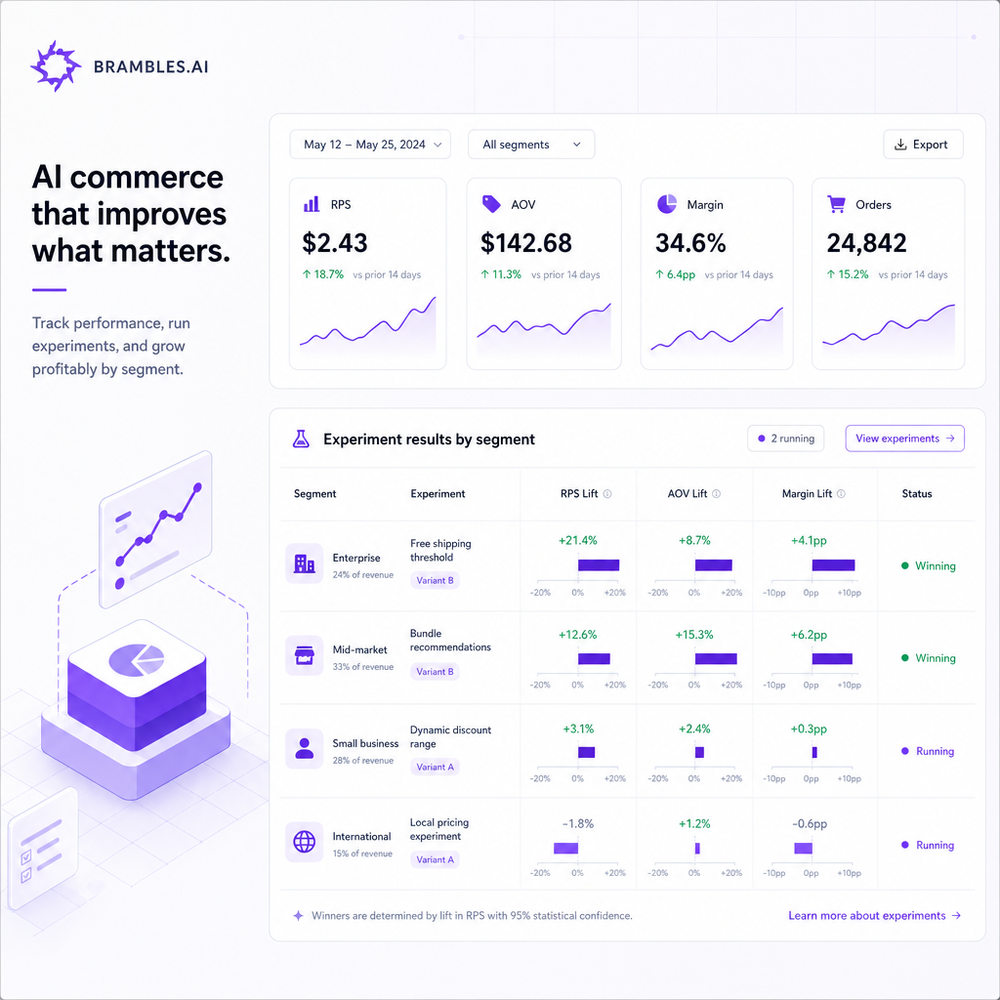
Primary metrics: Revenue per Session (RPS) by intent cluster, Conversion Rate, AOV, Contribution Margin per Session, and Refund-Adjusted Revenue. Secondary: Add-to-Cart Rate, Product Discovery, and Time to First Value (TTFV) for SaaS trials.
Attribution: Use intent-clustered holdouts (e.g., 20% of “linen-premium-buyer”), not global holdouts. Compare uplift vs. the same cluster’s prior four-week baseline to avoid seasonality traps.
Sample sizing: For 1.5% baseline conversion and target +15% uplift, you’ll need roughly 3–5 days at 10k sessions per cluster to call it with 95% confidence, assuming stable pricing and promos.
Margin math: Optimize to contribution margin per session, not top-line revenue. Route discounts only where they lift units without cannibalizing margin. We often see bundles beat % off by 8–12% in profit where margin spread exists.
Practitioner note: on a B2B SaaS trial page, swapping generic social proof for industry-specific logos based on query (“SOC 2 logging”) drove 27% more qualified trials and cut CAC by 18% in paid retargeting because sales cycles shortened. Calibrate KPIs to what the next step should be, not a one-size-fits-all conversion.
First-Party Data, Consent, and Trust
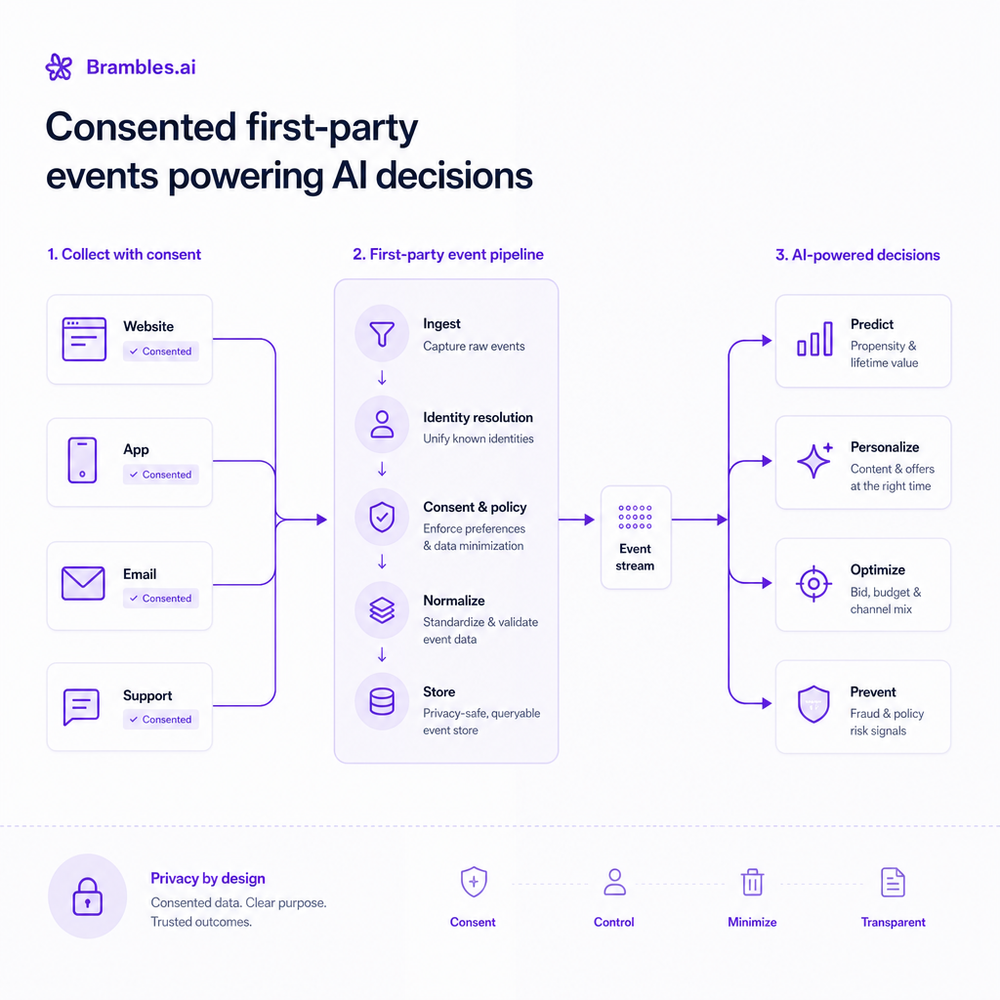
The best conversion AI runs on first-party signals with explicit consent. Salesforce’s Connected Customer research shows 73% of customers expect better personalization in exchange for data—provided it’s transparent and useful. Put value first.
- Consent UX: ask for preferences only when it changes the page immediately (e.g., “Show waterproof options first?”). That’s a value exchange, not a form.
- Progressive profiling: after purchase or sign-up, ask one clarifying question that improves the next visit (“Men’s or women’s sizing?”). Store it as first-party preference, not a cookie hack.
- Data minimization: keep only what you need for decisions (intent cluster, category affinity, price band). Reduce blast radius in case of incident.
- Server-side events: send critical events server-to-server to preserve accuracy as third-party cookies fade. Map a plain-English event schema so marketing and engineering can debug quickly.
Anecdote: a DTC electronics brand surfaced a privacy-friendly quiz that fed into on-page modules without creating profiles for ad networks. Email signups grew 31%, unsubscribes dropped 14%, and revenue per session for quiz takers rose 26%. Trust and relevance are compounding assets.
Common Pitfalls (And How to Avoid Them)
- Optimizing for clicks, not cash: CTR rises while RPS falls. Fix: optimize on contribution margin per session; make it your primary success metric in the decision engine.
- Discount addiction: AI learns “discount = win.” Fix: teach alternative offers (bundles, financing, free shipping by threshold) and cap discount exposure by SKU margin band.
- Ignoring inventory: promoting out-of-stock variants tanks trust. Fix: pipe real-time stock into the decision layer; auto-swap to in-stock substitutes.
- Latency creep: clever modules that load slowly. Fix: edge-cache HTML and lazy-load personalized blocks with a sub-100ms API target; test on 3G throttling.
- No guardrails: models exploring nonsense. Fix: whitelist eligible modules per page type and freeze models during high-volatility periods.
- QA gaps on mobile: variants look great on desktop only. Fix: screenshot diffs across top devices and emulate low-end Android; block rollout if CLS > 0.1.
- Misaligned KPIs: SEO team celebrates rank, sales team misses target. Fix: cluster by intent and report shared KPIs (RPS, AOV, margin) weekly across teams.
Reference points: Baymard on checkout friction, Google Web Vitals for speed perception, and McKinsey on personalization economics are your calibration anchors. Use them as guardrails, not gospel.
Future Outlook: Search, AI, and the Checkout
Two shifts to plan for now. First, generative search will route more long-tail visits directly to deeper pages. That’s a gift if your modules are attribute-aware and fast; it’s a penalty if you rely on one-size-fits-all templates. Second, privacy norms will continue to tighten. Server-side events and first-party preferences will become table stakes. Expect on-device modeling for simple classification (e.g., intent to compare vs. buy now) to reduce round trips and costs.
Tactically, invest in attribute tagging (materials, features, fit, compatibility) and a library of modular blocks that can be arranged by intent. Maintain an experiment backlog per cluster—not per page—so insights travel. And reserve budget for non-discount value: content that compresses decision time (fit finders, compatibility checkers) often returns better margin than any coupon.
One last anecdote: adding a “compatibility checker” module to a high-intent accessories page took 2 hours to ship and produced a 42% lift in add-to-cart for organic visitors over 10 days. Simple, specific, and fast tends to beat clever every time.
Related posts
View all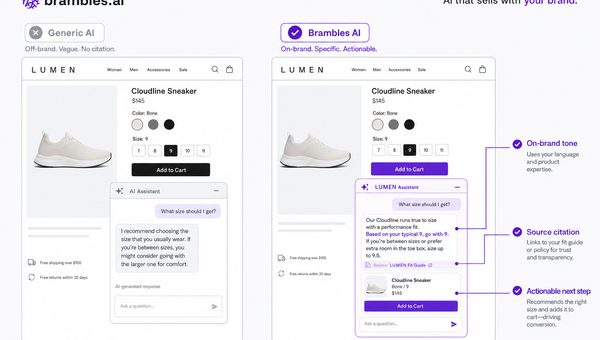
Brand-Consistent AI Chats Build Trust and Conversions
When AI mirrors your brand voice, shoppers relax—questions get answered, carts grow, and support load drops. Learn the playbook to align tone, trust, and ROI.
How Context-Aware AI Recommendations Lift CTR
See how context-aware AI recommendations lift CTR by 25–60% with intent signals, page context, and history. Practical steps, KPIs, and implementation tips.

Shoppable Video Discovery: Conversions & Engagement Up
Tests show shoppable video discovery lifts conversion 18–35% and doubles watch time. See the UX patterns, KPIs, and how to deploy it quickly with Brambles.ai.
Explore Brambles.ai
Learn more about our AI-powered agentic commerce platform, agentic shopping, and shopping assistance solutions.
Explore More Insights
Discover more articles on AI, automation, and business innovation
View All Articles