From CPM to EPC: Convert Ad Metrics to Chat Revenue
Stop optimizing CPM and start funding chats that convert. Learn how to translate ad spend into EPC, instrument conversations, and attribute real revenue.
Two weeks after a retailer shifted its paid social reporting from CPM to EPC tied to chat-assisted purchases, budget moved from a high-impression carousel to a lower-CPM story unit—and revenue rose 18% with fewer support tickets. The carousel pulled a gorgeous 0.9% CTR, but the story’s proactive chat prompt (“Find your fit in 3 questions”) produced a 0.34 EPC against the carousel’s 0.19. The CFO didn’t ask for impressions again; they asked, “What did the conversation do?”
I’ve seen this play out across categories. On a 100k-session electronics store, replacing a generic chatbot with a guided assistant lifted cEPC (conversational earnings per click) 41% in 14 days. A DTC skincare brand drove EPC from $0.18 to $0.31 by switching the entry point from a passive bubble to a timed benefit-led prompt on PDPs; returns fell 9% because the chat asked about skin sensitivity up front.
This article is a field guide to translating traditional ad metrics (CPM, CPC, CPA) into a single number that funds conversations: EPC. We’ll map the math, build the instrumentation, and show how to measure—with the boring gotchas that blow up attribution if you miss them.
What’s broken with CPM-era optimization
CPM and CPC optimize attention, not outcomes. They’re fine for top-of-funnel, but they fail when a large fraction of revenue is mediated by assistants, quizzes, or product finders. Three realities make CPM-centric reporting misleading:
- Conversations don’t resemble landing pages. Entry happens mid-journey (PDPs, cart, post-purchase). CPM can’t see this micro-context.
- Last-click bias punishes chat. If checkout or email captures the last click, chat’s value disappears unless you instrument assist and attribution windows.
- Generic bots depress conversion. Baymard’s 2024 checkout benchmark pegs average abandonment near 70%; undifferentiated help UIs add friction, not clarity, at the worst moment (source: Baymard Institute).
We also see measurement drift. Many teams log a single “chat_open” but miss intent detection, product recommendations, and add-to-cart events. That makes a high-CTR campaign look effective while chat quietly fails to qualify. Google UX research shows delays over 3 seconds spike abandonment on mobile; slow chat boot implies fewer qualified intents (Think with Google). McKinsey continues to find personalization lifts 10–15% revenue on average when grounded in first-party data—precisely what a good assistant harvests (McKinsey, Next in Personalization).
How EPC translates the ad dollar into chat revenue
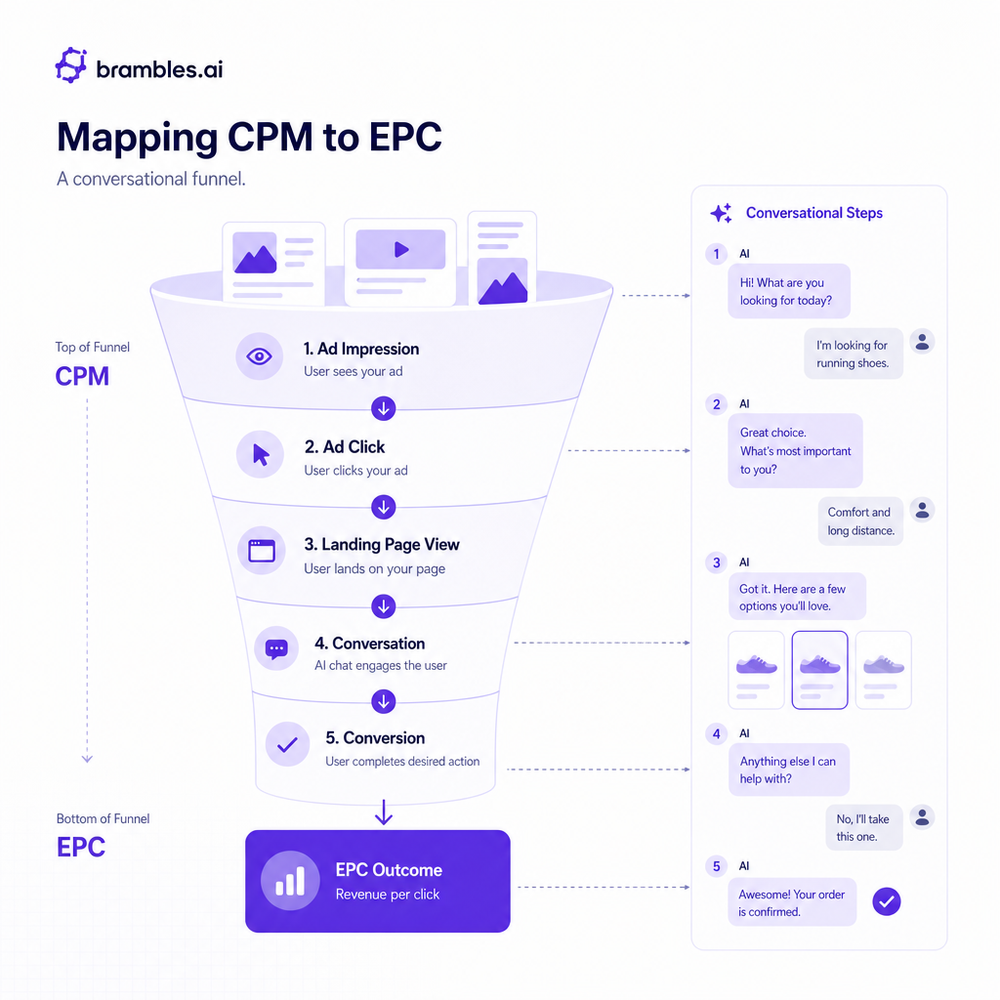
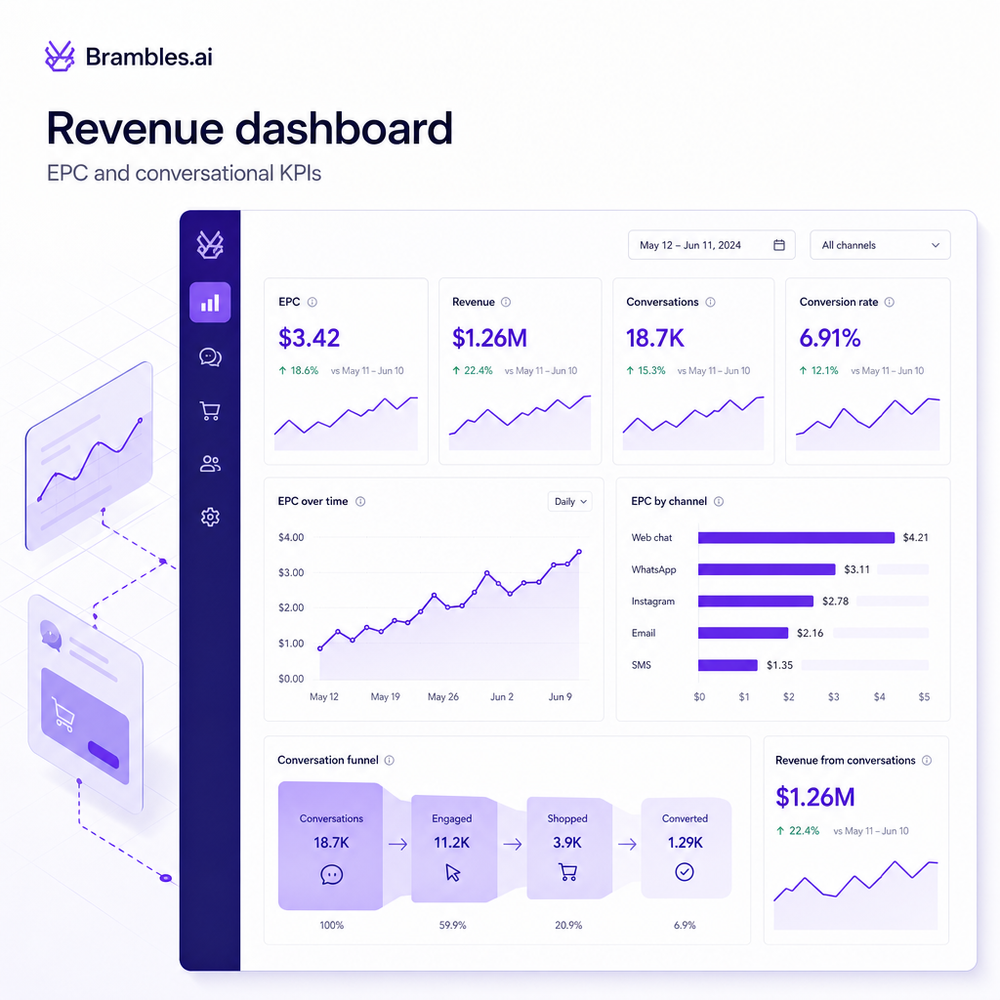
EPC answers the only question that matters: For every click we bought or earned, what did we make? In conversational commerce, compute cEPC by tying revenue to sessions that entered via a chat entry point or produced a chat-assisted order.
Core relationships:
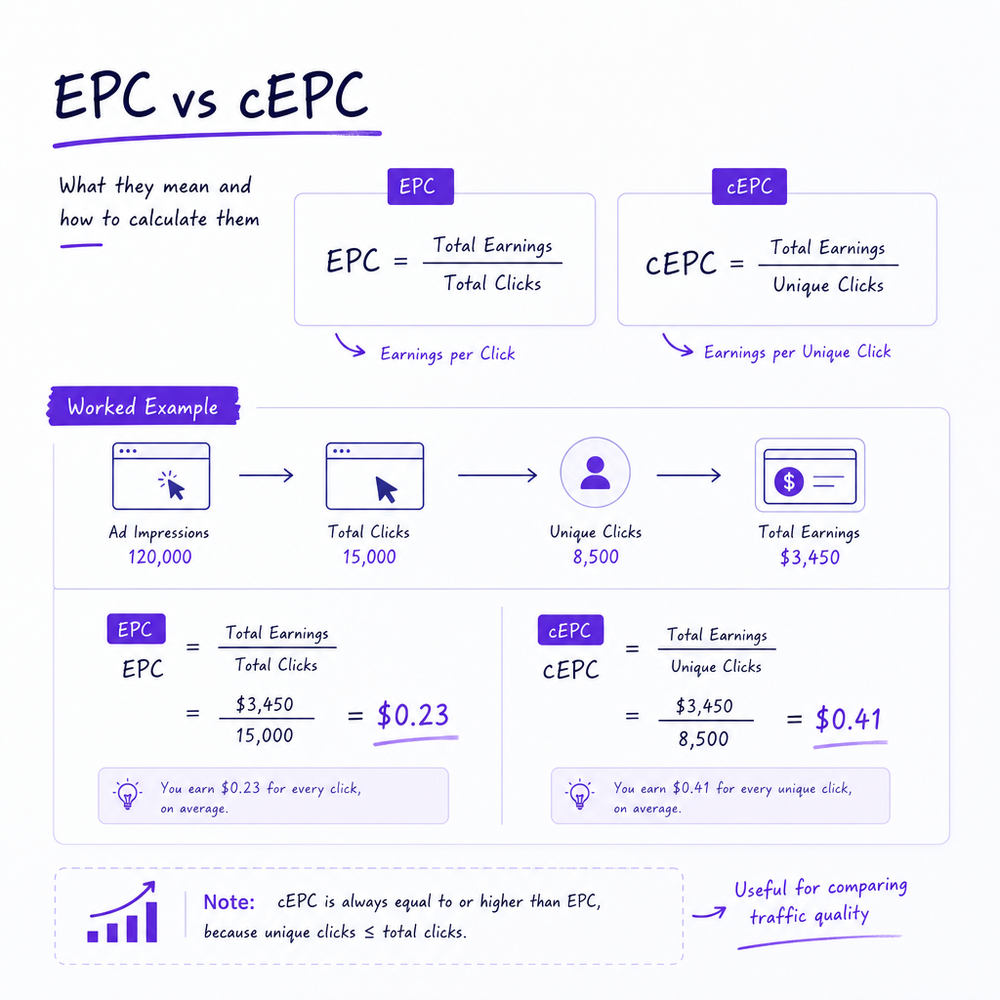
- EPC = Revenue / Clicks.
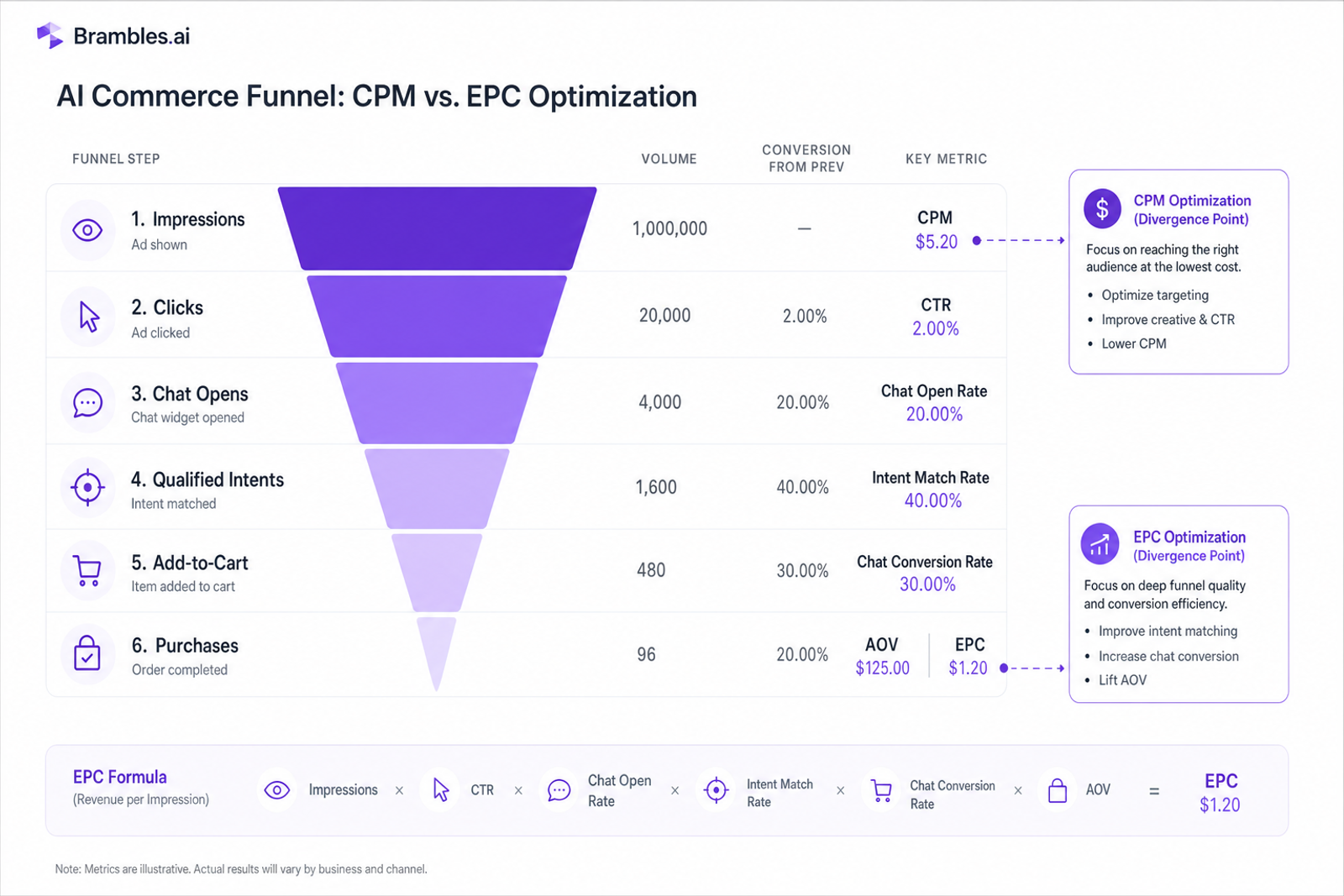
- Revenue per 1,000 impressions (RPM) = EPC × CTR × 1,000. This connects CPM to yield.
- Chat yield: cEPC = (Chat-assisted revenue) / (Ad clicks that engaged chat).
- Qualification gears: cEPC = CTR × COR × IQ × CR × AOV × 1,000 ÷ 1,000 clicks simplified, where COR is Chat Open Rate, IQ is Intent Qualification rate, CR is chat-to-order conversion, and AOV is average order value.
Example: 1,000,000 impressions at a $12 CPM, 1.2% CTR → 12,000 clicks. If 28% open chat, 46% are qualified, 10% convert with $78 AOV, then revenue = 12,000 × 0.28 × 0.46 × 0.10 × 78 = $11,995. cEPC = $11,995 / 12,000 = $0.9996. Your RPM is ~ $1,200 (cEPC × CTR × 1,000), out-yielding the $12 CPM cost by 100×. If cEPC < CPC, you’re buying clicks that the conversation can’t monetize—fix the assistant or cut the creative feeding it.
Implementation guide: instrument for cEPC
1) Define a clean UTM and entry taxonomy
- utm_source, utm_medium, utm_campaign as usual; add utm_content for prompt variant and utm_term for audience/creative ID.
- Store chat_entry = {auto, proactive, button, checkout_help}, chat_surface = {PDP, PLP, cart, post-purchase}.
- Persist session_id across page → chat via URL param or postMessage and fall back to first-party cookie.
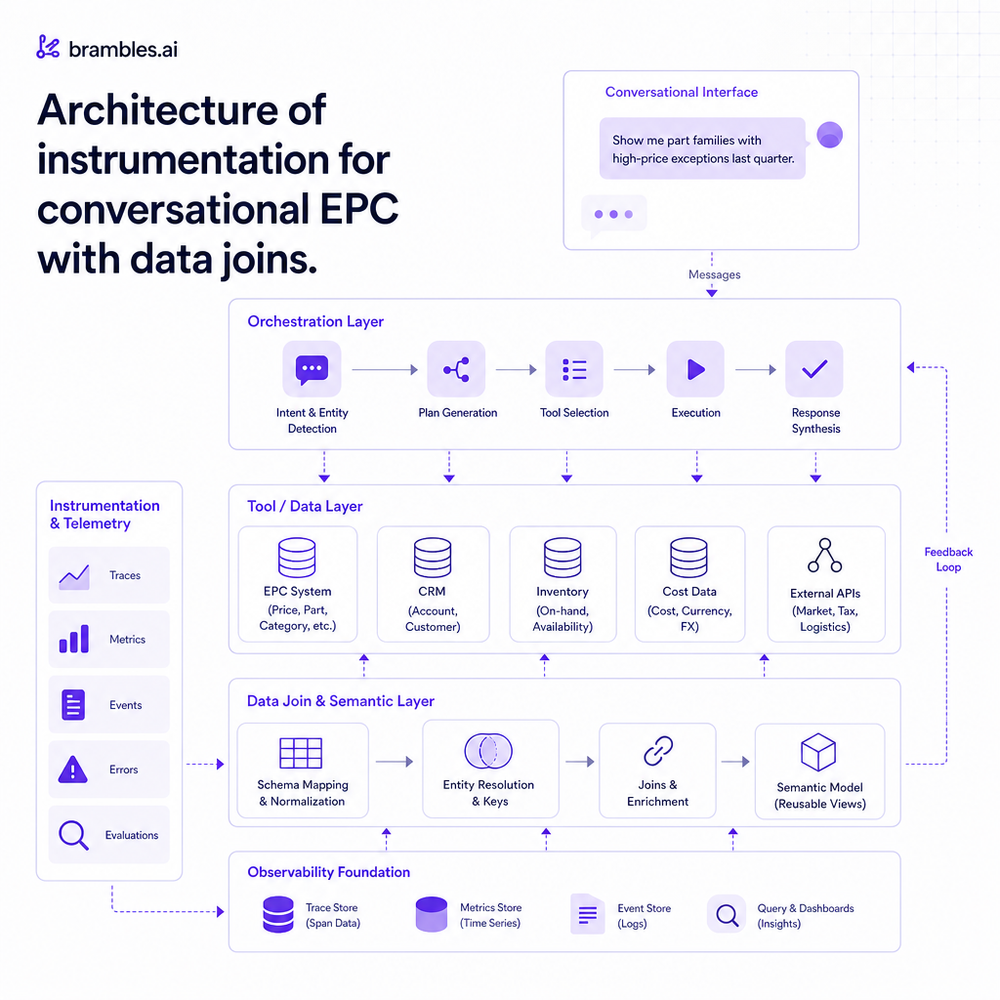
2) Event schema (send to GA4 + your warehouse)
- chat_open (surface, prompt_id, load_latency_ms)
- chat_message (role, intent, tokens, latency_ms)
- product_recommended (sku, price, margin_tier)
- add_to_cart_chat (sku, qty, price)
- checkout_start (cart_value, discount)
- purchase (order_id, revenue, margin, chat_assist_flag)
3) Attribution rules
- Define chat_assisted if: chat_open within 7 days pre-purchase AND at least one product_recommended for purchased SKU.
- Use 7–14 day lookback per category complexity; keep consistent across channels.
4) Privacy & consent
- Fire chat only after consent where required; log consent_state for audits.
Two practitioner notes: On a home furnishings brand (AOV ~$420), moving chat_entry from “auto open on PDP” to “proactive after 8s + scroll 40% + in-stock” raised IQ from 33%→52% and cut bounce 14%. A fashion marketplace tied product_recommended margin_tier into routing; when margin_tier=low, the assistant prioritized bundles—EPC rose 22% without changing media spend.
Measuring ROI and choosing KPIs that move EPC
Start with three layers:
- Yield: EPC, cEPC, EPV (earnings per visit), EPMV (per 1,000 visits).
- Conversational health: Chat Open Rate, Intent Match Rate, Guided Flow Completion, Time-to-First-Response.
- Commercials: AOV, margin %, return rate, resolution rate (self-serve vs. agent).
A/B the conversation, not just creatives. Randomize at session level; store experiment_id on all chat events and orders. For smaller budgets, run geo-experiments or CUPED-adjusted holdouts to stabilize variance. Sample calc: Variant A cEPC = $0.27 vs B = $0.33 across 60k clicks; with 95% power and pooled stdev $0.45, B wins—ship it. Salesforce’s Connected Customer research shows 73% expect better personalization as they share data; use that expectation to justify progressive profiling, not to over-message (Salesforce, 2023).
Attribute correctly in dashboards:
- Primary: cEPC by campaign × prompt_id × surface.
- Assisted: revenue where chat_assist_flag=true even if last click is checkout or email.
- Cohorts: EPC by new vs. returning, device, and first-touch channel—mobile chat performance often lags desktop until latency is fixed.
- Cost-aware: Compare cEPC to CPC; cEPC should exceed CPC plus target margin buffer (e.g., 30%).
First‑party data, consent, and trust
Great EPC depends on great qualification, which depends on trust. A few rules of thumb:
- Earn the right to ask. Start with 1–2 high-yield questions (use case, budget band) before email. Tie each question to a visible benefit in the chat copy.
- Progressive profiling. If the user returns, remember prior choices and skip repeats. This alone lifted completion 19% for a nutrition brand we worked with.
- Consent-forward UX. Respect region-specific consent; disclose why data helps (fewer returns, better fit). Store consent_state and surface it in support tools.
- Close the loop. If chat recommends a product and the user buys, send a short how-to in the same channel post-purchase; it reinforces value and reduces returns.
McKinsey’s personalization research and Google’s UX speed findings both point to the same conclusion: relevance + performance compound. Lightweight chat, relevant prompts, and clear value exchange will beat heavy scripted flows every time.
Common pitfalls that wreck cEPC
- Counting the wrong click denominator. If you compute cEPC using all ad clicks but only 20% see the chat surface, you’ll understate potential. Use “clicks that loaded the chat.”
- Double attribution. If both the chat and the email capture claim full credit, your EPC inflates. Define assisted logic and cap to 100% per order.
- Ignoring returns and margin. EPC on gross revenue lies. Use net revenue or margin-adjusted EPC (EPCm) for scale decisions.
- Latency blindness. Chat boot time silently destroys Intent Match Rate. Budget for performance work like any other lever.
- Static prompts. The best prompt on a PDP may hurt on cart. Measure cEPC by surface and rotate creative accordingly.
Future outlook: EPC meets LTV and margin
EPC will converge with contribution margin and LTV. Teams are already moving to EPCm (earnings per click on contribution margin) and EPCL (EPC including predicted LTV for email/SMS opt-ins captured in chat). Expect server-side tagging and modeled conversions to fill gaps left by privacy changes, while assistants become more like product specialists than bots. The north star remains the same: every click should fund a useful conversation that gets the shopper to a confident “yes.” Keep CPM and CPC as diagnostics; make EPC—and specifically cEPC—your budget arbiter.
If you’re running WordPress, it’s straightforward to operationalize this with a lightweight stack. Deploy your assistant, instrument the events, and wire EPC to your dashboards. If you need a jumpstart on implementation, you can download our WordPress plugin, connect the Brambles.ai WordPress plugin, and activate the Commerce Module to capture chat-assisted orders end-to-end in your Brambles.ai dashboards.
Related posts
View all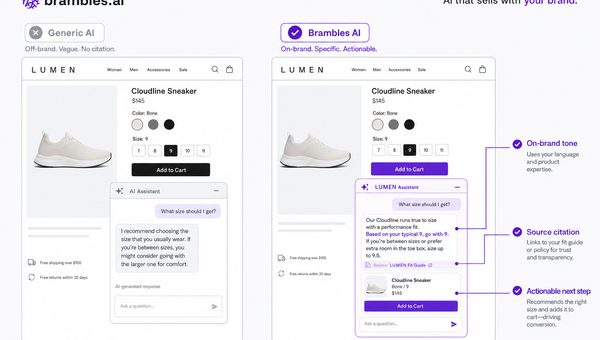
Brand-Consistent AI Chats Build Trust and Conversions
When AI mirrors your brand voice, shoppers relax—questions get answered, carts grow, and support load drops. Learn the playbook to align tone, trust, and ROI.
Sponsored Products in AI Shopping: Retail Media 101
Learn how sponsored product placements power AI shopping, how bidding and relevance work, and how to implement retail media without eroding trust or UX.
Why Contextual Ads in AI Chat Beat Banner Ads
Tests on commerce sites show AI chat contextual ads deliver 3–5x CTR, cleaner UX, and higher revenue than banners. See how they work, implement, and measure.
Explore Brambles.ai
Learn more about our AI-powered agentic commerce platform, agentic shopping, and shopping assistance solutions.
Explore More Insights
Discover more articles on AI, automation, and business innovation
View All Articles