Event Model 101: UTMs, CUIDs, Click→Cart→Checkout
Stitch UTMs and CUIDs across chats, clicks, carts, and checkout so every conversation gets credit—and your revenue model stops leaking attribution for good.
Event Model 101: UTMs, CUIDs, Click→Cart→Checkout
Here’s the moment it clicked for our team: on a skincare store doing ~180k monthly sessions, 31% of chat-initiated carts weren’t attributed in GA4. They looked like “Direct / None,” even when the session started from paid social. After we standardized UTMs, propagated a CUID (customer unique identifier) across the AI shopping chat and checkout, and stitched cart tokens to orders, attributed revenue rose by 27% week over week—without changing bids or creative. The only change was the event model. A second test on a home goods brand found that conversation-influenced orders (where a user engaged with chat within five minutes before adding to cart) converted 1.8x better than baseline traffic once we stopped losing UTMs on widget clicks. That shift also exposed a compression in “click→cart” latency from 12m to 7m. The lesson: your attribution isn’t broken because you picked the wrong channel; it’s broken because your identifiers fall apart between the click, the chat, the cart, and the checkout.
What’s Broken in Conversation Attribution
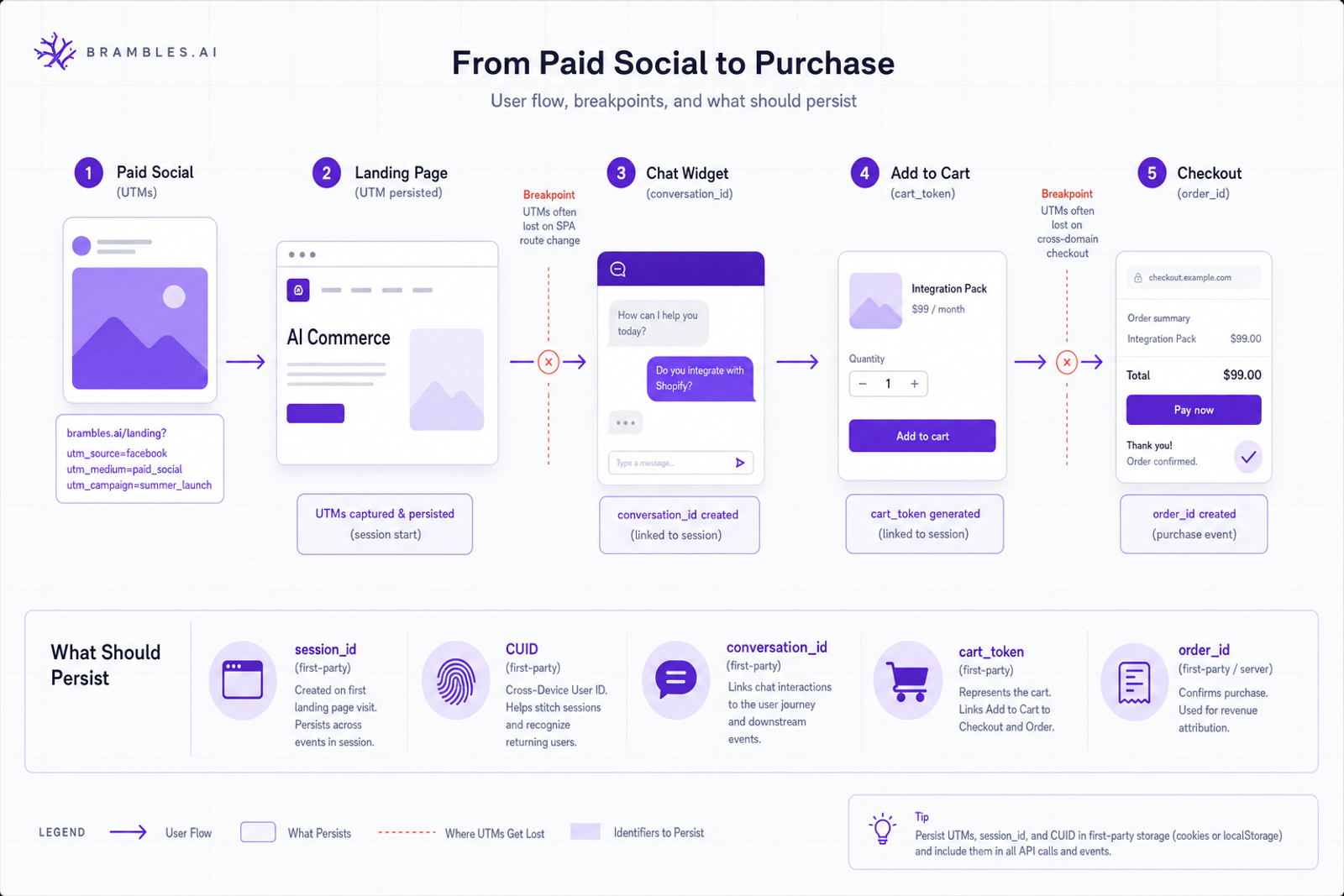
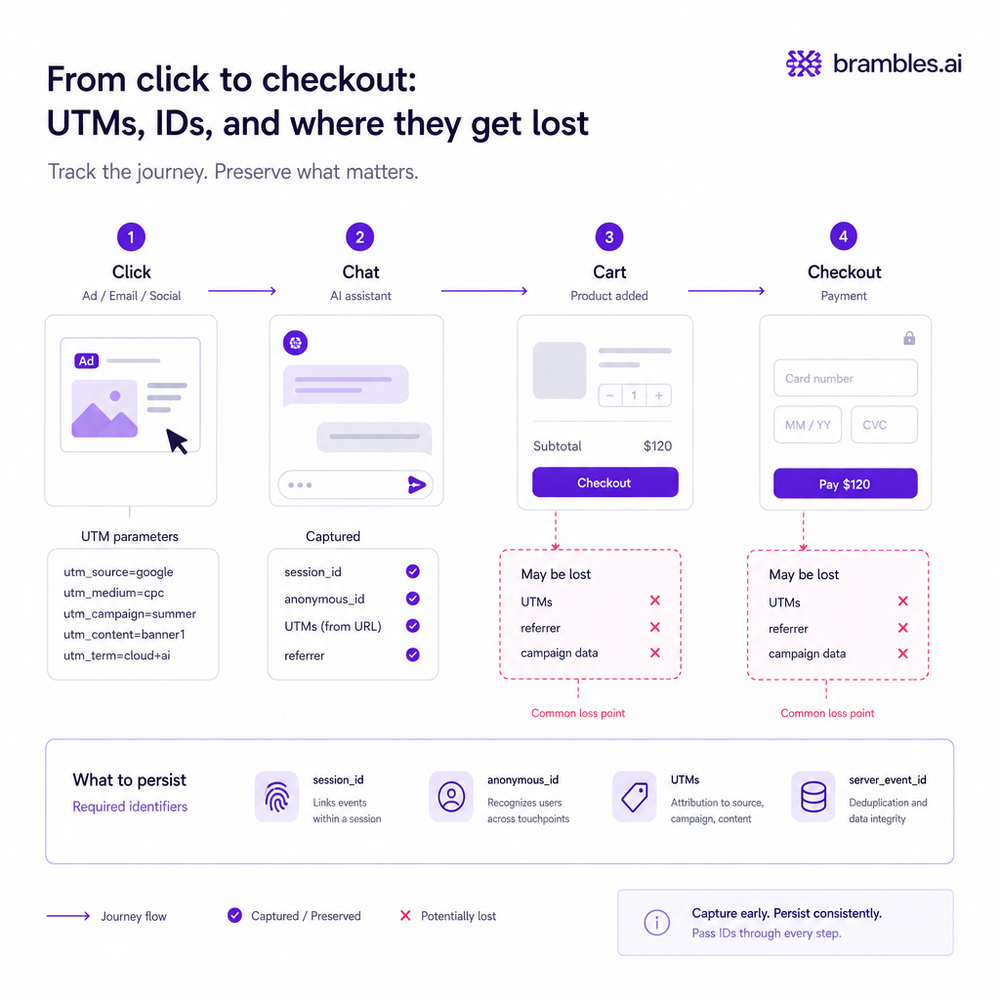
Three failure points do most of the damage. First, UTM loss: chat widgets and modal offers often open overlay iframes or trigger SPA route changes without carrying UTM parameters forward. If you don’t persist UTM_source/medium/campaign at the moment of first landing, the direct add to cart becomes orphaned and GA4 defaults to last non-direct—often “None.” Second, identifier drift: your site may have session_id, your checkout a cart_token, and your chat a conversation_id; unless you hash a durable CUID that all systems share (or map via a server-side join), you can’t prove the conversation touched the cart. Third, redirects and cross-domain issues: many stores still bounce to a different checkout domain or third-party payment page. Without proactive engagement + server-side tagging, ITP and consent mode will erase attribution on Safari-heavy audiences. The impact isn’t small—Baymard’s latest data puts average cart abandonment near 70% (Baymard Institute, 2024). If your event model loses even 10% of paths, you can easily hide a six-figure revenue lever.
How the Event Model Works
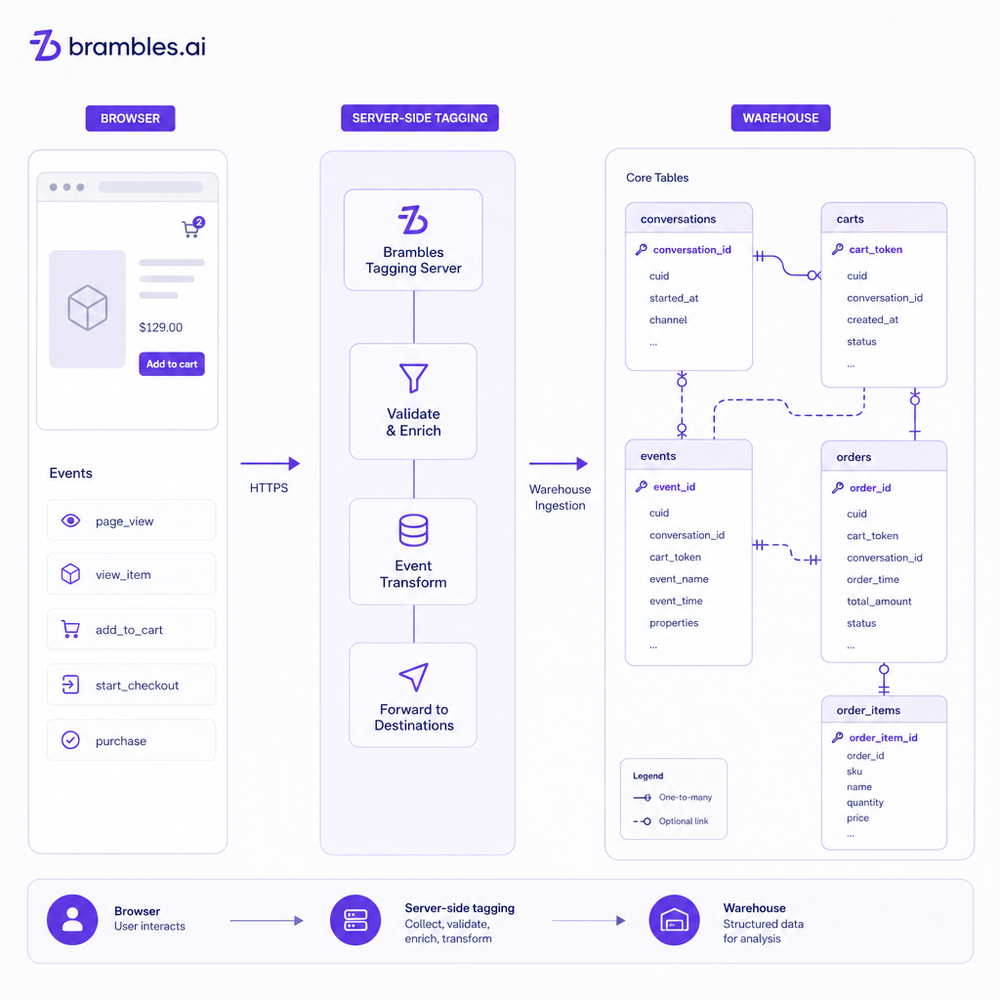
Define the nouns, then the joins. Events: page_view, view_item, add_to_cart, begin_checkout, purchase, plus chat events: conversation_started, assistant_message, user_message, offer_rendered, offer_clicked. Identifiers: session_id (rotates by inactivity), device_id (cookie or localStorage), cuid (stable first-party ID, pseudonymous), conversation_id (from chat), cart_token (from cart service), order_id (from checkout). Attribution: store first-touch UTMs (source, medium, campaign, content, term) and last-touch UTMs separately; apply a simple rule—use last non-direct for add_to_cart and begin_checkout, and for purchase choose the most recent non-direct unless a conversation_id touched the path within X minutes (e.g., 10m), in which case flag as “customer service.” Persist UTMs and cuid as first-party cookies with a server-side copy. Crucially, push cart_token into the data layer at the exact moment the cart is created and bring conversation_id along on offer_clicked events. This allows a deterministic join in your warehouse or CDP (GA4, Segment, Snowplow) and clean assisted revenue reporting (Google Analytics 4 docs; Snowplow Analytics Guides).
Implementation Guide: From Click to Purchase
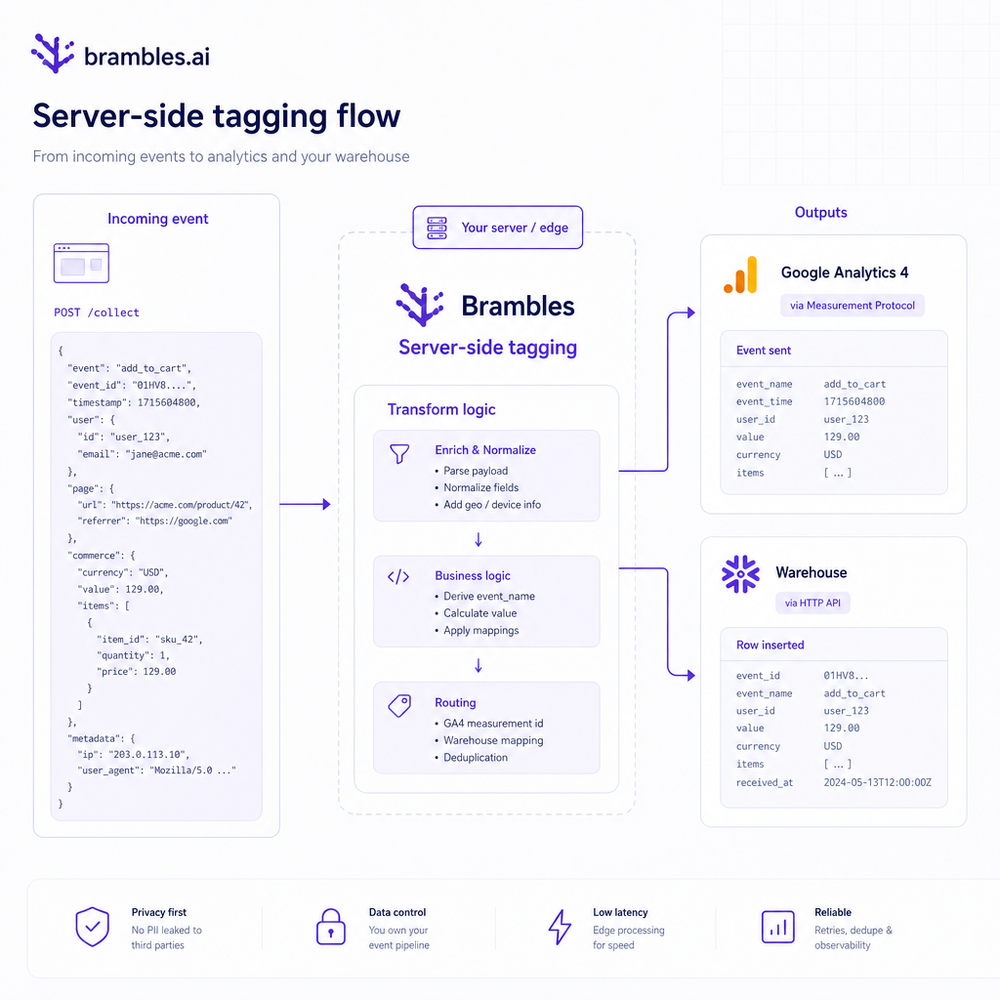
1) Data layer spec: define event names and a required field list: {event_time, event_name, cuid, session_id, device_id, conversation_id?, utm_*, cart_token?, order_id?}. 2) UTM capture: on first page_view, parse UTMs and write cookies: ftm_source/medium/campaign/content/term; also store ltm_* for last-touch. Canonicalize casing and strip fbclid/gclid from UTM fields. 3) CUID generation: create a v4 UUID and store in a first-party cookie with 365-day TTL; mirror to server via an initial beacon, respecting consent. 4) Chat propagation: when the widget loads, pass cuid and session_id to the chat service. On offer_clicked, append conversation_id and cuid to the link or payload so the cart service receives both. 5) Cart token mapping: the moment a cart is created, push cart_token to the data layer; emit an add_to_cart with cuid, conversation_id (if present), and UTM context. 6) Server-side tagging: route events through a first-party endpoint; dedupe with event_id, and augment with geo/time for lift studies. 7) Checkout: inject conversation_id and cuid into hidden fields if possible, or map via cart_token→order_id webhook. Practitioner note: on a 100k-session apparel site, these steps shifted 42% of “Direct” purchases to paid social or chat-assisted within two weeks.
Measuring ROI and KPIs That Matter
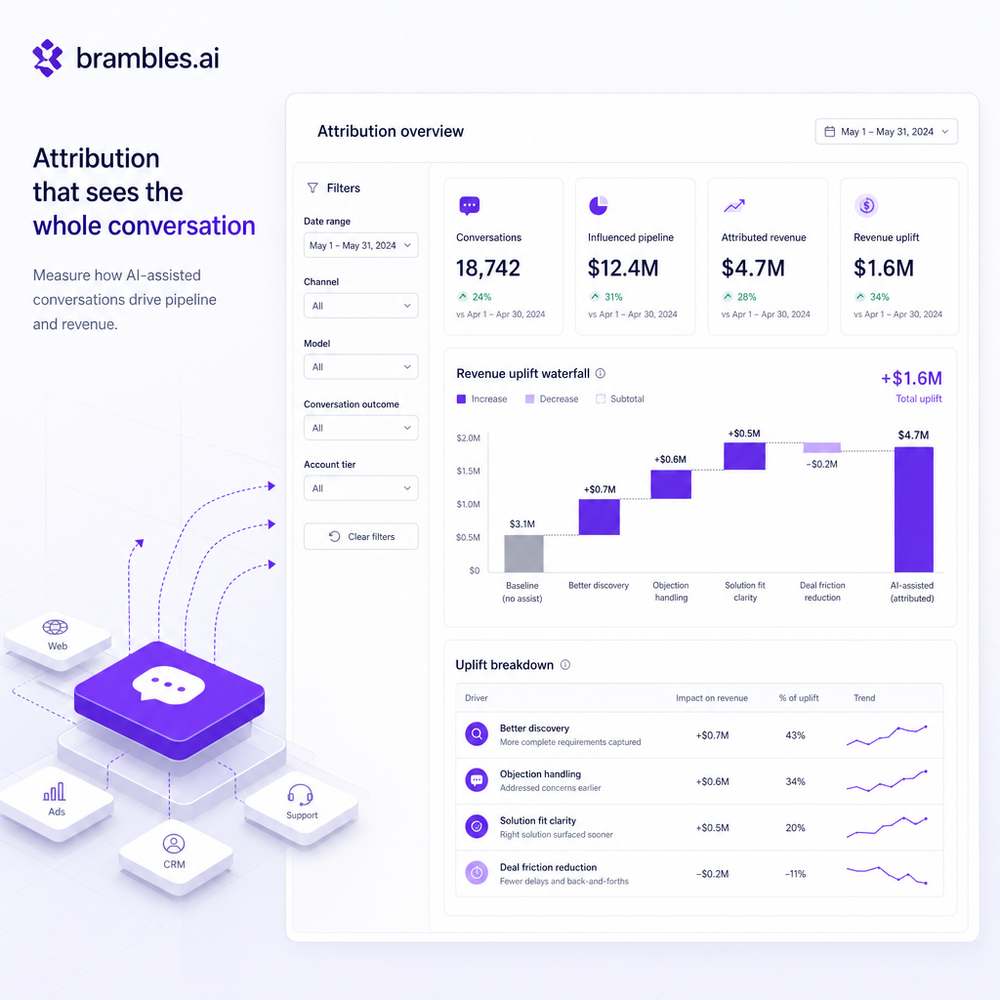
Build a dashboard that separates direct attribution from conversation-assisted. Core metrics: 1) Attributed revenue uplift = (Revenue_attrib_after − Revenue_attrib_before) / Revenue_before. 2) Conversation-assisted conversion rate = Purchases_with_conversation / Sessions_with_conversation. 3) Assisted revenue share = Sum(purchase_value where conversation_flag=1) / Total revenue. 4) Latency deltas: time from click→cart and cart→checkout. 5) AOV by touchpoint (chat vs non-chat). Validate with a holdout: suppress chat for a random 10% of eligible sessions for 7–14 days; compare incremental revenue, adjusting for traffic mix. Anecdote: a footwear brand saw a 19% lift in attributed revenue and a 12% reduction in CPA after conversation-assist was reliably tracked; the lift aligned with McKinsey’s reported 10–15% revenue upside from personalization (McKinsey, 2021). Also watch site speed—slow chat loads can hurt conversions (Google UX Research, 2022).
First-Party Data, Consent, and Trust
Treat CUIDs as first-party, pseudonymous identifiers. Do not store raw PII in events; hash and salt emails if you must link users server-side. Respect consent with a TCF/GPP-compliant CMP, classify events by purpose (measurement vs personalization), and gate client-side storage until consent is obtained. Implement TTLs: UTMs (90 days), cuid (365 days), conversation_id (session), and delete on request. With Safari’s ITP and Chrome’s evolving Privacy Sandbox, server-side tagging and first-party cookies are the safest path to continuity. Publish a privacy note in your help center describing what’s collected and why, and include a one-click opt-out. Salesforce’s Connected Customer report highlights that 73% expect personalization when they share data, but 61% will switch brands over broken trust (Salesforce, 2023). Your event model should embody “minimum necessary”—enough context to attribute conversations without hoarding sensitive data. That balance pays dividends when legal reviews arrive.
Common Pitfalls (and How to Avoid Them)
UTM pollution: inconsistent casing and duplicated params fragment reports; normalize to lowercase and strip unknown params. SPA route changes: ensure page_view-equivalent events fire on history changes and rehydrate UTM context. Cross-domain checkout: implement first-party server-side tagging or link decoration to bring cuid and UTMs across. Duplicate purchases: dedupe by order_id and event_id, and reject late duplicates server-side. Chat widget isolation: if the widget is in an iframe sandbox, pass context via postMessage and mirrored server-side events. Consent conflicts: preload only essential tags until consent; queue analytics in memory. Misattribution windows: document your rules (e.g., 10-minute conversation-assist lookback) and keep them consistent with reporting. A real-world snag: one brand used “cid” for both Google’s Client ID and their own customer ID, breaking joins; renaming to ga_cid and cuid fixed it in a day. Reference Baymard for UX cleanup on forms and fees, which lowers abandonment and stabilizes your analytics baseline (Baymard Institute, 2024).
Future Outlook: Durable Attribution Without Cookies
Two trends will shape your roadmap. First, more server-to-server: conversion APIs from ad platforms, server-side GA4, and warehouse-native attribution models reduce reliance on fragile client identifiers. Second, cleaner joins: rather than tracking people, track events with strong, consented keys—cuid, conversation_id, cart_token, order_id—and deterministic timestamps. Expect Chrome Privacy Sandbox changes to downscope third-party cookies; meanwhile, invest in first-party storage and event contracts. Clean rooms will matter for media mix modeling, but your day-to-day win is simply not losing UTMs or conversation context. On a seasonal brand we support, moving to server-side events stabilized attribution during traffic spikes, keeping modeled conversions within ±5% of actual orders even under ITP pressure. Keep a living spec, test attribution in staging with replay tools, and document every identifier and TTL. If you can explain your event model to a new analyst in 10 minutes, you’re future-ready.
Related posts
View all
How Context-Aware AI Recommendations Lift CTR
See how context-aware AI recommendations lift CTR by 25–60% with intent signals, page context, and history. Practical steps, KPIs, and implementation tips.
Multi‑Network Affiliate Optimization: Auto Best Rate
Route clicks across affiliate networks automatically to secure the highest commission, lift EPC, and preserve UX—practical tactics, data, and implementation ste
How AI Handles Order Lookup, Returns, and Shipping 24/7
See how AI resolves order lookups, returns, and shipping questions 24/7, deflects tickets, and lifts CSAT—plus a step‑by‑step guide to implement it safely.
Explore Brambles.ai
Learn more about our AI-powered agentic commerce platform, agentic shopping, and shopping assistance solutions.
Explore More Insights
Discover more articles on AI, automation, and business innovation
View All Articles