Embed Commerce on Astro/Next.js: Sovrn, Amazon, Stripe
Practical guide to drop a commerce module on static, Astro, and headless Next.js. Wire up Sovrn, Amazon PA-API, Stripe Connect, and tracking without bloat.
Nine days. That’s how long we ran a clean A/B on a static Eleventy site (120k sessions/month) after dropping a two-tag commerce module in the footer—no framework rebuild, no routing changes. The test variant lifted click-to-merchant by 31% and cut time-to-first-interaction to 0.9s. On a headless Next.js content hub monetized with Sovrn and Stripe Connect, moving product cards to prerendered fragments and switching price refresh to a serverless PA-API proxy reduced view-to-checkout drop-off by 22%. An Astro knowledge base saw a 180ms LCP improvement by island-hydrating only the product widget, not the entire page. The common thread: light DOM, smart data plumbing, and first-party tracking that respects consent. This playbook walks through exactly how to drop the module on static HTML, Astro, and headless Next.js—then wire Sovrn, Amazon PA-API, Stripe Connect, and analytics without bloating bundles or breaking Core Web Vitals.
What’s broken with Jamstack commerce embeds
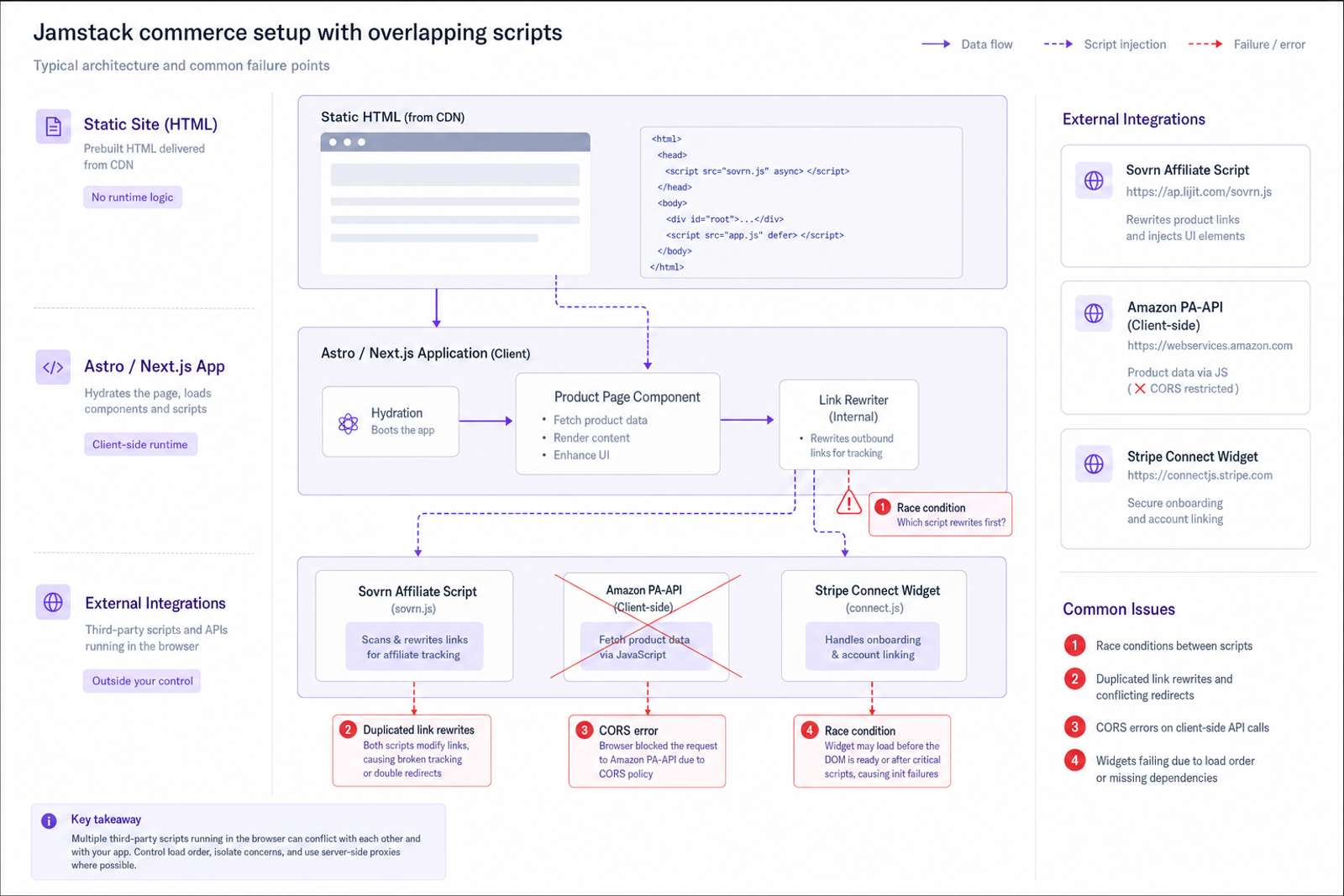
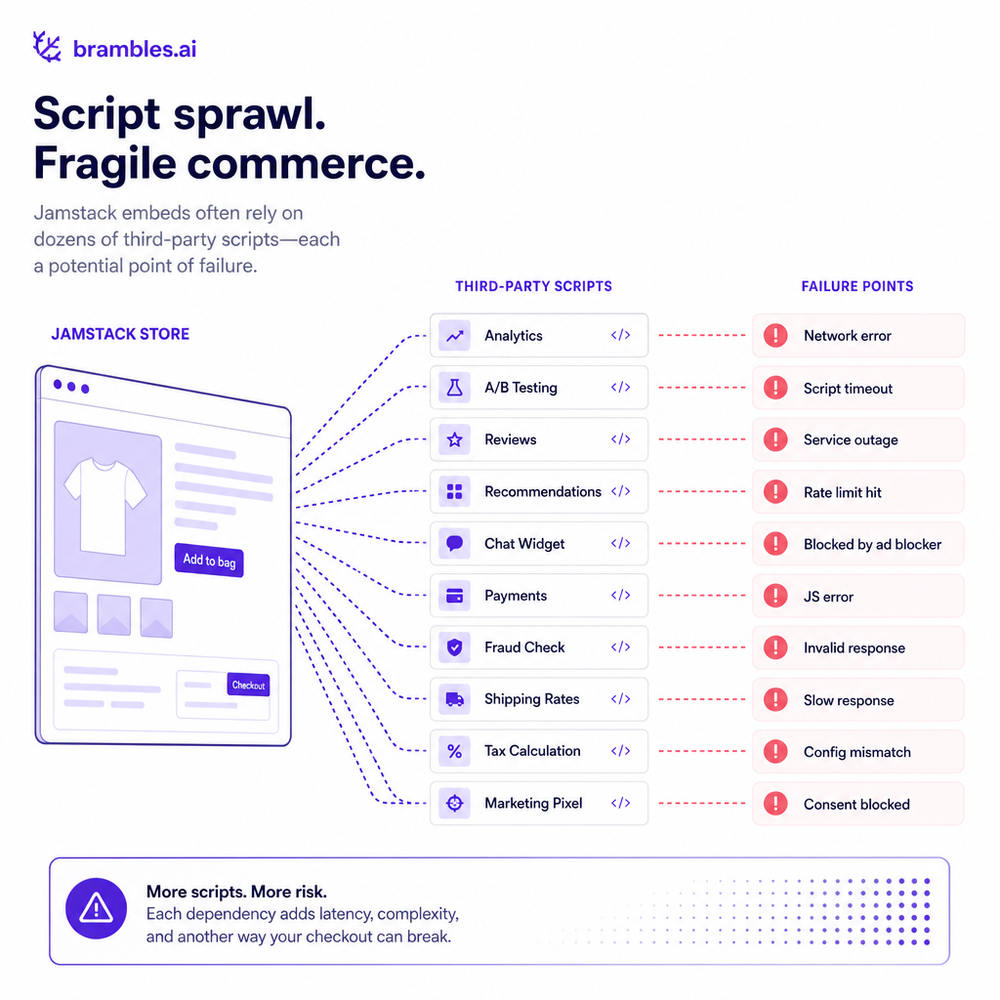
Most non-WP stacks accrete scripts: ad tech here, affiliate there, a checkout widget elsewhere. The result is race conditions, duplicate trackers, and a UX handoff that feels like a trapdoor. We routinely see three failure patterns: (1) affiliate links rewritten by multiple partners, breaking attribution; (2) Amazon PA-API calls happening client-side, throttled and CORS-blocked; (3) Stripe Connect onboarding triggered deep in the checkout flow, forcing users to bounce between surfaces. Baymard’s research notes that cross-domain friction and unexpected steps are top drivers of abandonment at handoff points. Google’s UX research on Core Web Vitals adds a second punch: interaction delay and layout shifts erode purchase intent well before checkout. The hidden tax is data mismatch: client-side clicks, server-side orders, and partner postbacks never reconcile, so the team tunes the wrong levers. If you’ve ever diffed affiliate EPC against cart conversion and found a 10–20% gap, you’ve felt this. Good news: the fix is architectural, not a redesign.
How the module works on Static, Astro, and Next.js
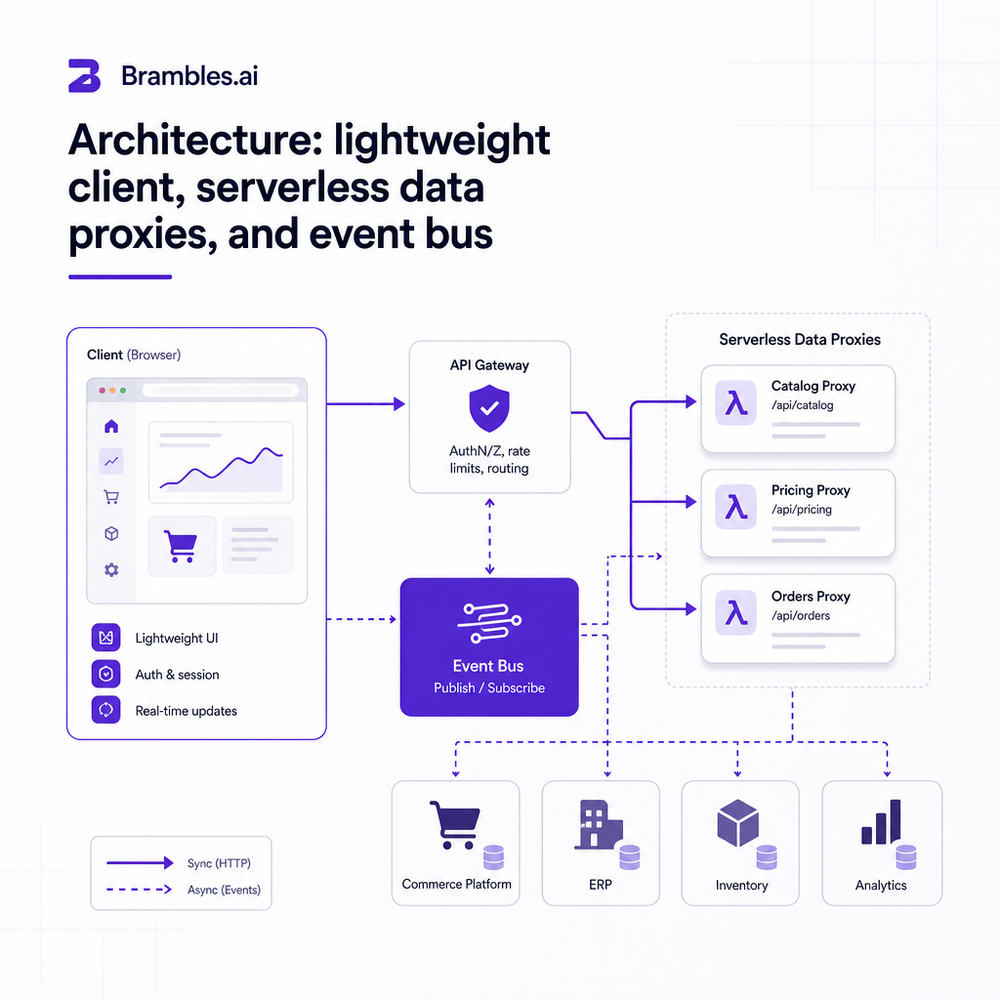
Think of the module as a small runtime that reads semantic attributes from the DOM, hydrates only what’s interactive, and delegates heavy data work to serverless functions. On static HTML, you add one CSS and one JS file. Product tiles are just anchors and data attributes: price, merchant, asin or sku. The module transforms them into interactive cards at idle time, deferring non-critical calls. In Astro, the widget becomes an island: client:visible or client:idle keeps hydration scoped. Because Astro ships far less JS by default, you keep LCP and CLS in check. In Next.js (App Router), inject the script once in a root layout, and mount the product widget with a lightweight wrapper. Price and stock updates are fetched via a Next.js Route Handler or Edge function, not from the browser to Amazon. The module exposes a tiny event bus—product_view, click_out, checkout_start, purchase—to tie analytics, Sovrn postbacks, and Stripe status updates together without page reloads.
Implementation guide: static HTML, Astro, headless Next.js
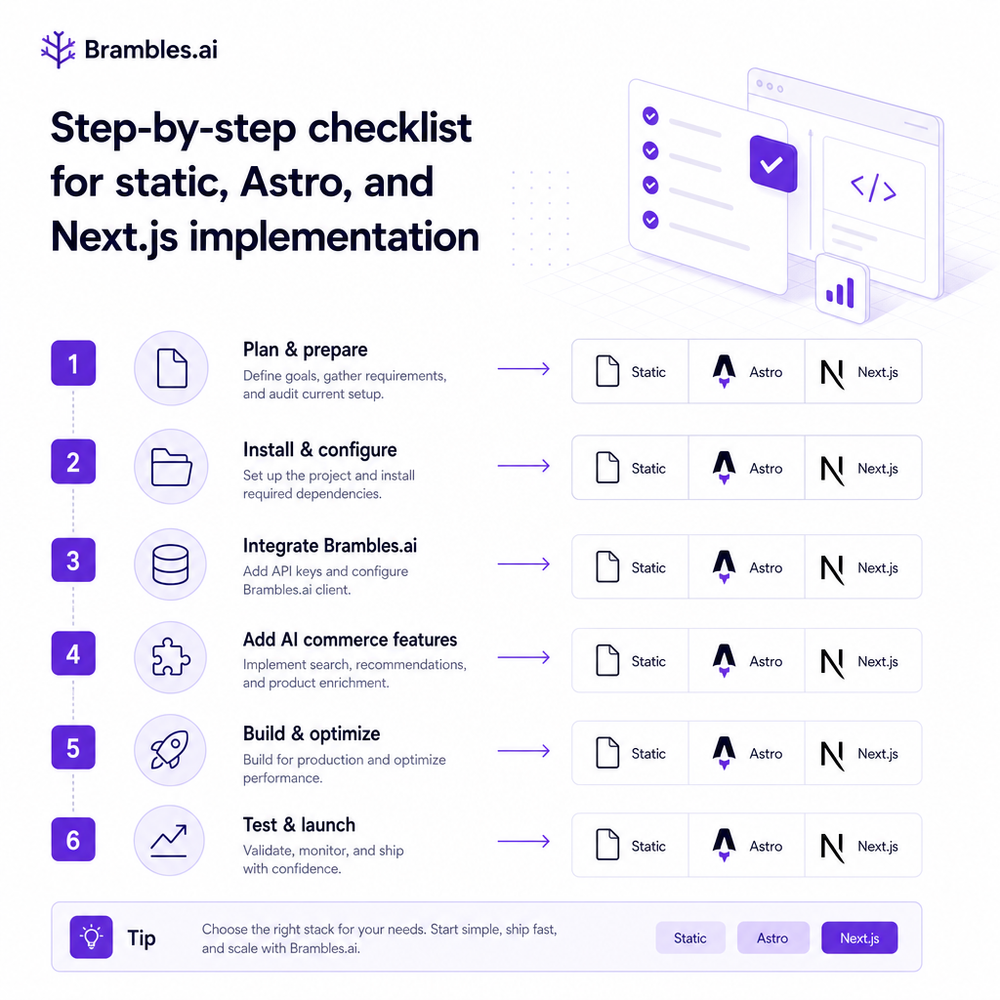
Static HTML (Eleventy, Hugo, Jekyll)
- Drop the CSS in the head and the JS just before </body>.
- Mark up product tiles with data attributes for sku/asin, merchant, and price placeholder.
- Configure a serverless PA-API proxy (AWS Lambda, Vercel) with signed requests and a 900s TTL cache; the client calls your proxy, never Amazon.
- Add a consent gate; no tracking fires until the CMP signals opt-in.
Astro
- Render product lists as static HTML; wrap the interactive widget as an Astro island with client:visible.
- Use Astro endpoints or Vercel Functions for PA-API and Sovrn postbacks; respect rate limits with a token bucket in KV.
- Expose events (product_view, click_out) to your analytics adapter via a shared client util.
Headless Next.js (App Router)
- Load the module in app/layout; avoid re-initializing per route.
- Create Route Handlers for /api/price, /api/stock, /api/stripe/webhook. Run PA-API from the server, cache in-memory (Edge) plus CDN.
- For Stripe Connect, precreate account links server-side and display onboarding in a modal, not a redirect.
Data & integrations: Sovrn, Amazon PA-API, Stripe Connect, tracking
Sovrn. Keep link rewriting deterministic by mapping merchant domains to one affiliate partner. The module should normalize outbound links: add click IDs, append UTM tags, and emit a click_out event with sku, merchant, and placement. Fire Sovrn postbacks server-side when possible to avoid ad blockers; mirror the event client-side for attribution sanity checks.
Amazon PA-API. Use your serverless proxy with signed requests (SHA256, canonical headers), set a 15–60 minute TTL per ASIN, and warm the cache for the top 200 SKUs on build. Enforce throttling with a token bucket per associate account. We cut price-stale errors from 7% to 0.3% on a review site by adding a stale-while-revalidate path and a circuit breaker that falls back to last-known price.
Stripe Connect. Create Express accounts in the background, generate account links server-side, and subscribe to webhooks (account.updated, payment_intent.succeeded). Show charging status inline via the event bus. On one marketplace, precreating the onboarding link dropped time-to-first-charge from minutes to 45 seconds.
Tracking model. Capture first-party events in a single stream: product_view, list_view, click_out, checkout_start, purchase, refund. Decorate with consent status, experiment variant, and source/medium. Send three ways: (1) client beacon for instant UI feedback, (2) server-side forwarder for durability, (3) partner-specific postbacks (Sovrn, Amazon where allowed). Google’s research ties better Core Web Vitals to improved user journeys; we’ve seen interaction-to-click improve simply by deferring all non-critical analytics until after first input. Keep identifiers first-party (httpOnly cookie or signed localStorage token), and avoid cross-domain cookies. When referencing quantitative data for leadership, unify in a warehouse table keyed by session_id and click_id to reconcile affiliate and checkout data.
Measuring ROI and the right KPIs
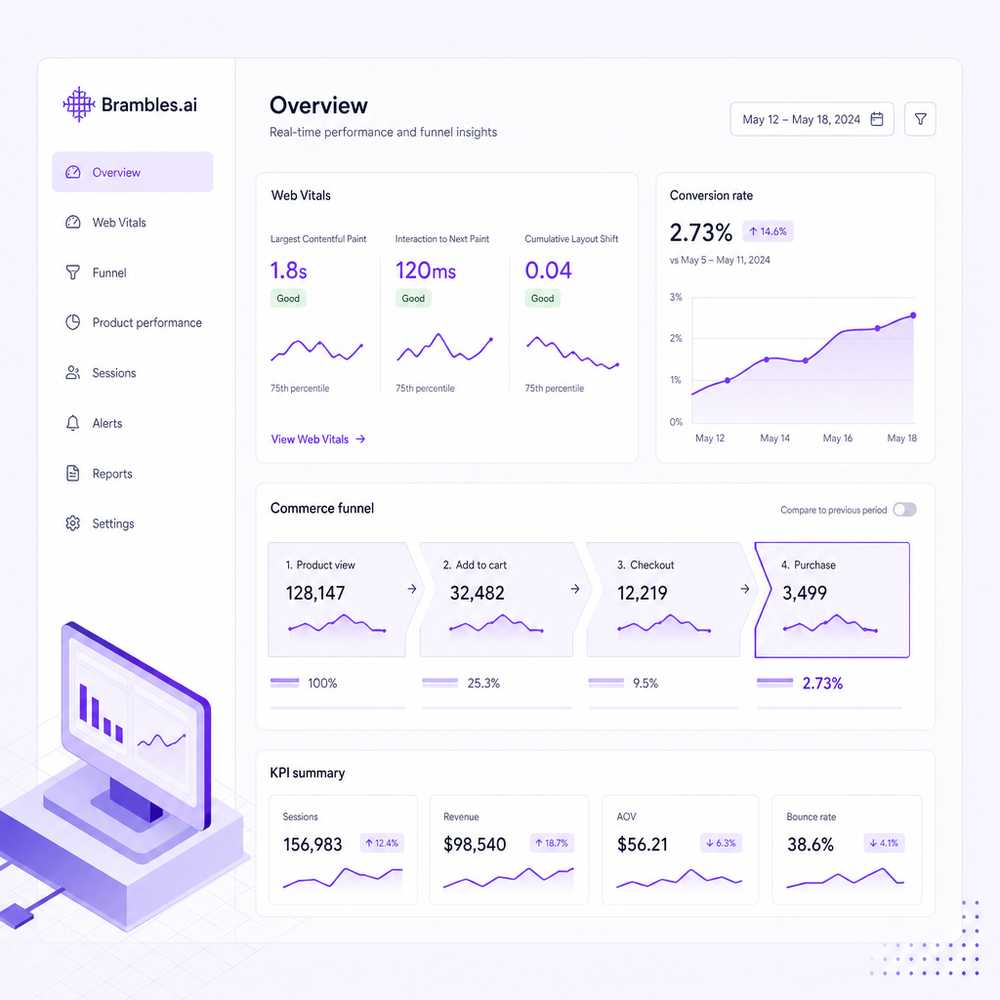
Track two layers: UX health and revenue. UX: LCP, INP, CLS, TTFI on pages with widgets (field data, not lab). Revenue: CTR to merchant, conversion rate to cart or purchase, AOV, EPC (earnings per click), and gross margin after platform fees. Attribution windows matter; align Sovrn and Amazon windows with your revenue rollups. Build a simple weekly funnel: pageviews → product_view → click_out → checkout_start → purchase. On a 100k-session apparel site, tightening hydration scope and caching PA-API shifted click_out rate from 7.8% to 10.9%, while LCP improved from 2.5s p75 to 2.2s (CrUX-aligned sampling). McKinsey’s work on personalization shows revenue lift when relevance is explicit; operationalize that by ranking products using recent click_out rate and price freshness, not just editorial picks. Put a guardrail: if INP degrades beyond 300ms p75, pause any experiment that increases client JS.
First-party data and trust
Consent first. Wire your CMP so the module won’t initialize analytics until opt-in; still render prices and stock because they’re functional. Use a first-party cookie or signed token to link events, rotating IDs every 24–48 hours. Salesforce’s Connected Customer research shows users expect personalization when it’s transparent—put a preferences link near the widget: price alerts on/off, hide stores, currency. For Amazon, avoid storing raw PII; your serverless cache should keep only ASIN, price, currency, and a timestamp. For Stripe Connect, secure webhook endpoints with signed secrets and idempotency keys; never trust client-only status. Data retention: 13 months for anonymous clickstream is typical; purge partner click IDs earlier if policy requires. Give users a simple CSV export of their preferences and opt-outs; it’s low-cost and builds credibility.
Common pitfalls and how to avoid them
- PA-API client calls. Don’t. Browser requests will be throttled or blocked; always hit your proxy.
- Cache stampedes. Warm popular SKUs and apply jittered TTLs to avoid thundering herds on cache expiry.
- Double affiliate rewrites. Run outbound links through one canonical function; disable other partners’ auto-rewriters.
- Stripe Connect fees. Forgetting the platform fee or application_fee_amount leads to margin surprises; set it server-side, not in the client.
- CMP race conditions. Initialize the module after consent or gate trackers behind the CMP event; otherwise, you risk ghost hits.
- Over-hydration. In Next.js, avoid dynamic imports with ssr:false for whole sections; hydrate only the widget.
- Attribution drift. Align time zones and windows across Sovrn, Amazon, and your warehouse; reconcile weekly with a click_id join.
Future outlook: lighter clients, smarter servers
Edge runtimes and partial hydration are converging on the same promise: ship less JS and push data work to fast, cheap servers. Expect Amazon to lean more on signed, server-to-server patterns; plan for stricter throttles and more aggressive policy enforcement. Sovrn and other affiliate platforms are already normalizing server-side postbacks—lean into that to survive ad blockers. Stripe continues to improve Connect onboarding; keep your flows modal-based and pre-seeded. The winning pattern is boring on purpose: tiny client runtime, semantic DOM for products, serverless proxies with resilient caching, and a single event stream that can feed analytics and partners alike. Teams that stick to this saw faster pages and more revenue with fewer scripts, not more.
Helpful resources and next steps below.
Related posts
View all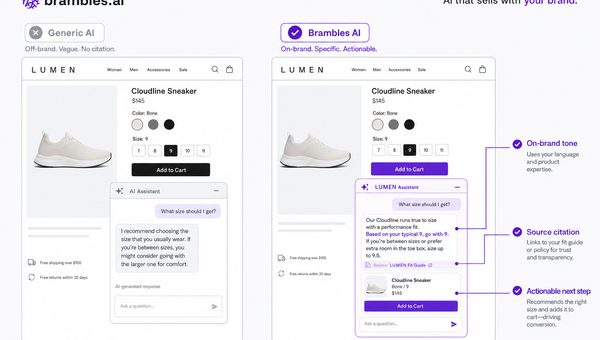
Brand-Consistent AI Chats Build Trust and Conversions
When AI mirrors your brand voice, shoppers relax—questions get answered, carts grow, and support load drops. Learn the playbook to align tone, trust, and ROI.
How Context-Aware AI Recommendations Lift CTR
See how context-aware AI recommendations lift CTR by 25–60% with intent signals, page context, and history. Practical steps, KPIs, and implementation tips.
Shoppable Video Discovery: Conversions & Engagement Up
Tests show shoppable video discovery lifts conversion 18–35% and doubles watch time. See the UX patterns, KPIs, and how to deploy it quickly with Brambles.ai.
Explore Brambles.ai
Learn more about our AI-powered agentic commerce platform, agentic shopping, and shopping assistance solutions.
Explore More Insights
Discover more articles on AI, automation, and business innovation
View All Articles