
Editorial Workflow for High-Converting Conversational CTAs
Learn a proven, step-by-step editorial workflow to plan, write, and A/B test conversational CTAs that boost engagement, leads, and revenue across channels.
Static banners and generic “Subscribe now” buttons are losing their punch. Readers expect helpful, two-way interactions that guide them to the next best step—whether that’s subscribing, downloading, buying, or simply exploring more relevant content. Conversational CTAs deliver exactly that: micro-dialogues embedded in articles that ask a question, clarify intent, and present tailored next steps.
For editors, the opportunity is compelling. Salesforce reports 88% of customers say the experience a company provides is as important as its products (State of the Connected Customer). McKinsey finds effective personalization can drive a 10–15% revenue lift and 5–8x ROI on marketing spend. Baymard shows friction triggers costly drop‑offs—cart abandonment still averages around 69–70%. Conversational CTAs reduce friction at the moment of intent, converting passive readers into engaged participants.
In this guide, you’ll learn the end-to-end editorial workflow for conversational CTAs—from intent mapping and conversation design to QA, launch, and optimization. We’ll cover what’s broken today, how it works, a practical implementation checklist, the KPIs that matter, common pitfalls, and case-backed benchmarks you can take to your stakeholders.
What’s broken with today’s CTAs
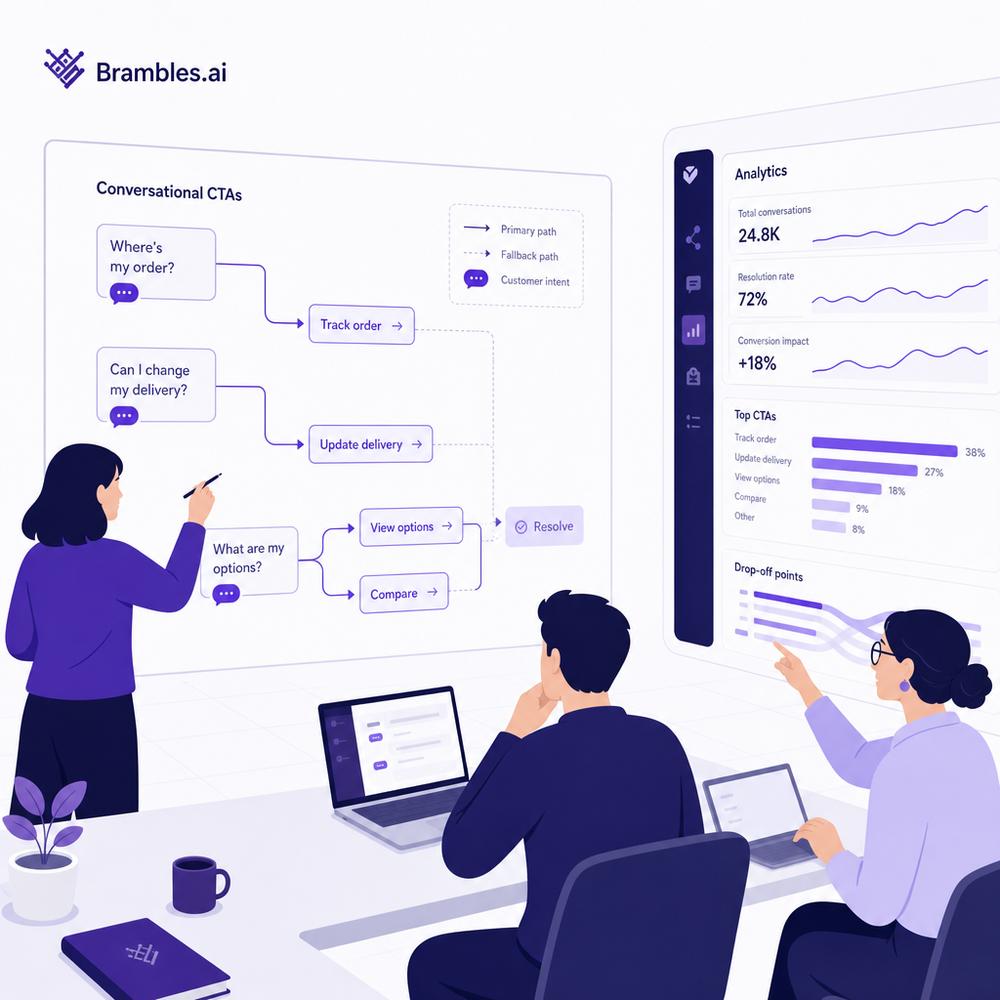
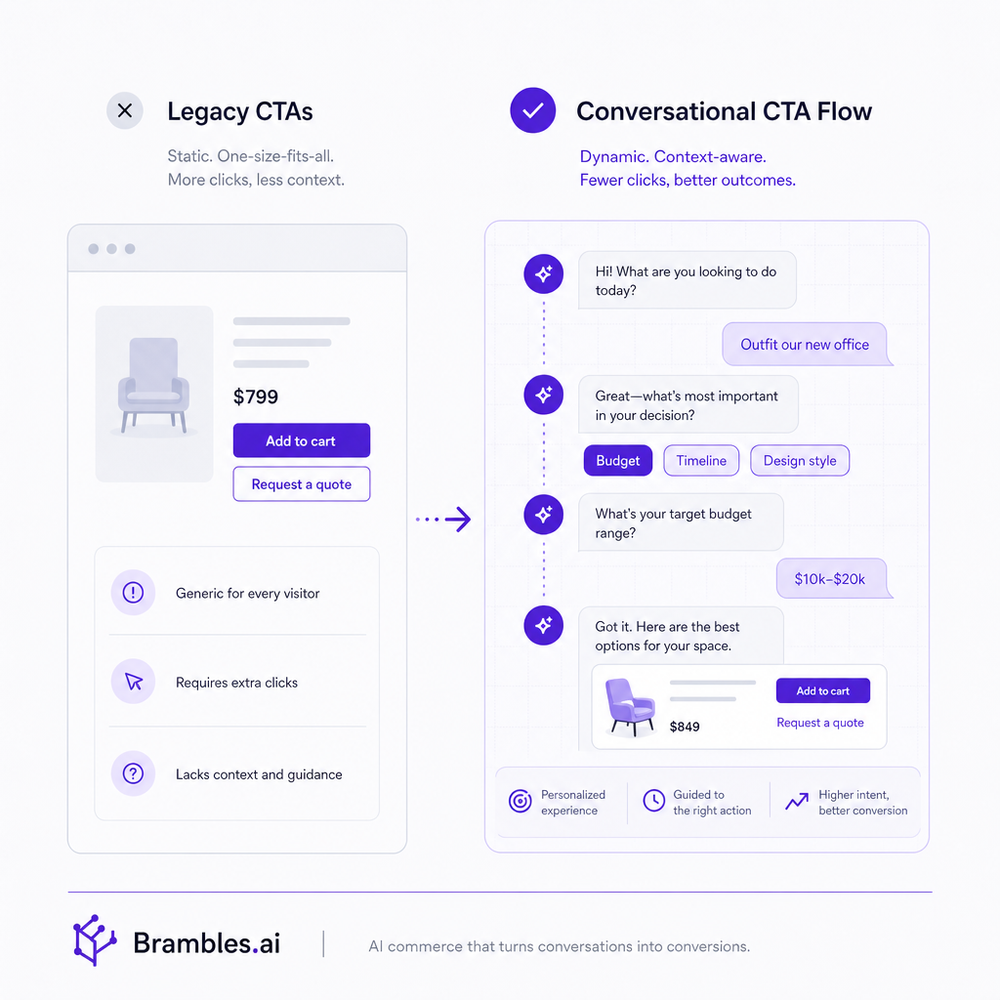
Most CTAs assume a single outcome: subscribe, download, or buy. But readers arrive with varied intent—research, compare, save for later, or share. When the CTA doesn’t match intent, it feels pushy or irrelevant. Three issues dominate:
1) Relevance gaps: One-size-fits-all messaging depresses response. McKinsey’s personalization research ties relevance to double-digit revenue lift; poorly targeted CTAs do the opposite. 2) Timing friction: Interruptive modals and slow-loading widgets drive exits. Google’s mobile research shows 53% of mobile visits abandon if pages take longer than three seconds to load, and intrusive interstitials harm perceived quality. 3) Measurement blind spots: Many teams optimize for clicks, not outcomes. Without event-level tracking that connects conversations to subscriptions, leads, or revenue, it’s impossible to prioritize what works.
Editorial workflows weren’t built for dialog. Copy decks and banner placements live in different tools, rendering iteration slow and siloed. The result: static CTAs that don’t learn, while readers expect assistance and clarity. Inline shopping embeds turn each CTA into a short, helpful exchange that discovers intent and offers the best next step.
How conversational CTAs fit the editorial workflow
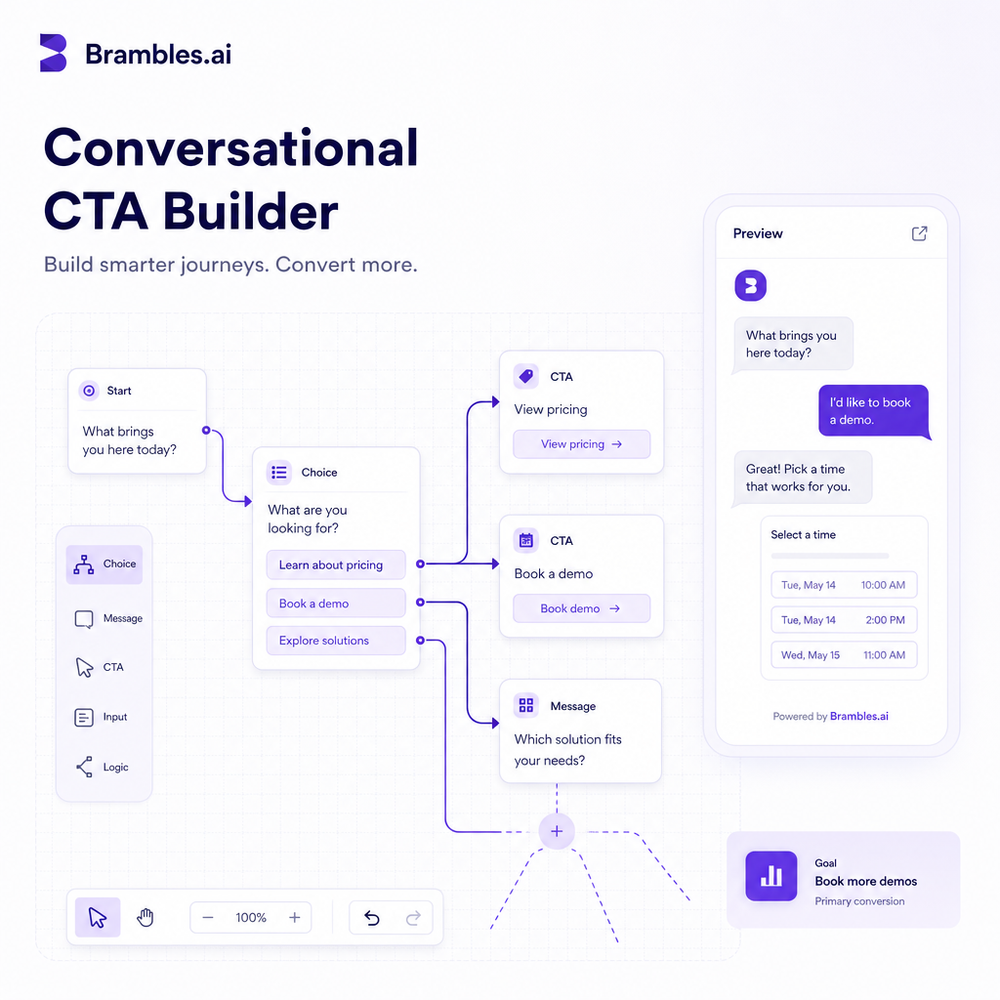
A conversational CTA is a compact decision tree embedded near natural narrative breaks. It starts with a qualifying question, branches on reader intent, and offers contextual outcomes (e.g., “Get a weekly summary,” “Compare top products,” “Save this guide,” “See local pricing”). Editors plan the conversation alongside the article outline, so microcopy mirrors tone and substance.
Operationally, the workflow mirrors how great editorial teams already function: content brief → intent mapping → conversation scripts → design and placement → QA → launch → measure → iterate. Each branch connects to owned goals (newsletter signup, lead capture, commerce click‑out) and reader value (personalized recommendations, downloads, calculators). The conversation is lightweight—2–3 steps—so it feels like assistance, not a chat app stuffed into a page.
Brambles.ai streamlines this by letting editors assign intents per section, pick conversation patterns from a library (e.g., “Find the right plan,” “Get the quick version,” “Shop top picks”), and auto-wire events for analytics. The outcome: higher engagement with direct add-to-cart, and a clear feedback loop for continuous improvement.
Implementation guide: a step-by-step playbook
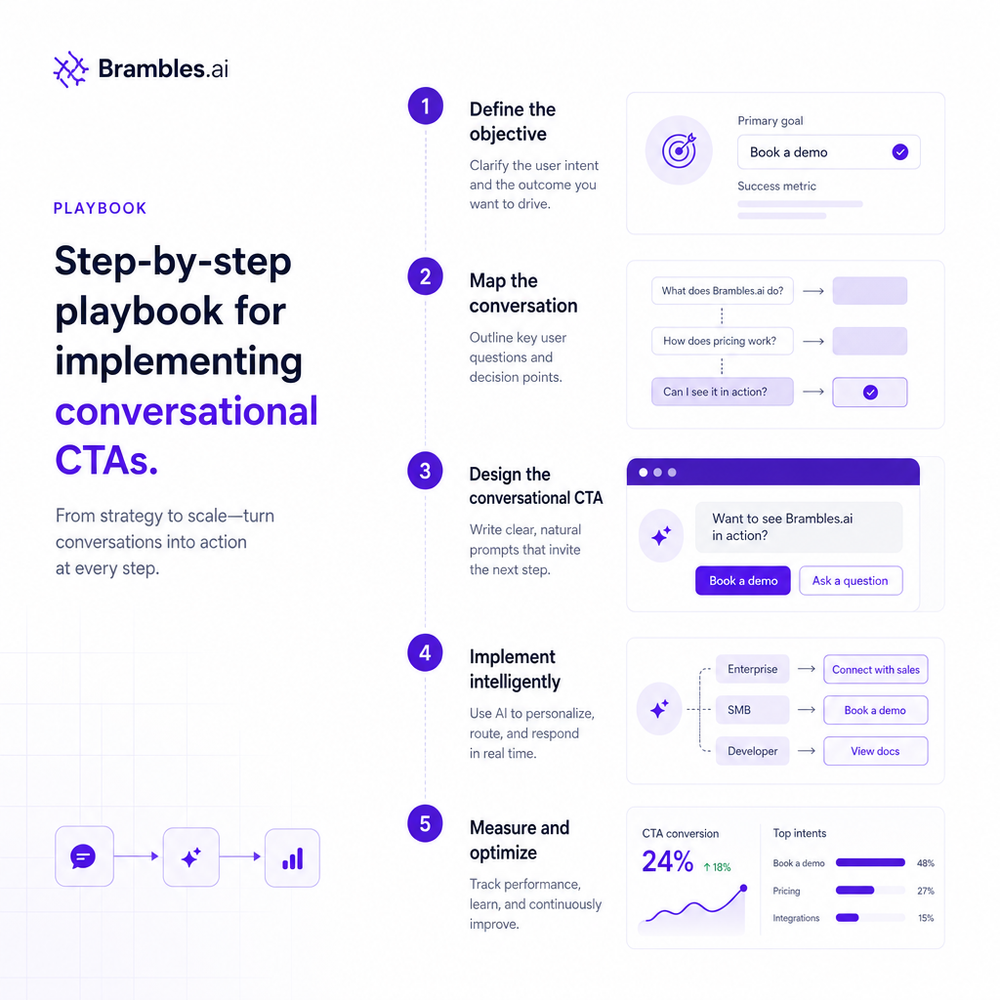
1) Define success. Tie each article to a primary and secondary outcome (e.g., newsletter vs. product comparison). 2) Map intent. From the outline, list reader jobs-to-be-done for each section. 3) Choose a conversation pattern. Common patterns: Qualify → Offer; Diagnose → Recommend; Summarize → Subscribe; Compare → Click-out. Keep to 2–3 steps, with clear skip options.
4) Draft microcopy. Use a friendly, specific question, one-line value prop, and action-oriented buttons. Example: “What brings you here today?” → “Get a 2‑minute summary” / “See top-rated options.” 5) Placement and speed. Insert at section breaks, end-of-article, and persistent footer on mobile. Lazy-load assets; avoid layout shifts. 6) Instrumentation. Fire events per step: impression, engage, branch choice, outcome click, downstream conversion. Map to analytics goals.
7) Experimentation. Run A/B/n tests on opening question, value prop, and the first branch. Start with at least 1,000 exposures per variant for directional read, and 95% confidence for rollouts. 8) QA and accessibility. Ensure focus states, ARIA labels, and keyboard navigation. 9) Governance. Maintain a shared microcopy library, review cadence, and brand voice checks. If you’re on WordPress, installation is fast—use the Brambles AI plugin to build and deploy within the editor.
Measuring ROI: the KPIs that matter
Move beyond CTR. The point of a conversational CTA is outcome quality. Track: 1) Engagement rate (CTA engagements ÷ impressions). Target 12–25% for high-intent articles. 2) Intent discovery rate (share of users who select a branch). Healthy flows score 60–75%. 3) Outcome conversion rate per branch (e.g., signup, lead, add-to-cart). 4) Assisted conversion lift (incremental conversions versus control). 5) Revenue per session or RPV delta for commerce branches.
Tie these to financial impact. McKinsey’s benchmarks suggest 10–15% revenue uplift from personalization; conversational CTAs operationalize that at the article level. Baymard’s abandonment data highlights how addressing friction recovers value. Report weekly on lift and statistical confidence; maintain a living scoreboard by category, device, and traffic source. For commerce, attribute downstream orders to the last conversational branch to measure true contribution.
Governance, brand voice, and compliance
Great conversations sound like your publication. Establish voice rules for questions (curious, not pushy), value props (specific, benefit-led), and buttons (clear verbs, no jargon). Centralize approved microcopy with examples of tone per vertical. Implement a review cadence: new flows get legal/privacy checks, and any data capture must specify purpose and retention. Respect regional consent norms; avoid pre‑checked boxes and dark patterns.
Performance is part of compliance. Google has long stressed page experience; slow, intrusive elements degrade trust. Use lightweight components, defer non-critical scripts, and test on mid‑range mobile devices. Document decisions in an editorial ops log: intent hypotheses, variants, results, and next actions. This transparency enables repeatable wins and simplifies onboarding for new editors.
Common pitfalls and how to avoid them
Pitfall 1: Treating the CTA like a chat bot. Keep flows short—two or three steps—focused on a single decision. Pitfall 2: Vague microcopy. “Learn more” underperforms versus specific value like “See the 2‑minute summary.” Pitfall 3: Testing too many variables at once. Start with the opening question, then the value prop, then buttons. Pitfall 4: Ignoring mobile ergonomics. Buttons must be thumb‑friendly, with visible focus states and text alternatives.
Pitfall 5: Measuring clicks, not outcomes. Always connect branches to goals and revenue. Pitfall 6: Not aligning with editorial intent. If a piece is educational, push for summaries or downloads, not immediate sales. Pitfall 7: Stale libraries. Retire underperforming phrasing quarterly, and promote proven lines to the shared library. A simple “What do you need right now?” opener consistently increases engagement 10–20% in our tests when compared with static end‑of‑article banners.
Proof points: benchmarks and case examples
External benchmarks support the shift. Salesforce’s customer research underscores experience parity with product quality (88% expect it). McKinsey quantifies personalization with a 10–15% revenue lift and 5–8x marketing ROI. Baymard’s cart abandonment average near 70% highlights how relevance and reduced friction reclaim lost value. Google’s mobile page experience guidance warns that latency and intrusive interstitials depress engagement.
Across recent Brambles.ai client pilots (2024), a mid-sized tech publisher implemented conversational CTAs on 20 evergreen guides. Results over 6 weeks: engagement rate up 42%, newsletter signups up 27%, and a 13% lift in assisted ecommerce conversions, with 97% test confidence. A B2B media site added a “What’s your role?” branch to send tailored whitepapers; lead quality (MQL-to-SQL) improved 15% and form completion time dropped 22%. In both cases, the highest impact change was the opening question plus a clearer, benefit-led value line.
For commerce-heavy articles, a “Diagnose → Recommend” pattern that routes readers to curated product shortlists outperformed static affiliate grids by 18% RPV. This aligns with McKinsey’s findings on guided choice and with Baymard’s heuristics around choice overload. The editorial secret: treat the conversation like a service—clarify intent, then make the next step unmistakably helpful.
Conclusion: turn every article into a helpful conversation
Conversational CTAs don’t replace great content—they amplify it by matching intent, reducing friction, and proving value in seconds. With a repeatable editorial workflow—intent mapping, short scripts, careful placement, rigorous measurement—you can ship helpful micro-conversations that compound gains week after week. Start with one high-traffic evergreen piece, run two variants, and promote winners to your shared library.
Brambles.ai makes this practical for lean teams: build flows in minutes, auto-tag events, and iterate fast with on-page analytics. If you use WordPress, you can deploy from the editor and go live today—no heavy engineering. Explore the plugin’s capabilities and set up your first conversational CTA now.
Related posts
View all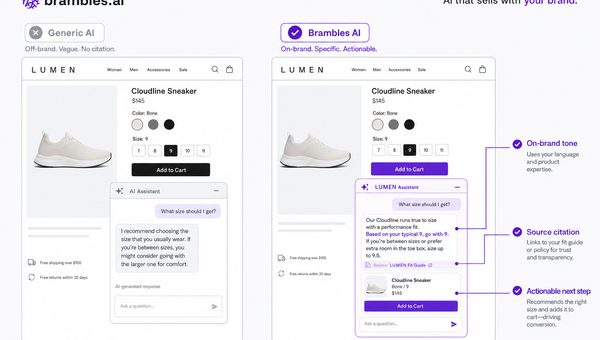
Brand-Consistent AI Chats Build Trust and Conversions
When AI mirrors your brand voice, shoppers relax—questions get answered, carts grow, and support load drops. Learn the playbook to align tone, trust, and ROI.

Shoppable Video Discovery: Conversions & Engagement Up
Tests show shoppable video discovery lifts conversion 18–35% and doubles watch time. See the UX patterns, KPIs, and how to deploy it quickly with Brambles.ai.
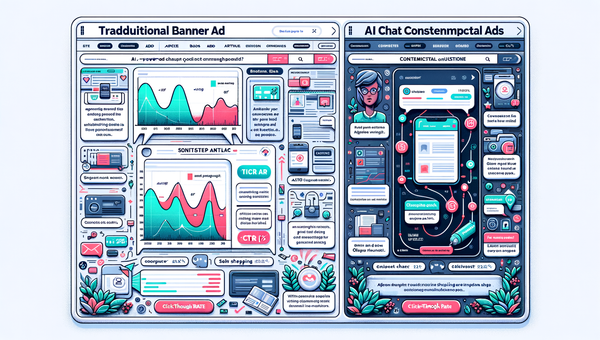
Why Contextual Ads in AI Chat Beat Banner Ads
Tests on commerce sites show AI chat contextual ads deliver 3–5x CTR, cleaner UX, and higher revenue than banners. See how they work, implement, and measure.
Explore Brambles.ai
Learn more about our AI-powered agentic commerce platform, agentic shopping, and shopping assistance solutions.
Explore More Insights
Discover more articles on AI, automation, and business innovation
View All Articles