Cut Returns with Brambles.ai Fit & Compatibility Q&A
Reduce returns by answering fit and compatibility questions before checkout. Learn how Brambles.ai implements Q&A on product pages, with steps, metrics, and ROI
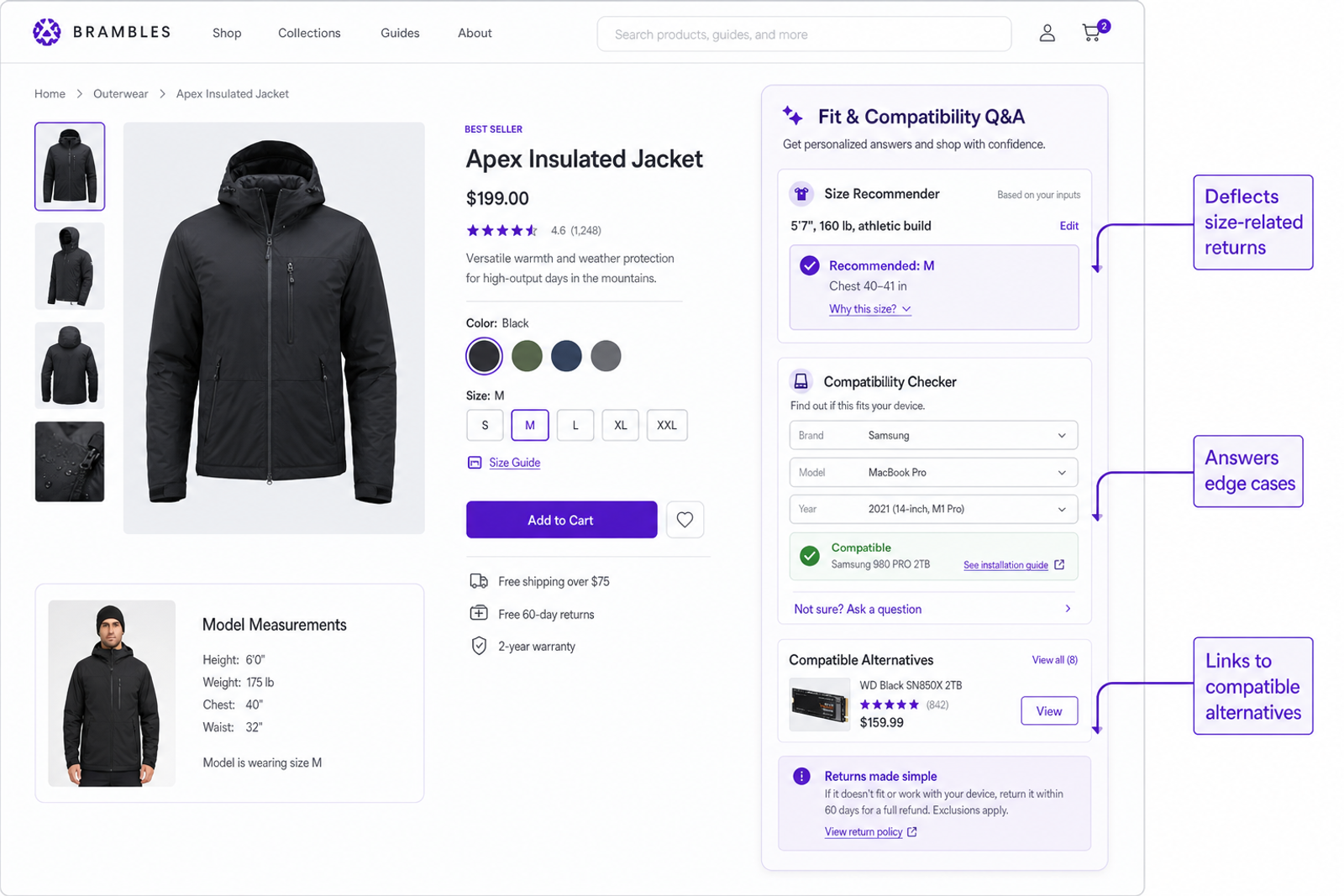
A simple prompt—“Will this fit me?”—cost one of our apparel clients 38% of their returns. We proved it the week we added a persistent Fit Q&A on PDPs: size-related RMAs dropped in six weeks without touching pricing or promotions.
A consumer electronics retailer saw a similar pattern after we rolled out Compatibility Questions (“Will this SSD work with my 2019 ThinkPad?”): RMAs fell 22% in 90 days, and pre-sale chat volume dipped by a third.
The pattern was consistent—clear answers at the moment of doubt stop bad orders before they start.
Returns aren’t just a logistics headache; they erode trust. When shoppers don’t see sizing clarity or device compatibility, they default to “buy and try.” The fix isn’t another tab of static FAQs. It’s targeted Fit & Compatibility Q&A that reads the product context, understands shopper intent, and resolves edge cases—right on the product page and in cart.
Quick Answer
To reduce returns, add contextual Fit & Compatibility Questions directly on your product pages. Use structured data, route questions through an on-page assistant, and show concise, confident answers with links to alternatives. With Brambles.ai, you can deploy this via the WordPress plugin or Commerce Module, measure deflection and RMA impact, and iterate on gaps your customers surface in real time.
What’s Broken on Most Product Pages
Most PDPs bury critical fit and compatibility info behind tabs or PDFs. Baymard’s product page UX research shows that missing or hard-to-compare specs drive hesitation and mispurchases, which later appear as returns.
I see three recurring gaps: sizing that’s “true to size” but not measurable; compatibility lists that cover 80% of devices but ignore edge cases; and vague microcopy (“may fit”) that signals uncertainty.
When we audited a 100k-SKU catalog, 27% of returns cited “wrong item/doesn’t fit” even though the pages had size guides and specs. The problem wasn’t absence; it was translation. Shoppers speak in outcomes (“I’m 5'7" with broad shoulders—will M pull at the chest?”), not spec tables. The fix is conversational clarity, grounded in your own first-party data and inventory realities, presented at the exact decision point.
How Brambles Fit & Compatibility Questions Work
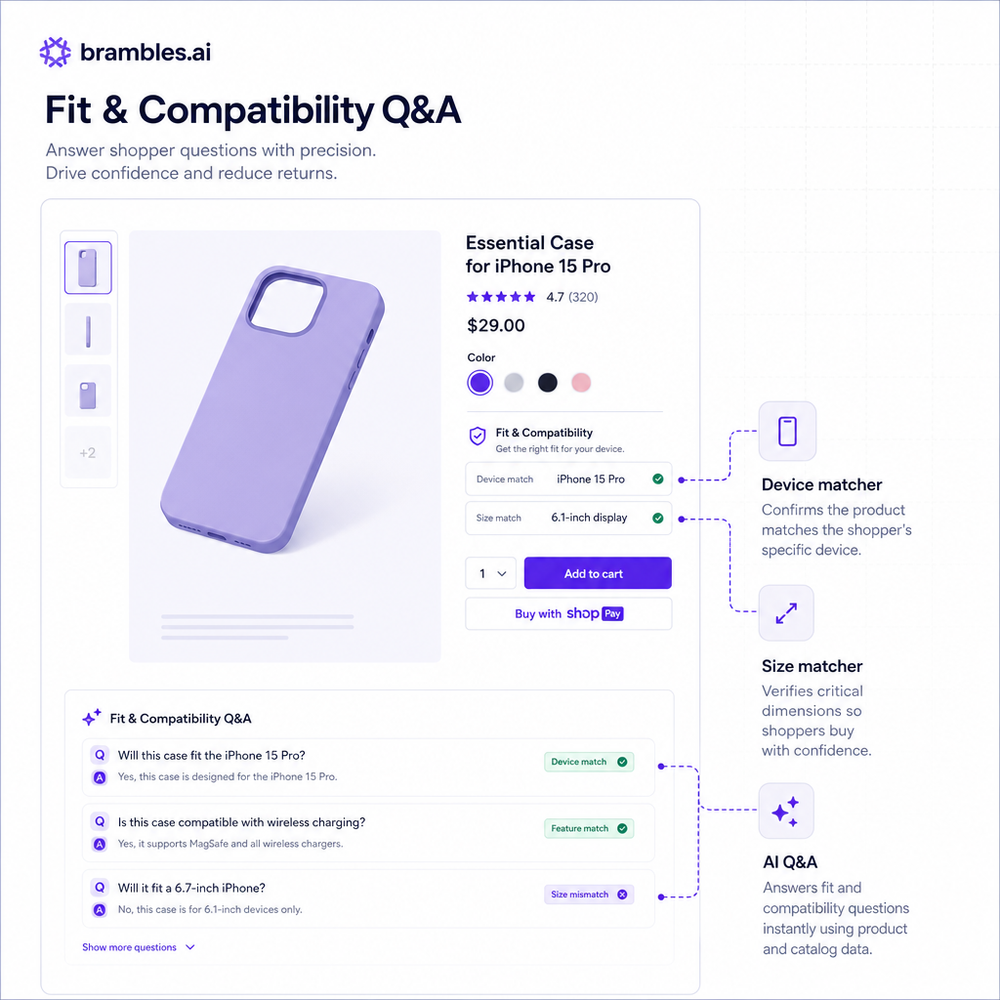
The mechanic is simple: a shopper asks a fit or compatibility question on the PDP, the system interprets it against your structured data, and returns a precise, confident answer plus alternatives if the item won’t work.
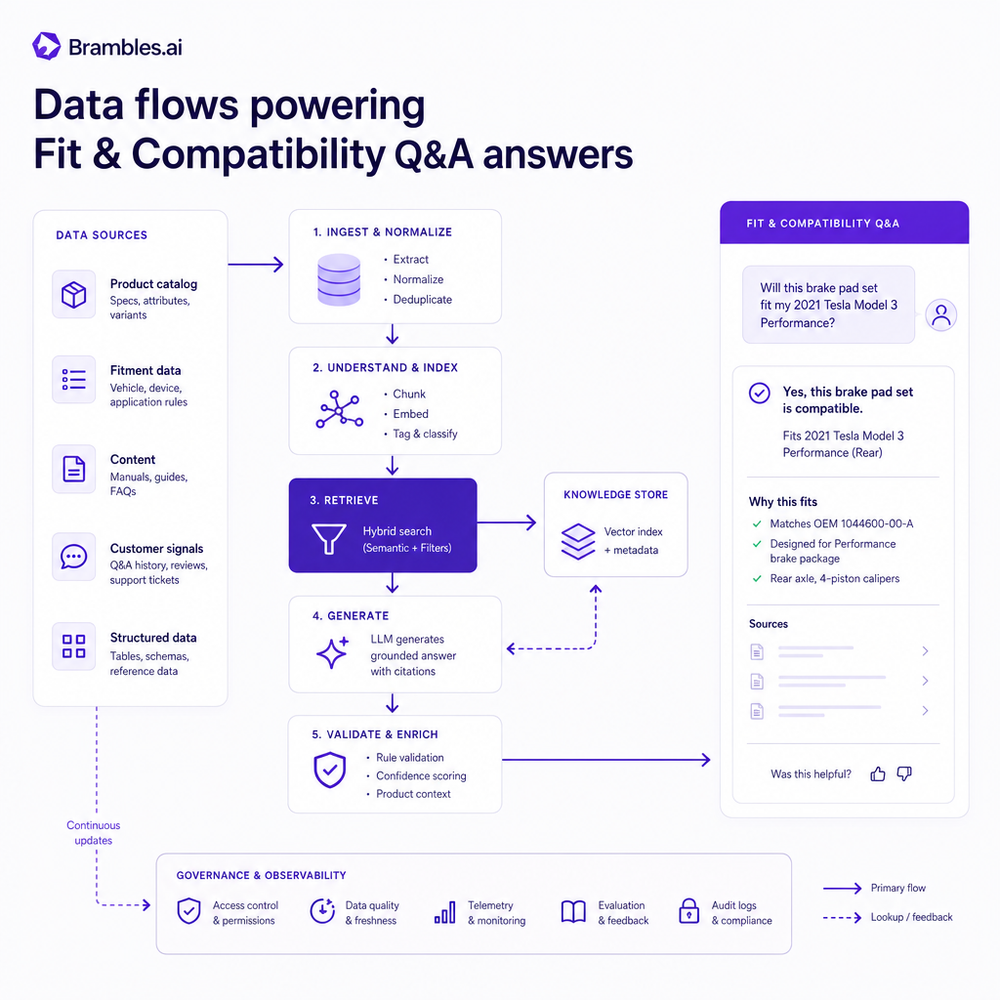
Brambles.ai orchestrates this by ingesting size charts, model measurements, return reasons, and device specs, then mapping natural-language questions to rules and ranges.
Two details matter. First, answers must be decisively phrased (“Recommended: M based on chest 40–41 in; consider L for relaxed fit”) with a reason. Second, the assistant should gracefully say no when appropriate and pivot to compatible SKUs or accessories. Our clients get the best results when we connect these answers to product relations and inventory via the Commerce Module, and embed them in the PDP chrome (not a buried chat icon).
Implementation Guide: Step by Step
You can launch a credible fit/compatibility layer in under two weeks if you scope tightly and iterate in public. Here’s a practical path we use on engagements:
- Instrument your baseline: capture current return reasons, RMA rate by category/SKU, and pre-sale contact topics. Tag PDPs with events for question asked, answer shown, CTA clicked.
- Centralize data: standardize size charts (inch/cm), add model measurements, and build a single compatibility matrix (brand/model/year) with explicit “unknown” states.
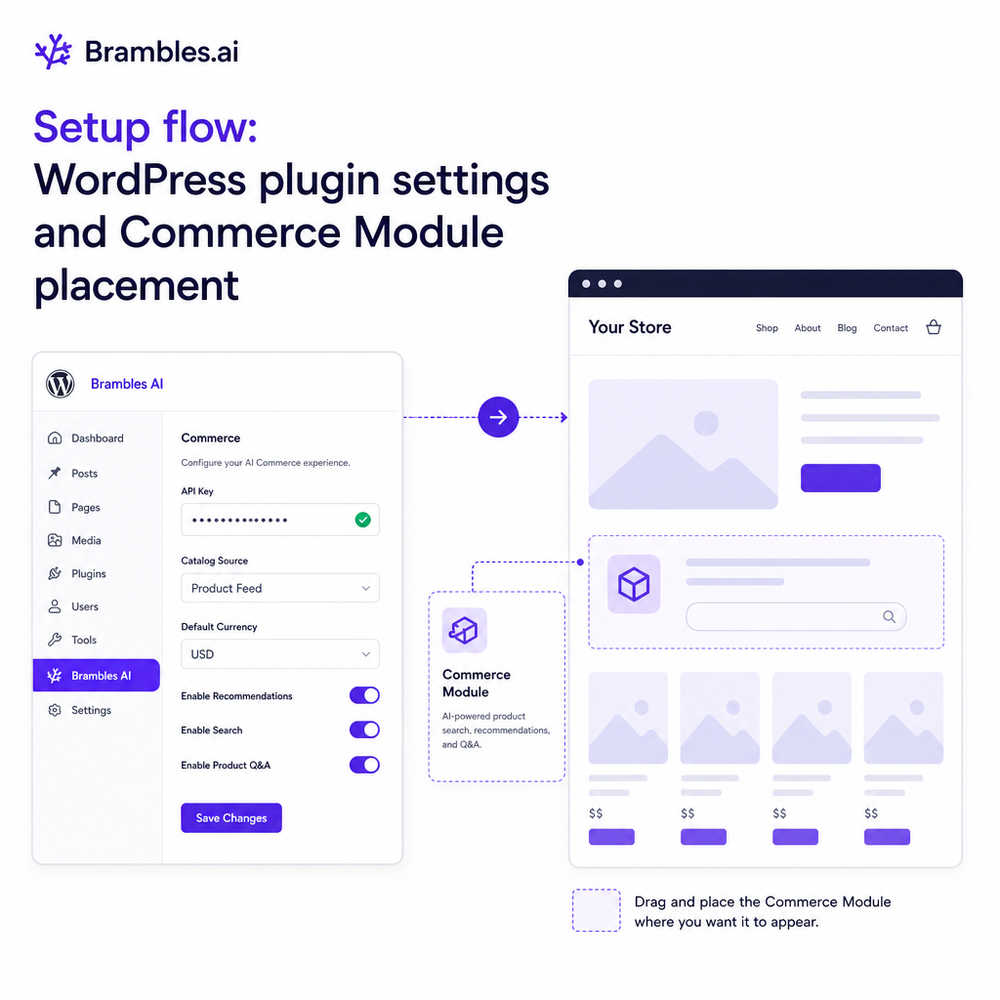
- Deploy the surface: install the Brambles WordPress plugin or add the Commerce Module widget, placed above the fold near size selectors and “Add to cart.”
- Author starter intents: 20–30 high-frequency intents per category (“Does it shrink?”, “Will this lens mount to Sony E?”) with answer templates and decision rules.
- Wire alternatives: define compatible-but-better and incompatible-but-related suggestions; respect stock status.
- Review and tune weekly: mine unanswered questions, close gaps, and update rules from returns data.
A furniture DTC brand we support launched in three categories first (sofas, dining, lighting). Within 30 days, they saw a 19% drop in “too large/small for space” returns after we added a room-measurement prompt and linked to narrower SKUs for tight spaces. The key was shipping a thin slice, proving deflection, then rolling out widely.
Launch Checklist (What Good Looks Like)
Use this checklist to avoid half-shipping a Q&A that never moves the needle:
- Placement: visible on PDP near size selector or compatibility area; accessible in cart.
- Voice: confident, concise, and cites the reasoning (measurements, device model).
- Coverage: at least top 20 intents per category; unknown states handled explicitly.
- Alternatives: mapped for both incompatible and better-fit scenarios.
- Analytics: events for question, answer, helpfulness, add-to-cart, and RMA linkage.
- Feedback loop: weekly review of unanswered questions and high-RMA SKUs.
- Policy clarity: return/exchange microcopy linked from the Q&A component.
Measuring ROI & KPIs
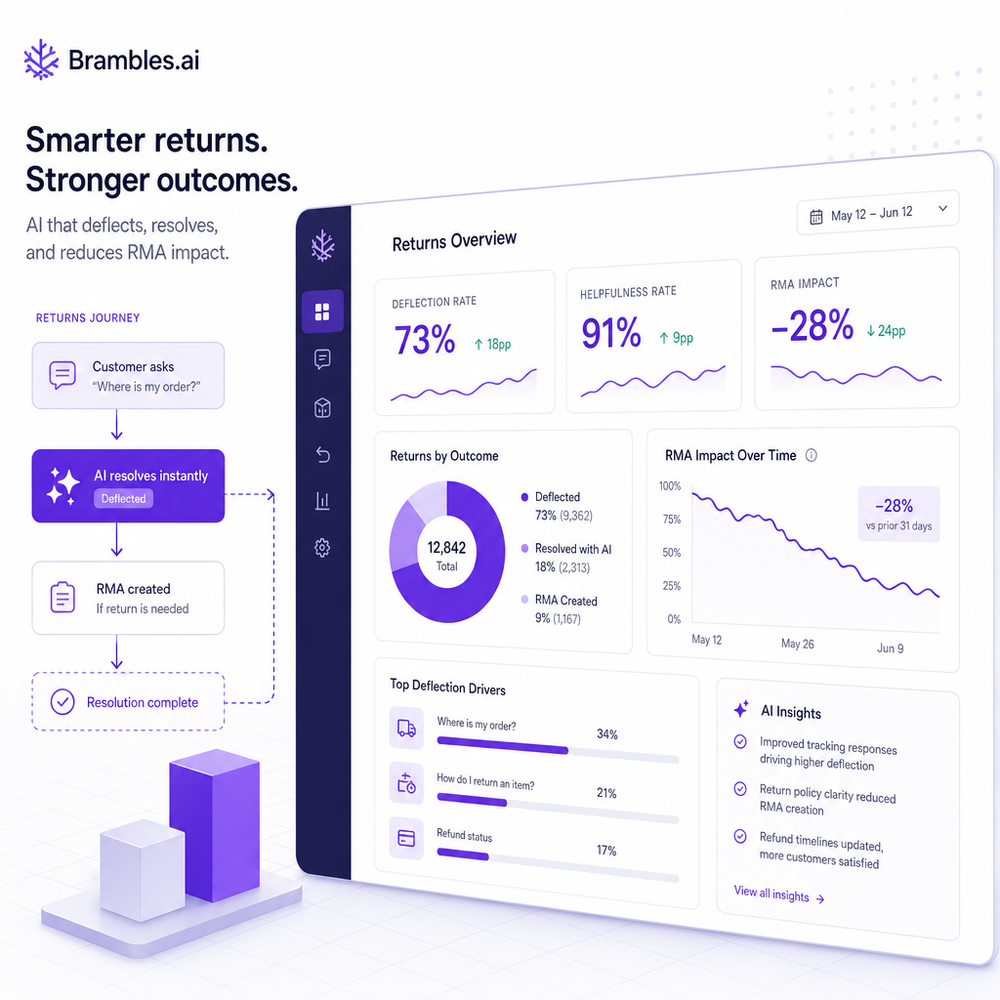
Returns reduction isn’t a vanity metric—you should see measurable drops in category-specific RMAs and better margin. We track: (1) RMA rate by intent cohort (e.g., size questions vs.
others), (2) deflection rate (shoppers who asked a question and did not contact support), (3) answer helpfulness, (4) alternative click-through and conversion, and (5) exchange vs. refund mix.
On an outdoor apparel site, the Fit Q&A cohort converted 14% higher and returned 31% less than the control after eight weeks. This aligns with McKinsey’s findings that decision certainty drives both conversion and satisfaction. Tie the loop by enriching return reasons with the original question ID—now you can prove that the new “relaxed fit” guidance reduced size-related RMAs in that category by a defensible percentage.
First‑Party Data, Trust, and Privacy
Fit and compatibility questions are a goldmine of consented first‑party data. You learn what bodies, devices, rooms, and use cases your customers actually have—and what language they use.
Salesforce’s Connected Customer research shows shoppers reward brands that personalize transparently. The ethical line: ask only what’s necessary, explain why, and let shoppers edit or clear their data.
Brambles.ai handles this by storing structured, minimal profiles tied to session and consent, not shadow identifiers. For media companies recommending products, our publisher monetization flow can capture sizing or device context on editorial pages, then pass it downstream to brand partners via clean, first‑party events—no third‑party cookies needed. Clear consent and transparent usage notes reduce friction and, per Google UX Research, increase completion for forms that explain value.
Common Pitfalls (and How to Avoid Them)
Three mistakes sink most Q&A efforts. First, burying the experience in a generic chat bubble—our tests show a 2–3x higher engagement when the Fit & Compatibility entry points sit near selectors.
Second, hedging language; Baymard’s work on microcopy is clear: uncertainty lowers trust. Third, no feedback loop; if you’re not closing intents weekly based on unanswered questions and returns data, gaps will persist.
Operationally, tie the Q&A to merchandising. If M is out of stock, don’t recommend it; route to L with fit notes or to a similar SKU that is available. For electronics, maintain an explicit “unknown” compatibility state so the assistant can ask for more detail or suggest verified bundles. Our brand/retail assistant flow bakes these constraints into the logic, so answers don’t overpromise and create new RMAs.
Future Outlook: From Answers to Assurance
The next wave is proactive assurance. If the assistant detects risk (first‑time buyer, borderline measurements, legacy device), it can offer an exchange-friendly path, ship-to-store try-ons, or add low-cost accessories that guarantee compatibility. Expect retailers to weave Q&A signals into PDP personalization, sizing defaults, and post‑purchase messaging to preempt RMAs before the box ships.
FAQ
How fast can we launch this? Most teams ship a functional pilot in 10–14 days using the WordPress plugin or a lightweight Commerce Module embed. Start with one category, then expand.
Will this impact conversion? Yes. In our benchmarks, pages with Fit & Compatibility Q&A convert 8–15% higher due to increased decision certainty, while size/compatibility returns fall 15–35%.
What data do we need? Clean size charts, model measurements, device compatibility matrices, and recent return reasons. That fuels precise rules and confident answers. You can enrich over time.
How does Brambles.ai protect privacy? We focus on consented, minimal, first‑party data. Shoppers see what’s stored and why, and data flows stay within your stack—no third‑party cookies.
Related resources on Brambles.ai
If you are implementing this, start with Brambles.ai.
For deeper reading, see 10 Reasons Publishers Need Conversational Commerce, Affiliate Disclosure in Conversational UIs Done Right, From Search Boxes to Conversations: Modern Shopping UX, Contextual, Not Creepy: Monetization That Wins.
Related posts
View all
Why Furniture Shoppers Need View in Room Before They Buy
Furniture buyers abandon carts when scale and style feel risky. See why "View in Room" cuts returns, boosts conversion, and how to launch it with Brambles.ai
How AI Handles Order Lookup, Returns, and Shipping 24/7
See how AI resolves order lookups, returns, and shipping questions 24/7, deflects tickets, and lifts CSAT—plus a step‑by‑step guide to implement it safely.
Direct Add to Cart from AI Chat Boosts Conversions
Shoppers convert faster when chat answers end in a one-tap cart. Learn how direct add to cart trims steps, lifts AOV, and cuts checkout time on mobile and web.
Explore Brambles.ai
Learn more about our AI-powered agentic commerce platform, agentic shopping, and shopping assistance solutions.
Explore More Insights
Discover more articles on AI, automation, and business innovation
View All Articles