AI Shopping FAQs (PAA): Answers with Brambles.ai
Shoppers ask if AI shopping is accurate, private, and worth it. We answer the top PAA questions with lived examples from Brambles.ai and an implementation guide
What People Also Ask About AI Shopping: Answered with Brambles.ai Examples
Last quarter, a bedding retailer sent us 2,100 shopper transcripts tagged “not sure what I need.” After launching conversational product discovery, the time-to-first-relevant product dropped from 2:37 to 0:41, and bounce rate on PDP visits fell 18%. A week later, their CX lead DM’d: “Customers stopped wandering.” That’s the pattern we keep seeing. When the AI is grounded in your catalog, content, and policies, hesitation turns into confident choices—and questions in People Also Ask (PAA) turn into revenue moments.
Another snapshot: on a 100k-session apparel site, swapping static recommendation widgets for conversational AI lifted assisted conversion rate by 32% and average order value by 9% in 21 days. The common PAA themes—accuracy, privacy, speed, ROI—are solvable with the right implementation. Below, we answer the top questions with concrete Brambles.ai examples and a step-by-step rollout plan.
Quick Answer
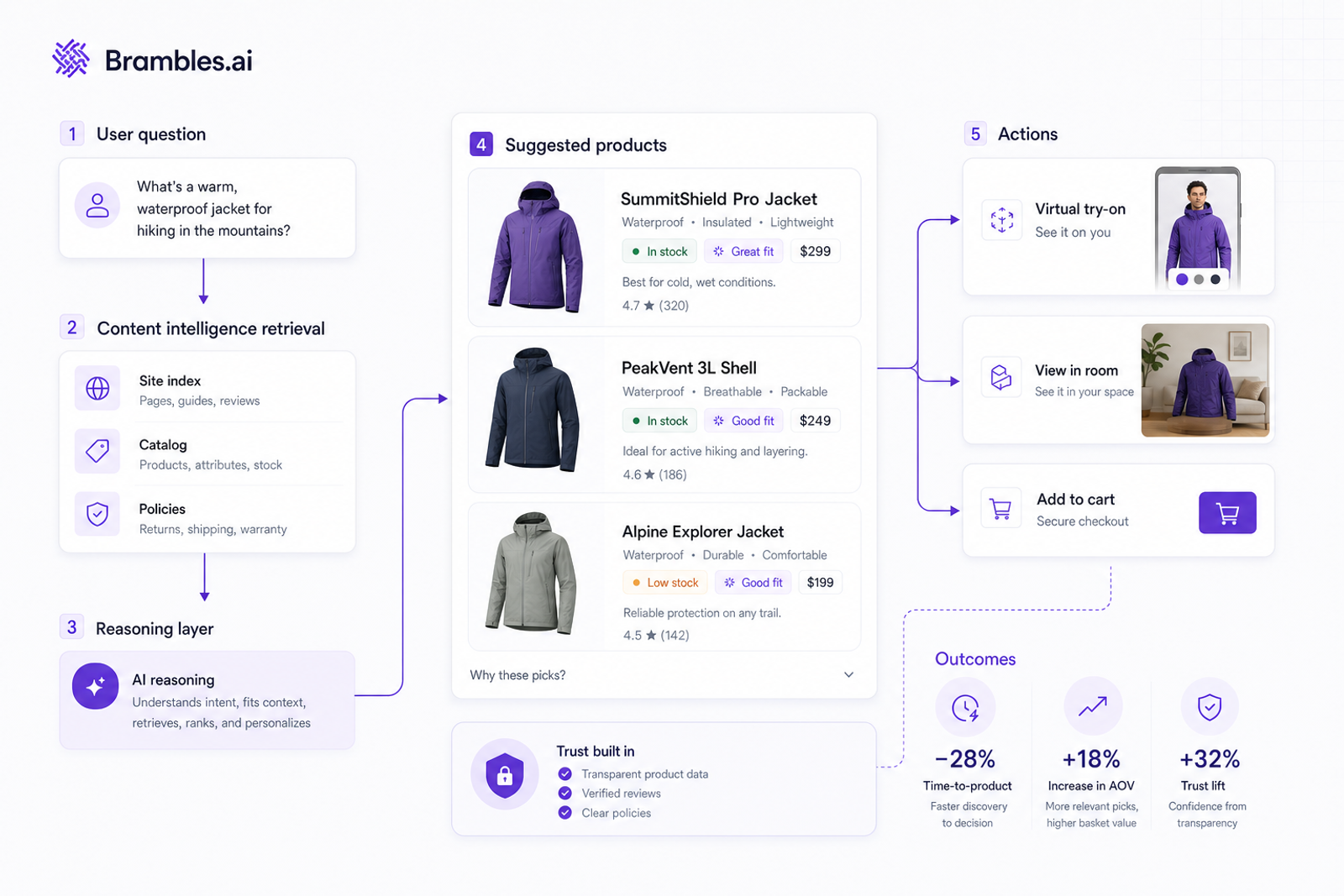
AI shopping works when it combines trusted first-party content with live inventory and clear guardrails. With Brambles.ai, shoppers ask in plain English, the AI retrieves structured product data and policy answers, then suggests 2–5 options with reasons and next steps (e.g., virtual try-on or add-to-cart). The fastest wins come from grounding via Content Intelligence, enabling AI Shopping Chat, and measuring assisted conversion, AOV, and time-to-product.
What’s Broken in AI Shopping (and What PAA Reveals)
PAA questions highlight four friction points: accuracy, privacy, integration effort, and ROI. Shoppers fear confident-but-wrong answers; teams fear black boxes and long dev cycles. Those fears are justified when AI sits apart from product data, policies, and UX flows.
Our audits echo Baymard’s long-standing UX findings: vague filters, hidden compatibility, and weak size/fit guidance kill confidence. Add generative answers that aren’t grounded, and trust erodes. The fix isn’t “more AI;” it’s better retrieval, declared reasoning, and tight handoffs to proven flows like size guides, view-in-room, and cart.
How It Works: Brambles.ai Examples That Answer PAA
Grounded retrieval prevents hallucinations. Brambles.ai indexes your catalog, PDP copy, size charts, returns policy, and stock in near‑real time using Content Intelligence, then retrieves facts before the AI explains anything. The AI cites attributes and links to relevant on-site resources when needed.
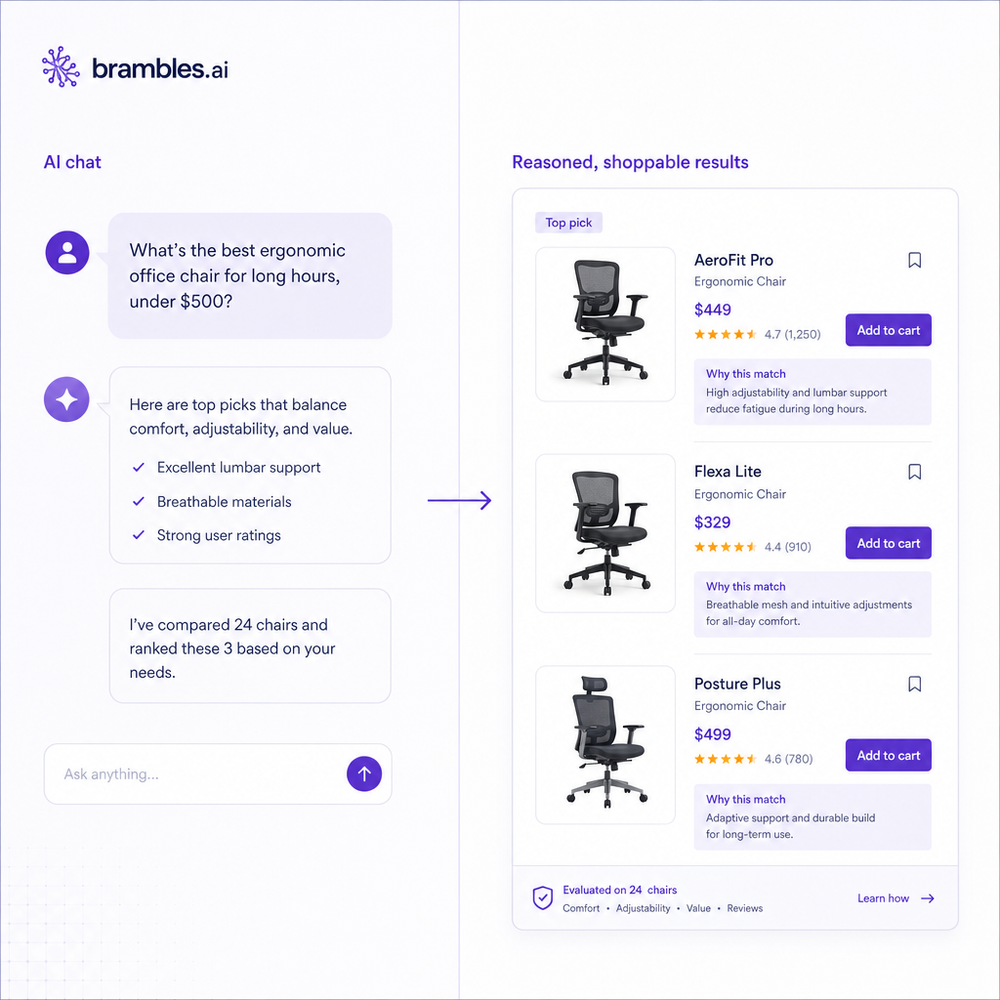
Natural-language product discovery. With AI Product Discovery, shoppers ask, “Quiet desk chair under $250 for hardwood floors, no PU leather.” The system returns 3–5 options with exact reasons (wheel type, material, noise). You can tune summarization depth and diversity to match your brand voice.
Engage at the right time, not all the time. Proactive Engagement can trigger when a user hesitates on a category page—e.g., “Need help sizing? I can compare fits across brands.” This respects intent and lifts assisted sessions without feeling pushy.
Bridge curiosity to purchase. Direct Add to Cart lets users add variants from chat without page-hopping, while Virtual Try‑On and View in Room reduce returns by setting accurate expectations. On a DTC eyewear test, enabling try‑on plus add‑to‑cart cut checkout time by 28%.
Publishers can monetize without pop-ups. When readers ask for alternatives in an article, Inline Shopping Embed surfaces relevant products contextually. Combined with Affiliate Revenue and Retail Media, we’ve seen RPM lift 22–45% on evergreen guides while keeping pages clean.
Implementation Guide: Rolling Out Brambles.ai
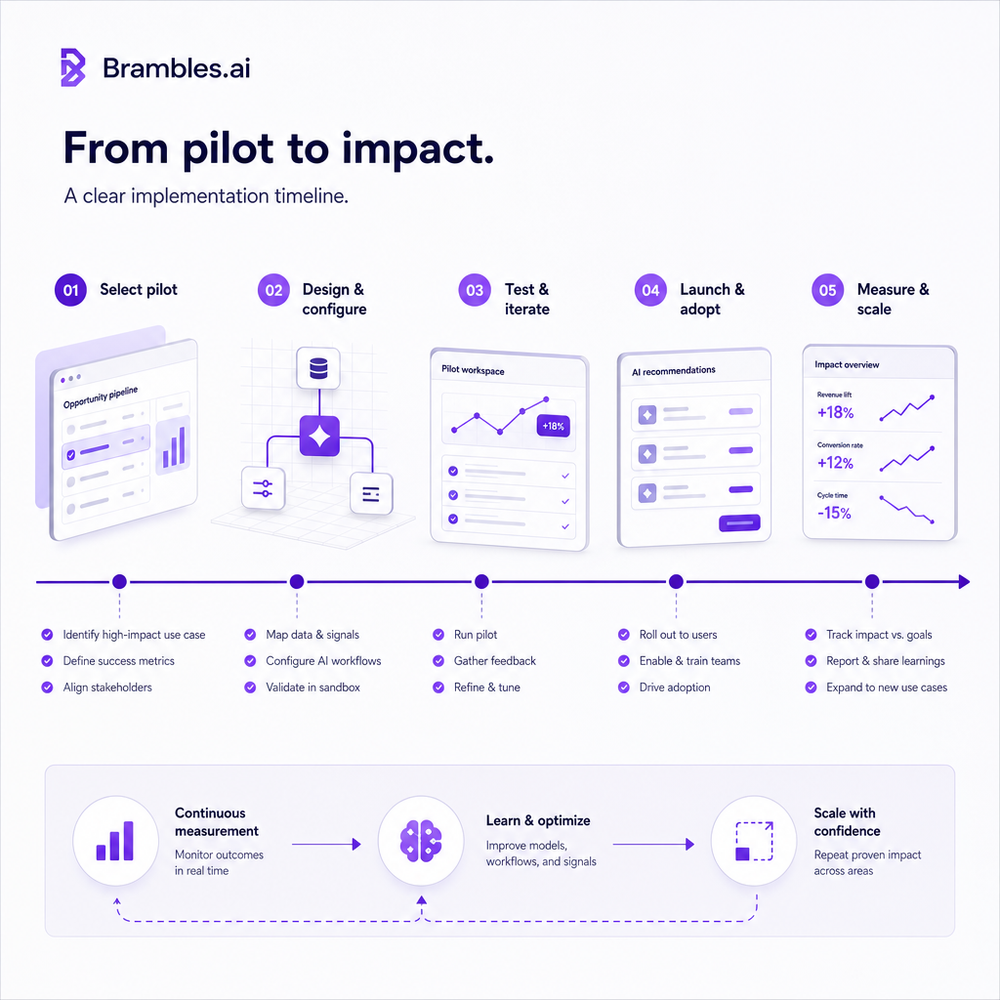
You can stand up a pilot in a week. Below is a pragmatic rollout that avoids scope creep and shows value fast.
1) Choose a high-intent surface. Pick a category, PDPs with fit/compatibility friction, or a buying guide with steady traffic. 2) Install the Agentic Commerce Module (copy-paste JavaScript) and verify load, CLS, and event tracking. 3) Index your site and catalog via Content Intelligence, including policies and size charts.
4) Configure personality and guardrails. Set tone, compliance boundaries, and fallbacks for uncertain answers. 5) Wire commerce actions: Direct Add to Cart, variant selection, and back-in-stock alerts. 6) QA with edge cases (bundles, low inventory, shipping cutoffs) and shadow live traffic for 48–72 hours.
7) Expand channels. For CMS-driven sites, the WordPress plugin is one-click. For retail platforms, the Shopify app accelerates catalog sync. Dev teams can fine-tune with our developer guides, events, and config schema.
Anecdote: a specialty footwear brand piloted on women’s running shoes. With Brambles.ai on the category grid and PDPs, size-related tickets dropped 26% and revenue per session rose 14% in 30 days. Their ops lead: “We shipped fewer wrong sizes in week one.”
Measuring ROI and KPIs You Can Trust
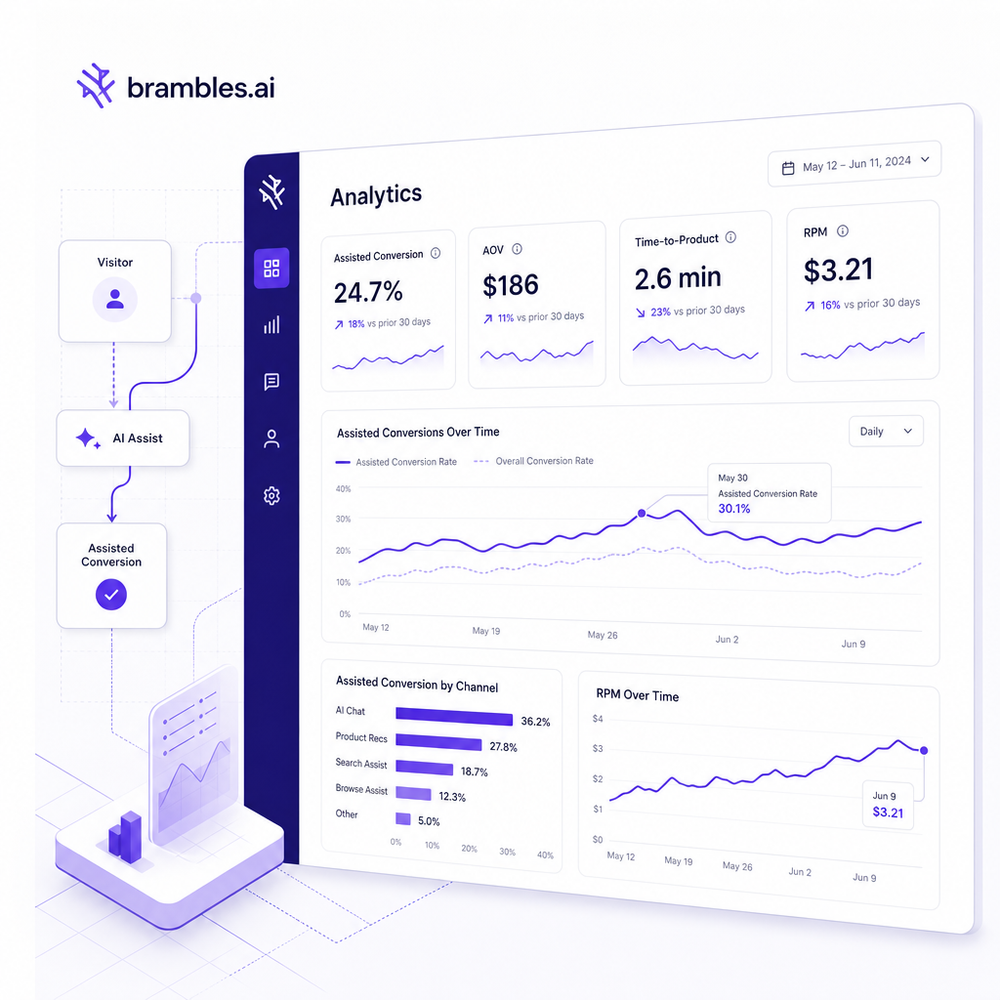
Align KPIs to buying friction. Track time-to-first-relevant product, assisted conversion rate (sessions with AI interaction that convert), AOV uplift, attach rate of recommended items, and return rate deltas on AI-assisted orders. For publishers: RPM, affiliate EPC, and scroll depth retention.
Benchmarks we’ve seen: +18–35% assisted CVR, +5–12% AOV, -20–40% time-to-product, and -8–15% support tickets related to sizing/policy confusion. These align with broader ecommerce research from McKinsey and Baymard showing that clarity, not novelty, drives conversion.
Attribution tips: 1) Use holdouts where chat is visible but disabled. 2) Compare assisted vs. unassisted cohorts within the same traffic source. 3) Run intent-specific reporting (e.g., sizing help vs. compatibility). 4) Combine qualitative transcript review with funnel metrics weekly.
Publisher anecdote: a lifestyle site embedded inline shopping in three evergreen gift guides. With contextual offers and clear affiliate disclosure, RPM rose 29% and average session length increased 17%. Their editor: “We finally monetized without wrecking the page.”
First‑Party Data, Disclosure, and Trust
Trust grows when AI is transparent and respectful. Brambles.ai relies on first‑party data you control—catalog, content, policies—and uses it to ground answers. The assistant states uncertainties, links to policies, and never gates basic help behind logins unless you choose to. This aligns with Salesforce and Google UX research on transparency as a driver of adoption.
For monetized content, disclosure must travel with the conversation. Our default template surfaces a concise affiliate note inline and on the first recommendation exchange. This preserves editorial voice while meeting regulatory expectations and reader trust.
Brand customization lets you keep tone and look consistent across devices. Configure persona, language, and UI via the dashboard or config file, so customers feel they’re conversing with your brand—not a generic bot.
Common Pitfalls (and How to Avoid Them)
- Ungrounded answers: Fix with Content Intelligence, strict retrieval, and policy linking. - Over-eager prompts: Use Proactive Engagement only on hesitation signals. - No handoff: Always expose Try‑On, View in Room, or Add to Cart. - One-size-fits-all tone: Calibrate AI Personality for each category. - Thin measurement: Implement assisted attribution and holdouts.
Operational watchouts: keep index freshness under 15 minutes for fast-moving SKUs, expose shipping cutoffs, and ensure performance budgets (LCP/CLS) are met. Brambles’ lightweight Agentic Commerce Module is tuned for speed and works alongside existing analytics.
Go‑Live Checklist
- Pilot surface selected with clear intent signals - Agentic Commerce Module installed and performance verified - Catalog, content, and policies indexed - Personality, guardrails, and fallbacks configured - Direct Add to Cart and variant selection tested - Try‑On or View in Room enabled where relevant - Proactive prompts tuned for hesitation - Assisted attribution and holdouts configured - Weekly transcript reviews scheduled - Rollout plan for next 2 categories ready
Future Outlook: Agentic Commerce, Not Just Chat
The next wave isn’t answers—it’s actions. Agentic systems will resolve tasks end-to-end: confirm fit, check store inventory, apply the best promotion, and stage checkout. Brambles.ai is built for that direction: retrieval grounded, policy-aware, and wired to commerce actions that respect brand rules and shopper intent.
FAQ
Is AI shopping accurate enough to trust?
Yes—if it’s grounded. Brambles.ai retrieves real catalog attributes, stock, and policies before it answers. It also declares uncertainty and links to source content when needed. In our audits, grounded responses reduce “confident-wrong” cases to under 2% on mature catalogs.
How fast can we implement?
Most teams pilot in 1–2 weeks. Install the Agentic Commerce Module, index content, configure personality, QA, and launch on a focused surface. Plugins and the Shopify app shorten timelines for common stacks.
Will this work for both publishers and brands?
Yes. Brands use it for guided discovery, fit help, and cart actions. Publishers use contextual embeds to recommend products without intrusive ads, monetizing via affiliate and retail media.
How do returns, policies, and service fit in?
Index policies for precise answers and add self‑service actions like order lookup or return initiation. The assistant can deflect tickets by answering policy questions and linking to next steps 24/7.
Does AI shopping impact SEO or site speed?
The widget is fast and non‑blocking. It doesn’t replace core content; it enhances discovery and engagement. Teams typically see improved behavioral signals—longer sessions, deeper PDP engagement—that reinforce SEO health.
Related resources on Brambles.ai
If you are implementing this, start with enterprise solutions, publisher pricing, brand pricing, about Brambles.ai.
Related posts
View all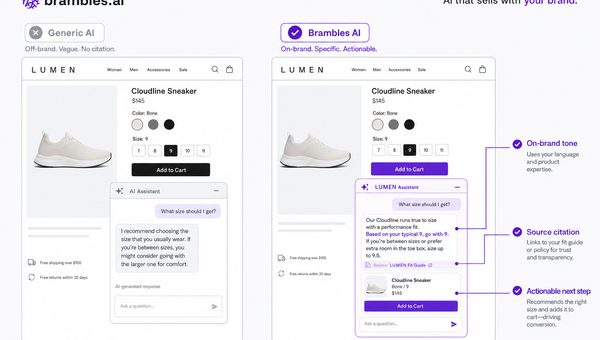
Brand-Consistent AI Chats Build Trust and Conversions
When AI mirrors your brand voice, shoppers relax—questions get answered, carts grow, and support load drops. Learn the playbook to align tone, trust, and ROI.
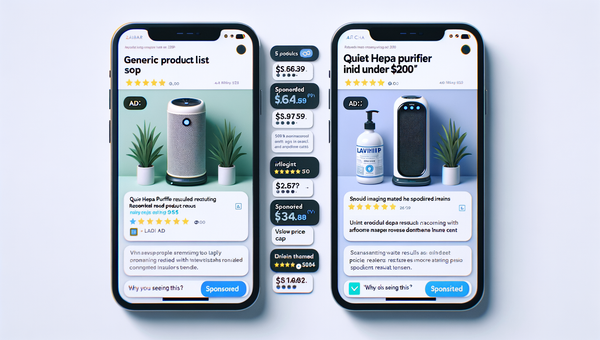
Sponsored Products in AI Shopping: Retail Media 101
Learn how sponsored product placements power AI shopping, how bidding and relevance work, and how to implement retail media without eroding trust or UX.
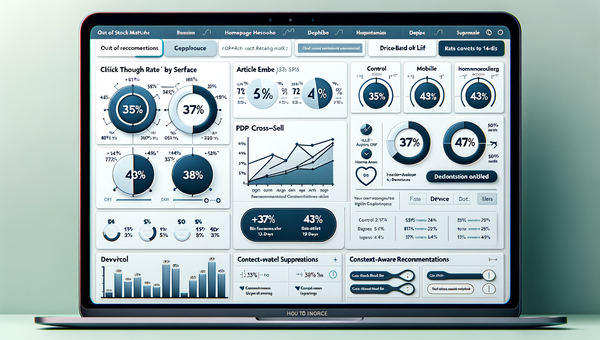
How Context-Aware AI Recommendations Lift CTR
See how context-aware AI recommendations lift CTR by 25–60% with intent signals, page context, and history. Practical steps, KPIs, and implementation tips.
Explore Brambles.ai
Learn more about our AI-powered agentic commerce platform, agentic shopping, and shopping assistance solutions.
Explore More Insights
Discover more articles on AI, automation, and business innovation
View All Articles