AI Shopping Assistant for Small Businesses: Brambles.ai
See how AI shopping assistants work for small businesses, real results to expect, and a step-by-step plan to launch one with Brambles.ai’s tools in days.
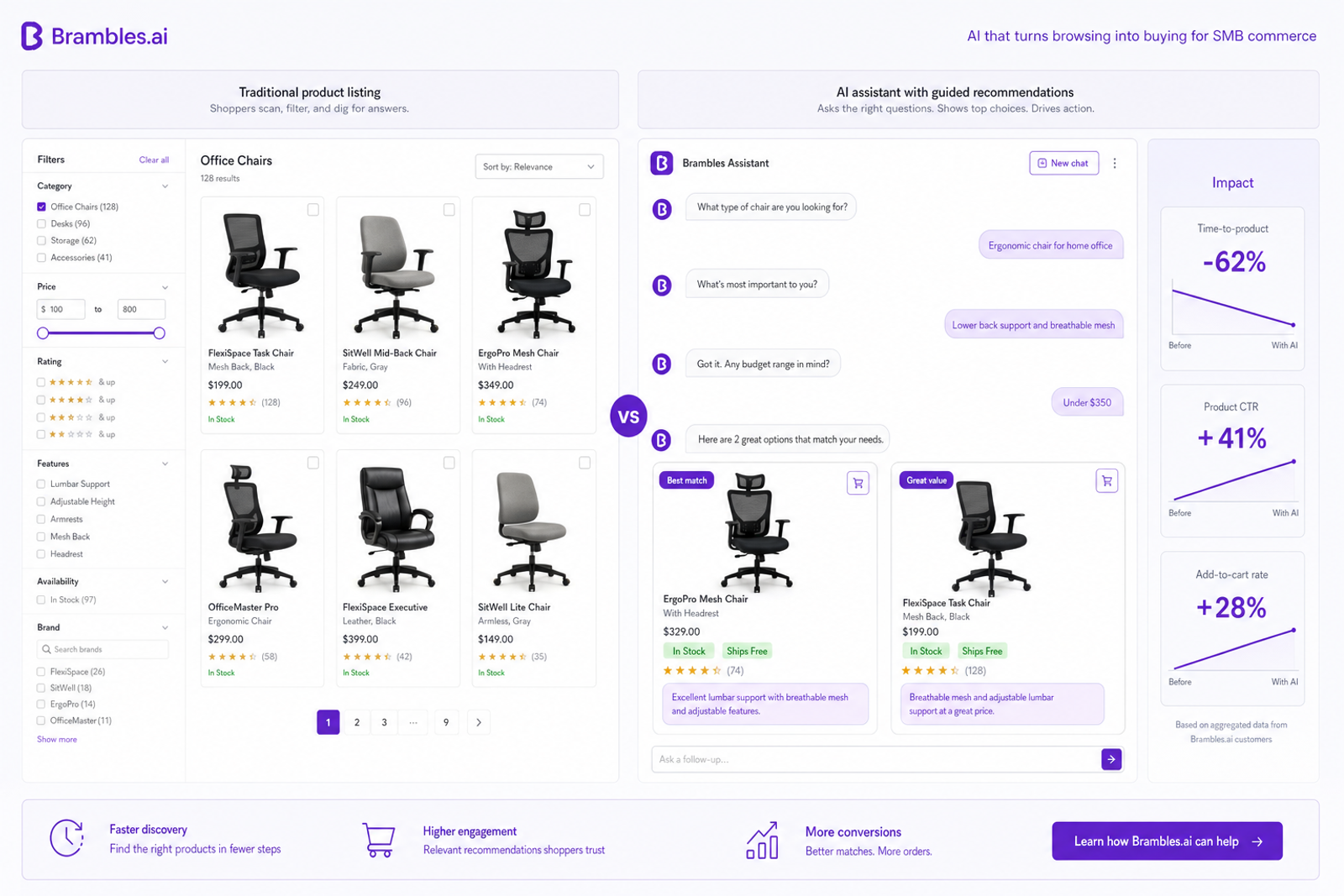
Two weeks after we added a conversational assistant to a 12‑SKU coffee roaster’s site, time‑to‑product dropped 47% and checkout conversion rose 31%. Not with discounts—just faster answers: “light roast, low acidity, ships to Denver?” The chats removed dead ends in navigation and bundled filters into a single, helpful exchange.
We’ve seen the same pattern on a boutique cycling site: the assistant clarified tire width and terrain, then offered a prebuilt kit. Average order value climbed 18% and returns dipped 9% month-over-month. The throughline is simple—when shoppers can natural questions and get trustworthy, in-stock recommendations, they buy with less friction and fewer regrets.
Quick Answer
AI shopping assistant is a chat-style guide on your site that product questions, compares options, and assembles carts based on the shopper’s goals. It connects to your catalog, policies, and inventory so advice is grounded in real data.
For a small business, it feels like your best sales associate working 24/7—scoping needs, handling objections, and handing off to a clean checkout with measured lifts in conversion, AOV, and customer satisfaction.
What’s Broken in SMB Shopping UX
Small stores lose sales to silence. Shoppers hesitate on sizing, compatibility, or shipping costs, then bounce. Baymard’s research shows that unclear costs and hard-to-find info drive a large share of abandonment; the pattern is worse on mobile, where filtering and comparison are cramped. Navigation trees are rigid for tasks like “gift for a runner under $50 who hates neon,” and search often chokes on synonyms and misspellings.
On a 100k‑session apparel site we audited, 38% of internal searches ended with no product click. The terms were perfectly human—“breathable office shirts summer.” An assistant collapses the loop: it asks one clarifying question, narrows by stock and size, and justifies the pick with benefits shoppers actually care about. That’s the fix: fewer dead ends, more confident choices.
How an AI Shopping Assistant Works
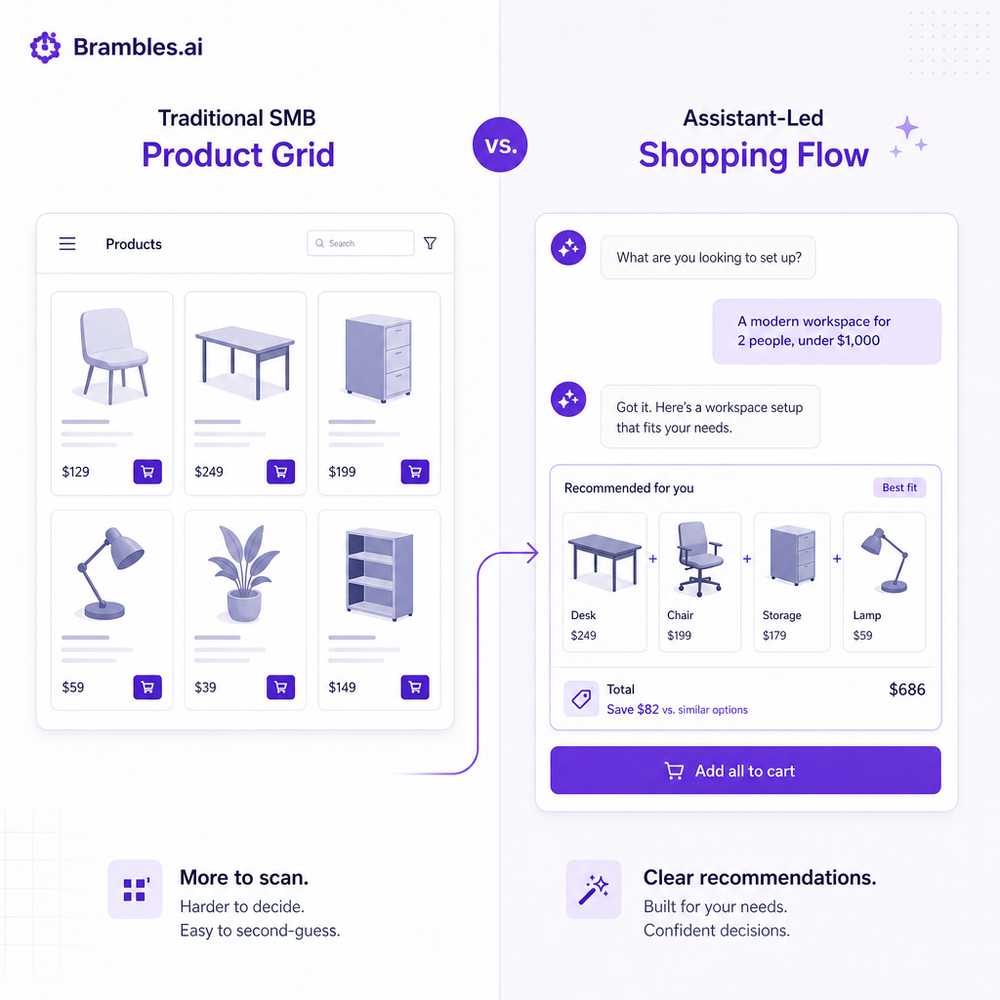
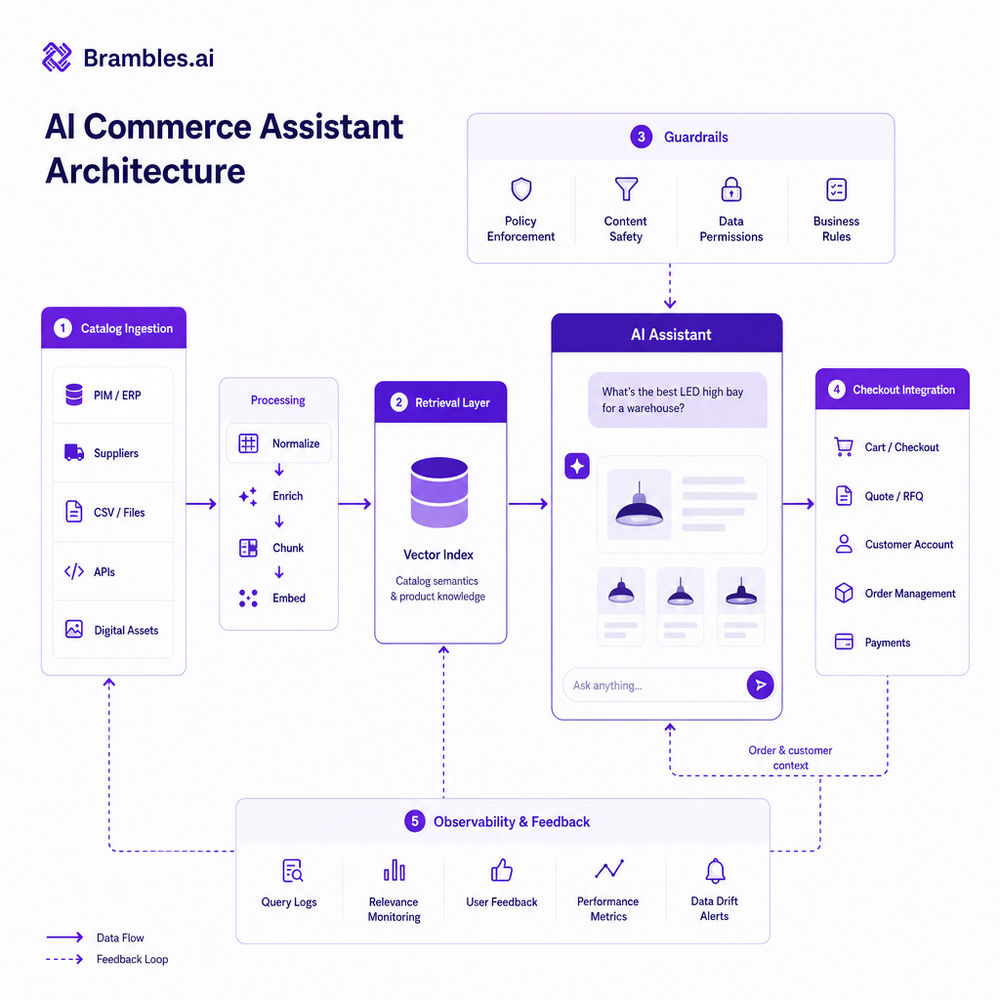
The assistant blends retrieval and reasoning. It indexes your catalog, attributes, reviews, and policies, then answers with references to real SKUs in stock. It asks clarifying questions (budget, size, use case), ranks options by fit, and shows the “why”—not just the what. When it’s unsure, it narrows the question instead of guessing. In Brambles.ai’s brand/retail assistant flow, the model is grounded by structured product data and guarded by rules that block unsupported claims and respect price/promos from your source of truth.
Think of it as guided selling plus live documentation. The assistant can compare items side-by-side, check compatibility (“Will this lens fit my Z-mount body?”), and pre-assemble a cart or bundle. It hands off to checkout through a secure cart link and logs events for analytics. If confidence falls below a threshold, it offers human handoff or an email capture for follow‑up rather than bluff. That’s how you keep trust high and returns low.
Implementation with Brambles.ai
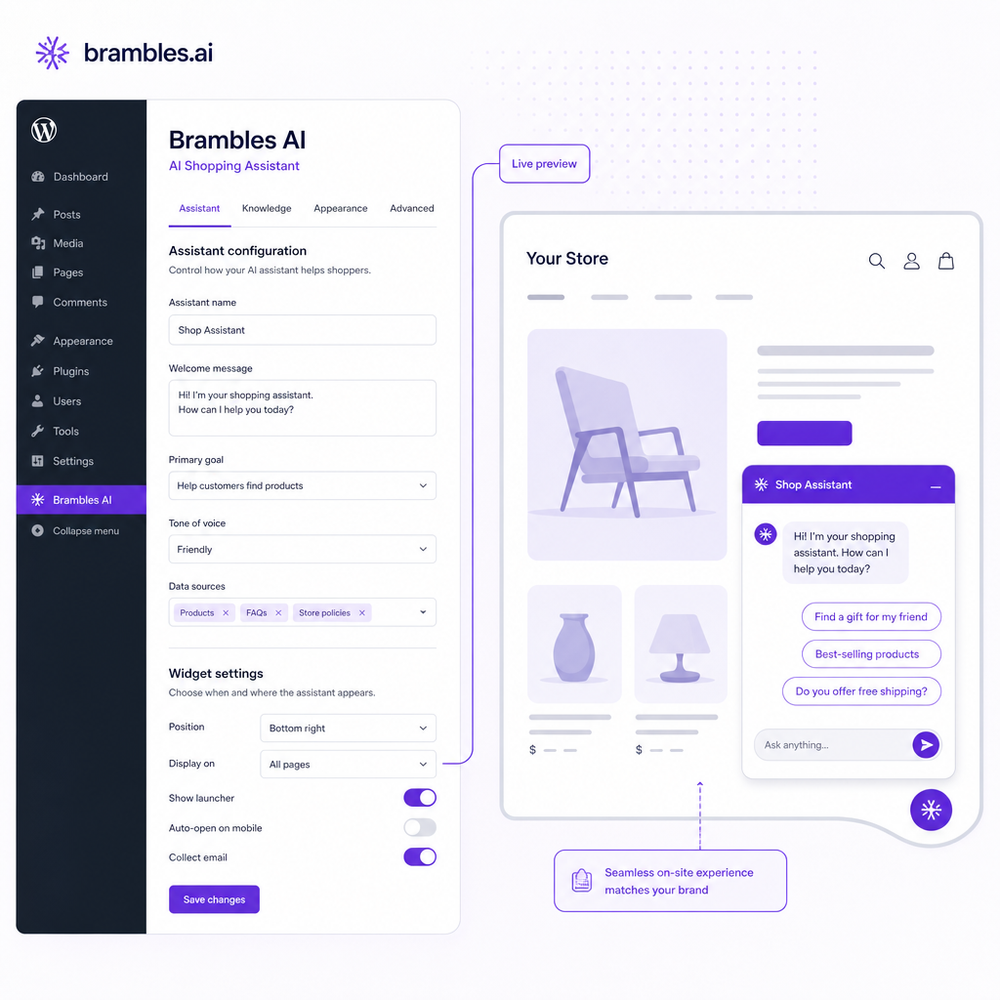
You can stand up a pilot in a week. Start with a small slice—a top category, or your bestsellers—and measure deltas before rolling out sitewide. Brambles.ai plugs into common stacks and keeps your assistant aligned with live inventory and policies.
Step-by-step checklist:
- Connect your catalog: upload a feed or sync via API; include titles, attributes, price, stock, and canonical URLs.
- Ground knowledge: add FAQs, shipping/returns, and size charts so answers cite your rules.
- Configure tone and goals: set brand voice, upsell rules, and fault tolerance for unknowns.
- Place the widget: install the WordPress plugin and position it on PDPs, PLPs, and cart.
- Map checkout: enable cart handoff via the Commerce Module; test taxes, shipping, and coupons.
- QA with 50 real queries: collect gaps and tune prompts; only then expand coverage.
- Track KPIs: publish a pre/post dashboard and share weekly wins with the team.
Measuring ROI and KPIs That Matter
Measure what changes shopper behavior. Benchmarks we use: conversion rate lift (assistant sessions vs. non-assistant), AOV delta from bundles/accessories, time-to-product, and resolution rate (helpful answer with click-through). Track assistant‑attributed revenue and return rate delta for assisted orders. One cycling client saw +18% AOV and a 22% faster path to cart within 30 days. Personalization can move the needle—McKinsey reports revenue lifts from targeted experiences, but only when grounded in real inventory and intent.
Set up clean attribution:
- Define an “assisted session” when a user sees a model recommendation and clicks a product.
- Compare CVR and AOV on assisted vs. unassisted cohorts.
- Monitor helpfulness score (thumbs up/down) and fallbacks to human.
- Log NPS after checkout for assisted orders.
Brambles.ai’s Commerce Module emits standard events (view_item, add_to_cart, begin_checkout) so you can stitch into GA4 or your warehouse without duct tape.
First‑Party Data and Trust
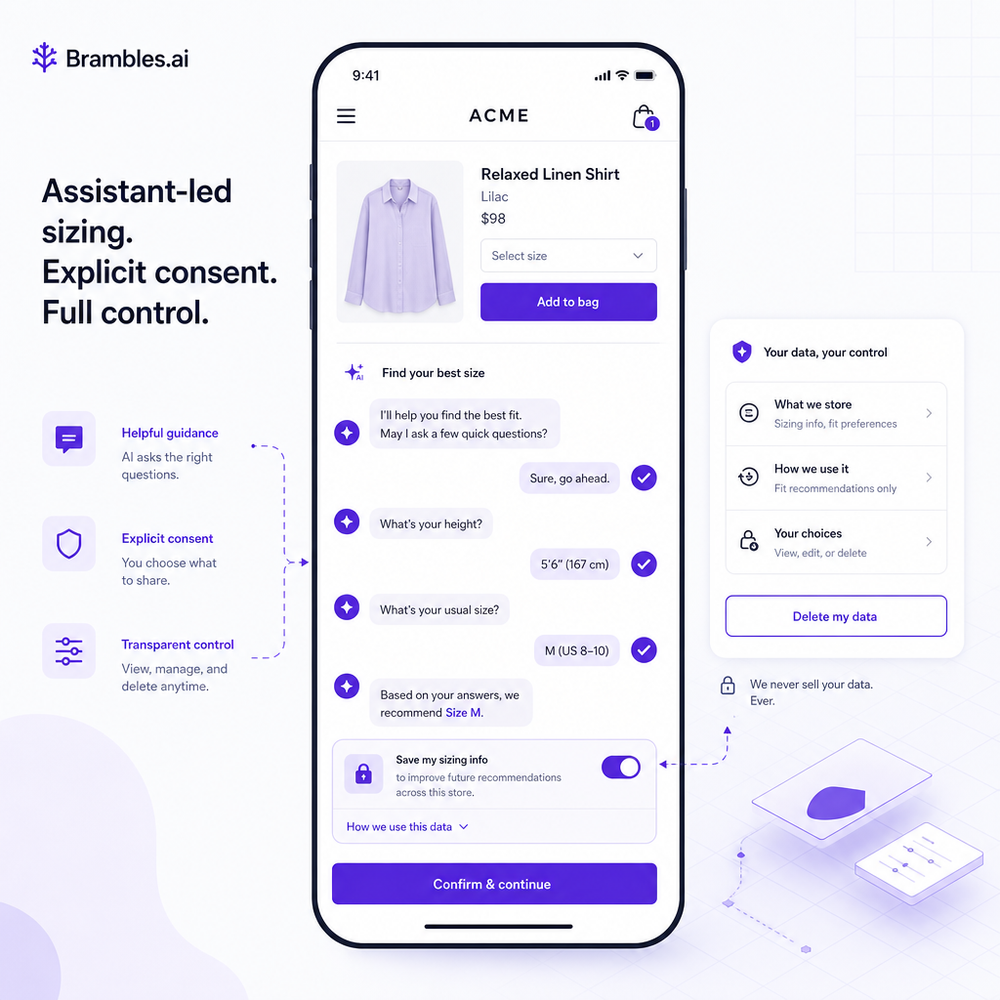
Trust is the growth cap. Ask for the minimum data to be helpful, and earn the rest. Use progressive profiling: email capture only when offering tangible value (back‑in‑stock alerts, saved sizing, or expert follow‑up). Show sources: link to the size chart you used, or the review you quoted. Google’s research shows users value transparency and control; practical consent UI beats legalese every time. If you partner with publishers, keep routing clean so their sessions monetize fairly and your shoppers don’t feel ambushed.
A pet‑supply retailer cut return‑related tickets 12% by adding a two‑question fit flow in the assistant, then storing the pet’s weight and breed as first‑party preferences (with clear opt‑in). Salesforce reports customers reward brands that remember preferences—but only when it’s transparent and reversible. Put an “edit my data” link inside the chat header and honor it instantly.
Common Pitfalls and How to Avoid Them
Don’t deploy a chat bubble that can’t sell. Common misses:
- Ungrounded answers: no catalog or stock link; fix with retrieval and strict source binding.
- Over‑talkative models: set confidence thresholds and offer clarifying questions, not guesses.
- Tone mismatch: import brand voice and keep responses concise on mobile.
- No escalation path: add human handoff or email capture when confidence is low.
- Cold start: launch in one category, tune on real queries, then expand. A short QA sprint with 50 live questions surfaces 80% of issues.
FAQ
How fast can a small business launch an assistant?
Most SMBs can pilot in 5–7 days: wire a catalog feed, load policies, place the widget, and QA with 50 queries. Plan another week to tune prompts and tracking before widening coverage.
Will it replace human support or sales?
No. It handles repetitive, high‑intent questions so humans focus on complex or high‑value cases. Use confidence thresholds and offer handoff when the model isn’t sure.
What about accuracy and returns risk?
Ground the model in SKUs, policies, and size charts; show sources; and block unsupported claims. Monitor assisted orders’ return rate and iterate on the top 10 confusing attributes.
How does pricing work for SMBs?
Start small and scale. Many teams begin with a category pilot and a message cap, then expand as ROI proves out. Review tiers and expected volume, and factor in AOV and margin.
Related resources on Brambles.ai
If you are implementing this, start with Brambles.ai, for publishers, for brands, get started.
For deeper reading, see 10 Reasons Publishers Need Conversational Commerce, Affiliate Disclosure in Conversational UIs Done Right, Contextual, Not Creepy: Monetization That Wins, From Search Boxes to Conversations: Modern Shopping UX.
Related posts
View all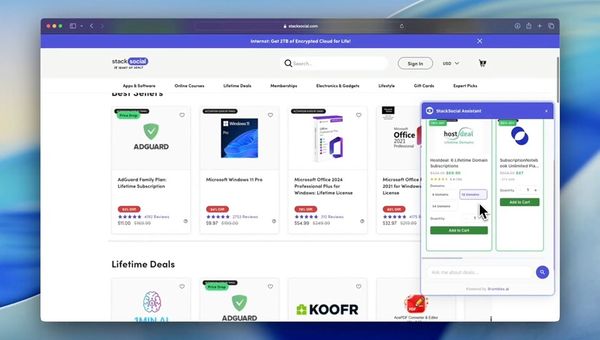
StackSocial Goes Live with Brambles.ai
StackSocial shoppers can now ask product questions on the page. Brambles.ai answers from the catalog, and support stays in the help desk they already use.
RebatesMe Partners with Brambles.ai to Launch Remmee
RebatesMe is partnering with Brambles.ai to launch Remmee, the first AI assistant built into a cash back site. Rates Remmee quotes are rates members can earn.
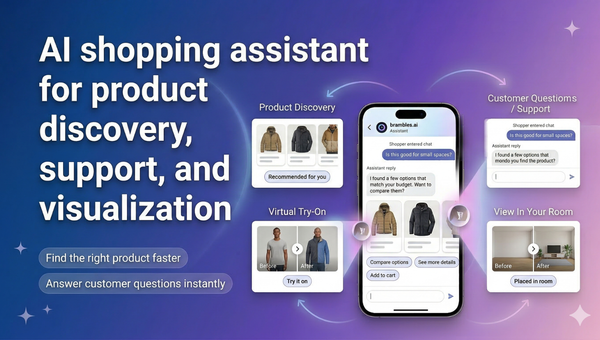
Brambles.ai Is Live on the Shopify App Store
Brambles.ai is live on the Shopify App Store, giving merchants an AI shopping assistant for discovery, support, try-on, and add-to-cart.
Explore Brambles.ai
Learn more about our AI-powered agentic commerce platform, agentic shopping, and shopping assistance solutions.
Explore More Insights
Discover more articles on AI, automation, and business innovation
View All Articles