AI Shopping Agents: A Beginner Guide with Brambles.ai
A plain-English guide to AI shopping agents: how they work, where they fail, and how to launch one fast with Brambles.ai's plugin and Commerce Module. today.
AI Shopping Agents: A Beginner Guide with Brambles.ai
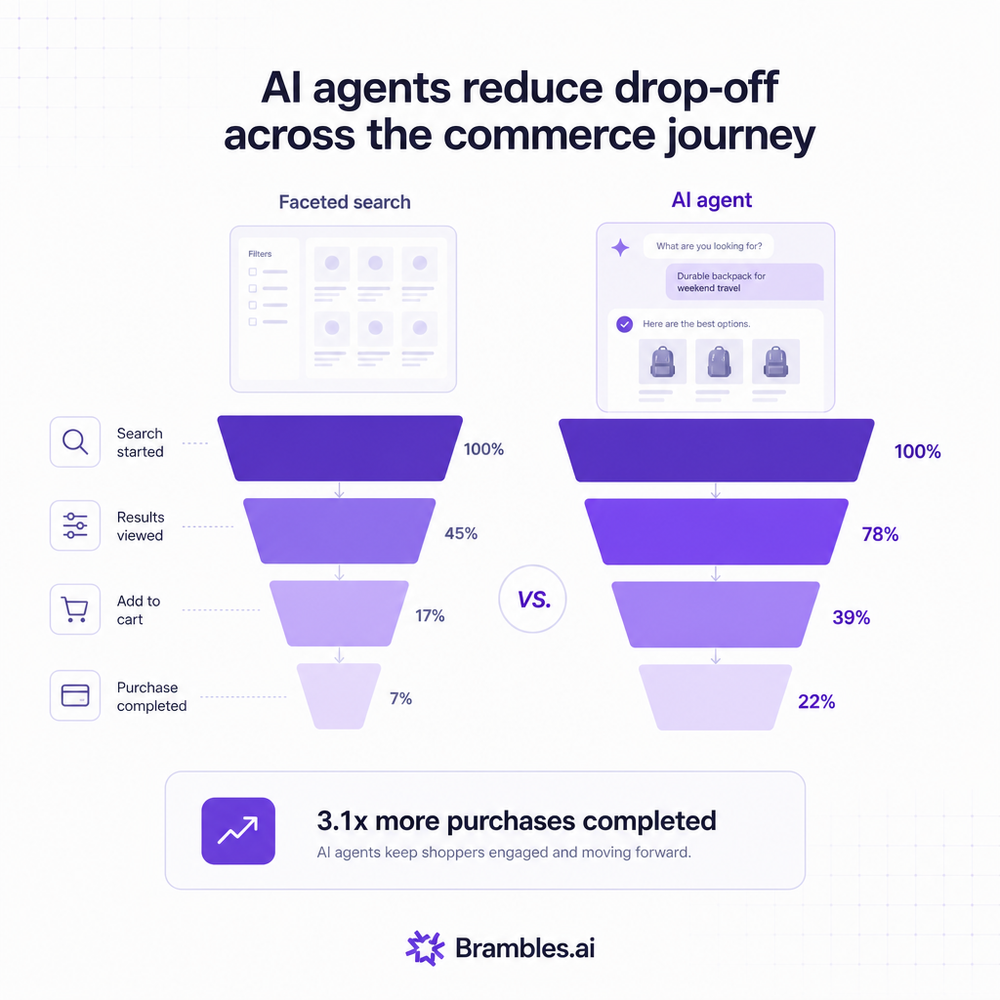
Two weeks after we added an AI shopping agent to a mid-market apparel site (120k monthly sessions), add-to-cart rate from search-driven visits rose 38% and product views per session jumped from 3.1 to 5.4. The surprise wasn’t the lift; it was the pattern. Shoppers stopped pogo-sticking between filters and instead asked for outcomes: “show me breathable joggers under $60 that won’t shrink.” The agent answered in one step with sized inventory, care notes, and direct add-to-cart. Support tickets about sizing dropped 21% the same month. That’s the point of an AI shopping agent: translate messy intent into purchase-ready options without forcing users to relearn your navigation.
Quick Answer
An AI shopping agent is a conversational interface that understands a shopper’s intent (“I need a carry-on that fits Delta’s overhead and weighs under 7 lbs”), searches your catalog and policies, and returns shoppable answers with variants, availability, comparisons, and reasons to believe. Done right, it reduces friction across search, discovery, and checkout while respecting consent and first-party data. With Brambles.ai, you can deploy this on your site or content in days using the WordPress plugin and Commerce Module—without rebuilding your stack.
What’s Broken in Online Shopping
Most ecommerce experiences make users do the hard work: guess keywords, stack filters, and open 12 tabs. Baymard Institute reports that poor on-site search drives abandonment and that 42% of sites can’t handle even basic synonyms. We still see shoppers fail on natural questions like “waterproof, not water-resistant.”
Even when search “works,” results rarely explain why a product is right. Google’s UX research shows users need confidence boosters—specific reasons, tradeoffs, and comparisons—before committing. Traditional PDPs bury this in tabs. An agent surfaces it conversationally: “This jacket uses a 2.5L membrane; it’s lighter but less durable than 3L—good for city rain, not alpine.”
Anecdote: on a 35k-SKU electronics catalog, we watched “USB-C monitor for MacBook, no wobble” queries bounce at 78% on legacy search. With an agent interpreting stability reviews and VESA specs, bounce fell to 49% and AOV climbed 12% in three weeks.
How an AI Shopping Agent Works
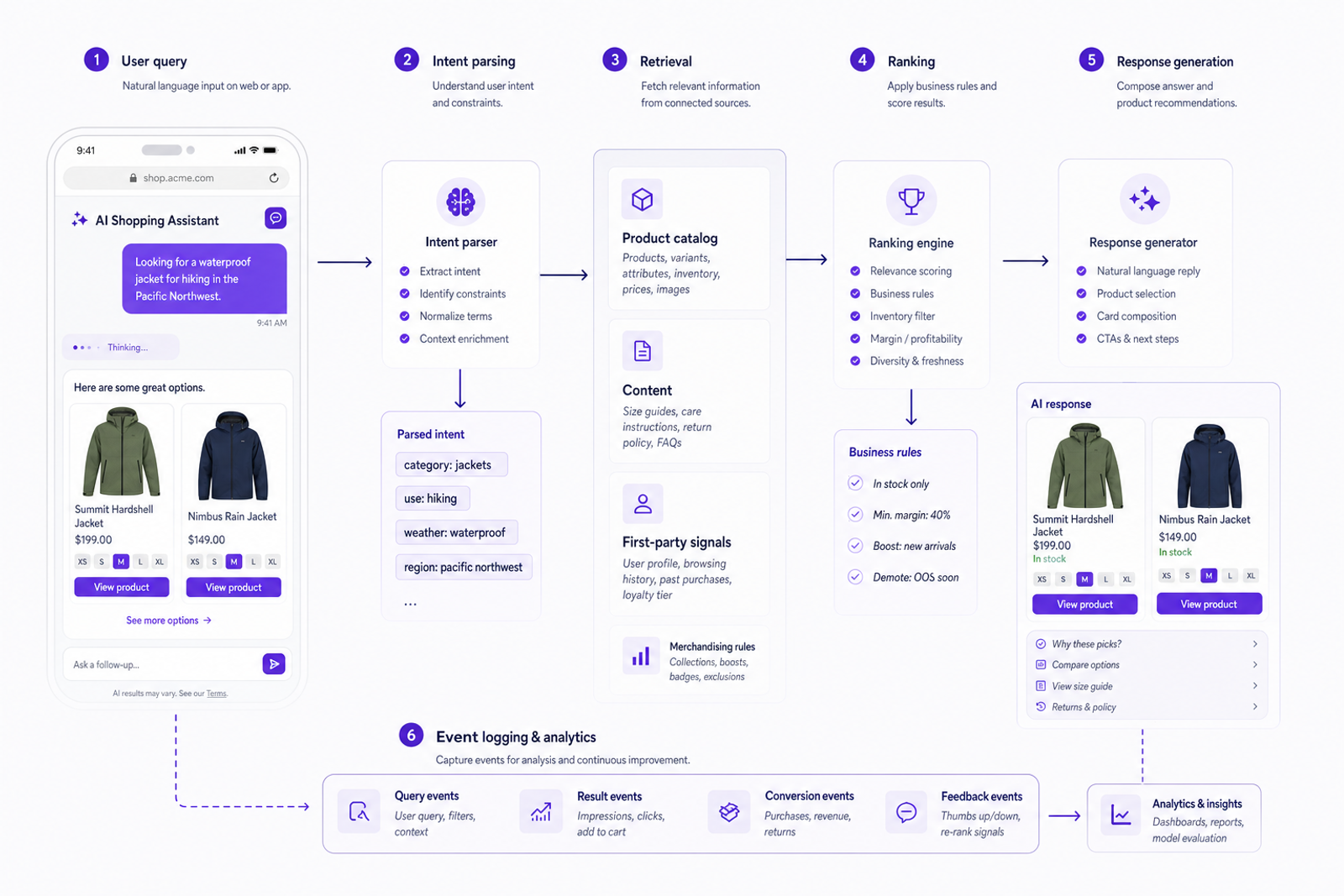
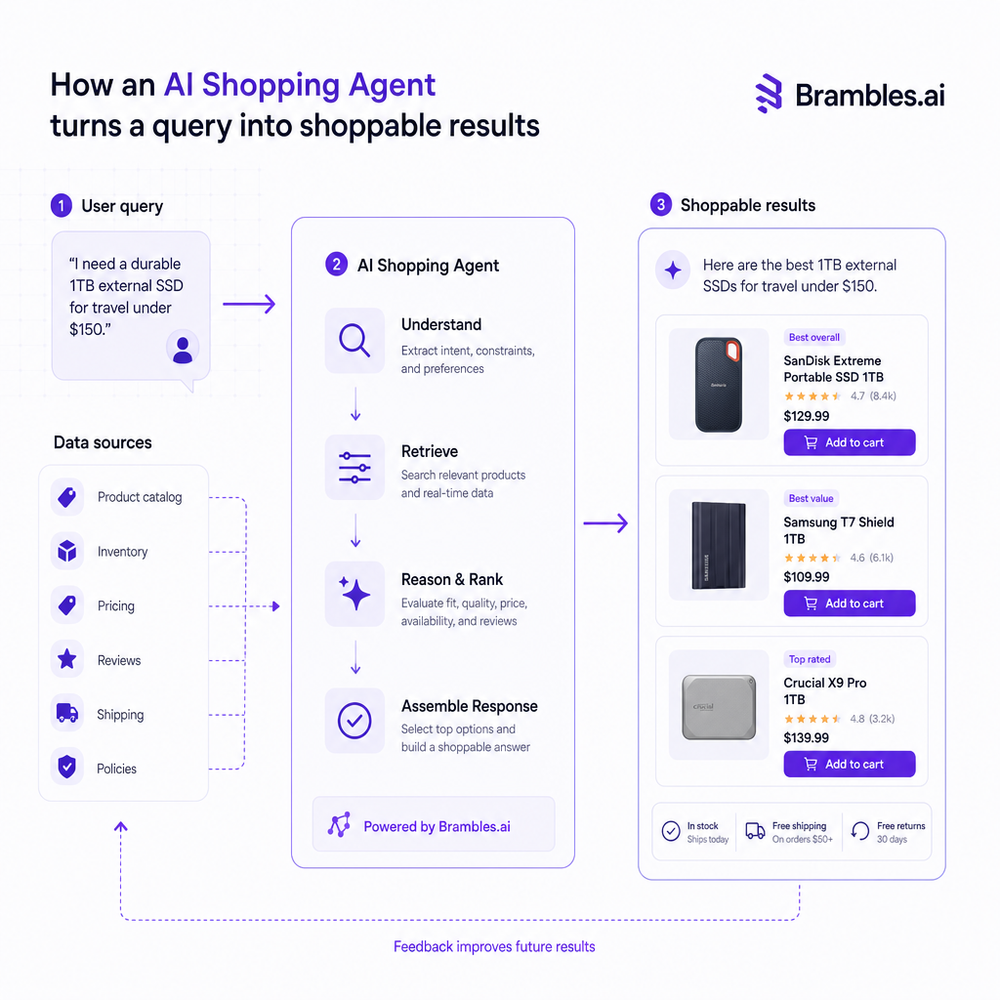
The core job is intent understanding, not chit-chat. The agent maps user language to structured signals: attributes (size M, 28–30L), constraints (under $100), contexts (carry-on rules), and preferences (vegan leather). It then retrieves candidates from your catalog and content, applies business rules—inventory, margin, merchandising—and returns a concise answer with product cards and next steps.
Technically, most robust agents use a retrieval-augmented generation (RAG) stack: embeddings for products and policies, a re-ranker tuned to conversions, and a response layer aligned to brand tone and compliance. Guardrails matter. For example, if an item is out of stock in the requested size, the agent should propose close alternatives and offer restock alerts—never hallucinate availability.
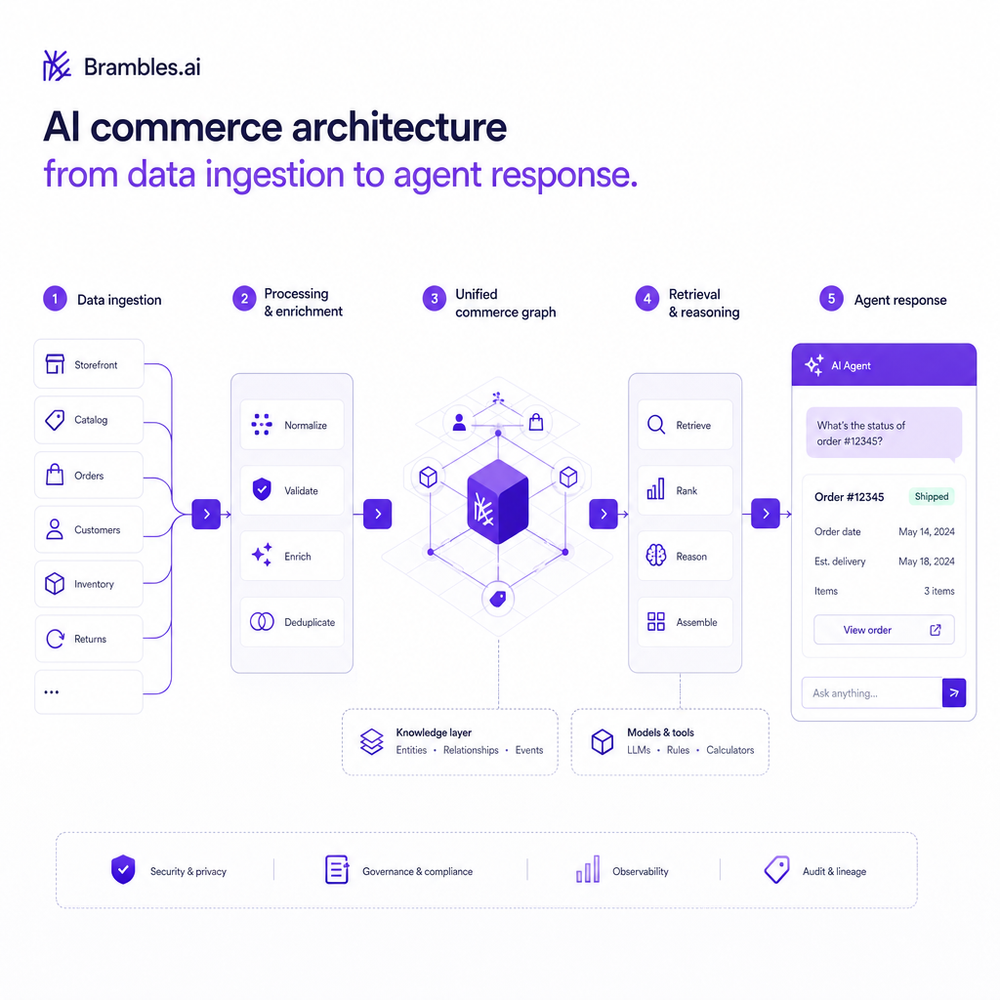
Where Brambles.ai helps is in the last mile: ingesting feeds (Shopify, BigCommerce, custom), normalizing attributes, and exposing inventory, pricing, and content to the agent with deterministic controls. Our WordPress plugin turns content like gift guides and reviews into shoppable agent experiences without rewriting templates.
Implementation Guide with Brambles.ai
You can stand up a production-grade agent in days, not quarters. Here’s a pragmatic path we use with teams under real traffic pressure.
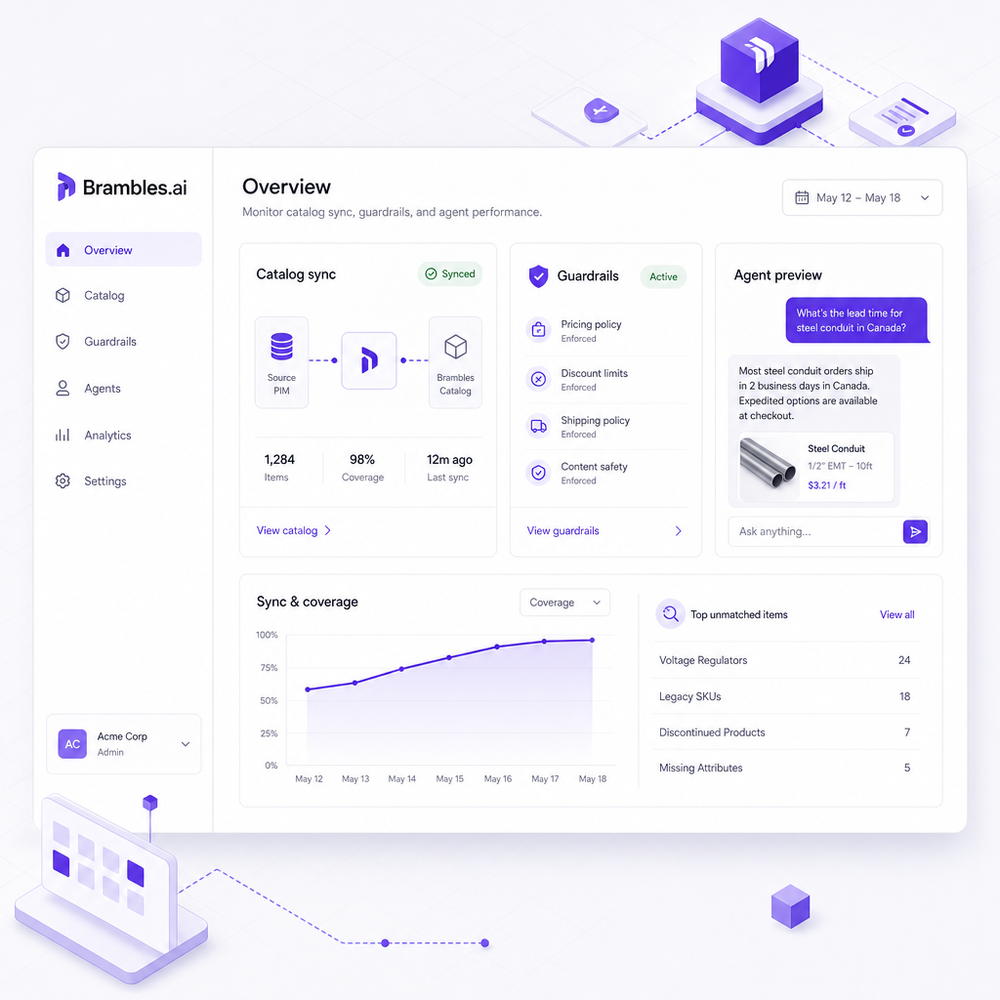
Step 1: Connect your catalog and content. Sync your product feed and taxonomy, then add size guides, warranty pages, and return policies. Brambles.ai’s Commerce Module auto-detects attributes and flags gaps like missing inseams or incompatible color names.
Step 2: Place the agent where intent is highest. Add it to site search results, category tops, and gift guides. The WordPress plugin lets editors embed an agent block into posts (“The 10 Best Carry-Ons”) that returns in-stock picks personalized to the reader’s constraints.
Step 3: Set business guardrails. Define upsell/cross-sell rules, preferred brands, minimum margins, and stock thresholds. Tie returns eligibility and shipping cutoffs directly into the agent so it can answer logistics questions without handoffs.
Step 4: Train on real questions. Import on-site searches and support transcripts. Tag 50–100 canonical intents (e.g., “non-slip nursing shoes,” “carry-on for Delta”) and review answers in batches. In our tests, 30 minutes of weekly review preserved a 90th-percentile helpfulness score as catalogs changed.
Step 5: Ship, watch, refine. Instrument events—intent matched, product recommended, clicks, cart adds, checkouts—and compare against a control surface. One retailer phased rollout to 25% of search traffic and saw 17% more revenue-per-visit within 14 days, then expanded to all traffic.
Measuring ROI and KPIs That Matter
The right scorecard avoids vanity metrics. Focus on outcomes tied to shopping friction: intent resolution rate, discovery depth, assisted revenue, and support deflection for pre-purchase questions. We also track time-to-first-meaningful-result—how fast a shopper sees their first truly viable option.
On a 100k-session apparel site, adding an agent to search lifted add-to-cart by 42%, bumped AOV 9%, and cut zero-result queries by 67%. A publisher running gift guides saw a 12% RPM lift after enabling embedded agents that respected affiliate rules and out-of-stock logic.
Use controlled rollouts. Randomly assign traffic to the agent experience and to your baseline. Track session-level conversions and add-to-cart velocity. McKinsey notes that faster path-to-value correlates with higher loyalty; our own data shows agent-led sessions return within 30 days 1.3x more often.
First-Party Data and Trust
Trust is an input, not just an outcome. Ask for minimal data up front, honor consent, and keep explanations plain. Salesforce’s Connected Customer report shows 73% expect brands to use data responsibly—and to explain how. Your agent should handle that in-line, not in a buried policy page.
Brambles.ai supports first-party data only by default, with optional enrichment you can switch on per region. The agent cites sources when it recommends (“Based on your fit profile and this size guide”) and avoids dark patterns. When it can’t answer confidently, it says so and offers helpful next steps like email follow-up or a curated collection.
For regulated categories (supplements, finance-adjacent accessories), implement eligibility checks and mandatory disclaimers. Google UX research suggests clear constraints reduce decision anxiety; we see higher completion when the agent sets safe boundaries instead of pretending every option fits everyone.
Common Pitfalls to Avoid (Checklist)
Treat this like a product, not a plugin. Here’s the short checklist we hand teams during kickoff.
- Don’t launch without guardrails. Define inventory, margin, and brand-preference rules before day one.
- Don’t bury the agent. Place it on search, category headers, and key content.
- Don’t hide rationale. Show why items match—attributes and tradeoffs.
- Don’t skip measurement. A/B test against baseline, track assisted revenue.
- Don’t over-personalize. Ask only for what improves the decision now.
- Don’t ignore editorial. Keep a weekly review loop for edge cases.
If you’re migrating from a legacy chatbot, keep expectations sharp: a shopping agent should answer specific purchase questions, not company trivia. Brambles.ai’s publisher and brand flows separate monetization logic from product matching so conversions aren’t diluted by off-path chatter.
FAQs
What exactly is an AI shopping agent?
It’s a conversational layer that turns intent into shoppable answers by pulling from your catalog, policies, and content, applying business rules, and returning ready-to-buy options with clear rationale.
How fast can I launch with Brambles.ai?
Most teams connect feeds and ship a measured rollout in under two weeks. WordPress sites often embed the agent in a day using the plugin, then tune guardrails over the first week.
Will it replace my site search?
Not immediately—and it shouldn’t. Run it alongside search on high-intent pages, compare outcomes, and iterate. Many teams keep both, using the agent for complex queries and search for quick lookups.
How do I measure success without bias?
Use randomized traffic splits, session-level conversion tracking, and identical merchandising promos across variants. Track both assisted and last-click revenue, plus time-to-first-meaningful-result.
Related resources on Brambles.ai
If you are implementing this, start with Brambles.ai, for publishers, for brands, get started.
For deeper reading, see 10 Reasons Publishers Need Conversational Commerce, Affiliate Disclosure in Conversational UIs Done Right, Contextual, Not Creepy: Monetization That Wins, From Search Boxes to Conversations: Modern Shopping UX.
Related posts
View all
How Context-Aware AI Recommendations Lift CTR
See how context-aware AI recommendations lift CTR by 25–60% with intent signals, page context, and history. Practical steps, KPIs, and implementation tips.
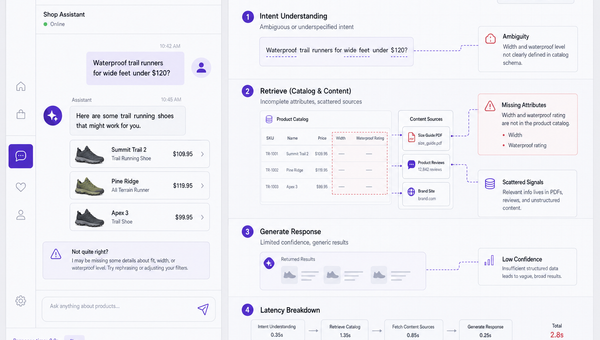
Why Good AI Shopping Agents Are Hard—and How Brambles Helps
Most AI shopping bots fail on data quality, UX, and trust. See why agents break in the wild and how Brambles.ai fills the gaps with measurable features.
Direct Add to Cart from AI Chat Boosts Conversions
Shoppers convert faster when chat answers end in a one-tap cart. Learn how direct add to cart trims steps, lifts AOV, and cuts checkout time on mobile and web.
Explore Brambles.ai
Learn more about our AI-powered agentic commerce platform, agentic shopping, and shopping assistance solutions.
Explore More Insights
Discover more articles on AI, automation, and business innovation
View All Articles