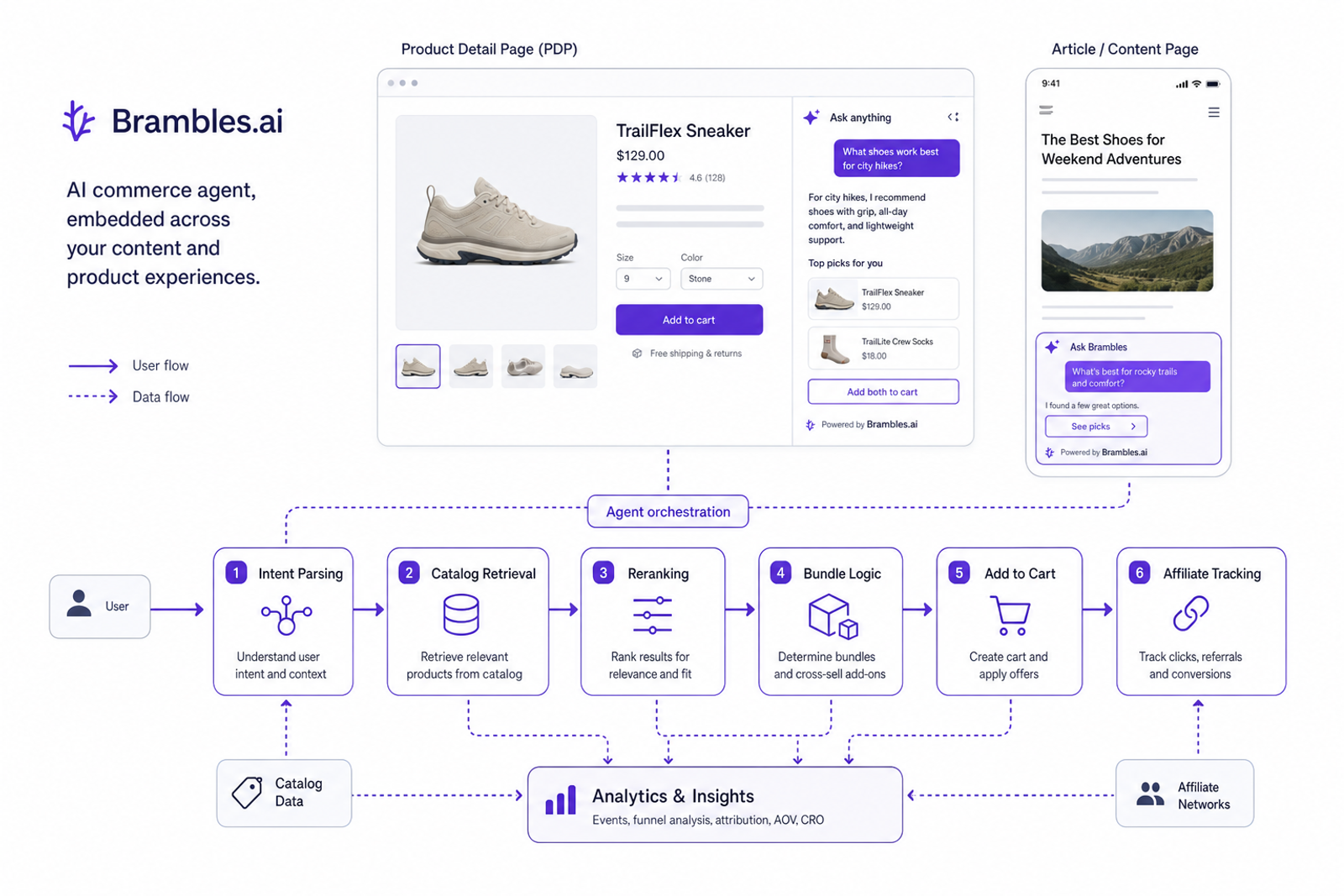
AI Agents Are Commerce Power Brokers: Win with Brambles
AI agents steer purchase decisions. Deploy and measure agentic commerce with Brambles—from product discovery to add-to-cart and profitable affiliate revenues.
The moment agents started moving revenue
On an apparel site with ~100k monthly sessions, a chat-driven agent outsold the site search box 2.3:1 during a 14‑day A/B. The change? The agent asked, “What’s the vibe and budget?” then presented 6 ranked looks with a one‑tap add. Add‑to‑cart rate from chat was 5.8% vs 2.4% from search—driven largely by direct purchase actions inside the conversation, not after it.
We saw a similar pattern on a consumer electronics publisher: when the agent clarified use case (“coding, AAA gaming, or everyday work?”) before recommending laptops, affiliate EPC rose 31% week over week. Conversations compressed the messy middle into decisive next steps.
These lifts align with Baymard’s long‑standing findings on friction from overbroad filters and thin guidance, and with Google’s “messy middle” research on hesitation loops. Contextual conversations break indecision—especially when they’re embedded where readers already are, not siloed on a “search” page.
Quick Answer
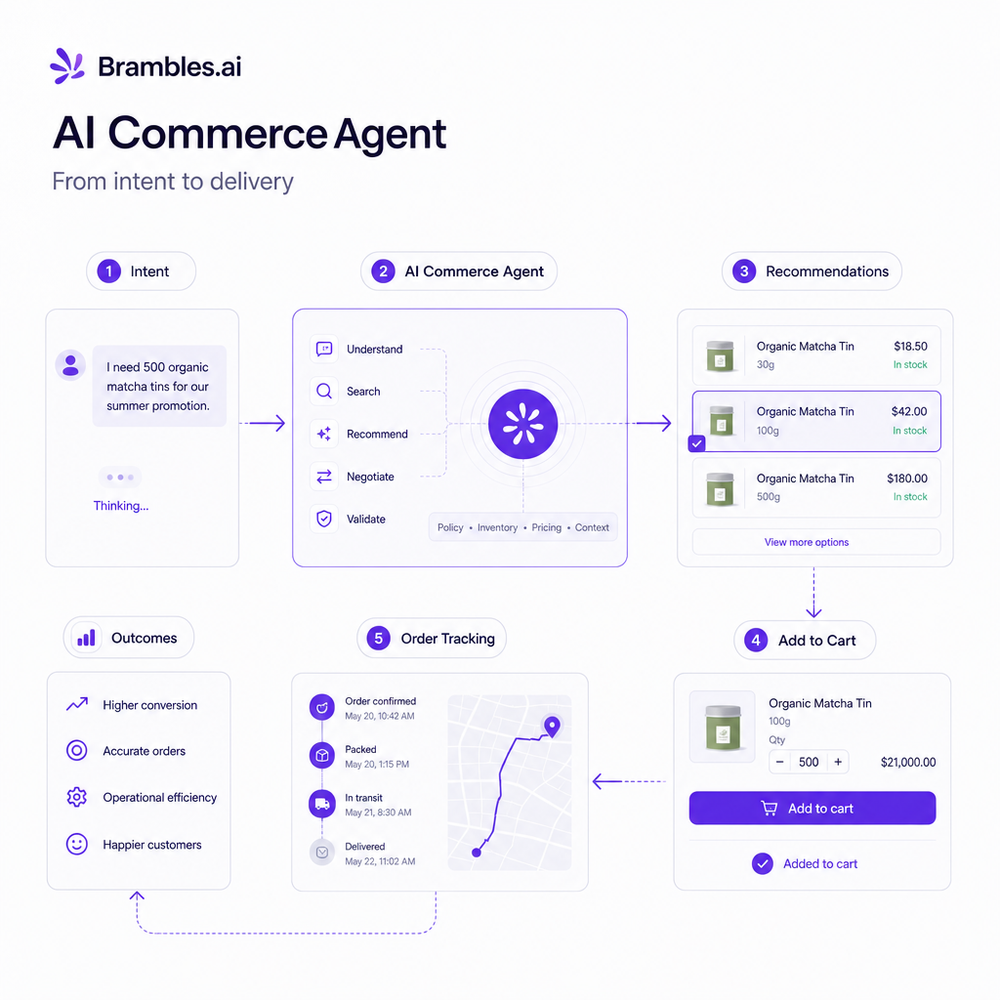
AI agents are becoming commerce power brokers because they remove decision friction at the exact moment of intent. Brambles.ai operationalizes this with AI product discovery that understands natural language, a floating AI shopping chat that lives on every page, and direct add to cart from the conversation. For publishers and brands, that means fewer clicks, faster buys, and measurable revenue you can attribute and scale.
What’s broken in today’s buying journeys
Category pages, filter walls, and comparison matrices assume shoppers already know which attributes matter. Many don’t. Baymard notes users often stall when forced to self‑diagnose before seeing helpful options. Google’s messy‑middle loop shows people oscillate between exploration and evaluation—time the agent can collapse with clarifying questions and confidence cues.
For publishers, monetization is brittle: links decay, prices shift, and inventory vanishes. For brands, PLPs over‑rank popular SKUs instead of mission‑fit products, inflating returns. Both sides struggle to convert mobile intent where screen real estate punishes long paths.
The fix is not “more filters.” It’s a buying partner. When an agent asks two to three smart qualifiers, then shows exactly‑right choices (with reasoning), shoppers proceed with confidence. And when the purchase action is inside the chat, you avoid drop‑offs between pages.
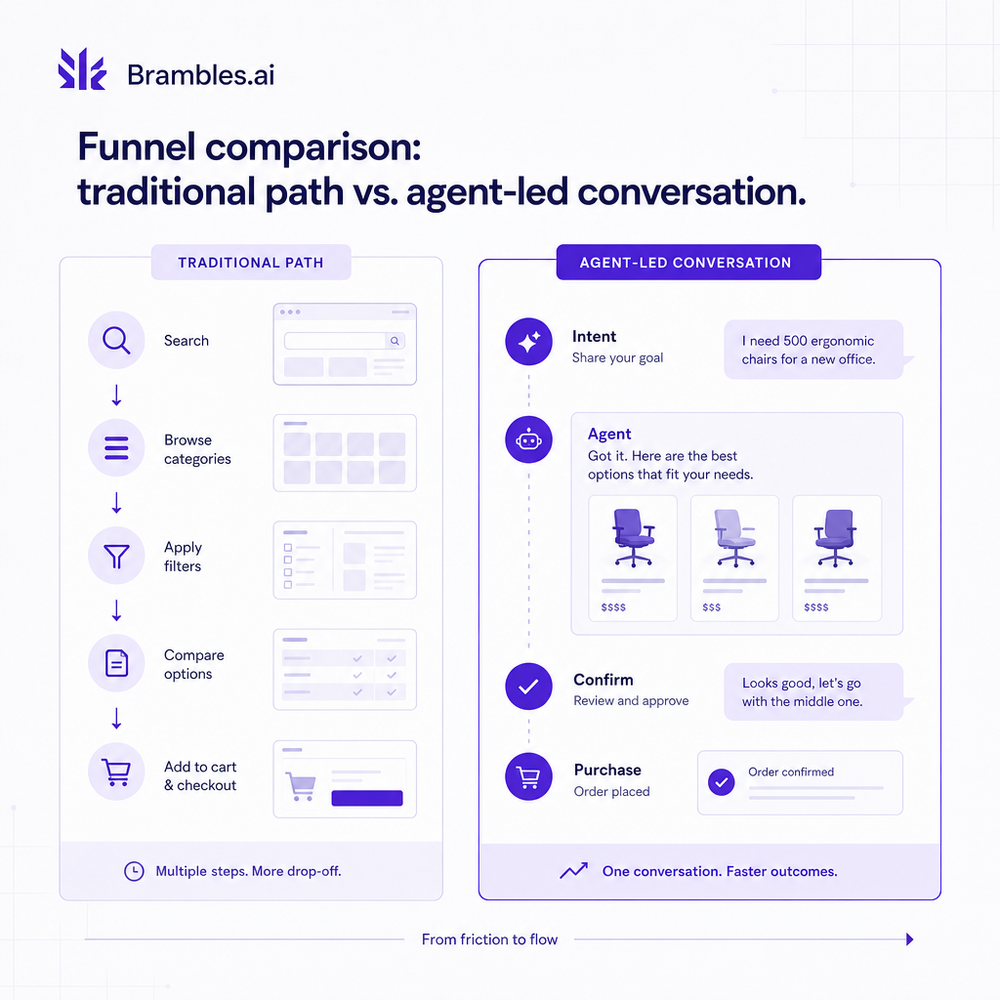
How AI commerce agents work (in practice)
Great agents translate human intent into ranked, buyable options. First, they capture context (“I need a quiet treadmill under $800 for an apartment”) and build a constraint set. Then they retrieve structured product data and editorial insights, rerank by mission fit, and present shoppable recommendations with clear tradeoffs.
Brambles powers this workflow end‑to‑end: AI product discovery parses natural language and aligns it with your catalog; AI shopping chat embeds the conversation across pages; proactive engagement can greet visitors with intent‑specific prompts based on page context. This triad turns idle browsing into guided buying without engineering a bespoke stack.
On a 2M‑session review site, this flow raised CTR to affiliate merchants by 27% while reducing pogo‑sticking between articles. The agent explained why each pick matched the reader’s scenario (Baymard’s “decision support” heuristic) and offered a one‑tap jump to buy when readiness was highest.
How Brambles.ai makes agents your power broker
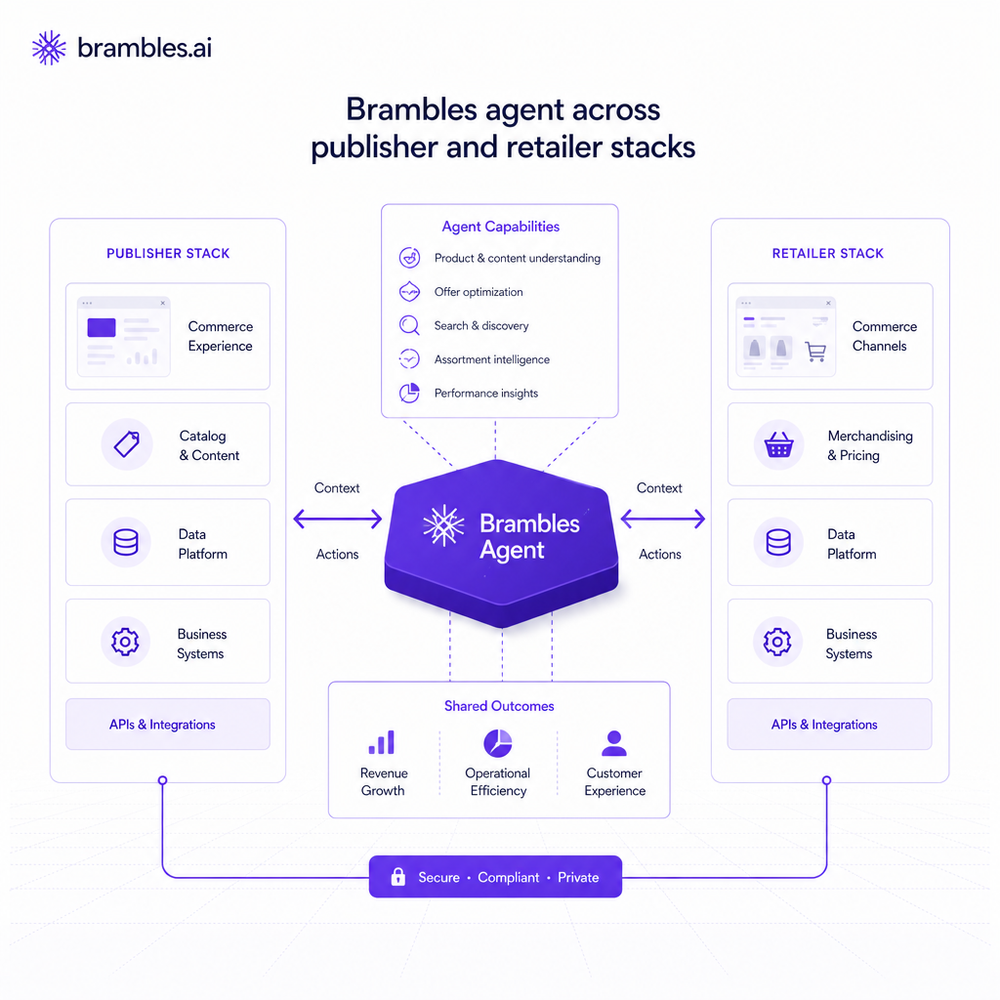
Brambles.ai aligns agent guidance with measurable outcomes for both brands and publishers. Direct add to cart lets shoppers purchase straight from chat, cutting steps and boosting cart creation. Affiliate revenue connects conversations to 1B+ shoppable products and up‑to‑date rates, so publisher advice turns into dependable earnings without manual link wrangling.
For lifecycle coverage, AI customer service handles order lookup and basic support in the same conversational surface, closing the loop when shoppers have post‑purchase questions. And for on‑page context, content intelligence indexes your site so the agent can cite and link your authoritative content in each recommendation—transparent, useful, and on‑brand.
If you monetize with commerce content, read how disclosure fits naturally in chat flows, and why conversational placements outperform static affiliate blocks in both trust and EPC. If you’re a retailer, see why conversational commerce is the next growth lane beyond search and email.
Implementation guide: a 10‑day launch plan
You don’t need a rebuild. Here’s a pragmatic rollout teams have executed in under two weeks.
Day 1–2: Install the Agentic Commerce Module via a single JS snippet. Validate the widget loads on staging and choose a default placement (bottom-right floating).
Day 3–4: Index your site and feeds. Point the crawler at your categories and buying guides; connect your product catalog. Use developers docs for configuration and schema tips.
Day 5–6: Customize the brand voice and visuals. Set colors, fonts, and tone so the agent feels native. Draft three greeting prompts per top page type (e.g., “Need a waterproof hiker under $150?”).
Day 7: Wire revenue actions. Enable direct add to cart for your catalog or affiliate handoffs for publisher flows. QA on mobile and desktop with at least 20 real queries per category.
Day 8: Launch on 10–20% of traffic. Use an A/B flag to measure conversion, AOV, and chat‑assisted revenue against control. Adjust prompts and ranking rules from early transcripts.
Day 9–10: Expand placements. Embed inline shopping blocks mid‑article and on gift guides. Consider native WordPress or the Shopify app for faster rollout across properties.
A home goods retailer followed this plan and saw a 19% lift in chat‑assisted revenue within 11 days. The win wasn’t flashy—just fewer dead‑ends and a cleaner handoff to cart.
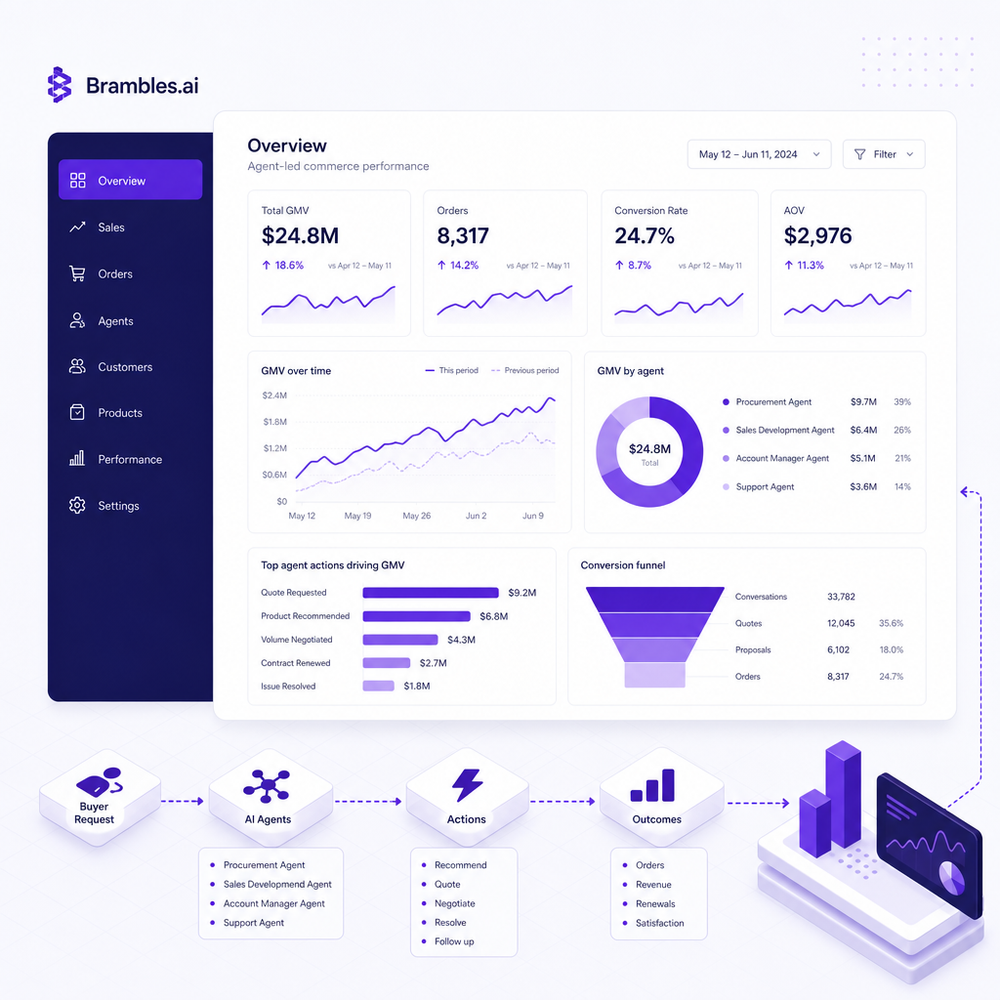
Measuring ROI and the KPIs that matter
Treat the agent like a revenue channel with its own P&L. Track leading indicators first, then tie them to hard outcomes. Salesforce’s customer trends and McKinsey’s personalization studies both connect relevance to revenue—your telemetry should prove the same, page by page.
Agent KPI checklist:
- Chat engagement rate (unique sessions with agent / total sessions)
- Clarification rate (agent asks a useful follow‑up within 2 turns)
- Recommendation click‑through (to PDP or affiliate)
- Direct add‑to‑cart rate and cart creation from chat
- Chat‑assisted conversion and revenue/AOV uplift vs. control
- Time‑to‑first‑answer and CSAT from post‑chat prompts
- Publisher EPC and RPM from conversational placements
First‑party data, disclosure, and trust
Agents must be transparent, privacy‑safe, and brand‑safe. Use first‑party signals (on‑page context, declared preferences) rather than third‑party profiles. Keep disclosures inside the chat, and let people understand why an item was recommended. That transparency earns permission to sell.
Use personality and brand controls so the agent sounds like you, not a template. When voice, disclosures, and reasoning are consistent, CSAT improves and escalations drop—mirroring findings from Google UX Research on clear explanations in complex choices.
For publishers who prefer ads as a complement, keep them contextual and commerce‑aligned, not interruptive. The same decisioning graph that powers recommendations can power lightweight on‑page sponsorships without tracking users across the web.
Common pitfalls (and how to avoid them)
- Treating the agent like a chatbot toy. Give it revenue‑grade goals, prompts, and guardrails.
- Launching only on the homepage. Put the agent everywhere people decide—articles, category pages, PDPs.
- No shopping actions in chat. Without direct add to cart or affiliate handoff, you’ll leak intent.
- Thin product data. Ingest attributes, pricing, and availability daily.
- Opaque reasoning. Show why items match; trust drives conversion (Baymard’s “product finding” heuristics).
Future outlook: agents meet media and video
Expect agent decisions to influence not just product picks but placement economics. As retailers and publishers unify first‑party commerce graphs, sponsored slots will be adjudicated by mission fit and predicted outcome, not blunt bids. Video will fold in too: shoppers will ask, watch, then buy—without leaving the thread.
FAQ
What’s the difference between an AI commerce agent and a chatbot?
A chatbot answers questions; an AI commerce agent drives outcomes. It captures constraints, ranks products, explains tradeoffs, and enables purchase actions—ideally inside the conversation via add‑to‑cart or affiliate handoffs.
How fast can we deploy?
Most teams ship a staged MVP in 7–10 days using the JS module and default settings, then iterate. Plugins accelerate rollout on CMS and commerce platforms with minimal engineering lift.
Does the agent replace site search or PLPs?
No. It complements them and absorbs high‑intent journeys where conversation is faster than clicks. Keep search for known‑item tasks and use the agent to resolve ambiguous missions and bundles.
How should we disclose affiliate relationships in chat?
Use a short, plain disclosure at the start of recommendation threads and keep a persistent info icon. Link to a full policy from the chat footer. This is proven to maintain trust and does not reduce CTR when phrased clearly.
What will this cost and how do we evaluate plans?
Price it against incremental revenue, not pageviews. Start with a pilot tier, confirm KPI lift, then scale. Separate publisher and brand plans help match your monetization model and catalog size.
Related resources on Brambles.ai
If you are implementing this, start with Brambles.ai, enterprise solutions, about Brambles.ai, virtual try-on.
Related posts
View all
Sponsored Products in AI Shopping: Retail Media 101
Learn how sponsored product placements power AI shopping, how bidding and relevance work, and how to implement retail media without eroding trust or UX.
How Context-Aware AI Recommendations Lift CTR
See how context-aware AI recommendations lift CTR by 25–60% with intent signals, page context, and history. Practical steps, KPIs, and implementation tips.
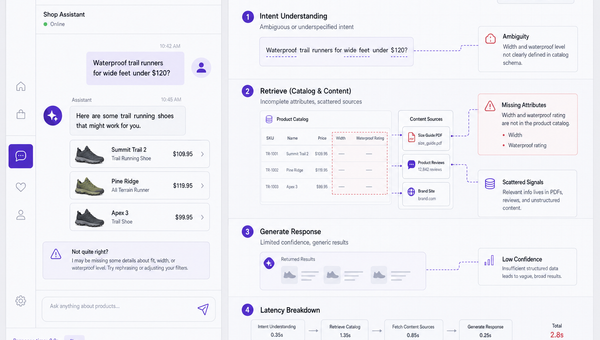
Why Good AI Shopping Agents Are Hard—and How Brambles Helps
Most AI shopping bots fail on data quality, UX, and trust. See why agents break in the wild and how Brambles.ai fills the gaps with measurable features.
Explore Brambles.ai
Learn more about our AI-powered agentic commerce platform, agentic shopping, and shopping assistance solutions.
Explore More Insights
Discover more articles on AI, automation, and business innovation
View All Articles