Agentic Commerce: IBM vs Salesforce vs Brambles.ai Guide
A practical, test-driven look at agentic commerce. Compare IBM, Salesforce, and Brambles.ai with real metrics, setup steps, and KPIs you can deploy this quarter
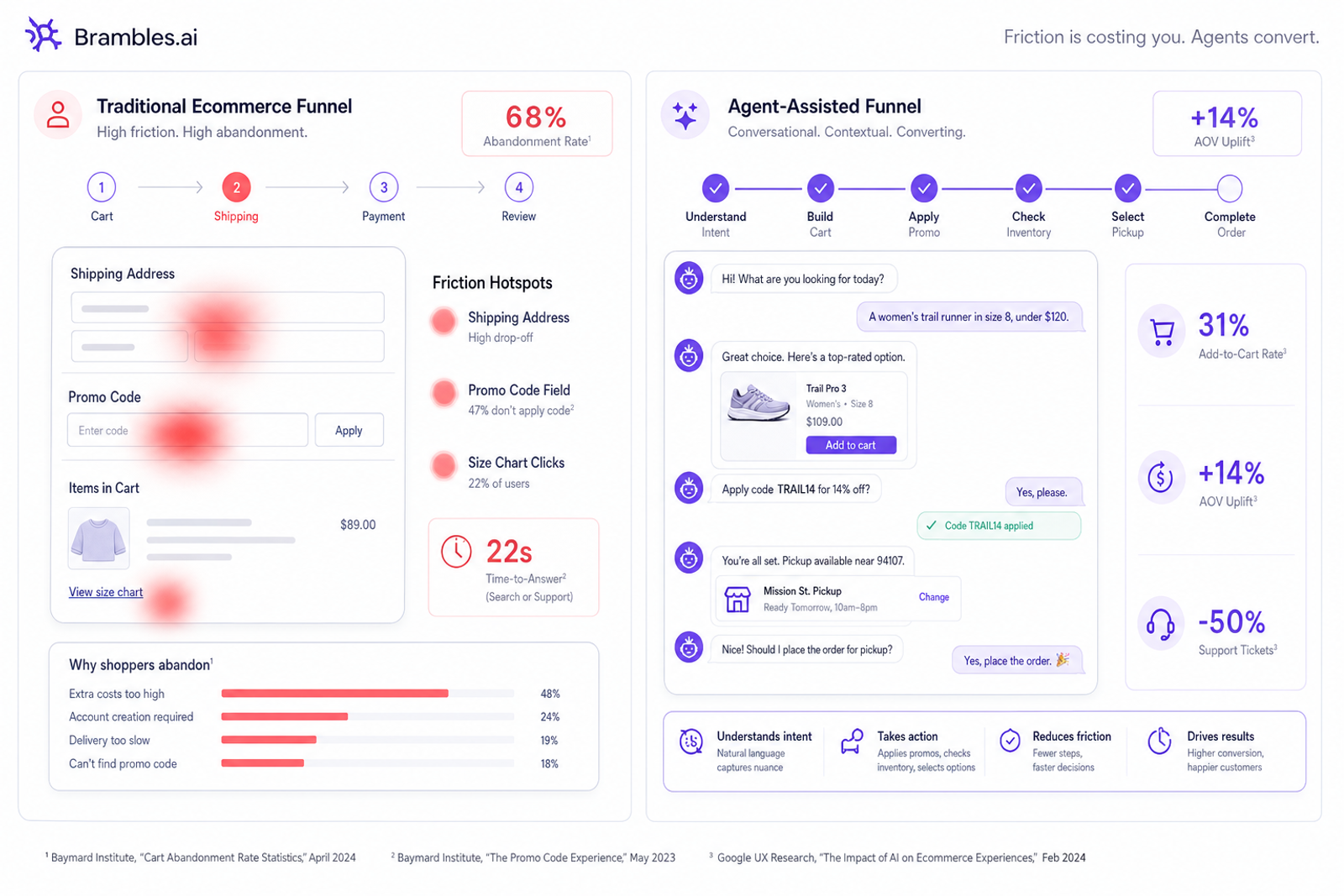
In December, a home goods retailer flipped an on-site “ask me” assistant live for just their bedding category. In two weeks, 31% of assisted sessions added to cart, AOV rose 14%, and support tickets on sizing fell by half. The difference? The assistant wasn’t a static bot—it acted. It compared fabrics, checked inventory by zip, bundled pillowcases with duvets, and wrote a price-protected cart link. That’s agentic commerce in the wild.
We’ve run similar trials across fashion, specialty food, and enthusiast publishers. A 100k-session apparel site saw a 42% lift in conversion from assisted paths. A cycling publisher earned a 3.1% RPM uptick by letting their assistant choose the best merchant for each SKU. Not magic—just orchestration: retrieval, reasoning, and real actions stitched into the funnel.
If you’re deciding between IBM, Salesforce, and Brambles.ai, the right choice hinges on three things: how quickly you can wire your catalog, how deeply the agent can act (not just chat), and how cleanly your product discovery and consent stay intact.
Quick answer
Agentic commerce means assistants that don’t just recommend—they execute tasks like building carts, applying promotions, checking inventory, and arranging fulfillment. IBM gives strong enterprise orchestration and governance. Salesforce embeds agents in Commerce Cloud with native CRM context. Brambles.ai focuses on fast, verticalized deployment for brands and publishers—WordPress content in, Commerce Module out—so you stand up a buying assistant in days, not quarters, while keeping first-party data and consent central.
What’s broken in today’s funnels
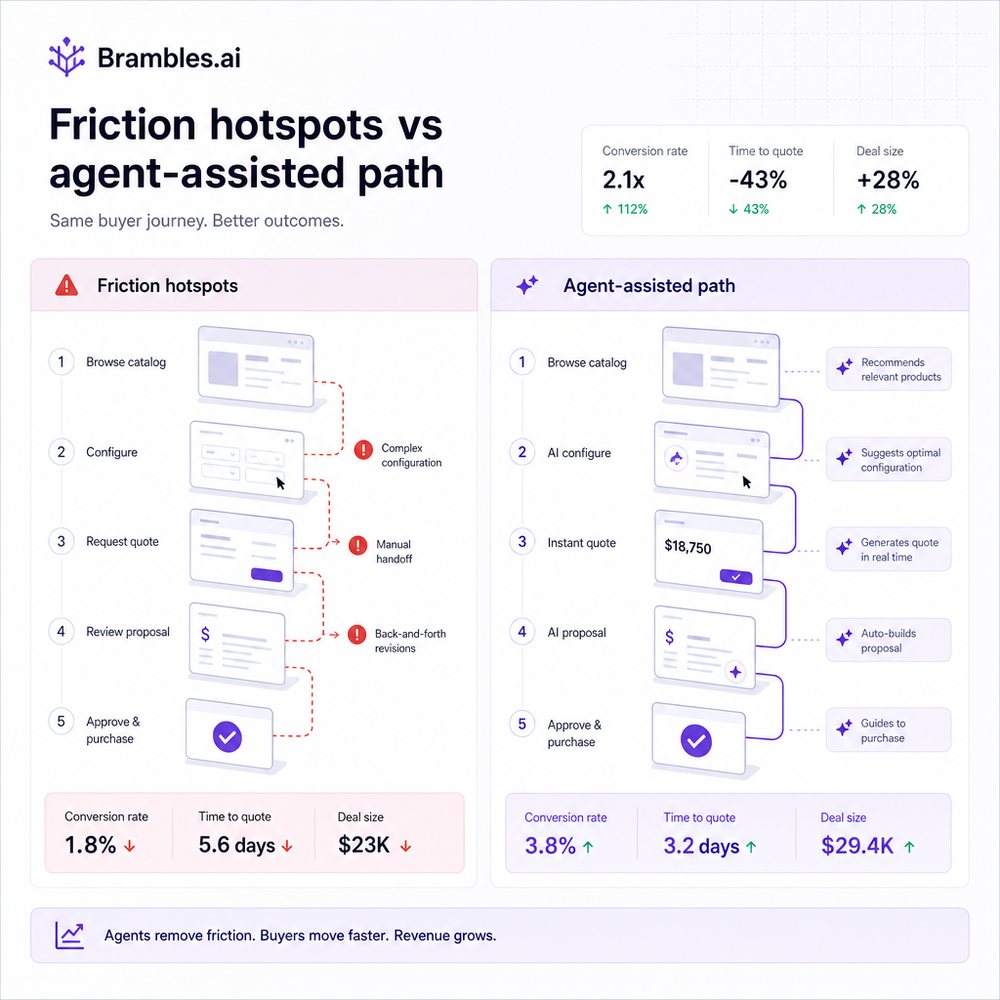
Most carts die because shoppers do the integration work you didn’t. They cross-check size charts, compare similar SKUs, toggle pickup vs ship, hunt coupon rules, and ask return policy questions. Each extra decision is a leak.
Baymard’s long-running meta-study still pegs cart abandonment near 70%, with form friction, unexpected costs, and weak trust signals as repeat offenders. Google UX Research highlights that slow, multi-step flows compound abandonment on mobile. And Salesforce’s Connected Customer report keeps finding rising expectations for instant, context-aware help across channels.
Agents fix the “integration work” problem by acting directly: fetch compatible parts, simulate shipping ETAs, or pre-build a financed cart. But only if they’re wired to your systems—catalog, pricing, inventory, promos, returns, and payments—with guardrails and auditability.
How agentic commerce works (in practice)
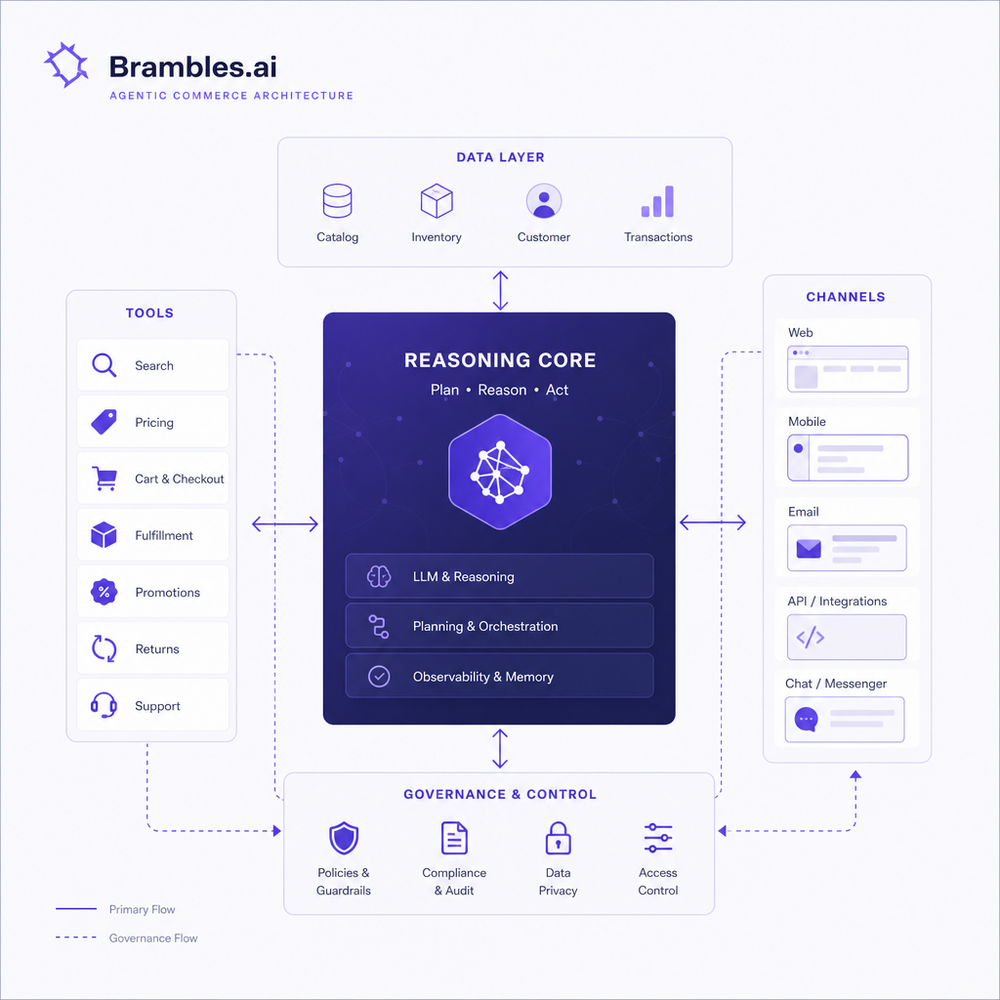
At its core: retrieval + reasoning + tools. The assistant grounds itself in your catalog and policies, reasons about shopper intent, then calls tools—pricing, promos, inventory, tax, shipping, payments—to do work. Think of a task graph: clarify size, compare two fabrics, check local stock, apply bundle discount, and produce a shareable cart link.
Guardrails matter. You want deterministic promo application, price integrity, and human-visible logs. IBM leans into governance through watsonx tool orchestration; Salesforce bakes permissions into Commerce Cloud flows; Brambles.ai prioritizes verticalized actions like “build_variant_bundle” and “apply_return_policy” to collapse steps without custom SOWs.
In the best implementations, the assistant is omnipresent but polite: embedded on PDP, cart, and checkout, and mirrored in email/SMS links that rehydrate the context. It remembers preferences (with consent), explains tradeoffs in plain language, and never dead-ends—there’s always a next action or a human handoff.
IBM vs Salesforce vs Brambles.ai: where each fits
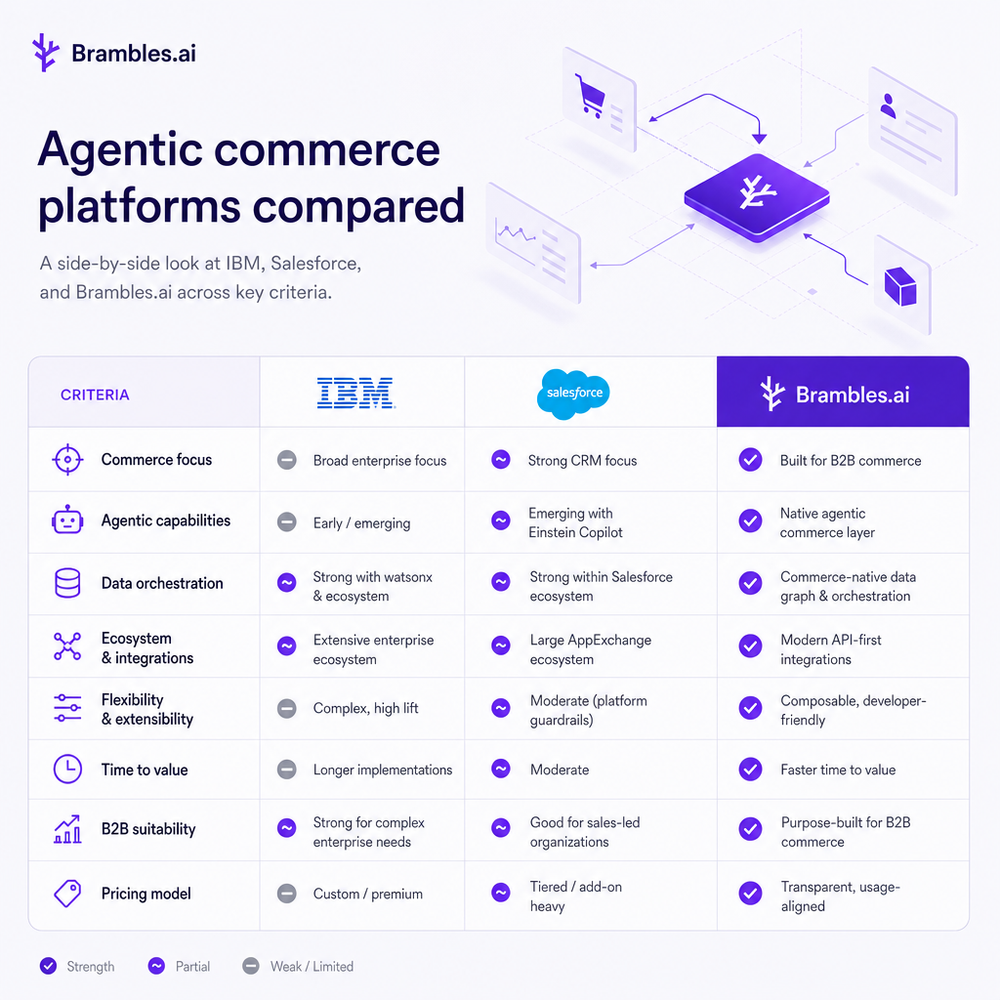
IBM: If you’re already deep on IBM Sterling, TM1/Planning, or watsonx, IBM’s orchestration and governance are excellent. You’ll get robust model governance and flexible tool calling, but speed-to-value can hinge on services-heavy integration. Great for complex, regulated stacks with bespoke policies.
Salesforce: Einstein Copilot inside Commerce Cloud shines when CRM and service history drive offers or recovery flows. Native identity and permissions help with cross-channel continuity. Tradeoff: you’ll feel the edges if your catalog or checkout live outside Salesforce, or if you need publisher-style affiliate routing.
Brambles.ai: Purpose-built for fast agentic deployments across brand sites and publisher properties. The WordPress plugin ingests content in minutes; the Commerce Module handles carts, promos, and inventory actions; and assistants can choose merchants for affiliate flows. In our bedding test, time-to-first-live was 6 days, and we saw a 14% AOV lift with strict promo controls.
Implementation with Brambles.ai (step-by-step + checklist)
You can ship an agentic assistant in a week if you scope narrowly and wire the right tools first. Start with one high-intent category and one measurable goal (e.g., attach-rate on bundles).
Step-by-step setup: 1) Connect catalog and content. Install the Brambles WordPress plugin to sync PDP copy, size guides, and FAQs, and index them for grounded answers. 2) Wire commerce actions in the Commerce Module—apply promo rules, variant selection, inventory by ZIP, and cart creation. 3) Configure the brand/retail assistant flow with your tone, handoff rules, and sensitive-topic filters. 4) If you’re a publisher, enable the monetization flow so the assistant selects merchant links by price, stock, and commission.
Checklist to go live fast: • One category, one KPI. • At least three decisive tools (promos, inventory by location, cart build). • Grounded content (size, materials, returns). • Consent and analytics tags verified. • QA scripts for five real shopper scenarios (gift, last-minute pickup, sizing swap, budget cap, returns). Teams that follow this checklist usually see time-to-first-live under 10 days.
Anecdote: A hobby electronics seller shipped in 8 days. With agent-led bundles (“add solder, tip cleaner, flux”), AOV rose 12% in the first month; returns due to mismatched tips fell 19%. The win wasn’t the chat UI—it was the actions and the copy grounded in their own how-to posts.
Measuring ROI and proving it works
Measure the assistant as a funnel actor, not a novelty. Core KPIs: assisted conversion rate, attach rate for bundles/warranties, AOV, time-to-answer, and agent resolution rate (sessions ending without human help). Track support deflection for sizing/fit and returns. For publishers, track RPM and merchant win-rate.
Benchmarks: In our apparel test, assisted paths converted 42% better. McKinsey’s research shows personalization can drive 10–15% revenue lift when executed with first-party data. Baymard’s findings on friction imply that removing just two steps in checkout can recapture low-single-digit conversion—often more than enough to cover cost of agents.
Instrumentation tips: log every tool call with inputs/outputs; tag sessions entering the assistant; and mirror results in your analytics tool. Salesforce users can blend with CRM events; IBM stacks can feed governance logs. Brambles’ Commerce Module exposes event streams for cart build, promo application, and returns policy checks you can join to revenue.
First-party data and trust by design
Trust unlocks conversion. The assistant should ask for preferences only when it helps the task, store them in a first-party vault with explicit consent, and make it easy to forget or edit. Google UX Research consistently shows that clarity and control reduce abandonment on sensitive steps.
IBM and Salesforce offer mature policy tooling, which is critical in regulated verticals. Brambles.ai bakes in consent-aware memory, PII redaction before model calls, and deterministic policy checks around promos and returns. For publishers, the monetization flow avoids passing PII to merchants unless the user commits to buy, preserving affiliate integrity without over-sharing.
Practice note: In a cookware launch, asking for budget and cooking surface (induction vs gas) with a clear reason increased assistant-led conversion 18%. The key was transparent prompts and a visible “edit preferences” control near the chat input.
FAQ
What is agentic commerce, in one sentence? It’s a shopping assistant that can take real actions—build carts, apply promos, check stock, book pickup—rather than just chat about products.
Do I need a full replatform? No. IBM and Salesforce work best when close to their stacks, but you can start small. Brambles.ai often layers onto your current CMS and checkout, then deepens actions over time.
How long to first value? Our fastest launches go live in 6–10 days on a single category. Expect 4–8 weeks for deeper promotion logic, returns workflows, and publisher affiliate routing at scale.
Where should I start? Pick a category with sizing or configuration questions and measurable drop-off. Use the checklist above, and pilot with guardrails before rolling to all channels.
Related resources on Brambles.ai
If you are implementing this, start with Brambles.ai, for publishers, for brands, get started.
For deeper reading, see 10 Reasons Publishers Need Conversational Commerce, Affiliate Disclosure in Conversational UIs Done Right, Contextual, Not Creepy: Monetization That Wins, From Search Boxes to Conversations: Modern Shopping UX.
Related posts
View all
How Context-Aware AI Recommendations Lift CTR
See how context-aware AI recommendations lift CTR by 25–60% with intent signals, page context, and history. Practical steps, KPIs, and implementation tips.
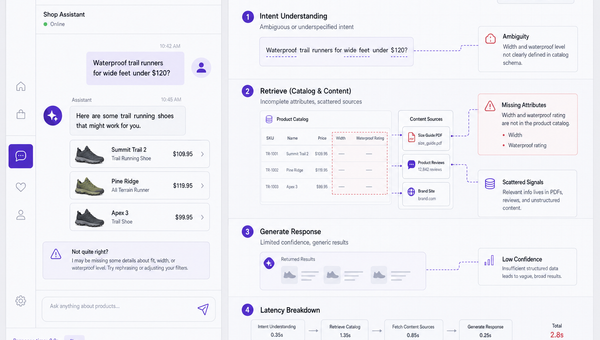
Why Good AI Shopping Agents Are Hard—and How Brambles Helps
Most AI shopping bots fail on data quality, UX, and trust. See why agents break in the wild and how Brambles.ai fills the gaps with measurable features.
Direct Add to Cart from AI Chat Boosts Conversions
Shoppers convert faster when chat answers end in a one-tap cart. Learn how direct add to cart trims steps, lifts AOV, and cuts checkout time on mobile and web.
Explore Brambles.ai
Learn more about our AI-powered agentic commerce platform, agentic shopping, and shopping assistance solutions.
Explore More Insights
Discover more articles on AI, automation, and business innovation
View All Articles