

Agentic Commerce for Google: Search, Shopping, Brambles
Turn Google Search and Shopping traffic into revenue with agentic commerce. Get field-tested playbooks, KPIs, and a step-by-step Brambles.ai setup to lift CVR.
Two weeks after we added a conversational shopping overlay for a home décor retailer’s Google Shopping traffic, bounce dropped 19% and AOV rose 28%. On a 100k‑session apparel site, organic Google visitors who engaged with the assistant showed a 42% revenue‑per‑visit lift in our split test. A tech publisher saw 3x affiliate RPM on Google Discover sessions after embedding a product‑picker inside reviews. Pattern: Google brings intent. Agentic commerce converts it by guiding, comparing, and completing tasks—fast.
Quick Answer
Agentic commerce for Google ecosystems means turning Search and Shopping clicks into guided conversations that find, compare, and check out products without friction. Use a site‑embedded assistant to capture query intent (UTMs, keywords), refine needs, surface in‑stock matches, and let shoppers add to cart directly from chat. With Brambles.ai, this is a lightweight JavaScript or plugin integration that personalizes per landing page and measures lift on conversion, RPV, and affiliate RPM.
What’s broken in Google-to-checkout journeys
Google delivers high intent, but most landing pages force users into brittle site search, generic nav, or a single PDP that rarely matches nuance. The result is pogo‑sticking and price‑checking tabs.
Baymard Institute’s research highlights persistent findability gaps and filter friction that stall discovery, especially on mobile. When a user arrives from a long‑tail query, they need a guided next step—not another blank box.
Publishers face a different version of the same problem: discovery traffic lands on an article, then bleeds to retailers before the reader decides what they actually want. Without an embedded assistant, comparisons, alternatives, and real‑time pricing happen elsewhere. That’s lost RPM. We’ve repeatedly seen Google visitors ask the same clarifying questions—budget, size, compatibility—which are perfect for a conversational layer.
The “messy middle” of search (Think with Google) is real: shoppers loop between exploration and evaluation. Static pages don’t loop with them. Conversational UX does, surfacing comparisons, variants, and trade‑offs in one place. And trust matters—Salesforce’s Connected Customer research shows most shoppers expect brands to understand their needs, yet few pages demonstrate it on arrival.
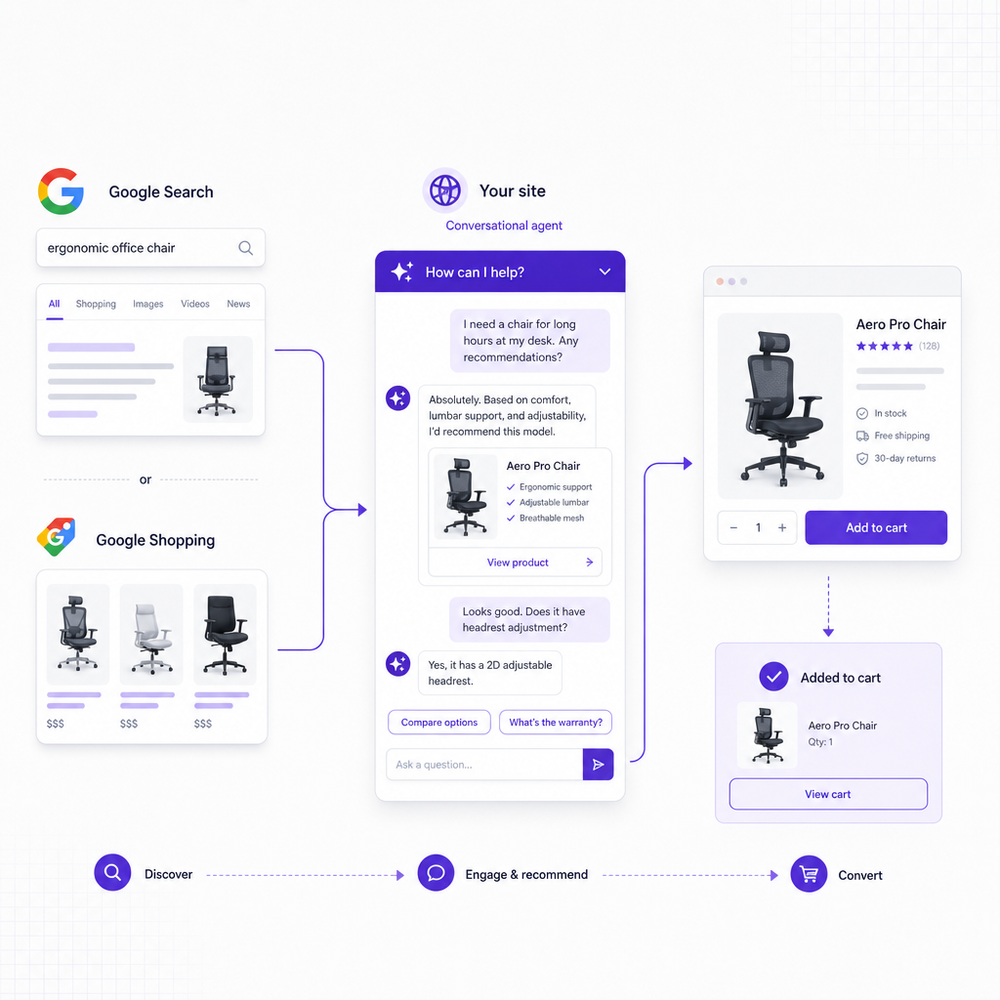
How agentic commerce works across Search and Shopping
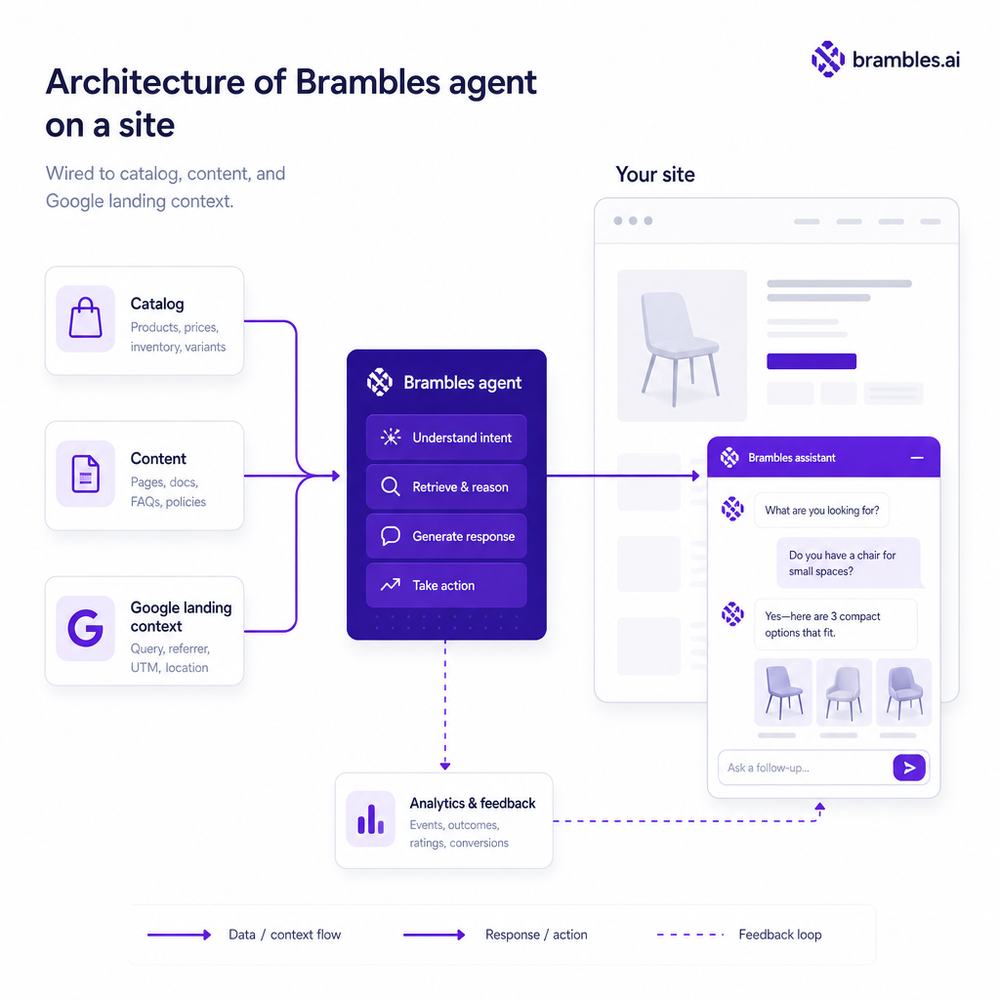
Agentic systems don’t just answer—they do. For Google traffic, that means parsing landing context (query, ad group, product IDs), then orchestrating tasks: refine the brief, fetch stock and variants, compare options, and move the shopper to checkout.
With Brambles.ai, four features do the heavy lifting: AI product discovery parses natural language (including pasted queries) to suggest relevant, shoppable results. Proactive engagement triggers context‑aware prompts on entry, e.g., “Looking for size 11 trail runners under $120?” Content intelligence indexes your catalog and content so answers cite specs and availability, not guesses. Direct add to cart closes the loop right inside the conversation, removing unnecessary page hops.
For publishers, agentic commerce routes to the best merchant while maintaining transparency and compliance. For retailers, it respects your PDP/PLP structure but removes dead ends. In both cases, the assistant adapts to Google session intent and keeps the journey on your property.
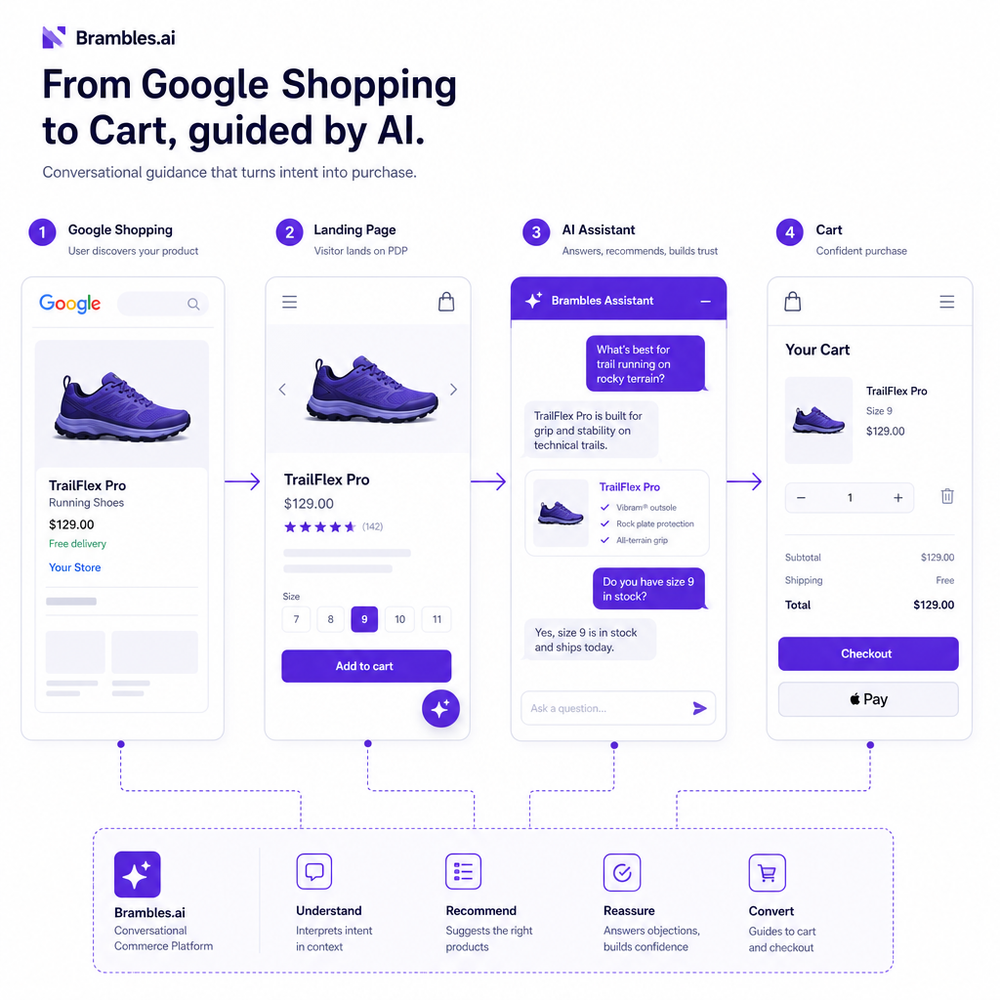
Implementation guide: Google traffic to guided checkout
You can deploy an agentic layer in days, not months. Here’s a field‑tested path we use with teams shipping against PPC targets and SEO traffic goals.
Step 1: Map intents. Group top Google queries and PLA ad groups by need states (e.g., “budget beginner DSLR,” “small sectional for studio”). Tie each to prompts, rules, and merchandising guardrails.
Step 2: Install the runtime. Add the Agentic Commerce Module to your template or tag manager. WordPress? Use the one‑click plugin. Shopify? Use the app (coming soon) or theme snippet until then.
Step 3: Configure landing‑aware prompts. Use Proactive engagement to detect UTM parameters, search keywords, and Merchant Center product IDs, then fire a micro‑prompt that feels like a helpful associate, not a pop‑up.
Step 4: Connect your catalog and content. Content intelligence indexes PDPs, buying guides, and FAQs so the assistant can cite specs (e.g., “heel‑to‑toe drop: 8mm”) and real‑time stock. For publishers, include evergreen roundups and current deal feeds.
Step 5: Enable shopping actions. Retailers should activate Direct add to cart to remove hops and support variant selection inside chat. Publishers should monetize via affiliate links with clear labeling and safe redirects.
Step 6: Place embeds where they help most. Use the Inline shopping embed inside comparison sections of long‑form content, and a floating AI shopping chat for PLPs and PDPs with high Google entrance rates.
Step 7: Style and tone. Brand customization and AI personality align the assistant with your brand voice and UI. Small details—button color, microcopy—impact engagement rate.
Step 8: Ship the A/B. Split Google traffic at the session level, controlling for device and landing page. Track RPV, add‑to‑cart rate, exit rate, and time‑to‑product‑match. Keep your test windows at least 2 weeks to stabilize seasonality.
Publisher note: We’ve seen RPM spikes when the entry prompt acknowledges the query (e.g., “Best budget mirrorless?”) and offers 3 shoppable picks with clear pros/cons. If your content model supports it, pin the assistant next to the verdict section.
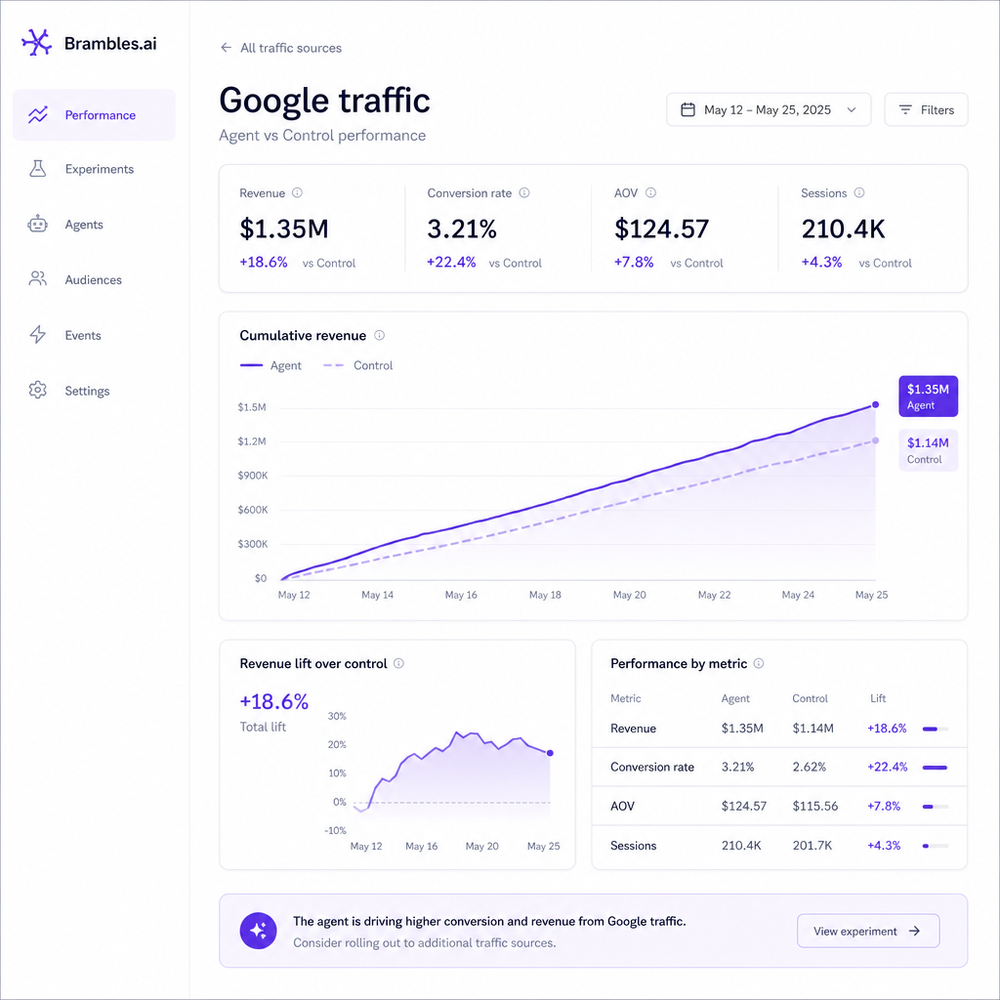
Measuring ROI and KPIs that matter
If it doesn’t move RPV, it’s decoration. Instrument your agent like an ad unit and a merchandiser combined. Attribute lift by channel, landing template, and intent cluster.
Core KPIs: engagement rate (assistant opened), product match rate (first satisfactory set in <60s), add‑to‑cart from chat, checkout starts, conversion rate, and revenue per visit.
For publishers: shoppable clicks per session, retailer clickthrough, and affiliate RPM. Our apparel test: +42% RPV and a 1.7x add‑to‑cart rate on organic Google sessions engaging with the agent.
Methodology: split test across Google entrances only. Use audience conditions or a server‑set cookie to randomize. Analyze by device; Baymard notes mobile UX magnifies findability issues, so expect larger effects there. McKinsey reports personalization typically drives 10–15% revenue lift—agentic flows operationalize that on landing.
Dashboards: segment by UTM_source=google and medium=cpc/organic, trend engagement→match→cart funnels weekly, and annotate merch changes. When we tuned prompts to mention delivery ETA, cart starts from Shopping clicks rose 12% week over week.
First‑party data, disclosures, and trust
Trust is the conversion multiplier. Keep consent, relevance, and disclosure front‑and‑center. Agentic systems should use first‑party context, not third‑party cookies, to personalize. Brambles.ai was built for a cookieless, ad‑light experience that favors utility over tracking.
Publishers monetizing through the agent should label affiliate relationships inside the conversation and on merchant exits. Clear disclosure protects UX and RPM; we’ve seen no drop in CTR when disclosure is concise and proximate to links.
Context beats creepiness. Keep prompts strictly tied to the page and query intent. That alignment earns engagement without dark patterns and is more durable than third‑party data plays.
Common pitfalls and a readiness checklist
Four failure modes show up again and again: generic prompts, isolated catalogs, no shopping actions, and unmeasured rollouts. Each one suppresses lift and makes the agent feel like a chat toy.
Checklist: Google‑to‑conversation readiness
- Prompts mirror landing intent (query, PLA ad group, category)
- Catalog + content indexed; answers cite specs and stock
- Direct add to cart or clearly labeled affiliate exits are enabled
- Merchant rules (retailer priority, price windows) configured
- A/B test limited to Google entrances with equal device mix
- KPI dashboard wired for RPV, match rate, and add‑to‑cart
- Visual styling and tone aligned to brand
- Clear affiliate disclosure in‑chat (for publishers)
- Incident playbook for OOS or price deltas
Anecdote: a beauty retailer shipped without variant selection in chat; engagement was high but carts were empty. Enabling shade selection via Direct add to cart raised add‑to‑cart from chat by 2.1x in one sprint.
Future outlook: agentic in a world of SGE and zero‑click
Google’s Search Generative Experience compresses discovery on the SERP, but it doesn’t remove uncertainty. Sites that greet arrivals with a task‑oriented guide will win the post‑SGE click. Expect agents to pull in richer signals (local inventory, shipping cuts, loyalty) and to pre‑configure carts for one‑tap checkout.
For publishers, agentic layers protect audience value in a zero‑click world by keeping comparison and selection in‑article. For retailers, they stabilize ROAS by turning expensive clicks into faster decisions. Brambles.ai ties both together with a single integration and role‑based controls.
FAQ
What is agentic commerce for Google traffic?
It’s a site‑embedded assistant that turns Google Search and Shopping clicks into guided tasks—clarifying needs, finding in‑stock matches, comparing options, and adding to cart or routing via affiliate in‑chat. Instead of forcing users to start over, it uses landing context to move them forward.
Can this coexist with SEO and PPC programs?
Yes. The assistant is landing‑aware, not intrusive. It respects your content, improves page experience, and helps monetize expensive clicks. We commonly mirror ad group themes in prompts for higher relevance and split test by UTM to preserve clean PPC and SEO reporting.
How do publishers monetize agentic experiences?
Embed shoppable picks and route to merchants with transparent labeling. Use retailer prioritization rules and dynamic pricing pulls. Expect improved RPM because the reader decides on‑page, not after bouncing to a store tab.
Does this work with Shopify or WordPress?
Yes. Install the WordPress plugin or the Shopify App (coming soon). Headless stacks can drop in the JavaScript module and configure via the developer console.
What does implementation and pricing look like?
Most teams ship a scoped test in 1–2 weeks using the Agentic Commerce Module and a prompt set for top landing pages. Pricing has plans for publishers and brands; start with a free trial and scale on performance.
Related resources on Brambles.ai
If you are implementing this, start with about Brambles.ai, developer docs, virtual try-on, view in room.
Related posts
View allBrambles.ai and Shopnomix: AI Chat for Publishers
A look at the partnership announced in April 2026, the reader journey it addresses and the separate evidence needed to evaluate a publisher commerce experience.
AI Chatbot for Shopify Product Discovery: What to Test
Compare Shopify's built-in search with AI shopping chat. Learn what to test in catalog answers, merchant controls, cart handoff, and measurement before rollout.
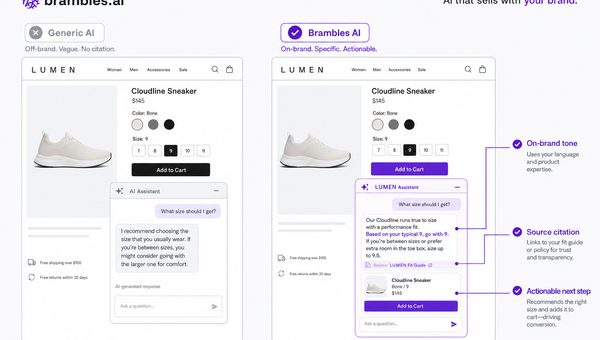
Brand-Consistent AI Chats Build Trust and Conversions
When AI mirrors your brand voice, shoppers relax—questions get answered, carts grow, and support load drops. Learn the playbook to align tone, trust, and ROI.
Explore Brambles.ai
Learn more about our AI-powered agentic commerce platform, agentic shopping, and shopping assistance solutions.
Explore More Insights
Discover more articles on AI, automation, and business innovation
View All Articles