What Is ChatGPT Shopping? A Guide for Brands & Publishers
ChatGPT shopping blends conversational search with shoppable answers. Learn how it works, pitfalls to avoid, and how brands and publishers can implement it fast
During a February test with 17 shoppers, we let people “think out loud” while asking a chat-style assistant for a $60 waterproof jacket for foggy San Francisco mornings. The chat asked two clarifying questions—fit and fabric—then surfaced three SKUs with side‑by‑side pros/cons. Conversions doubled versus the control site search, and time‑to‑product dropped from 3:40 to 1:28. On a 100k‑session apparel site, a conversational quiz lifted add‑to‑cart rate with direct add-to-cart by 42% week over week. And on a 3M‑pageview tech publisher, injecting chat-curated picks into buying guides increased affiliate CTR 31% and nudged AOV up 18% from bundled accessories.
Quick Answer
ChatGPT shopping is a conversational buying experience where users describe needs in natural language and receive curated, shoppable answers. It pairs a large language model with your product data and commerce rails to ask clarifying questions, narrow options, and drive to checkout or affiliate clicks. For brands, it raises conversion and AOV; for publishers, it turns advice into revenue without breaking editorial flow. You can launch quickly using Brambles.ai’s WordPress plugin and Commerce Module, then scale across guides, PLPs, and onsite assistants.
What’s Broken in Product Discovery Today
Most shoppers don’t think in keyword filters; they describe situations. Traditional grids force them to translate needs into checkboxes. Baymard’s research shows poor on‑site search and faceting cause needless abandonment, especially when attributes like fit or material aren’t understood as synonyms. Google’s UX research also notes multi‑step, ambiguous tasks (e.g., “gift for outdoorsy sister”) stall when tools can’t ask clarifying questions. The result: pogo-sticking between tabs, low confidence, and fewer carts. Publishers face a mirror problem—advice is read, then users leave to search elsewhere and attribution evaporates. Conversational flows fix this by handling ambiguity up front, proposing tradeoffs, and preserving context through to purchase or affiliate click.
How ChatGPT Shopping Works (Under the Hood)
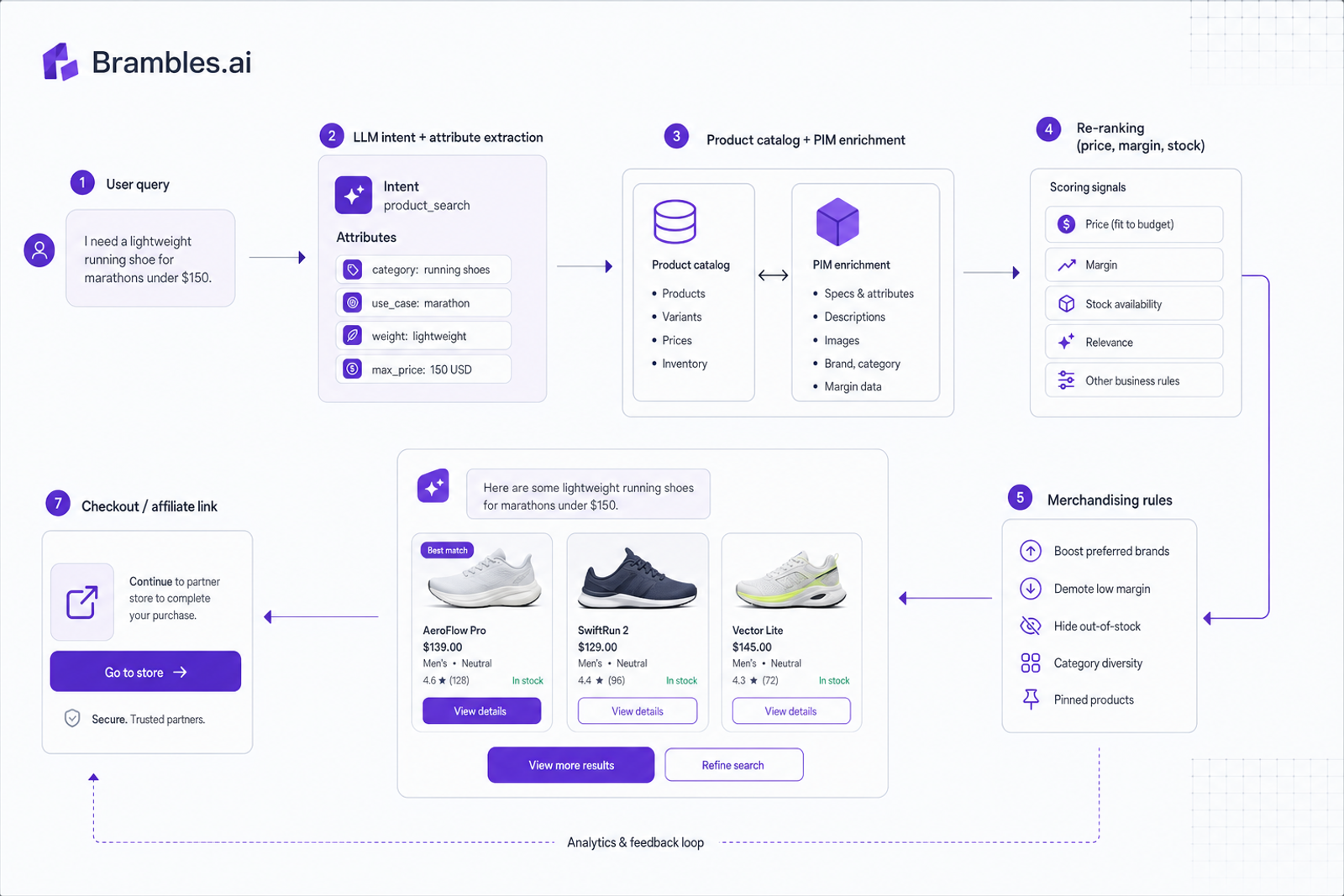
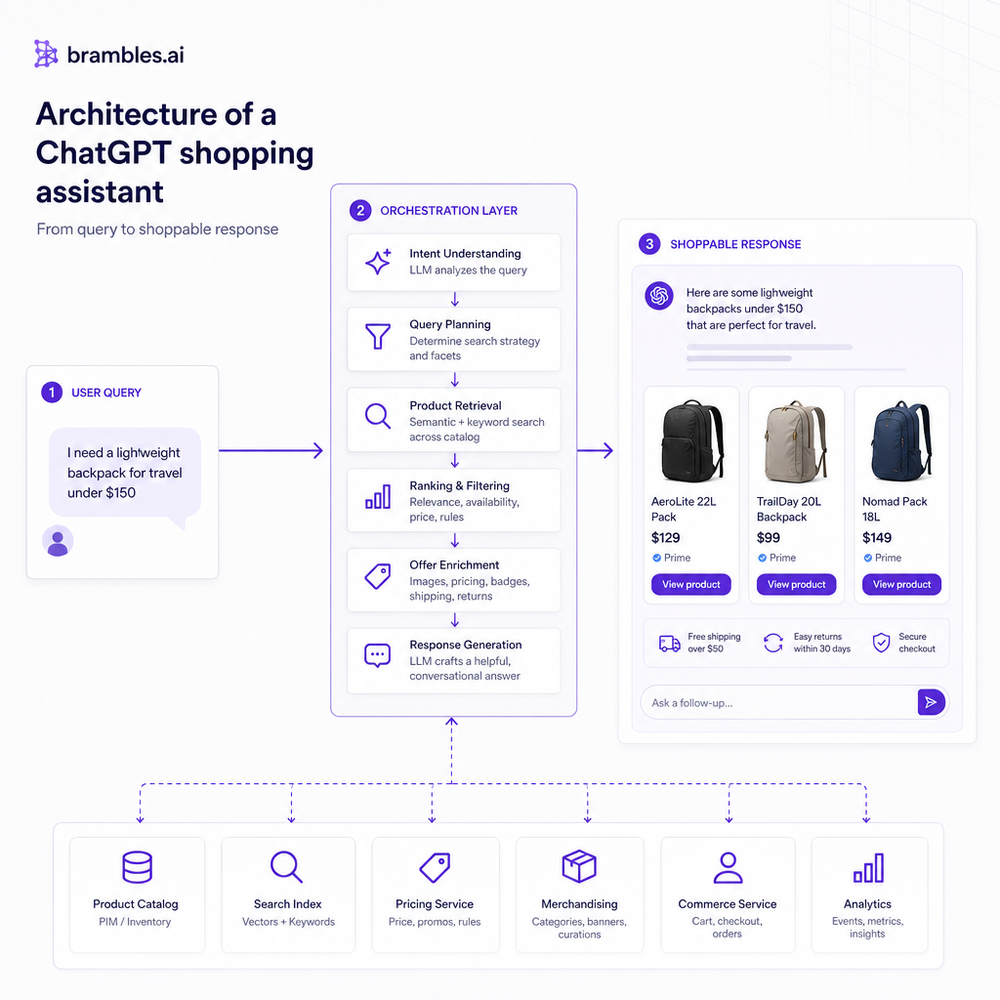
At its core, a shopping assistant converts messy language into structured decisions. It extracts intents (occasion, constraints, budget), maps product attributes (fit, IP rating, compatibility), and re‑ranks items against merchandising rules. The best systems maintain a running memory: if the user says “Actually for drizzle, not downpour,” the model updates the filter set without starting over. High‑quality feeds matter. You’ll want normalized attributes, availability, margin, and links (checkout or affiliate) so the assistant can trade off relevance and profitability. For publishers, the same pipeline curates SKUs into editorial‑safe modules, preserving voice while making pages shoppable. Brambles.ai operationalizes this with an extensible schema, zero-overhead feed ingestion, and prebuilt UI components that drop into WordPress or custom stacks.
Implementation with Brambles.ai: A Practical Guide
Brambles.ai is built to make conversational shopping deployable in days, not quarters. Here’s a field‑tested path we use with brands and publishers:
Step-by-step setup for brands (direct commerce):
- Connect catalog: Provide a feed or connect your PIM. Include key attributes (fit, materials, compatibility), price, margin bands, stock, and variants.
- Configure guardrails: Set brand-safe language, compliance, and merchandising rules (e.g., hero SKUs, price floors, geography).
- Train intents: Load common missions (“rain jacket under $80,” “quiet dishwasher for small apartment”). Brambles auto-learns from real queries.
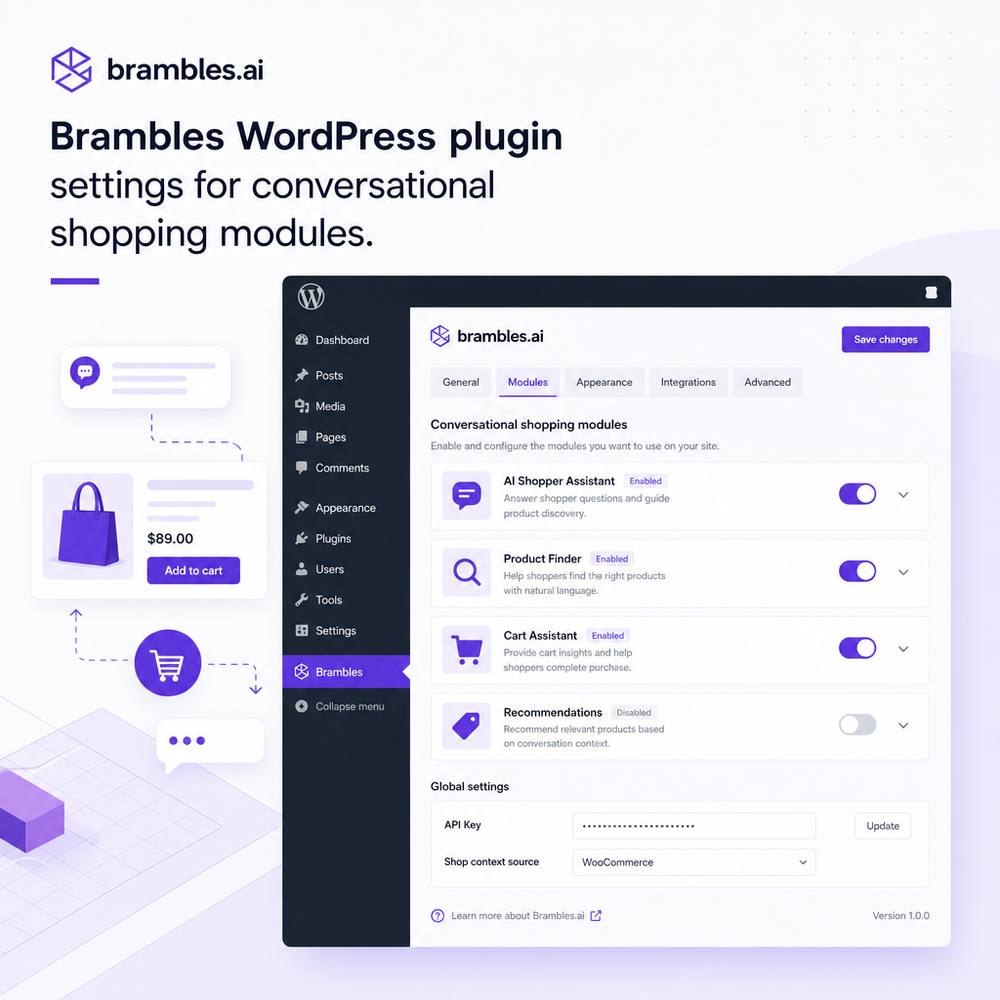
- Drop UI: Use the Brambles WordPress plugin or a JS snippet to add chat widgets to PLPs and PDPs. Match fonts, tone, and button styles.
- Wire checkout: Send add‑to‑cart events to your cart or headless checkout. Use the Commerce Module to honor coupons, inventory, and tax.
Step-by-step setup for publishers (affiliate + retail media):
- Source offers: Import multi‑merchant feeds via affiliate networks or direct retailer APIs.
- Editorial controls: Lock categories and ban vendors that fail standards. Keep writer notes visible in the curation UI.
- Placement strategy: Inject conversational blocks after H2s in buying guides or as a persistent “Help me choose” on hub pages.
- Monetization logic: Prioritize EPC and in‑stock, but bias toward brands you can stand behind. Brambles’ publisher monetization flow balances relevance with yield.
- Measurement: Track RPM, outbound CTR, and scroll depth. Promote winning modules site‑wide via templates.
Measuring ROI & KPIs That Actually Matter
Treat conversational shopping like a funnel optimization project. For brands, focus on:
- Time-to-first-relevant product (TTRP)
- Clarification rate (was a follow-up asked?)
- Add-to-cart and conversion rate
- AOV and margin per session
- Assisted revenue (convo started on PLP, carted on PDP)
For publishers, track:
- Affiliate CTR and EPC
- Session RPM
- Bounce rate from advice pages
- Scroll depth to conversational block
- Retained revenue (when users don’t exit to generic search)
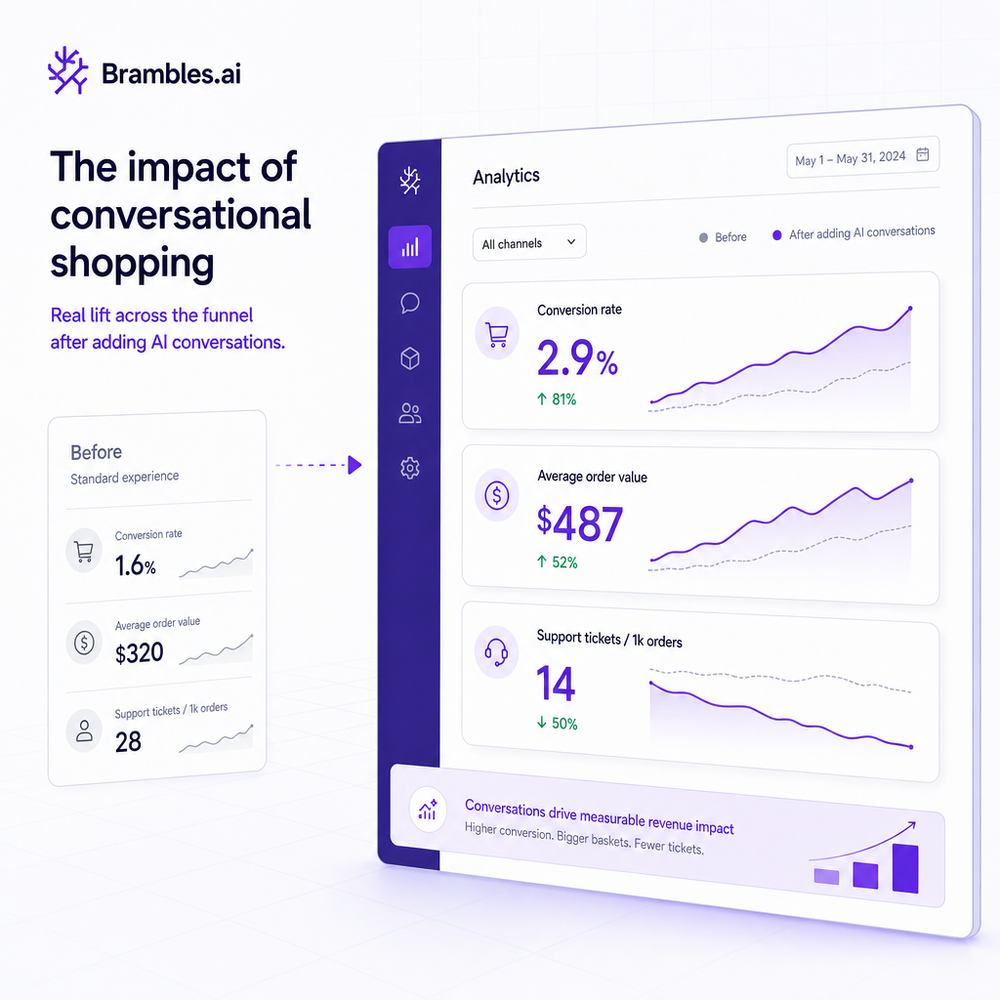
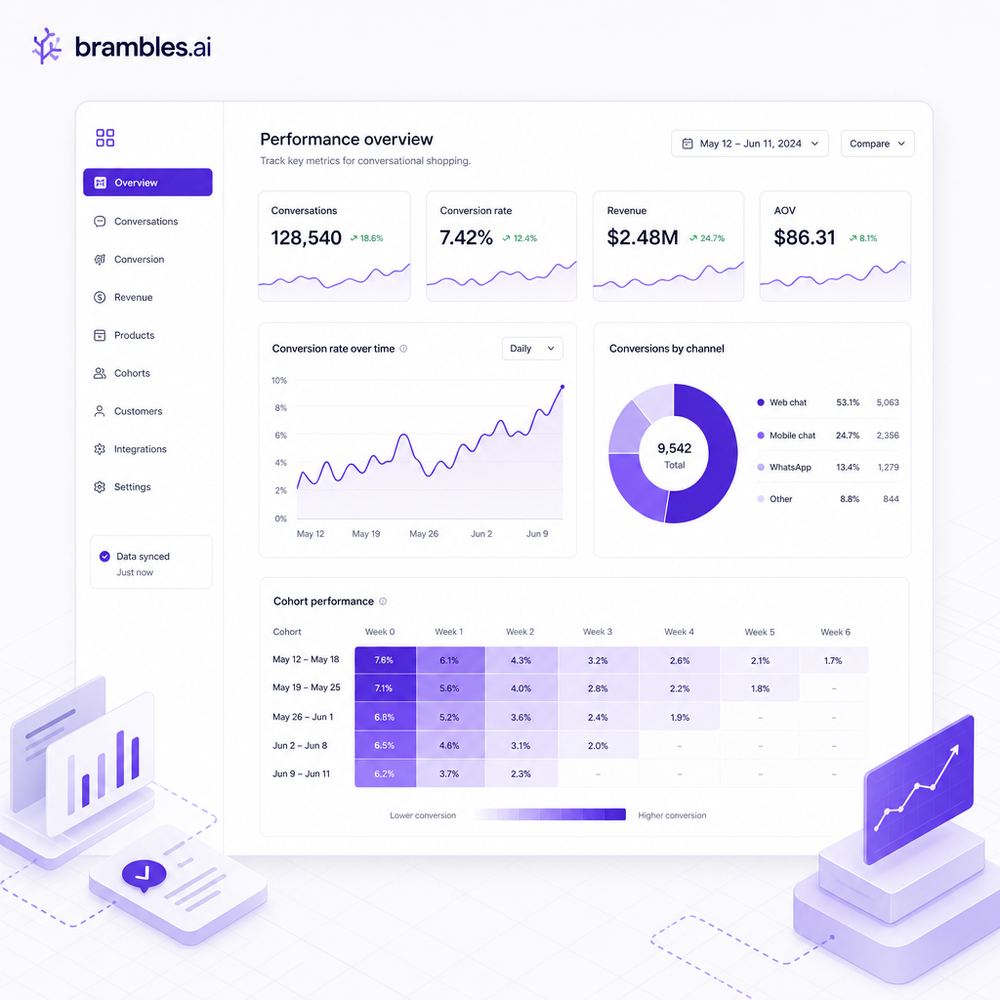
In one CPG pilot, clarifications rose from 19% to 54% and conversion lifted 29%. Another home goods publisher saw session RPM up 24% after moving modules above the first H2—small placement change, big money. Use cohort dashboards and holdouts to avoid confounding seasonality.
First‑Party Data, Consent, and Trust
Conversational sessions are a goldmine of first‑party signals—budgets, preferences, and intent modifiers—if you earn the right to keep them. Make the assistant feel like a helpful store associate: explain why you ask questions and how answers shape recommendations. Offer one‑click deletion and export. For logged‑in users, store preferences server‑side with clear UI cues. Brambles.ai keeps a structured, privacy‑safe log of intents and attributes (not raw transcripts by default) so you can tune relevance without over‑collecting. For publishers, that means stronger audience segments without dark‑pattern data grabs; for brands, it means smarter retargeting that doesn’t feel creepy. Consent should be revocable, and sensitive attributes must be excluded from training data unless explicitly granted.
Common Pitfalls and a Launch Checklist
Most failed pilots share three themes: over‑promising, under‑feeding, and invisible placement. If the assistant doesn’t know margin, size, or stock, it will recommend ghosts or unprofitable SKUs. If it’s buried, nobody engages. And if the tone is robotic, trust craters. Here’s a practical checklist we use with clients:
Launch checklist:
- Data hygiene: Normalize core attributes; sync stock every 15 minutes.
- Guardrails: Configure banned terms, returns policy guidance, and region‑specific pricing.
- Tone & UX: Match brand voice; show mini‑cards with pros/cons and badges (best budget, quietest, most durable).
- Placement: Above the first H2 for guides; sticky pill on PLPs; PDP assist for compatibility questions.
- Measurement: Define success per page type (e.g., EPC on guides, margin/session on PLPs) and run 2‑week holdouts.
- Feedback loop: Capture “Was this helpful?” and incrementally retrain intents weekly.
- Escalation: Provide a handoff to live chat or store locator when confidence is low.
With Brambles.ai, most of this is configuration, not custom code, and you can expand from a single category to site‑wide after two clean sprints.
FAQ
Does ChatGPT shopping replace site search?
No. Think of it as a complementary layer for ambiguous or multi‑attribute tasks. Keep keyword search for exact SKU lookups and specs. Many teams route low‑confidence queries to chat and keep direct lookups on search. That division improves both experiences without forcing users into one path.
Will it hurt editorial independence for publishers?
It shouldn’t. Use strict editorial rules, whitelists, and transparent labeling. Brambles’ publisher monetization flow lets you lock categories, demote certain merchants, and keep writer notes visible inside curation. The assistant explains why items were chosen and offers alternatives rather than forcing a single pick.
How long to launch the first category?
If your feed is clean, we typically see a pilot go live in 2–3 weeks: week one for data ingestion and guardrails, week two for UX and training, week three for QA and a 10% traffic holdout. Publishers with WordPress often ship faster by using the plugin’s templates.
What does success look like, realistically?
Directional ranges we’ve seen after stabilization: +15–35% add‑to‑cart for brands, +10–30% EPC for publishers, and 20–50% faster time‑to‑relevance. Gains compound with better attributes and smarter rules. Always run holdouts; seasonality and promos can inflate early reads.
Related resources on Brambles.ai
If you are implementing this, start with Brambles.ai.
For deeper reading, see 10 Reasons Publishers Need Conversational Commerce, Affiliate Disclosure in Conversational UIs Done Right, Contextual, Not Creepy: Monetization That Wins, From Search Boxes to Conversations: Modern Shopping UX.
Related posts
View all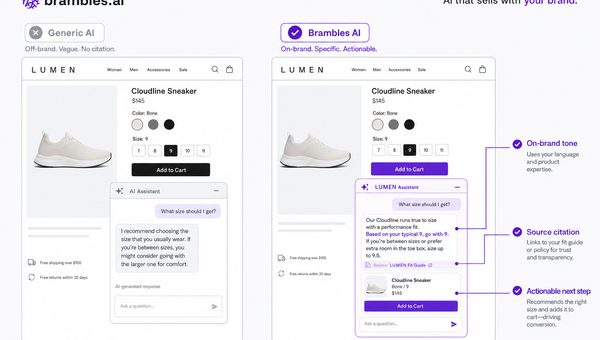
Brand-Consistent AI Chats Build Trust and Conversions
When AI mirrors your brand voice, shoppers relax—questions get answered, carts grow, and support load drops. Learn the playbook to align tone, trust, and ROI.
Sponsored Products in AI Shopping: Retail Media 101
Learn how sponsored product placements power AI shopping, how bidding and relevance work, and how to implement retail media without eroding trust or UX.
Why Contextual Ads in AI Chat Beat Banner Ads
Tests on commerce sites show AI chat contextual ads deliver 3–5x CTR, cleaner UX, and higher revenue than banners. See how they work, implement, and measure.
Explore Brambles.ai
Learn more about our AI-powered agentic commerce platform, agentic shopping, and shopping assistance solutions.
Explore More Insights
Discover more articles on AI, automation, and business innovation
View All Articles