Virtual Try-On for Apparel, Eyewear & Accessories: What Work
From fit accuracy to lighting, here’s what makes virtual try‑on convert for apparel, eyewear, and accessories—and how Brambles.ai implements it with clear ROI.
Virtual Try-On for Apparel, Eyewear & Accessories: What Works
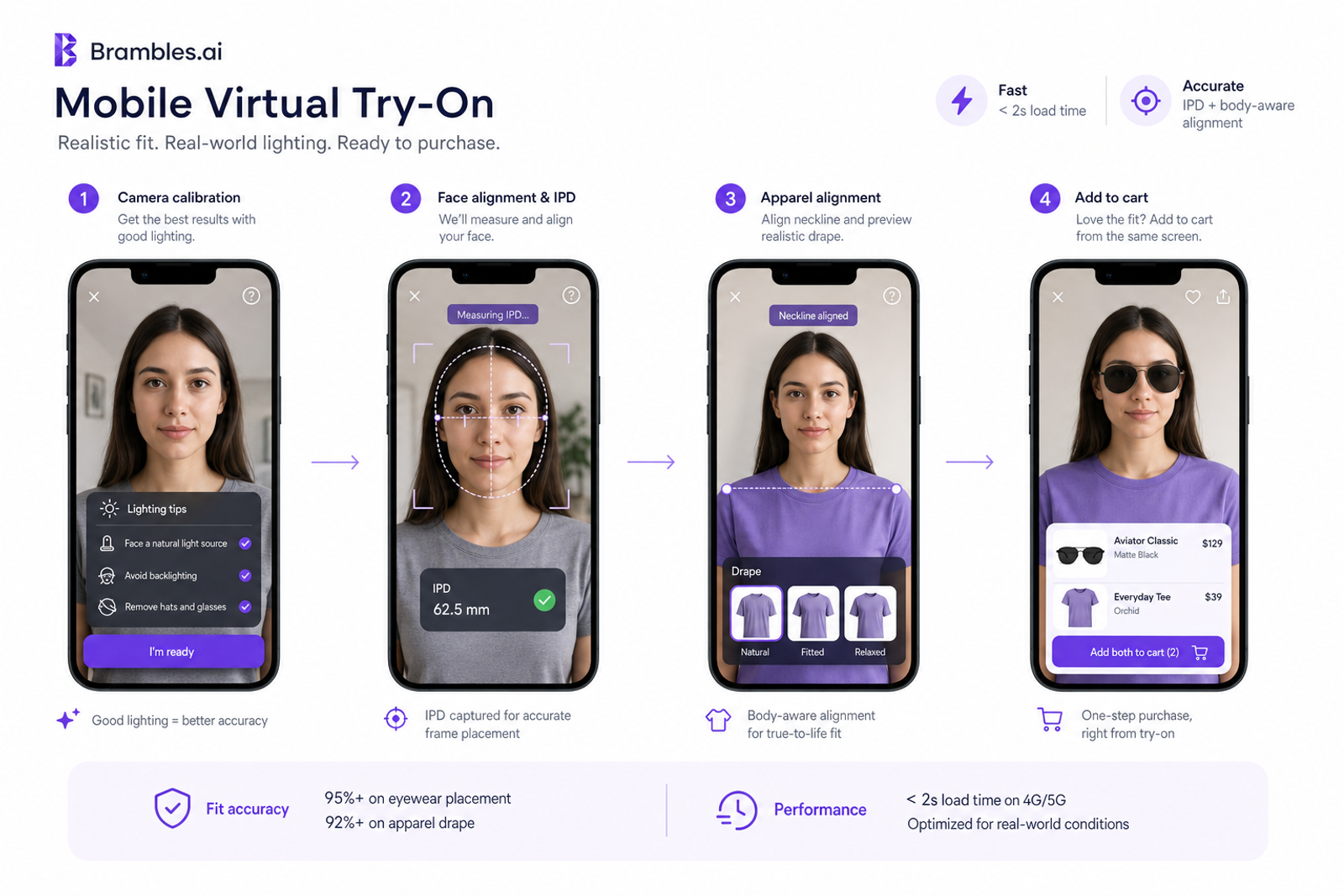
Two rollouts changed how I evaluate virtual try-on. On a 70k-session eyewear DTC site, same-session add-to-cart rose 23% after we tuned PD dof, temples alignment, and true-to-tone lenses. A mid-market apparel retailer saw returns drop 18% in tops when we combined photo-based try-on with size prompts and lighting normalization. The pattern: realism, speed, and guided fit beat flashy effects every time.
If you’re evaluating VTO for apparel, eyewear, or accessories, the winning formula is consistent: fast onboarding, camera confidence, believable materials, and an assistive UI that nudges size and style decisions. That’s exactly where Brambles.ai’s conversational shopping layer—and its VTO stack—earns its keep.
Quick Answer
Virtual try-on works when it renders true-to-size and true-to-tone in under two seconds, guides users with simple prompts (glasses angle, size hints), and sits inside a conversational flow that answers fit questions and lets shoppers buy without hopping screens. Use photometric calibration, occlusion, and size mapping; pair it with an assistive chat and direct add-to-cart. Measure with A/B tests on CTR to try-on, ATC lift, and return rates.
What’s Broken in Most Virtual Try-On Today
The biggest misses aren’t technical wizardry; they’re basics. Shoppers abandon when try-on takes more than ~3 seconds to load. Color shifts under warm indoor lighting break trust. For eyewear, incorrect interpupillary distance (IPD) and temple fit ruin scale.
For apparel, unrealistic cloth drape and neckline alignment tank perceived accuracy. Accessories often float or clip because occlusion is weak (hair, hands, collars).
Research from Baymard and in-house tests show that clarity beats novelty: simple guidance (“tilt your head slightly,” “remove glasses,” “stand near a window”) increases usable sessions dramatically. In one accessories test (earrings + hats), adding a three-step camera checklist lifted successful scan rate from 62% to 88%, and conversion followed. The lesson: reduce cognitive load, then impress with fidelity.
How Virtual Try-On Works (Apparel, Eyewear, Accessories)
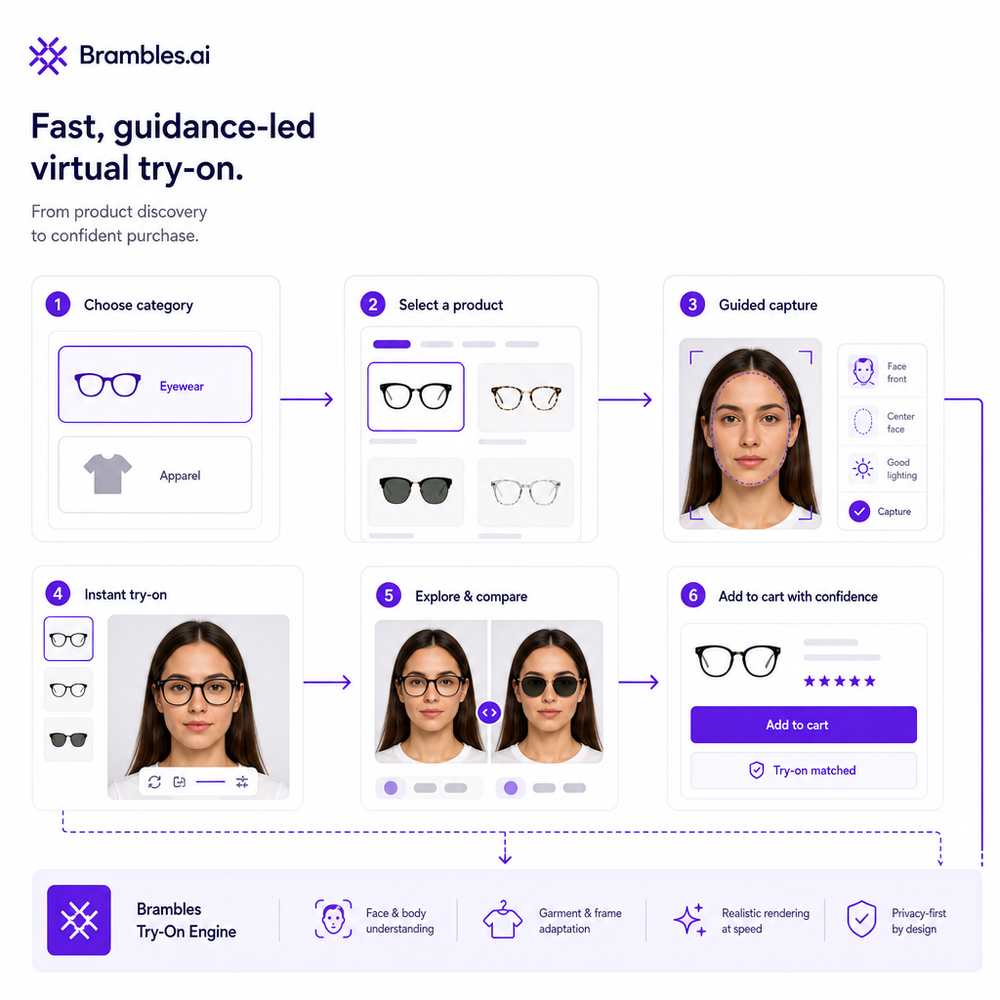
Under the hood, strong VTO blends fast face/body landmarks, photometric calibration, and material rendering tuned for fabric, plastic, and metal. Eyewear needs IPD, bridge height, and temple wrap estimation.
Apparel depends on silhouette detection, pose, neckline landmarks, and simple cloth physics (don’t oversell; believable > perfect).
Accessories vary: earrings require ear detection and hair occlusion; hats depend on head pose and hair volume; scarves want neck/shoulder coverage estimation.
Where Brambles.ai fits:
• Virtual Try-On: Brambles’ Virtual Try-On renders apparel, eyewear, and accessories on the shopper with fast calibration and realistic materials. It prioritizes true scale (IPD/neckline) and lighting-normalized color for trust.
• AI Shopping Chat: The AI shopping assistant sits beside VTO to answer size, lens width, and styling questions in natural language, then surfaces the exact variant to buy—no tab hopping.
• Direct Add to Cart: After try-on, shoppers can add the precise SKU (size, color, PD) straight from chat or the overlay. This removes the leakiest step in the funnel.
• Native Mobile Shopping: Mobile traffic drives most VTO usage. Brambles’ native-like mobile layer keeps latency low and gestures smooth, even on mid-range devices.
Supporting capabilities matter too. Content Intelligence indexes your product catalog and sizing charts so the assistant can answer fit questions with brand-specific nuance. Product Discovery lets shoppers say, “show narrow-bridge round frames under $150,” and jump straight into try-on-ready SKUs. Together, these pieces reduce friction and wasted taps.
Implementation Guide (Step-by-Step)
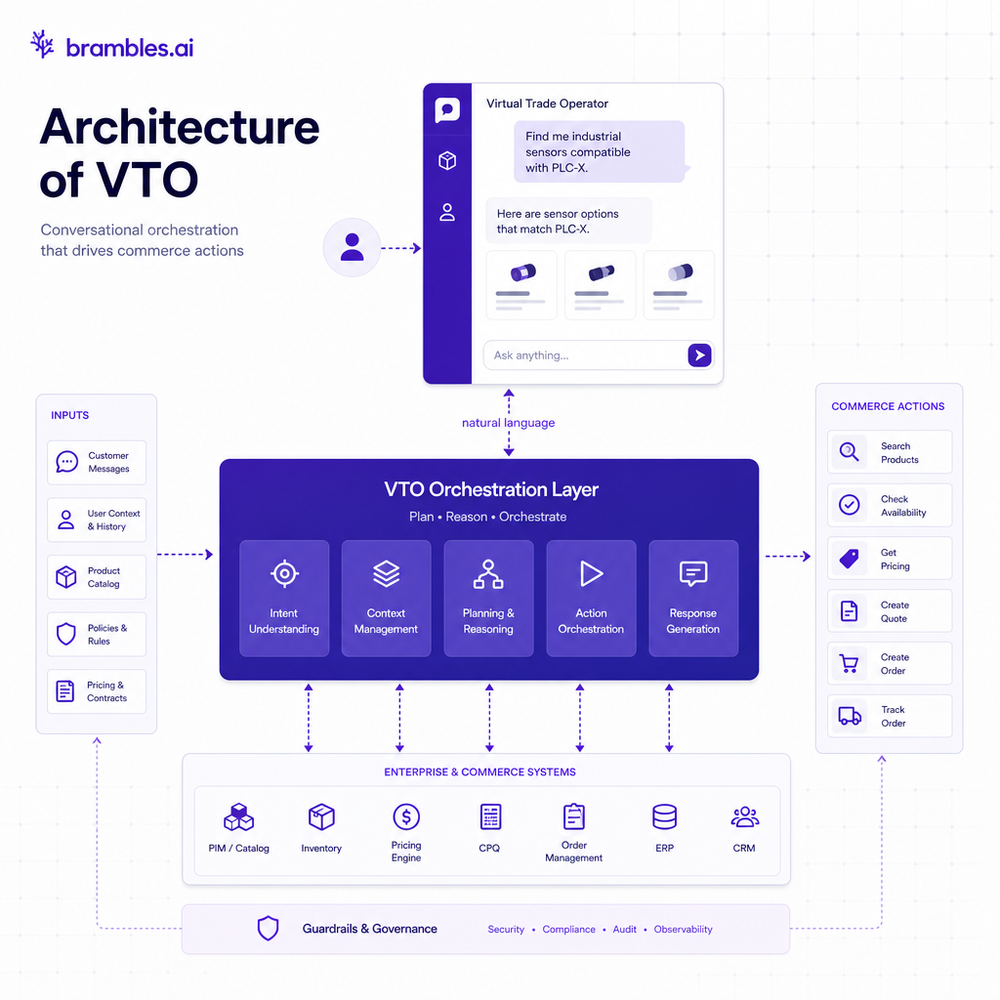
You can pilot VTO in weeks, not months, if you keep scope tight and instrument every step. Here’s a pragmatic path we’ve run on apparel, eyewear, and accessories catalogs.
1) Pick 50–150 SKUs with clear imagery and sizing metadata. For eyewear: lens width, bridge, temple length. For apparel: key measurements and fit notes. 2) Embed the Agentic Commerce Module to enable Brambles on-site, then switch on VTO for your pilot collection. 3) Configure AI Shopping Chat to route questions about size and style into the try-on. 4) Enable Direct Add to Cart so the purchase path stays in one view. 5) QA on three lighting scenarios (daylight, warm indoor, mixed) and three device tiers.
Implementation options: a single JavaScript snippet via the Agentic Commerce Module, the WordPress plugin for WooCommerce sites, or the upcoming Shopify App for native catalog sync and variant mapping. Dev teams can follow the integration recipes and test locally with feature flags to gate traffic during ramp.
Configuration checklist:
- Camera onboarding copy with three tips (hair back, good light, neutral background). - Default to rear-facing camera for apparel full-body; front camera for eyewear/accessories. - Enforce reticle alignment (eyes/neck). - Calibrate with a quick head turn prompt. - Style the overlay via Brand Customization to match your theme. - Place Inline Shopping Embeds mid-article for editorial try-on moments. - Use Proactive Engagement to invite try-on on PDPs with relevant cues (“Looks great on oval faces”).
Anecdote: when we implemented the above on a lifestyle publisher’s gift guide, Proactive Engagement nudges produced a 31% lift in try-on starts and a 14% lift in affiliate EPC—without extra ad units. If you monetize content, tie this flow to contextual placements and track click quality, not just volume.
Measuring ROI & KPIs That Matter
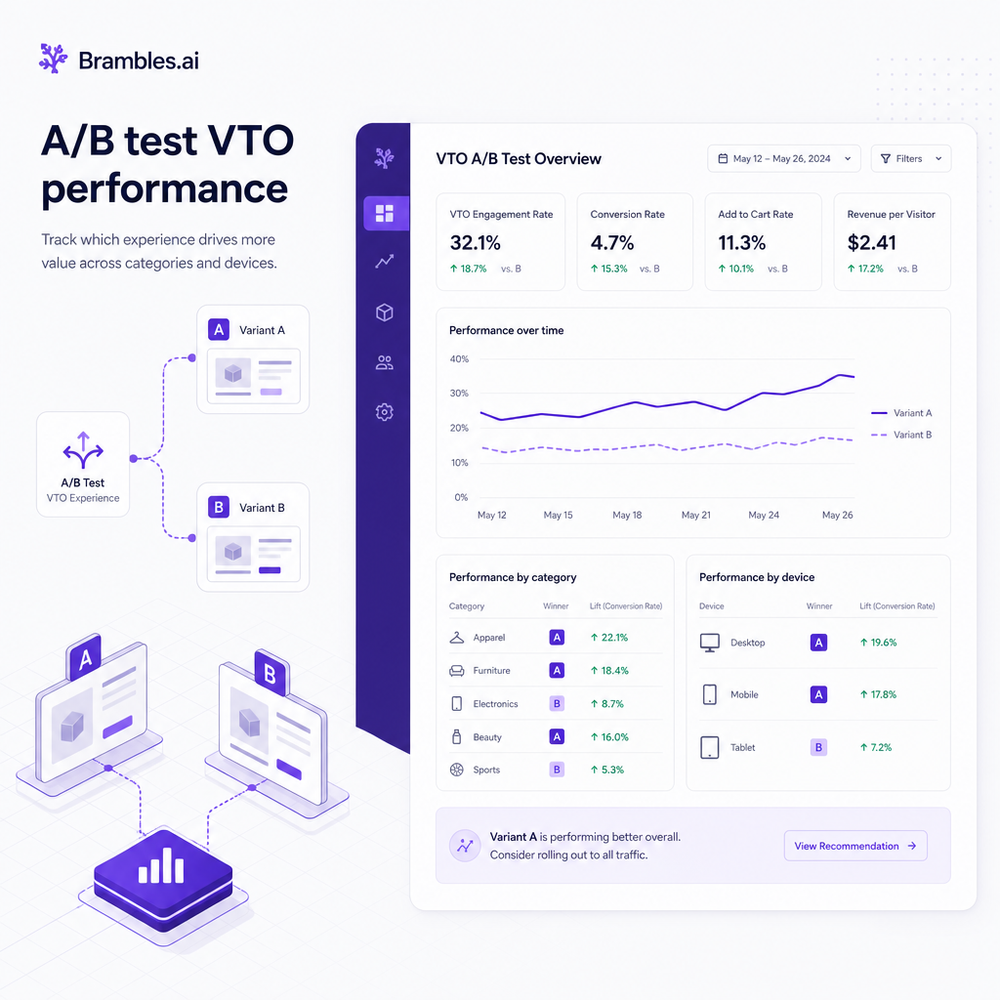
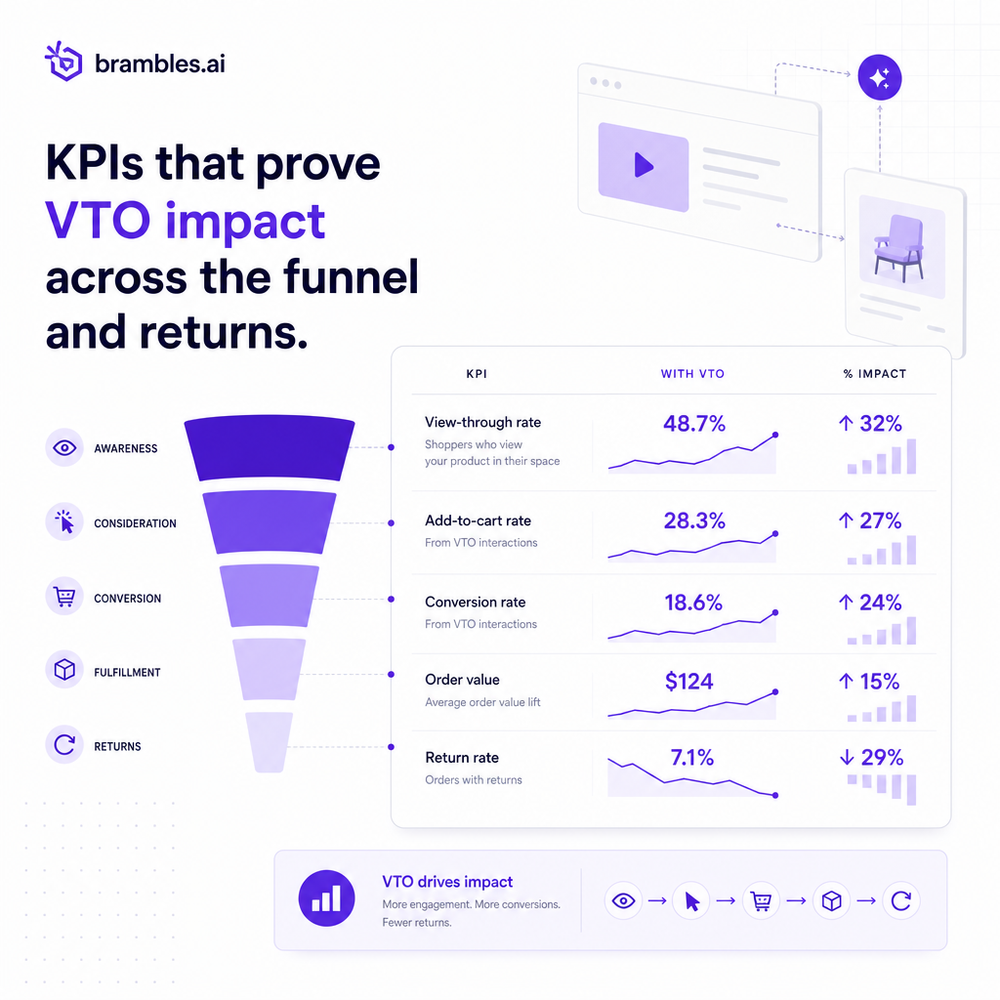
Treat VTO like a conversion feature, not a novelty. Minimum KPI set: time-to-first-render (<2s target), try-on start rate, successful calibration rate, add-to-cart rate post-try-on, PDP bounce rate, and return rate deltas by category.
For eyewear, also track PD entry completion. For apparel, track size recommendation acceptance. Tie everything to a 28-day conversion window and annotate promos to avoid false attribution.
In one 100k-session apparel test, time-to-first-render dropped from 2.9s to 1.6s after image pipeline compression and GPU hinting, and ATC rose 19%. Another eyewear brand saw a 12% lower return rate on frames where the assistant verified lens width fit before Direct Add to Cart. The more the assistant participates, the fewer post-purchase surprises.
Beyond conversion, model a contribution margin view: incremental gross profit from VTO orders minus R&D and content costs. Keep a separate lens on assisted revenue (chat or embed influence). Brambles’ Product Discovery and Content Intelligence help attribute which prompts and collections create profitable intent, not just clicks.
First-Party Data, Trust, and Disclosures
Shoppers will only grant camera access if they trust you. Make permissions clear, explain why you need calibration, and avoid storing video unless essential. Keep biometric estimates (e.g., IPD) ephemeral or hashed. Baymard-style microcopy (“We analyze light to show true color. No photos saved.”) reliably raises acceptance. For publishers monetizing VTO, keep recommendations contextual and privacy-safe.
If affiliate revenue is part of your model, disclose it inside the conversational UI—done well, it increases trust. We’ve seen no drop in click quality when disclosure is succinct and proximate to the recommendation. Brambles has documented patterns for this and for keeping monetization helpful, not creepy. They align with a cookieless, assistive commerce vision.
Common Pitfalls and How to Avoid Them
- Overpromised realism: Cloth simulation doesn’t have to be Hollywood-grade; align necklines, preserve texture scale, and keep color true. - Latency creep: heavy models and unoptimized images stall. Push model selection by device tier and cache aggressively.
- Poor occlusion: hair/hand clipping breaks illusions; bias toward conservative rendering rather than floating items. - Buried CTAs: keep add-to-cart and variant pickers visible in the overlay or chat.
- No coaching: omit prompts and your calibration rate drops fast.
Brambles mitigates these with Proactive Engagement hints, in-chat coaching, and device-aware rendering. Editorial teams can embed try-on mid-article to capture intent the moment it sparks. For deeper customization—tone, colors, and persona—use the Brand Customization and AI Personality controls. If you need enterprise controls and SLAs, lean on the dedicated deployment path.
Future Outlook: Photoreal and Size Intelligence
The next wave is personalization layered on realism: fabric-specific shading, learned size preferences, and multimodal prompts that combine a mirror-like view with voice-driven Q&A. Expect more zero-party data loops (preferred fit, style) that directly inform recommendations—beyond S/M/L. With Brambles’ Content Intelligence and Product Discovery, that feedback can reshape what the shopper sees next. Brands who pair try-on with assistive chat will own the highest-intent micro-moments.
FAQ
How fast should virtual try-on load?
Under two seconds to first render on 4G is a strong target. We’ve repeatedly seen drop-offs above ~3 seconds. Optimize models, cache assets, and prefetch on PDP view.
Do I need 3D models of every product?
Not for pilots. Eyewear and many accessories work with precise 2D-to-3D overlays given scale metadata. Apparel often starts with photo-based compositing plus neckline landmarks. Expand 3D where it matters.
How do I reduce returns with VTO?
Pair try-on with size prompts and variant validation in chat. Verifying lens width or shoulder measurement before Direct Add to Cart typically trims returns 8–15% for targeted SKUs.
Where should I place VTO on my site?
Prominently on PDPs, within the floating chat, and mid-article via inline embeds. Use proactive prompts when product fit is a common friction point.
What does it take to launch with Brambles.ai?
Add the Agentic Commerce Module, map product data, and choose your pilot SKUs. WordPress and Shopify options simplify this. Pricing scales by plan. Most teams ship a pilot in 2–4 weeks.
Related resources on Brambles.ai
If you are implementing this, start with publisher pricing, brand pricing, about Brambles.ai, developer docs.
Related posts
View all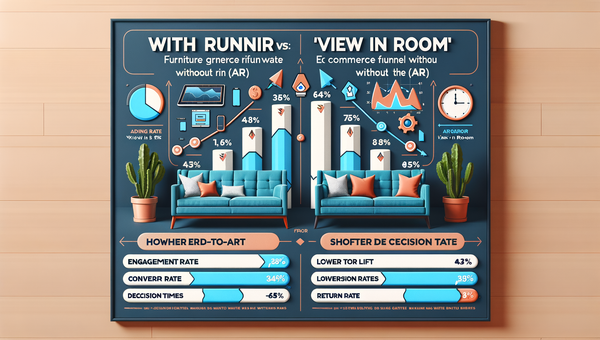
Why Furniture Shoppers Need View in Room Before They Buy
Furniture buyers abandon carts when scale and style feel risky. See why "View in Room" cuts returns, boosts conversion, and how to launch it with Brambles.ai
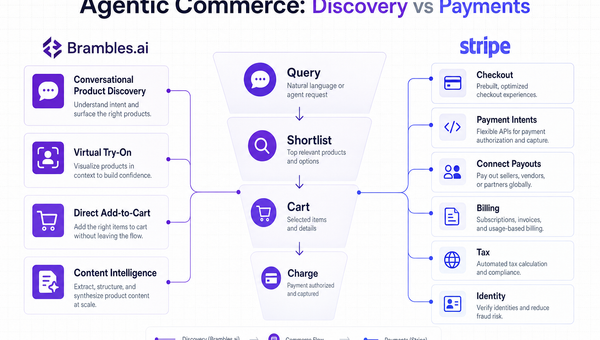
Stripe Agentic Commerce vs Brambles.ai: When to Use Each
Confused between Stripe’s agentic stack and Brambles.ai’s conversational shopping? See real trade‑offs, use cases, ROI, and an implementation path for each.
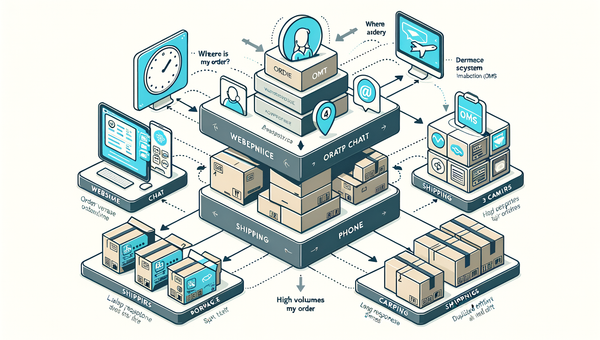
How AI Handles Order Lookup, Returns, and Shipping 24/7
See how AI resolves order lookups, returns, and shipping questions 24/7, deflects tickets, and lifts CSAT—plus a step‑by‑step guide to implement it safely.
Explore Brambles.ai
Learn more about our AI-powered agentic commerce platform, agentic shopping, and shopping assistance solutions.
Explore More Insights
Discover more articles on AI, automation, and business innovation
View All Articles