Agentic Commerce vs. Storefronts: A Brambles.ai Playbook
Agentic commerce is reshaping how people buy. See what it means for storefronts, where it wins, and a hands-on Brambles.ai playbook to launch in weeks.
Agentic Commerce vs. Storefronts: A Brambles.ai Playbook
In a three-week pilot for a mid-market apparel brand, 38% of carts were built entirely through an assistant that guided shoppers from size fit to checkout—without the traditional category grid. Yet the same site still saw 62% of revenue flow through the storefront. That split captures the moment: agentic commerce isn’t a replacement; it’s a parallel path that removes friction for high-intent tasks and undecided shoppers.
We’ve also watched a publisher launch curated, assistant-driven buying guides and see a 27% boost in affiliate EPC when the assistant could ask one clarifying question before showing products. Meanwhile, a home goods retailer reduced support-driven returns by 19% after the assistant verified compatibility pre-purchase. These aren’t demos; they’re production results from teams wrestling with thin margins and impatient shoppers.
The question behind all of this—“Does agentic commerce end the storefront?”—misses the real opportunity. The winners will route traffic dynamically: assistant-led when intent is narrow or decisions are complex, storefront-led when browsing and discovery matter. This playbook shows how to do that, where it tends to win, and how Brambles.ai teams implement it without tearing out your stack.
Quick Answer
No, agentic commerce doesn’t end the storefront. It complements it. Use assistants to collapse high-friction tasks—fit, compatibility, bundling, replenishment, post-purchase service—while keeping storefronts for discovery, brand storytelling, and broad comparison. Route users by intent signals (search queries, referrer, SKU context) and measure success with blended KPIs: time-to-solution, assisted conversion rate, AOV, and return reduction. Most teams can launch a viable assistant in 2–4 weeks alongside the current site.
What’s Broken in the Storefront Model
Traditional storefronts force users into your taxonomy. That works for browsing but stumbles when shoppers need outcomes. Baymard Institute’s research shows that complex filters, sizing ambiguity, and weak on-site search still stall sessions at product-list pages. We see this in heatmaps: pogo-sticking between PDPs is often a symptom of unanswered questions, not lack of interest.
Checkout friction compounds it. Even small asks—account creation, address re-entry—hurt completion rates (Baymard). And when shoppers hit edge cases (compatibility, warranty fit, parts matching), human chat queues are slow and expensive. A static grid simply doesn’t negotiate with uncertainty or context; it waits for the shopper to figure it out.
Agentic flows repair this by turning needs into actions. Instead of “find me a 65-inch TV under $900,” shoppers say the goal, and the system asks only what’s missing (wall width, HDMI 2.1?). The shift reduces cognitive load and shortens the path from intent to purchase—especially for complex or novel categories.
How Agentic Commerce Works
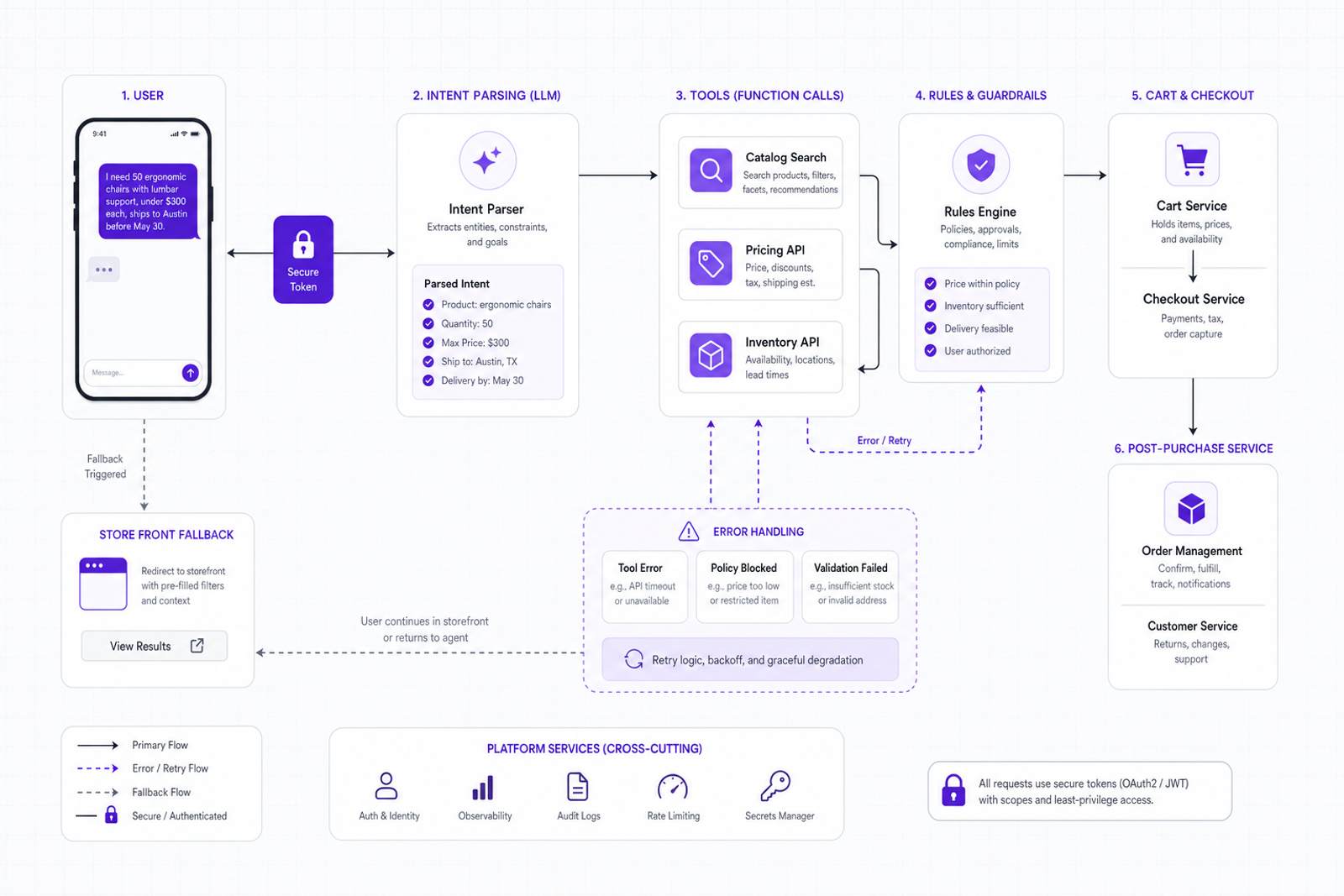
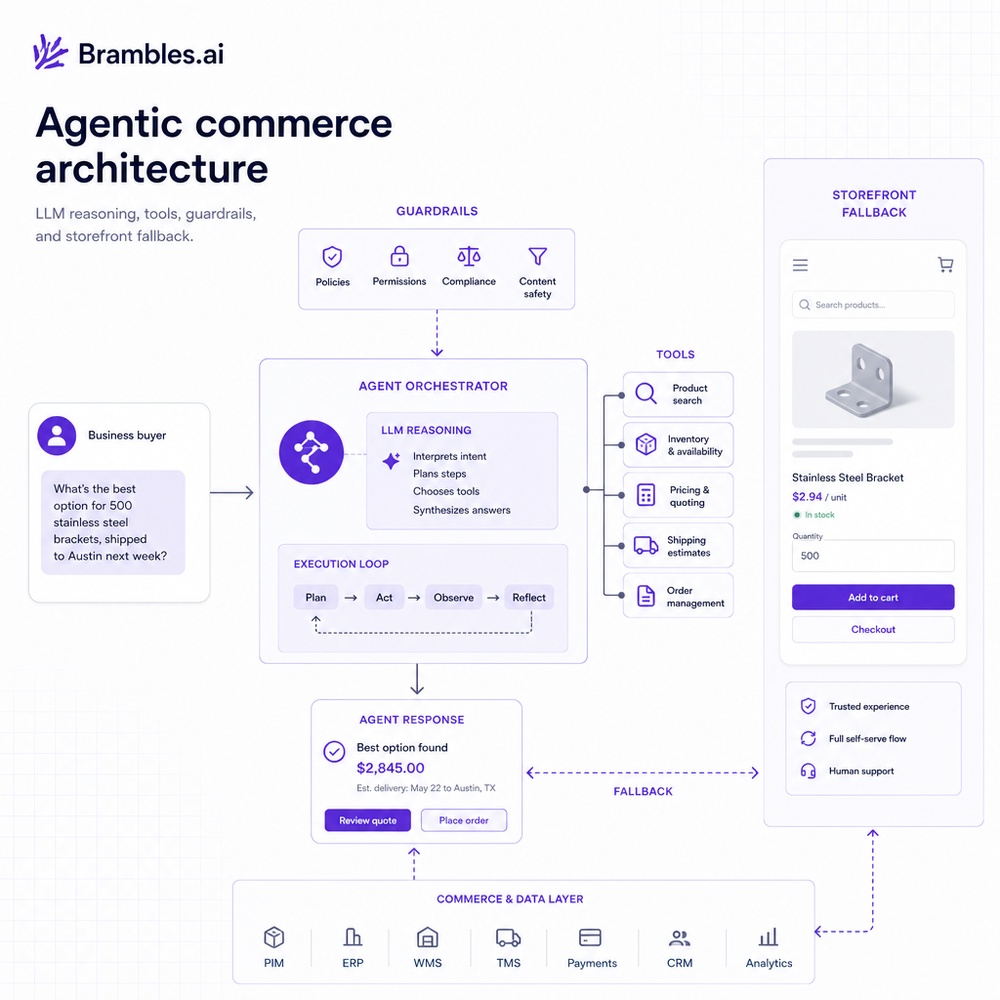
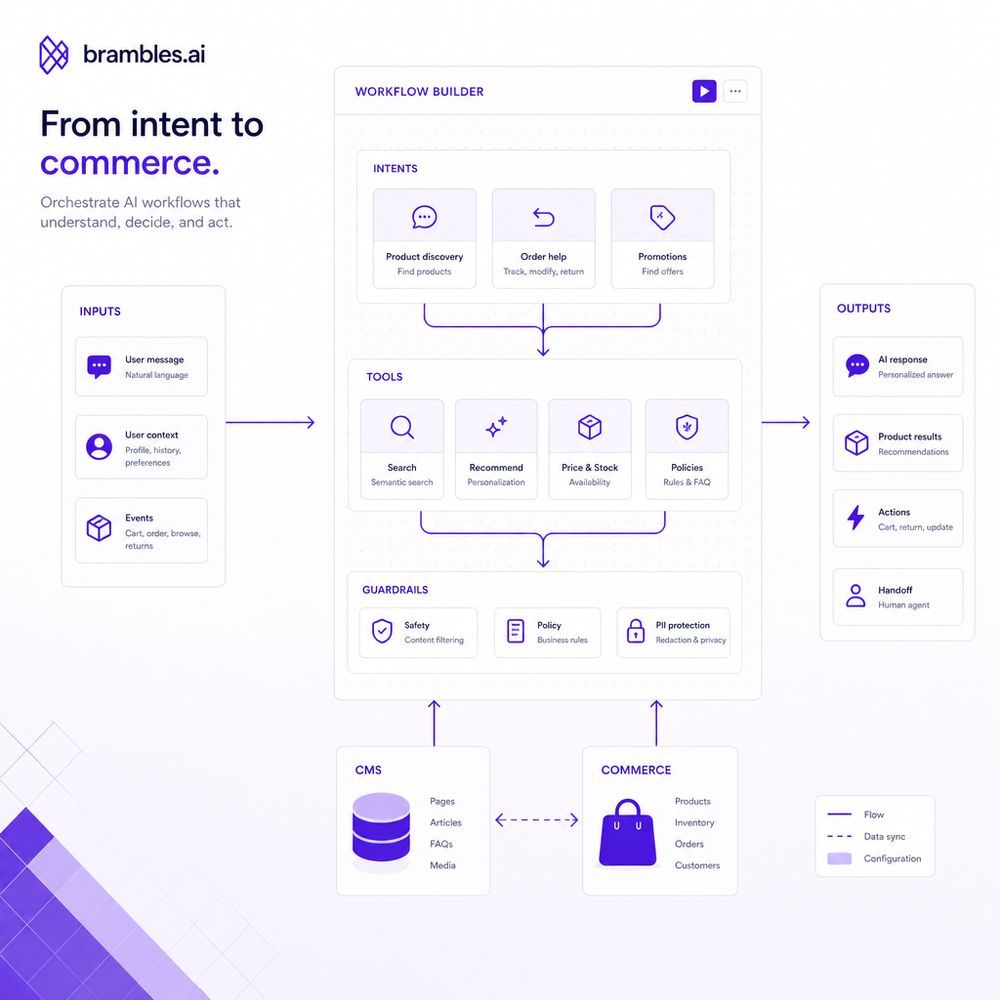
An agent takes a user’s goal, decomposes it into steps, and executes them across your stack. Think: understand intent, retrieve data, reason over constraints, present options, and transact. Technically, that means orchestrating LLM reasoning with deterministic services: catalog, pricing, inventory, CMS, and checkout. The magic isn’t chat—it's secure action-taking with traceable state and guardrails.
A pragmatic design is “assistant-first, storefront-available.” For targeted entries (search, product support, pre-qual leads), route to the assistant; for browsing and brand discovery, keep the storefront primary.
Use intent signals to decide: referral keywords, query patterns, PDP context, geolocation, inventory constraints, and cart contents. Always offer an escape hatch back to the full site.
Implementation Guide with Brambles.ai
You can stand up an agent without ripping out your site. Here’s the path we’ve used with teams that shipped in under a month. It’s opinionated and boringly practical—on purpose.
Step-by-step plan:
1) Pick one job-to-be-done. Example: “Find the right toner cartridge by printer model.” 2) Wire data sources: catalog, inventory, pricing, PDP content. 3) Define tools: search, compare, add-to-cart, create ticket.
4) Write decision rules: out-of-stock handling, price floors, bundling logic. 5) Design dialogue: minimum questions before showing results. 6) Add guardrails: restricted SKUs, age gates, returns policies. 7) Launch a small cohort. 8) Measure and iterate.
Where Brambles.ai fits: the WordPress Plugin injects the assistant into existing CMS routes with one line of embed and supports server-side rendering for SEO-sensitive pages. The Commerce Module handles secure tool execution—cart, promo checks, inventory locks—so you can test flows without custom middleware. For brands, the retail assistant flow ships with templates for fit, compatibility, and bundling. For publishers, the monetization flow supports affiliate link enrichment and price comparisons.
Routing rules that work in practice: send search-driven sessions and product-support entries to the assistant; keep homepage and editorial landers storefront-first; on PDPs, offer a “Check fit/compatibility” callout that opens the assistant in a side panel. This balances discovery with decisive action and avoids chat fatigue.
Measuring ROI and the KPIs That Matter
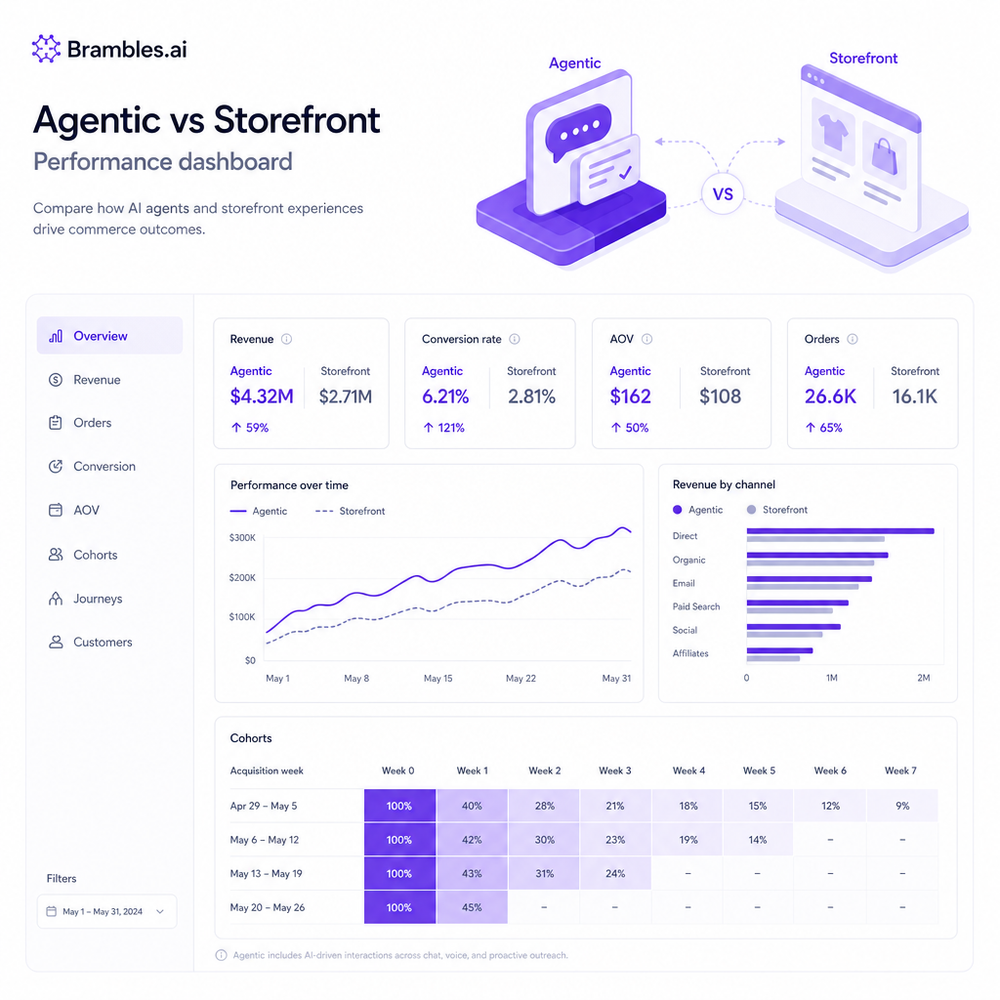
Measure blended success, not just conversion. Primary KPIs: assisted conversion rate, time-to-solution, AOV lift, cart creation rate, return reduction, and deflected support contacts. Secondary: assistant response latency, tool failure rate, and drop-off after clarifying questions. Tie goals to user jobs, not features.
Two implementation anecdotes: On a 100k-session apparel site, assistant-led fit checks cut PDP exits by 21% and lifted AOV 14% due to recommended bundles. At a specialty electronics seller, compatibility verification reduced returns 23% over eight weeks.
Both teams validated results with holdout cohorts and standardized funnels (Google Analytics + server events).
Set up your measurement loop: 1) Create intent-tagged funnels (e.g., “Assistant > Bundle > Checkout”). 2) Use server-side events to capture tool outcomes, not just chat messages. 3) Add sentiment and CSAT sampling to transcripts (Salesforce Connected Customer shows trust drives spend). 4) Instrument form friction on the storefront (Baymard). 5) Report a blended scoreboard weekly.
First-Party Data and Trust
Agentic commerce thrives on first-party context, but only when consented and useful. Google UX research shows users trade data for clear value and control. Build progressive profiles: ask for zip when it affects delivery, ask for fit preferences when sizing differs by brand, and always show the benefit (“we’ll only show in-stock sizes near you”).
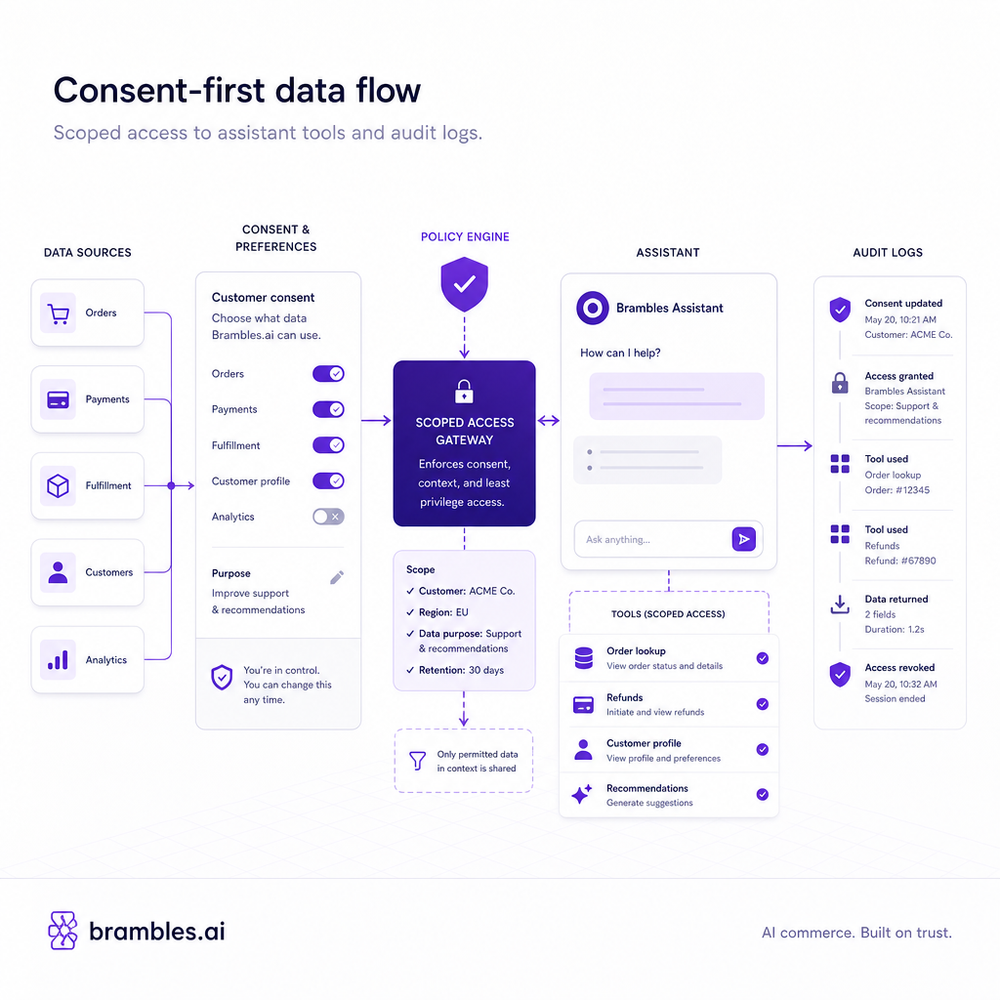
Operationally, store PII separately, encrypt at rest, and log every tool call that touches customer data. Keep transcripts auditable and redact sensitive strings. For publishers, keep affiliate disclosures explicit; for brands, include opt-outs for personalization. McKinsey’s personalization studies tie trust to long-term value; you earn it with clarity and restraint.
How we implement: Consent banners feed a profile vault; the assistant reads only the scopes granted and cites how it used data. Post-purchase, a short follow-up checks satisfaction and permission to improve recommendations. It’s simple, transparent, and measurable—qualities that keep regulators and customers calm.
Common Pitfalls (and a Quick Checklist)
Teams stumble when they ship “chat” without agency. Avoid these traps with this checklist you can run before go-live.
Checklist:
- The assistant can execute key tools (search, compare, add-to-cart) and explain each step. - There’s a storefront escape hatch on every assistant screen. - Guardrails exist for restricted SKUs, price floors, and returns. - Dialogues ask for the minimum necessary data. - KPIs are blended across assistant and storefront. - Holdout cohorts are configured. - You’ve load-tested for Black Friday traffic. - Privacy scopes are visible and revocable.
A final caution: don’t over-personalize early. Salesforce research shows relevance beats creepiness every time. Start with context that obviously helps—a local inventory check beats guessing someone’s style. Expand only when your metrics confirm sustained lift.
Future Outlook: Storefronts Will Specialize, Agents Will Execute
Expect storefronts to double down on brand, story, and rich comparison—features where browsing wins. Agents will own high-intent tasks, replenishment, and service. Search engines and social will continue to send mixed-intent traffic; routing logic becomes a core competency. Teams that ship both modes—cleanly integrated—will see steadier CAC payback and fewer returns.
FAQ
Does agentic commerce cannibalize my storefront?
In our deployments, it usually redistributes by intent rather than cannibalizing. Browsers stay in the storefront; decisive shoppers shift to the assistant. Measure blended KPIs and aim for net-lift in AOV, conversion, and fewer returns.
How fast can we launch a production-ready assistant?
Most teams ship a narrow job-to-be-done in 2–4 weeks. Reuse CMS content, wire the catalog, and enable a small toolset. Expand scope as metrics validate. The WordPress Plugin and Commerce Module shorten this path.
What does this cost compared to live chat or full rebuilds?
Operationally, agents deflect repetitive tickets and speed decisions; most teams see lower cost-per-resolution than live chat after stabilization. Because you don’t rebuild the storefront, capex stays low. Pricing scales with usage and tool complexity.
Where exactly does Brambles.ai help?
Brambles.ai provides the plumbing: embeddable assistant for CMS, secure tool execution for commerce actions, and templates for retail and publisher flows. You focus on intent, data, and guardrails; we handle orchestration and scale.
Related resources on Brambles.ai
If you are implementing this, start with Brambles.ai, enterprise solutions, publisher pricing, brand pricing.
For deeper reading, see Why Conversational Commerce Is Next For Affiliate Marketing, The Brambles.ai Vision: Ad‑Free Shopping Internet, From Search Boxes to Conversations: Modern Shopping UX, Contextual, Not Creepy: Monetization That Wins.
Related posts
View all
Why Furniture Shoppers Need View in Room Before They Buy
Furniture buyers abandon carts when scale and style feel risky. See why "View in Room" cuts returns, boosts conversion, and how to launch it with Brambles.ai
Why Good AI Shopping Agents Are Hard—and How Brambles Helps
Most AI shopping bots fail on data quality, UX, and trust. See why agents break in the wild and how Brambles.ai fills the gaps with measurable features.
Stripe Agentic Commerce vs Brambles.ai: When to Use Each
Confused between Stripe’s agentic stack and Brambles.ai’s conversational shopping? See real trade‑offs, use cases, ROI, and an implementation path for each.
Explore Brambles.ai
Learn more about our AI-powered agentic commerce platform, agentic shopping, and shopping assistance solutions.
Explore More Insights
Discover more articles on AI, automation, and business innovation
View All Articles