Start One Agentic Commerce Use Case with Brambles.ai
Launch agentic commerce: pick one high-impact use case, wire it to your catalog and checkout, and validate ROI in weeks using Brambles.ai's Commerce Module.
Start One Agentic Commerce Use Case with Brambles.ai
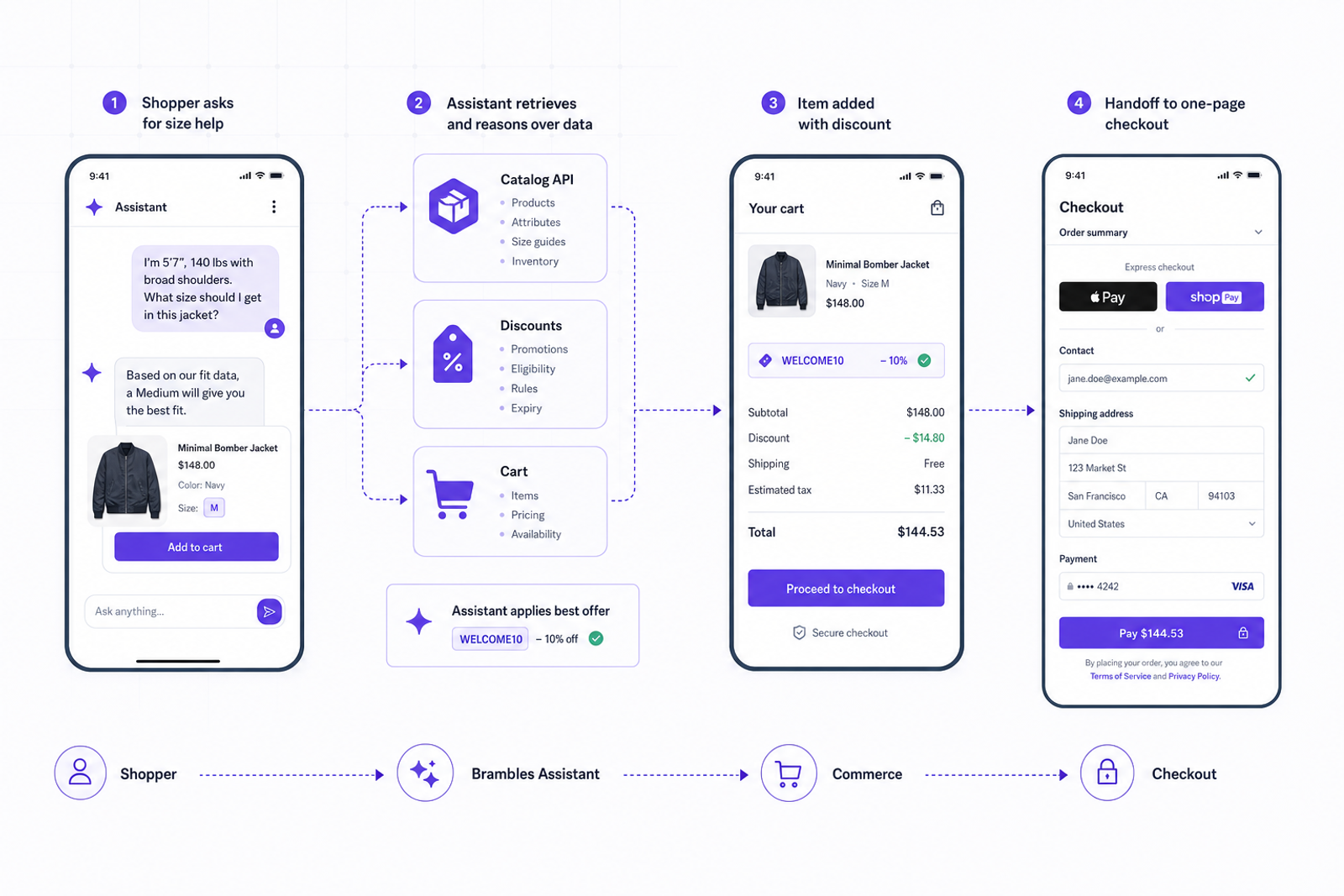
Three weeks after launching a single “Find-My-Size + Cart” assistant, a 90k‑session/month apparel site saw a 12% lift in conversion among engaged users and a 21% drop in fit-related tickets. Build time: 10 days. That result wasn’t magic; it was ruthless scoping. One agentic use case, wired to product data and checkout, measured cleanly.
When we ran a similar micro-journey for a DTC coffee brand—“Recommend grind + autoship discount, then checkout”—AOV rose 18% for assistant-led orders and subscription opt-ins increased 9 points. The project shipped without touching the core PDP template. Small surface. Big impact.
If you’re staring at a roadmap full of grand assistants, resist. Start with one shopper task that makes money this month, connect three tools (catalog, cart, discount), and set guardrails. Brambles.ai gives you those rails plus production-grade commerce connectors so you can prove ROI before you scale.
Quick Answer
Pick one high-intent task (e.g., “size and add-to-cart experience” or “compare two laptops and checkout”), wire the assistant to your catalog, cart, and discount tools, and stick to clear rules. Ship via a lightweight widget, run A/B, and track add-to-cart rate, assisted conversion, and AOV. With Brambles.ai’s Commerce Module and WordPress plugin, most teams pilot in 1–2 weeks and see signal within another 1–2 weeks.
What’s Broken in Commerce Journeys (and Why One Use Case Helps)
Most funnels leak in the same places: search that doesn’t speak human, PDPs that bury fit or compatibility, and checkouts that ask for 20 fields on a 5-inch screen. Baymard’s research repeatedly shows form friction and unclear guidance are top abandonment drivers on mobile.
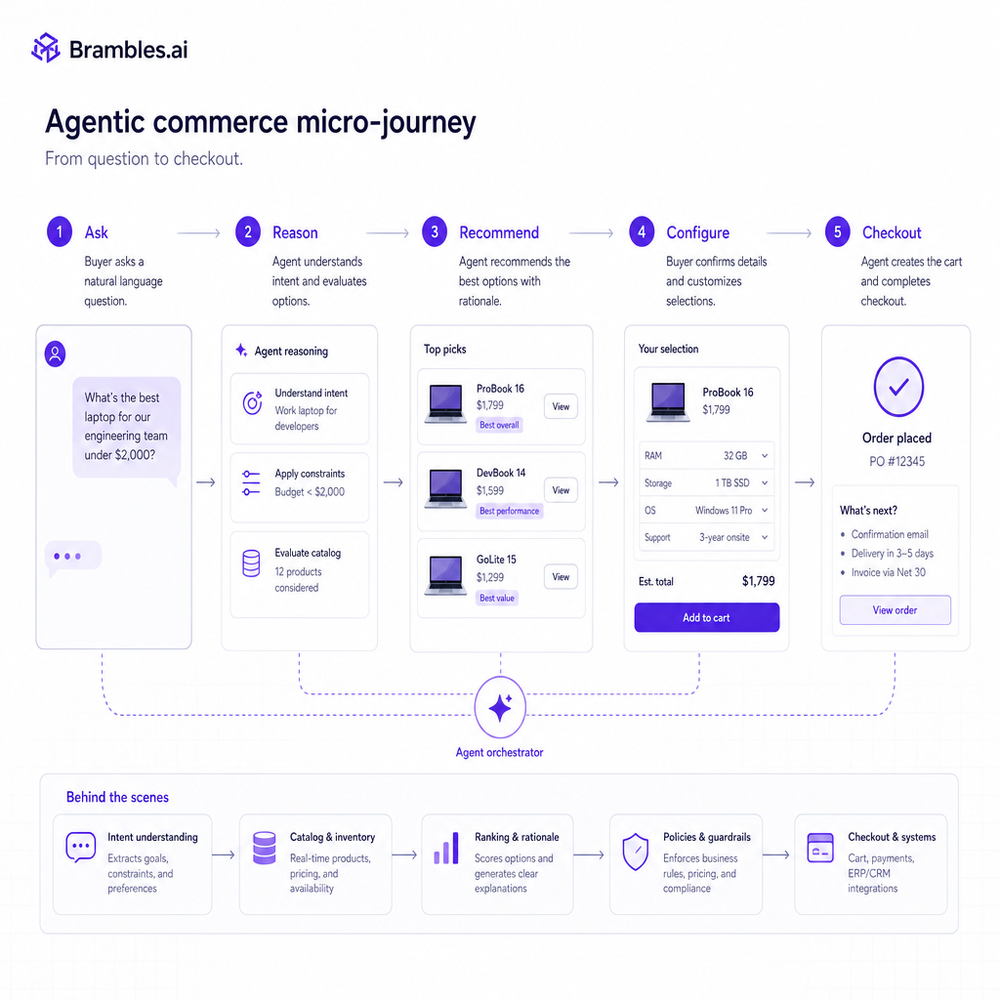
Agentic commerce fixes leaks by guiding one task end-to-end. Not a chat toy—an action taker. The assistant understands intent, gathers what’s needed, executes a few tools, and stops. Narrow scope means fewer ways to go wrong and cleaner measurement.
If you want examples of tight, high-yield flows, study conversational checkout patterns and the moments where shoppers hesitate. We’ve documented practical patterns and copy that reduce ambiguity and clicks.
How a Single Agentic Micro‑Journey Works
At its core, you define an intent, a small toolbelt, and guardrails. Example: “Help me choose the right running shoe and check out.” Tools: product search with filters, size advisor, cart, and discount applier. Guardrails: max two clarifying questions, must cite source attributes, and never proceed to payment without confirming cart contents.
The assistant orchestrates: it asks for foot width, pulls sizes from the catalog, applies a new-customer code, then hands off to checkout. Google’s UX research on micro‑moments supports this shape—short, decisive interactions beat long explorations when stakes are low and intent is high.
For brands, this lives as a retail assistant on PDP or cart. For publishers, the same pattern can pre-qualify a shopper and deep-link into a merchant, powering affiliate or co-op models. Both flows are supported out of the box.
Choose One Use Case That Pays Back in 30 Days
The winning first project sits at the intersection of high intent and common confusion. Think “size and add-to-cart,” “compatibility checker for accessories,” or “compare two SKUs and checkout with a launch promo.” These compress decision time and reduce pogo-sticking across tabs.
Score candidates against three questions: Does it impact an existing revenue event quickly? Can we answer with first‑party data? Can we bind it to three or fewer actions? If you can’t say yes to all three, it’s not your starter use case.
One outdoor retailer picked “bundle my camp kitchen.” Result: 27% higher AOV on assistant-led checkouts and a 14% reduction in returns from incomplete kits. We shared the prompt pattern and dialog pacing they used so you can adapt it quickly.
Implementation Guide: 7 Steps in Brambles.ai
This is a precise, time-boxed build. You’ll wire data, define tools, and ship a widget—no theme surgery required.
Step 1 — Define the job: Write a one-sentence intent (e.g., “Find my size and add to cart with welcome discount”). List the exact fields needed from users and the attributes you’ll cite back from the catalog.
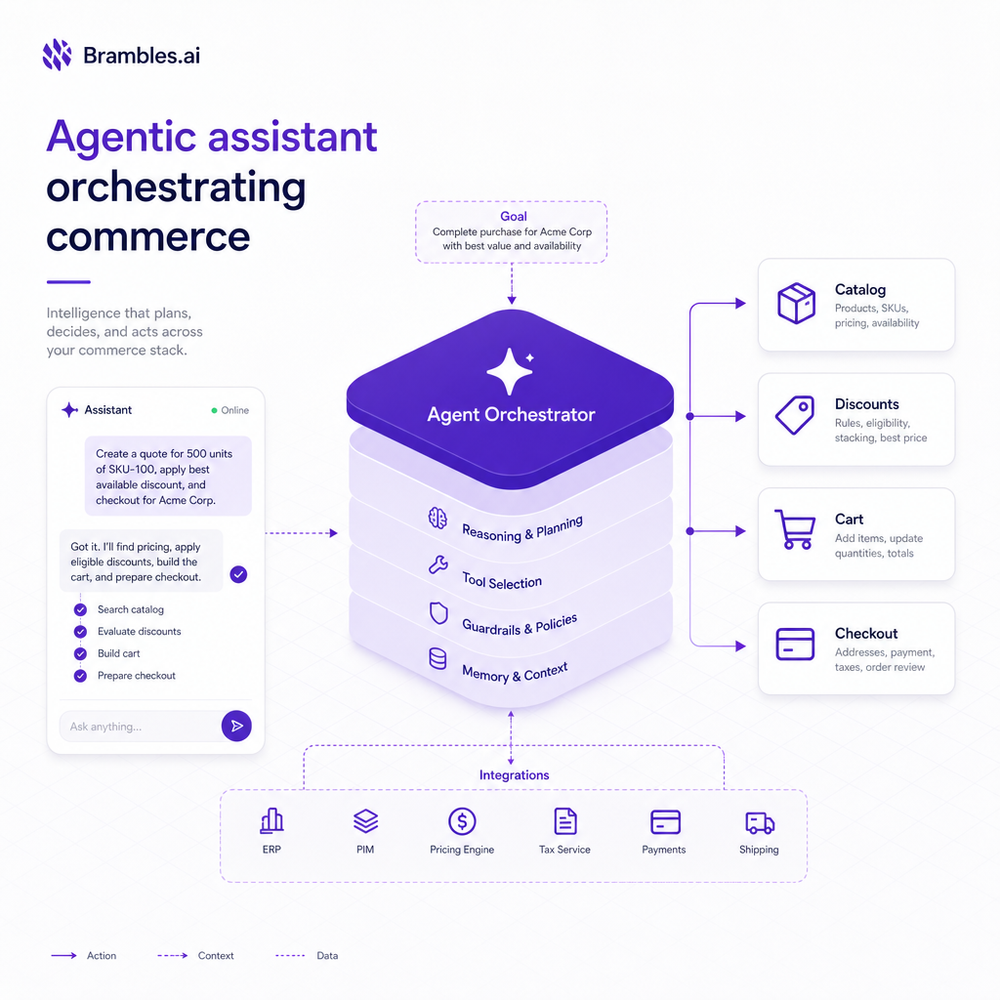
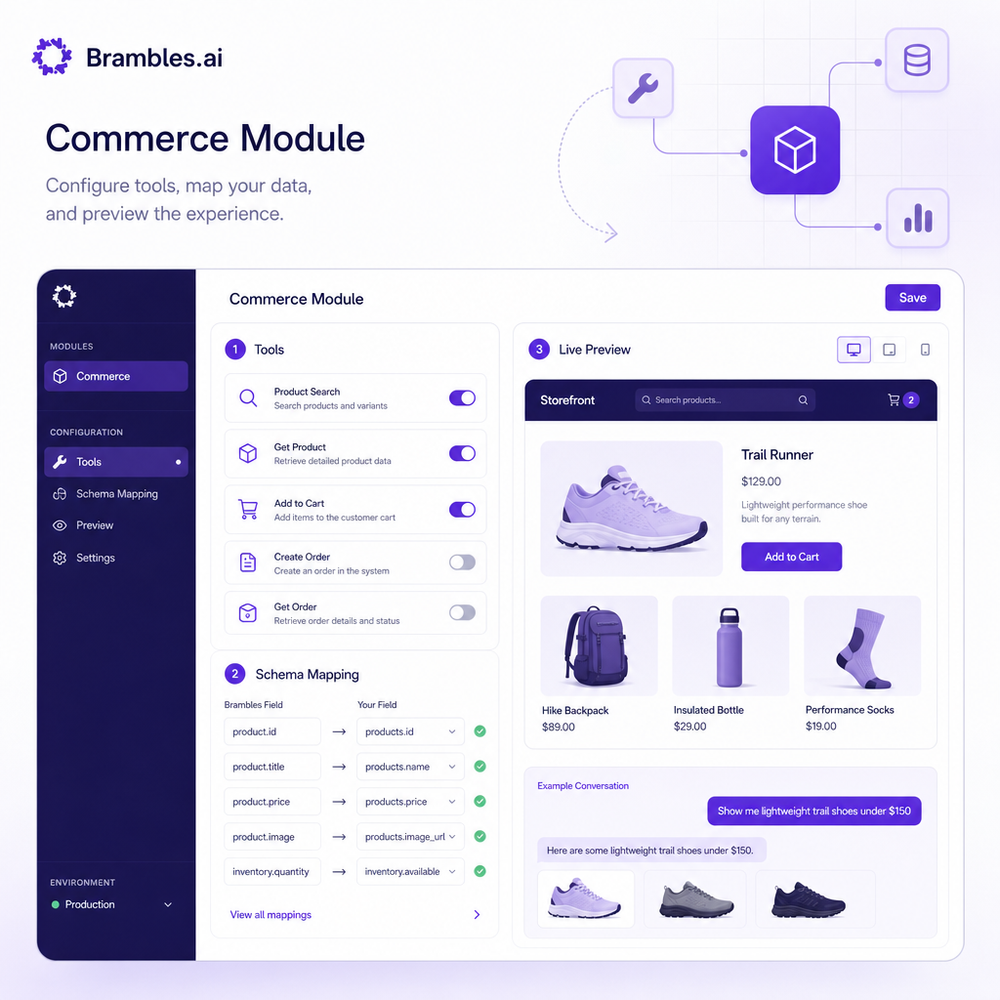
Step 2 — Connect your catalog: In Brambles.ai’s Commerce Module, map product attributes (size curves, stock, price) and expose only what the assistant needs. Keep the schema small to reduce hallucination surface.
Step 3 — Add tools: Enable search with filters, discount applier, and cart actions. Keep it to three. Name them in plain English so logs read clearly for QA.
Step 4 — Guardrails: Limit clarifying questions, require citing product attributes with values, and enforce an “Are you ready to checkout?” confirmation. Log all tool calls for review.
Step 5 — Place the widget: Use the Brambles WordPress plugin to drop the assistant on PDPs or in cart. If you’re headless, paste the JS snippet and gate it to 50% of traffic for clean A/B.
Step 6 — Checkout handoff: Hand off to your existing one‑page checkout with cart prefilled. Don’t rebuild checkout on v1. Confirm cart line items and promo code in the dialog before the redirect.
Step 7 — Launch and QA: Role‑play edge cases (OOS, conflicting discounts, uncommon sizes). Monitor logs twice daily for week one. Tighten the tool prompts; avoid adding new tools unless a pattern repeats.
If you need help scoping or want templates, the team can share ready-to-run flows for size & fit, laptop comparison, and kit bundling. Brambles.ai keeps you focused on one job and provides production connectors so you don’t fight glue code.
Measuring ROI and Proving This Isn’t Just Chat
Your proof is a lift in assisted conversion and AOV—not chat volume. Split traffic 50/50. Primary KPIs: assistant engagement rate, add-to-cart rate among engaged, assisted conversion rate, and AOV. Secondary: promo redemption and ticket deflection.
Baseline targets are modest and compound quickly. On a 100k‑session gadgets site, an assistant-led comparison flow increased add-to-cart by 23% for engaged users and lifted sitewide conversion 0.7 points within 18 days. We saw a 32% AOV bump on bundles when the agent proposed a two-item upsell, with no change to shipping logic.
Instrument events from the widget through checkout. Keep attribution simple: if the cart contains an assistant session ID at handoff, attribute the order as assisted. McKinsey reports personalization lifts revenue 10–15% on average; your micro‑journey is the most measurable form of personalization you can ship this month.
For deeper patterns, review tool call transcripts. If “apply_discount” fails often, adjust eligibility rules or dialog copy. We published a teardown with common failure modes and fixes for the first two weeks of data.
First‑Party Data, Consent, and Trust by Design
Only collect what the task requires. For size, that’s height, weight, and fit preference—not email. Ask for contact only when there’s value, like back‑in‑stock alerts or warranty registration. Salesforce’s Connected Customer research shows trust is the price of admission for personalization.
Brambles.ai enforces data minimization in tool schemas, supports consent prompts in the widget, and lets you configure log retention so sensitive fields aren’t stored longer than needed. Keep PII out of free text when possible by offering structured inputs.
For publishers, pass only what’s necessary when deep‑linking to merchants, and disclose clearly. For brands, reflect consent status throughout the assistant and checkout. A crisp privacy posture reduces legal review time and speeds launches.
Common Pitfalls: A Checklist to Keep You Honest
Start narrow. Most stumbles come from over-scoping. Use this checklist to avoid the usual traps.
Scope: One intent, three tools, two clarifying questions max. If you need more, split into a second micro‑journey.
Data: Map only attributes you’ll cite. Name them consistently so you can debug transcripts quickly.
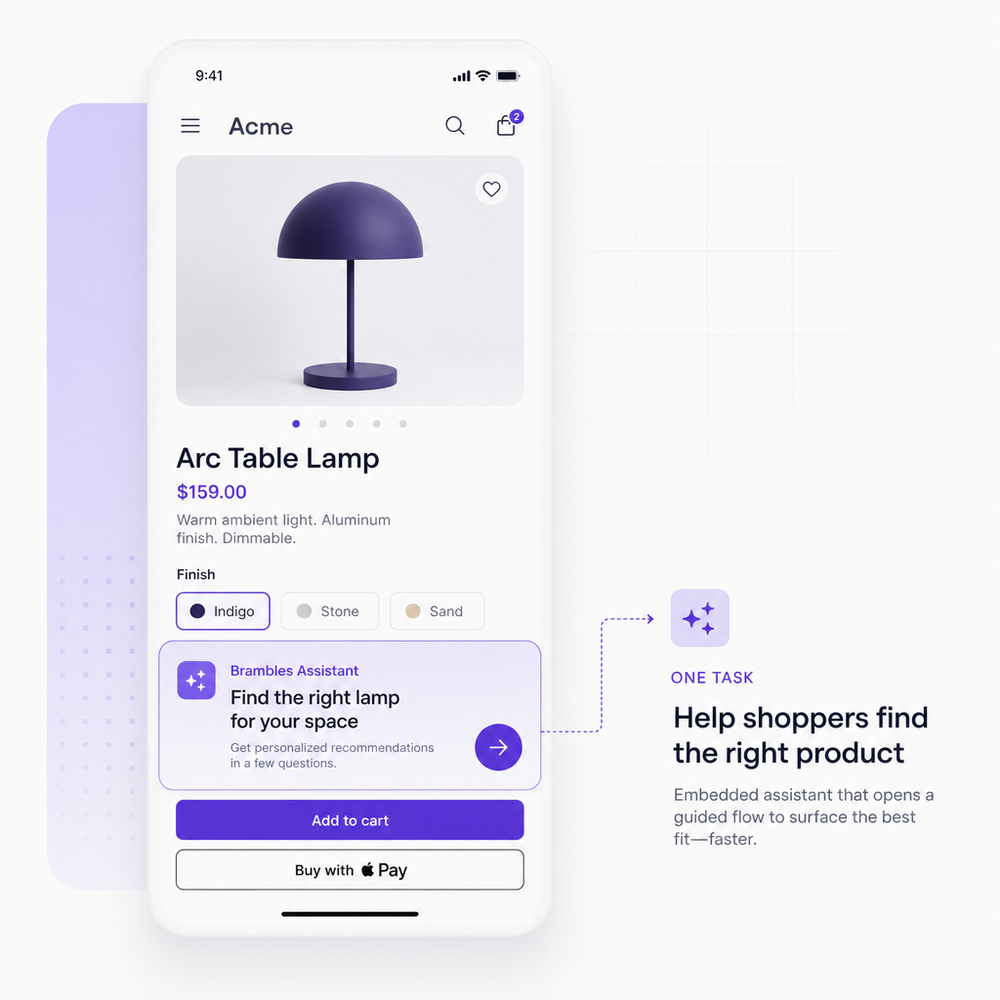
UX: Place the widget near the action (size selector, bundle builder). Write the CTA as a job: “Find my size and add to cart,” not “Ask a bot.”
Measurement: Ship with test/control from day one. Attribute by session ID at checkout handoff. Review failures daily for the first week, then twice weekly.
Expansion: Don’t add tools mid-test. Bank the win, then extend to the next use case. Templates help you move faster without breaking attribution.
Where Brambles.ai Fits (and Why It’s Faster)
You can build this with bespoke glue, but Brambles.ai ships the boring, essential parts: production connectors to catalog, discounts, cart, consent; a guardrailed tool runner; and a deploy-anywhere widget with built-in A/B. That’s why most pilots launch in under two weeks.
On WordPress, the plugin handles placement, consent UI, and analytics hooks. In headless stacks, the JS snippet slots into your router and hands off to your existing checkout. For brands and publishers, we offer flows that respect your monetization model without replatforming.
If you’re evaluating budget, keep in mind that proving lift on a single use case typically costs less than a landing page redesign and carries clearer attribution. When you’re ready, expand use cases instead of bloating your first one.
FAQ
What’s the smallest viable agentic use case? It’s one job with three tools or fewer—typically catalog lookup, cart, and discount. Anything larger muddies measurement and slows QA.
How fast can we launch? Teams with clean catalogs typically pilot in 1–2 weeks using the Commerce Module, then gather significance in another 1–2 weeks depending on traffic.
Do we need engineers? You’ll want one dev for schema mapping and placement, plus a marketer or merchandiser to shape prompts and guardrails. The WordPress plugin reduces code needed for many sites.
Will this replace our checkout? No. The assistant prepares the cart, applies promos, and hands off to your existing checkout with clear confirmation. That keeps risk low and results measurable.
How does this handle privacy? Collect only what the job needs, keep PII out of free text when possible, use consent prompts, and set log retention. Brambles.ai supports these controls in configuration.
Related resources on Brambles.ai
If you are implementing this, start with Brambles.ai, for publishers, for brands, get started.
For deeper reading, see 10 Reasons Publishers Need Conversational Commerce, Affiliate Disclosure in Conversational UIs Done Right, From Search Boxes to Conversations: Modern Shopping UX, Contextual, Not Creepy: Monetization That Wins.
Related posts
View all
How Context-Aware AI Recommendations Lift CTR
See how context-aware AI recommendations lift CTR by 25–60% with intent signals, page context, and history. Practical steps, KPIs, and implementation tips.
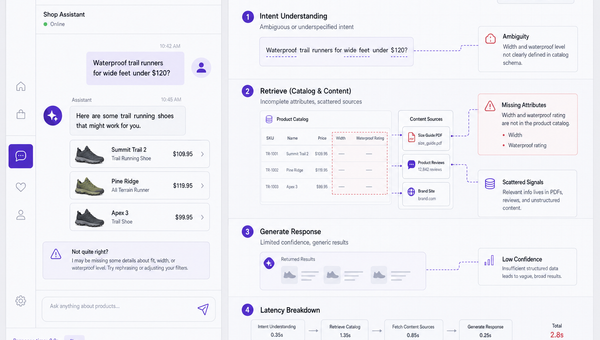
Why Good AI Shopping Agents Are Hard—and How Brambles Helps
Most AI shopping bots fail on data quality, UX, and trust. See why agents break in the wild and how Brambles.ai fills the gaps with measurable features.
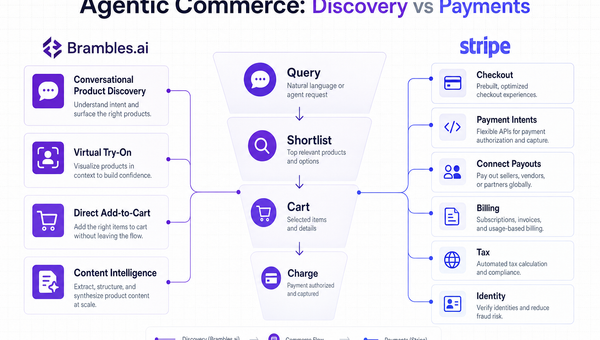
Stripe Agentic Commerce vs Brambles.ai: When to Use Each
Confused between Stripe’s agentic stack and Brambles.ai’s conversational shopping? See real trade‑offs, use cases, ROI, and an implementation path for each.
Explore Brambles.ai
Learn more about our AI-powered agentic commerce platform, agentic shopping, and shopping assistance solutions.
Explore More Insights
Discover more articles on AI, automation, and business innovation
View All Articles