Conversational KPIs: Search Exits, ATC from Chat, CVR, AOV
Which conversational metrics drive revenue? Learn to track search exits, add-to-cart from chat, CVR, and AOV with concrete steps, dashboards, and pitfalls.
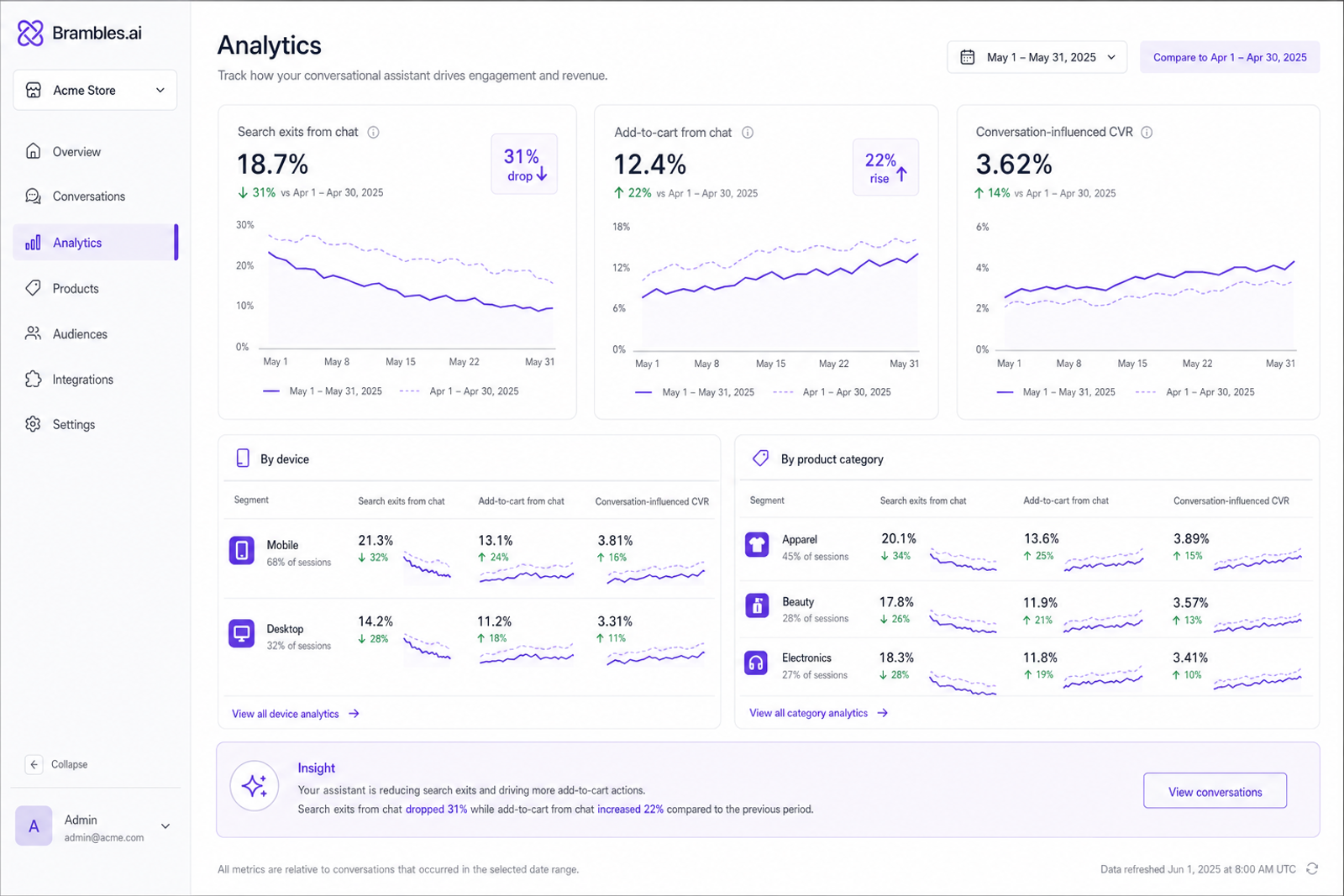
In our last holiday sprint, a beauty retailer’s chatbot handled 18% of product discovery queries, yet conversions lagged. The insight hit when we segmented by “natural language AI product search”—sessions where users tried the assistant, got zero traction, and bailed without another action. After tightening answer coverage for top 50 intents and adding a one-tap “Add to cart” for recommended shades, search exits from chat dropped 31% and purchase products directly from the AI chat rose 22% week over week. Revenue followed. That pattern—fewer dead-ends, more decisive actions—repeats across categories.
What’s broken with conversational metrics today
Most teams report “engagement” for their chat assistant—messages sent, sessions, time in chat—while missing the two levers that actually map to revenue: avoiding dead-ends and translating helpful moments into cart actions. Baymard’s research shows users abandon when friction stacks early in discovery; conversational dead-ends are friction incarnate. We frequently see inflated satisfaction scores from thumbs-up prompts, but a high satisfaction rate paired with high search exit from chat means users enjoyed the banter and still left empty-handed. Another common gap: conflating recommendation clicks with purchase intent. Without a clean tag for add-to-cart from chat, you can’t attribute conversion uplift or optimize the assistant’s prompts. If your dashboard can’t show search exits from chat trending down while add-to-cart from chat trends up—and how those two correlate with CVR and AOV—you’re flying by vanity metrics.
How it works: the four KPIs that actually matter
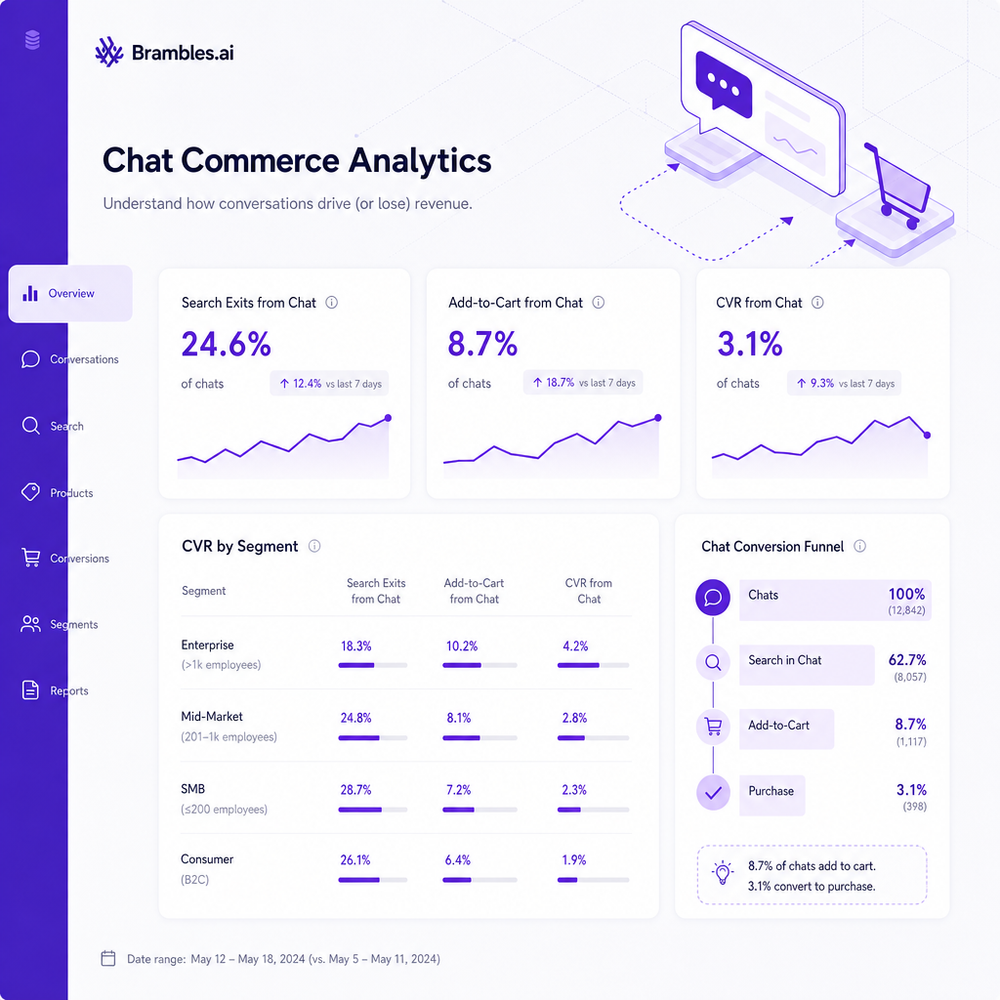
Search exits from chat: When a user engages the assistant, asks or taps, then terminates the session (or navigates away) without clicking a result, viewing a product, or refining—count it as a search exit. High rates signal gaps in answer coverage, indexing, or intent mapping. Add-to-cart from chat: A distinct event only when the cart action is triggered directly from a chat recommendation or inline product card. This isolates the assistive moment. CVR (conversation-influenced): Conversion rate for sessions with chat interaction vs. control sessions without chat, normalized by traffic source and intent. This guards against self-selection bias. AOV: Compare baskets with at least one chat-attributed add-to-cart against non-chat baskets; look for accessory attach or bundle lift. Google UX research emphasizes that quick, confident paths reduce decision fatigue; the assistant’s job is to remove doubt in two taps, improving both CVR and AOV.
Implementation guide: events, schema, and surfaces
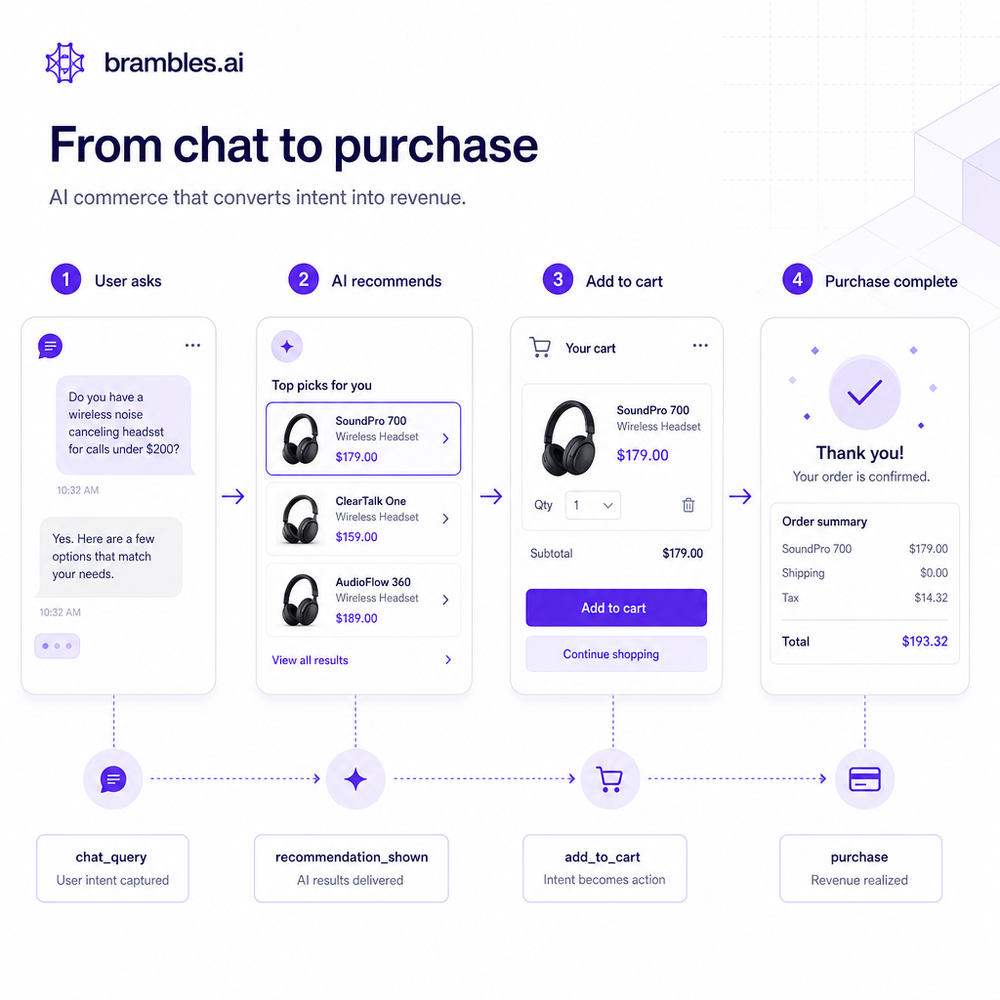
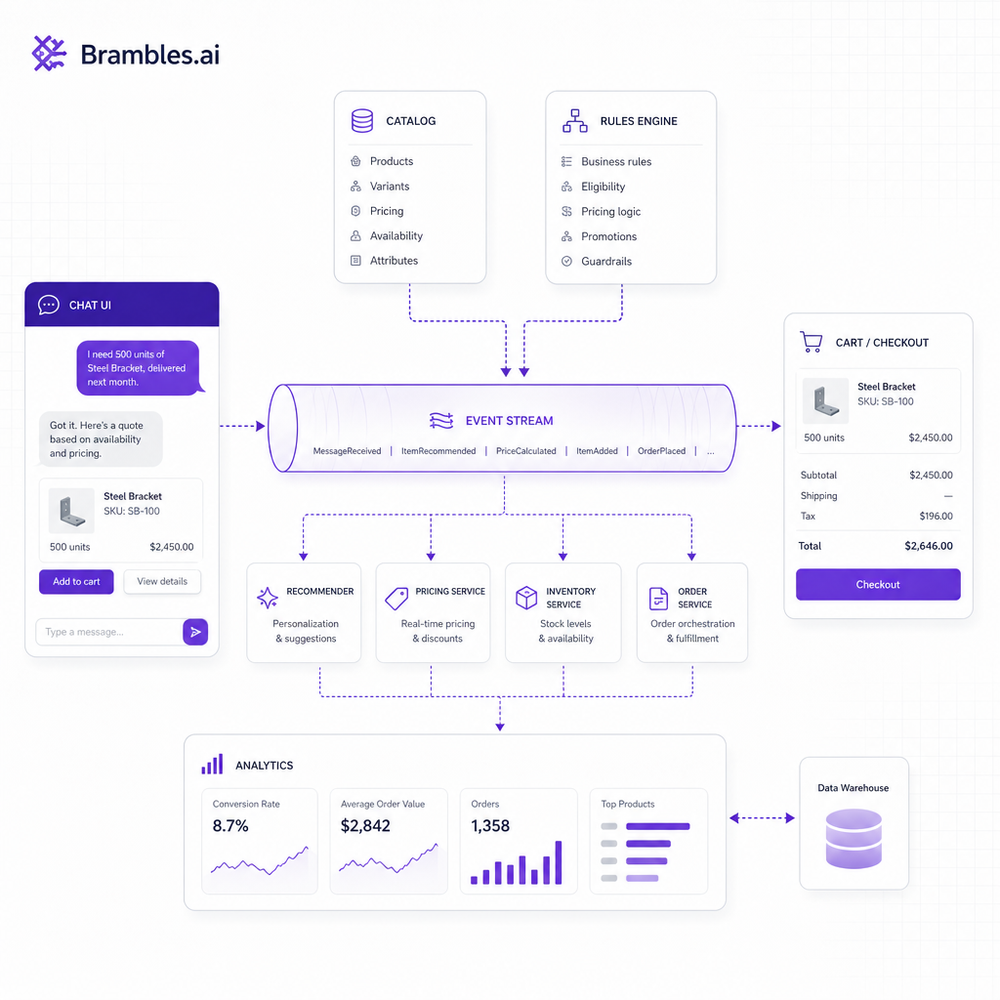
Instrument three layers: event capture, context, and surfaces. For event capture, define events with deterministic names and required properties. Example: chat_query (query_text, intent_id, model_response_id), chat_result_view (product_ids, rank, response_time_ms), suggestion_click (product_id, position, price), add_to_cart_from_chat (product_id, qty, price, currency, session_id), chat_exit (reason, last_intent_id), purchase (order_id, items, revenue). For context, attach device_type, page_type, traffic_source, and user_status (new/returning/loyalty). For surfaces, ensure the assistant can render inline product cards with price, size, and availability; include a native add-to-cart button that respects cart rules (variants, min quantities) and logs add_to_cart_from_chat. Build a server-side attribution join that tags a session as conversation-influenced if any chat events occur before the purchase event. This keeps CVR and AOV clean and auditable across vendors.
Measuring ROI and reporting the deltas that matter
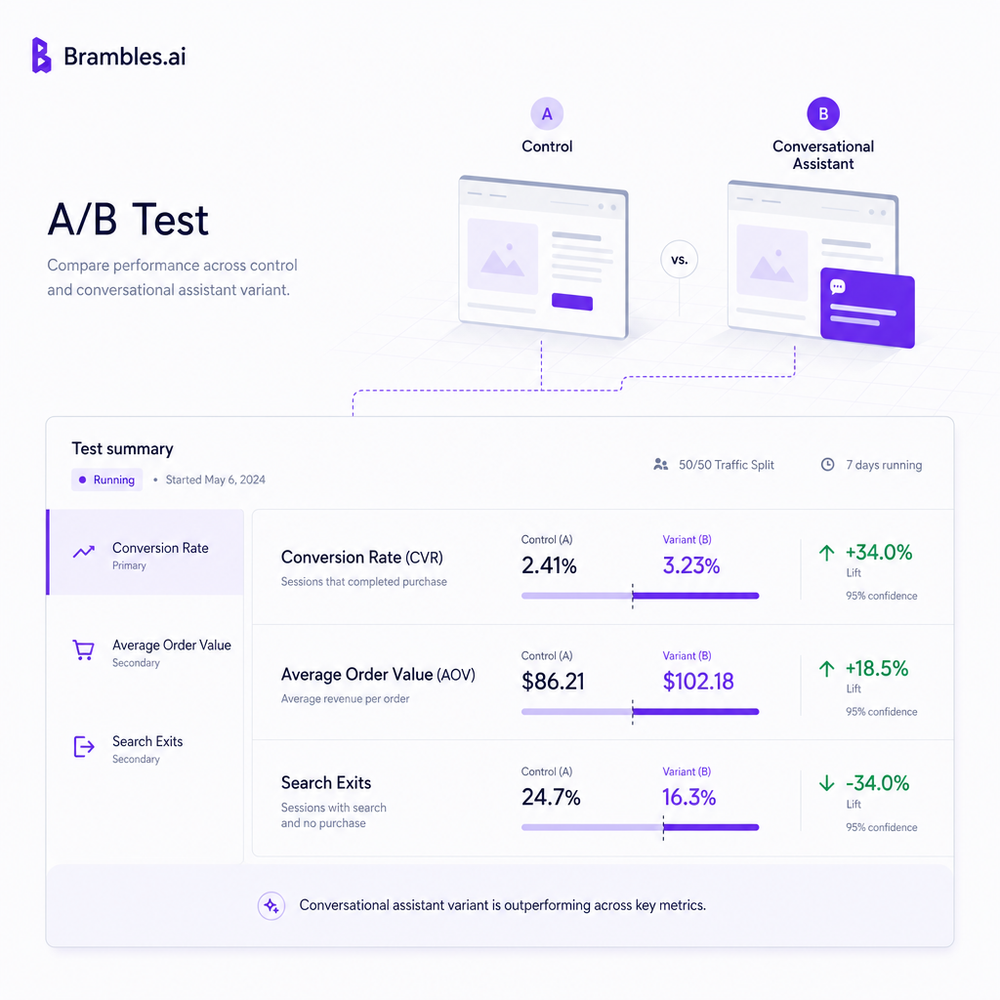
Start with a holdout: at least 10–20% of eligible traffic without the assistant, balanced by traffic source. Report deltas for four metrics each week. First, search exits from chat: target a 20–40% reduction within the first month by expanding answer coverage for the top 100 intents and adding fallback guardrails. Second, add-to-cart from chat rate: show the share of chat sessions that trigger at least one cart action; 10–25% is a realistic early benchmark for retail catalogs. Third, conversation-influenced CVR: compare test vs. control; lifts of 5–15% are common once dead-ends are pruned (Salesforce Connected Customer data supports rapid gains when guidance shortens decision paths). Fourth, AOV: look for 3–8% uplift from attach logic and bundles. Present a cost-per-assisted-order metric to finance so they can track payback as you scale.
First-party data, trust, and the consent handshake
Your assistant can gather zero- and first-party signals—size, shade, dietary constraints—but only if it earns the right. McKinsey’s research shows 71% of consumers expect personalization, yet trust hinges on clarity about data usage. Add friction only once: a simple, explicit consent prompt when the assistant first asks for personal preferences, coupled with a visible “Manage data” option. Store preferences client-side until consent is granted; then sync to a profile service with purpose tags (e.g., fit_profile, allergy_info). Use those tags to bias recommendations while keeping a clear audit of where each signal came from. When trust is visible, users volunteer signals that drive AOV up without feeling stalked. We saw a specialty grocer’s chat experience improve AOV by 6.4% after adding transparent “Why this recommendation?” notes that displayed allergy-safe logic next to each suggestion.
Common pitfalls and how to sidestep them
Pitfall one: collapsing chat clicks into generic PDP clicks. If add-to-cart from chat isn’t its own event, you lose your main optimization lever. Pitfall two: rewarding verbosity. Long model answers inflate time-in-chat but increase exits; tune for minimal steps to purchase. Google UX research highlights that fast, scannable responses drive satisfaction and conversion. Pitfall three: unmanaged zero-result queries. Route unanswerable intents to safe fallback: show top categories, bestsellers, and a human handoff if needed. Pitfall four: no inventory awareness—recommending out-of-stock items tanks trust and AOV. Pitfall five: single-model dependence; use retrieval and business rules to constrain answers. On a 100k-session apparel test, adding inventory and size filtering to responses cut search exits from chat by 38% and lifted conversation-influenced CVR by 12% in two weeks.
Anecdotes from the field: quick wins that compound
A mid-market electronics retailer swapped a generic “View details” button for a bold “Add to cart” on chat product cards, guarded by variant selection. Add-to-cart from chat jumped from 8.9% to 12.1%, and AOV rose 4.2% as accessories were bundled in-line. A DTC skincare brand throttled the assistant to three concise answers per session before suggesting a human, which cut search exits by 27% and improved CSAT without dampening CVR. Finally, a marketplace tagged “gift intent” when users asked for presents under a price cap; a single recommendation slot was reserved for bundles. Conversation-influenced CVR rose 9% and refund rates fell 1.3 points as gifts fit better the first time.
Future outlook: assistants as merchandising surfaces
Treat the assistant like a front-of-store display that updates every hour. Merchandisers will own curated answer packs, with model outputs fenced by real-time rules—inventory, margin, and attach logic. As models get faster and retrieval gets richer, the best teams will personalize not just products, but the decision path itself: one product card for decisive shoppers, a compare table for maximizers, and a guided Q&A for novices. The KPIs won’t change, but the levers behind them will: tighter answer coverage reduces search exits, smarter inline actions push add-to-cart from chat, and transparent logic keeps CVR and AOV compounding. Keep the instrumentation honest and the interfaces calm. The rest is weekly iteration.
Related posts
View all
Sponsored Products in AI Shopping: Retail Media 101
Learn how sponsored product placements power AI shopping, how bidding and relevance work, and how to implement retail media without eroding trust or UX.
Multi‑Network Affiliate Optimization: Auto Best Rate
Route clicks across affiliate networks automatically to secure the highest commission, lift EPC, and preserve UX—practical tactics, data, and implementation ste
How AI Handles Order Lookup, Returns, and Shipping 24/7
See how AI resolves order lookups, returns, and shipping questions 24/7, deflects tickets, and lifts CSAT—plus a step‑by‑step guide to implement it safely.
Explore Brambles.ai
Learn more about our AI-powered agentic commerce platform, agentic shopping, and shopping assistance solutions.
Explore More Insights
Discover more articles on AI, automation, and business innovation
View All Articles