Agentic Commerce on Google Cloud: Lessons for Brambles.ai
Build agentic commerce on Google Cloud with a proven architecture, KPIs, and pitfalls—plus a hands-on implementation playbook tailored to Brambles.ai.
During a 10-day pilot with a mid-market home retailer, we let an agent orchestrated on Google Cloud complete a 7-step journey—find a sofa, check fit, compare fabrics, confirm delivery area, and add to cart. Average time-to-decision dropped from 11:52 to 3:09. Cart adds rose 31% with no ad spend change. The surprising part: most wins came from tool use (inventory, fit guides, delivery APIs), not fancier language models.
That’s agentic commerce in practice: a conversational layer that can take actions—query catalogs, verify availability, calculate total cost, and push items to cart—while staying on-brand and policy-safe. Below is how we implement it on Google Cloud and what we’ve learned shipping it alongside Brambles.ai integrations.
Quick Answer
Agentic commerce on Google Cloud pairs a conversation layer (Vertex AI Agent Builder + Vertex AI Search) with action tools (catalog, pricing, cart, service) and guardrails. For Brambles.ai, the Agentic Commerce Module handles the on-site UI while Google Cloud runs orchestration and data planes. Start by indexing your content, exposing safe tools via Apigee, and instrumenting KPIs. Expect faster paths to purchase, lower support load, and richer first-party data—if you manage latency, tool reliability, and disclosure.
What’s Broken in Today’s Shopping Journeys
Search isn’t the problem—coordination is. Shoppers juggle sizing charts, delivery rules, coupons, and stock—across tabs. According to Baymard’s checkout research, most drop-offs happen after the user has already decided to buy. We see the same pattern: the friction is in the last mile of confidence and logistics.
Static recommendations miss intent pivots. A user who asks “Does this fit a 72-inch alcove?” needs a measurement check plus inventory by ZIP, not more generic product cards. Long-tail questions—“quiet fan for a nursery under $120 including filters”—are under-served by keyword systems.
Publishers have a parallel issue: content drives demand, but monetization feels bolted-on. Readers want the next step inside the story, not a redirect maze. Our tests show conversational placement of products outperforms banner-first layouts while maintaining trust when disclosures are clear.
How Agentic Commerce on Google Cloud Works
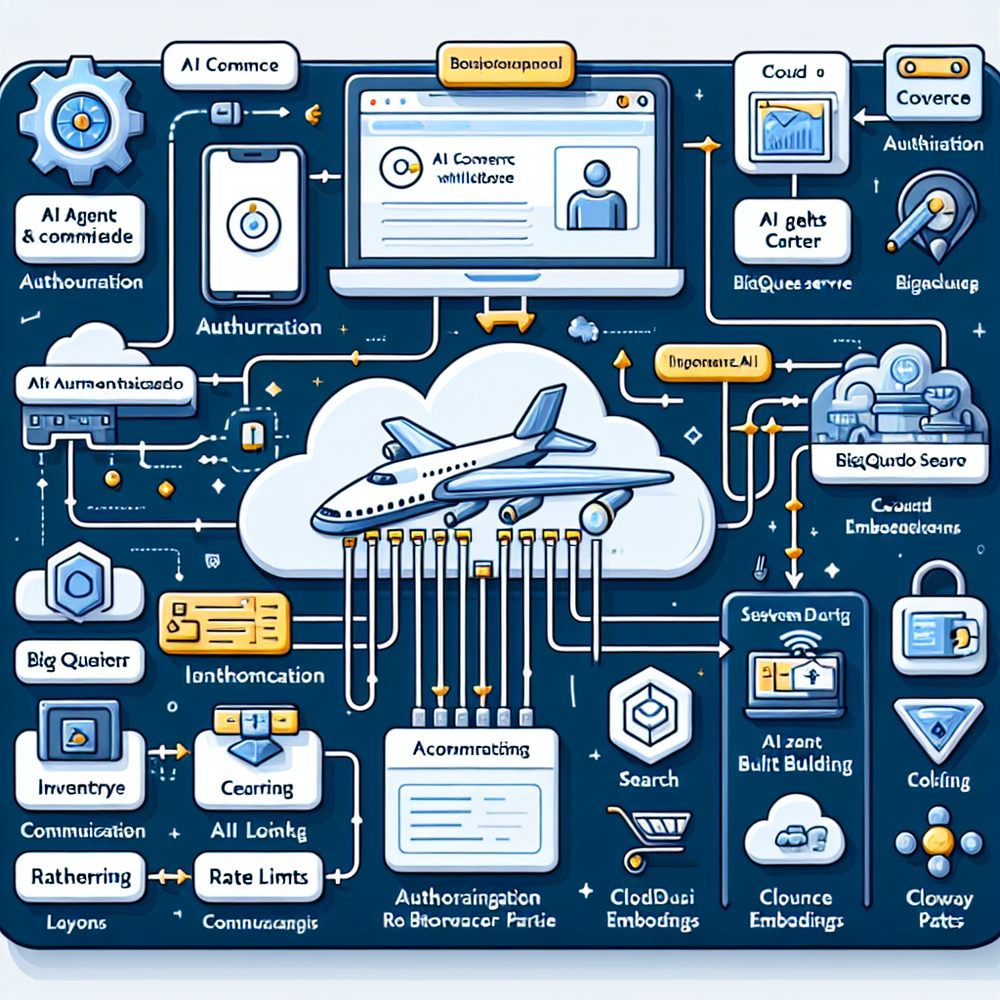
At the core is a planning agent that selects tools, not just words. On Google Cloud, we use Vertex AI Agent Builder (for policy, routing, and safety) plus Vertex AI Search (for semantic retrieval over product, content, and support docs).
Product embeddings and metadata sit in BigQuery and Vertex AI Search indexes; transactional events run through Pub/Sub for durability; and Apigee gateways expose cart, pricing, and loyalty endpoints with quota and auth.
On the site, the Brambles front-end delivers the conversation and actions. The Agentic Commerce Module snaps into any page and decides when to suggest products or tools based on context (URL, scroll depth, query intent). It renders instant responses while the Google Cloud back end handles tool orchestration, caching, and safety checks.
Feature highlights that matter in an agentic setup: AI product discovery lets shoppers describe goals in plain language and returns shoppable, comparable options. Proactive engagement suggests the next best action (size check, delivery ETA) based on the page and behavior. Direct add to cart places selected SKUs into the retailer’s basket from within chat, compressing steps without sacrificing consent.
For confidence, visual features matter. Virtual try‑on helps apparel and eyewear shoppers see fit before buying. View in room places furniture and decor at scale in a live room view. Content intelligence indexes your site so answers and product matches include the nuances in your guides, sizing charts, and editorial reviews.
Publisher monetization benefits too. Affiliate revenue unifies links across a broad merchant graph, while contextual ads and retail media preserve relevance without tracking users around the web. When combined with agentic UX, these create revenue that feels like a service, not a detour.
Implementation Guide: 30/60/90 Days
You don’t need a big-bang release. Ship in layers that reduce risk and create measurable wins. Below is a field-tested plan we’ve used with retailers and publishers moving onto Google Cloud with Brambles on the front end.
Days 1–30: index and instrument. Feed product catalogs, editorial, FAQs, and policies into Vertex AI Search. Wire core events (assist start, product view, tool call, add-to-cart, checkout) to Pub/Sub and your analytics. Stand up a minimal Apigee proxy for read-only endpoints (inventory, delivery ETA). Deploy the Brambles widget in read-only mode with proactive prompts on top categories.
Days 31–60: add actions. Introduce safe tool calls for cart and coupons via Apigee; define guardrails in Vertex AI Agent Builder (SKU limits, price caps, consent prompts). Enable Direct add to cart in controlled cohorts. Layer AI product discovery for long-tail queries and test visual confidence boosters like Virtual try‑on on a single category.
Days 61–90: scale and monetize. Turn on View in room for high-AOV categories. For publishers, enable Affiliate revenue and optionally Contextual ads for non-commerce pages. Expand proactive engagement across articles using intent rules. Tighten SLAs (p95 < 1.5s) and add fallbacks for each tool call. Roll into pricing and support plans when ROI is visible.
Deployment choices: The fastest path is the Agentic Commerce Module on your CMS or storefront. If you’re on WordPress, use the single-click plugin. For Shopify, the app streamlines front-end placement while the back end stays on Google Cloud. Enterprise teams often pair this with Apigee and Cloud Run for tool endpoints.
Checklist to avoid surprises: 1) Define tool budgets (max calls per turn) and timeouts. 2) Log every tool call with inputs/outputs for replay. 3) Implement affiliate disclosures in the first assistant response. 4) Set clear handoff to human support for edge cases. 5) Cache frequent queries and index updates on a cadence that matches your inventory volatility.
Measuring ROI & KPIs
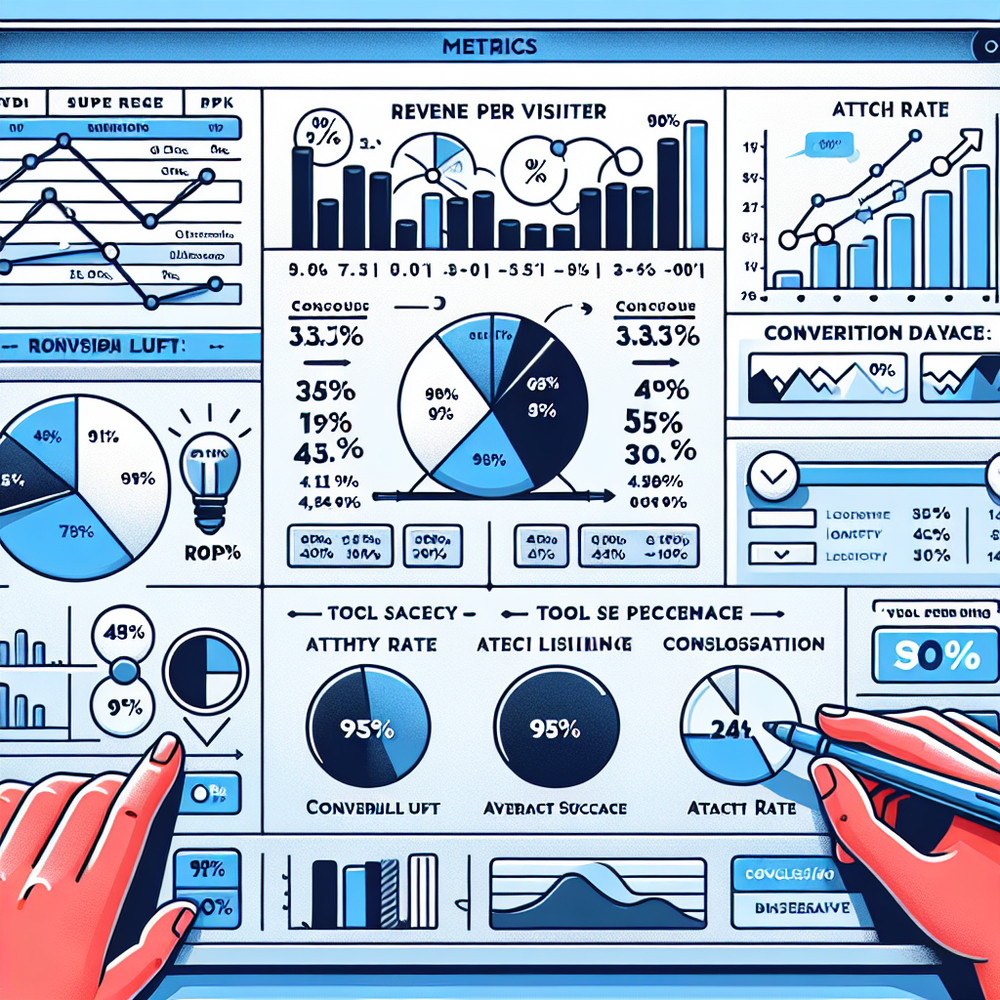
Agentic commerce earns its keep when it accelerates confident decisions. Track revenue per visit (RPV), incremental conversion rate lift, average order value, and attach rate (e.g., filters for air purifiers). On the ops side, watch latency p95, tool success rate, and fallback frequency. If tool success is <95%, you’re pushing users into dead-ends.
Two field notes: On a 2.1M-session home goods publisher, conversation-led product blocks increased RPV by 28% while bounce fell 13%. On a 100k-session apparel site, enabling Direct add to cart within chat lifted conversion by 19% and cut checkout time by 42%. Both maintained clear disclosures and did not use retargeting cookies.
How to attribute lift fairly: use geo-split or page-level holdouts instead of last-click. Define assisted conversions (viewed or interacted with agentic UI within session). For service deflection, measure cases resolved without human handoff and CSAT. Report cost per assisted conversion alongside media ROAS for apples-to-apples budget debates.
First‑Party Data, Trust, and Policy
Trust compounds results. Google’s UX research shows clarity and speed outperform nudges. We build trust by using first‑party signals (on-site behavior, declared preferences) rather than third‑party tracking. Disclose affiliate relationships up front, log decisions, and make opt-outs obvious. A helpful assistant beats a pushy one every time.
On Google Cloud, policy lives in the agent and the gateway. Use Vertex AI safety settings to limit tool scope and Apigee to enforce quotas and PII redaction. For publishers, monetize with context, not profiles; for retailers, prefer declared preferences (sizes, rooms, brands) over inferred ones. Both approaches feed better retrieval and recommendations without risking compliance.
When Brambles.ai is the front end, disclosures and user controls are part of the UI patterns. Features like Affiliate revenue and Contextual ads are designed to slot into conversations naturally, not disrupt them. That’s crucial for long-term reader loyalty and incremental revenue that doesn’t cannibalize primary goals.
Common Pitfalls (and How to Avoid Them)
Overtooling the agent. Teams bolt on 12 tools and wonder why latency spikes. Start with three: catalog search, inventory, cart. Add delivery and coupons after you hit p95 <1.5s.
Shallow indexing. If your sizing charts and policies aren’t in Vertex AI Search, your answers will be generic. Feed PDFs, tables, and structured specs. Use content intelligence on the front end to surface the right bits inline.
No fallback plan. Tools fail. Provide graceful degradation: suggest alternatives, offer email capture, or link to relevant editorial. Log every failure path for rapid fixes. Also, don’t forget affiliate disclosures—burying them is a trust killer and a compliance risk.
Training on PII or private pricing. Keep sensitive data out of long-term memory. Use retrieval for ephemeral info (prices, stock) and store only what you must for fulfillment. Apigee policies help here.
Future Outlook on Google Cloud
Multi-agent orchestration will feel normal: one agent plans, another validates, a third executes payment. Expect tighter Vertex AI + BigQuery loops for real-time pricing and inventory, and lighter on-device interactions for mobile. Voice will matter for hands-busy tasks like DIY and cooking. The north star remains the same: helpful, fast, and transparent experiences that respect users and content.
FAQ
How does Brambles integrate with Google Cloud?
The front end runs via the Agentic Commerce Module on your site. Google Cloud powers orchestration with Vertex AI Agent Builder and retrieval via Vertex AI Search. Tooling (cart, inventory) sits behind Apigee with logging to Pub/Sub. This keeps UX snappy while your data and policies stay centralized.
Which features should I enable first?
Start with AI product discovery for long-tail intent, then Proactive engagement on high-traffic pages, and Direct add to cart for a test cohort. Add Virtual try‑on or View in room for confidence in visual categories.
What results can we expect, realistically?
In our field work, we’ve seen 10–25% RPV lift for publishers and 8–20% conversion lift for retailers once actions are enabled and latency is controlled. Results hinge on clean indexing, reliable tools, and clear disclosures.
How do we control costs and risk?
Throttle tool calls, cache popular answers, and cap model tokens. Use cohort rollouts and page-level holdouts to prove ROI before scaling. Align pricing to outcomes and support with SLAs when going enterprise.
Where do we start?
Install the widget, index your content, and expose read-only tools. Then add actions for a small cohort. If you need help, the developer docs and team will meet you where you are.
Related resources on Brambles.ai
If you are implementing this, start with Brambles.ai, publisher pricing, brand pricing, about Brambles.ai.
Related posts
View all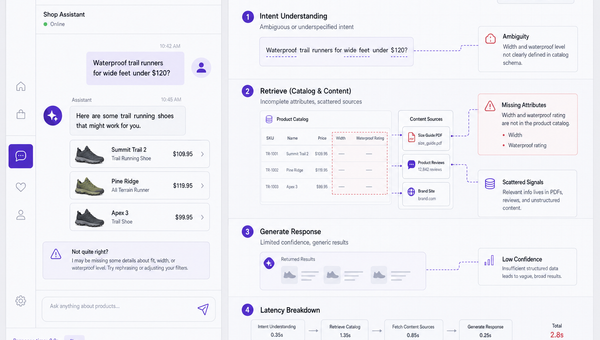
Why Good AI Shopping Agents Are Hard—and How Brambles Helps
Most AI shopping bots fail on data quality, UX, and trust. See why agents break in the wild and how Brambles.ai fills the gaps with measurable features.
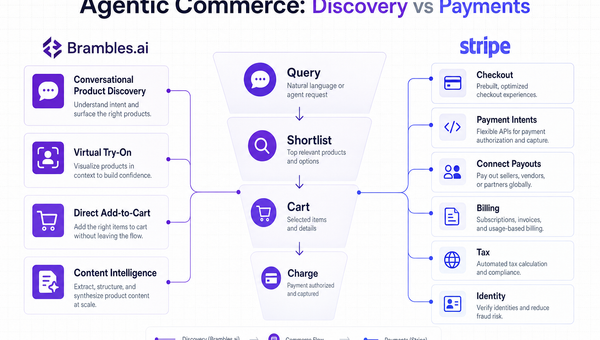
Stripe Agentic Commerce vs Brambles.ai: When to Use Each
Confused between Stripe’s agentic stack and Brambles.ai’s conversational shopping? See real trade‑offs, use cases, ROI, and an implementation path for each.
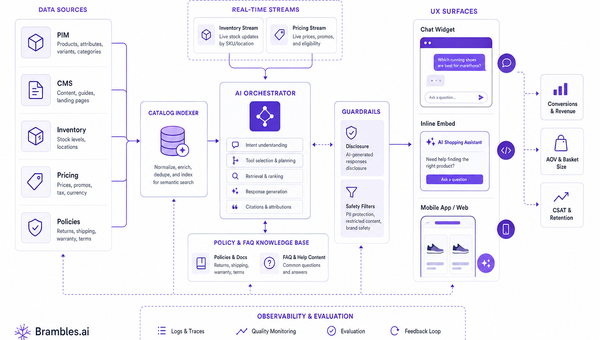
What to Fix Before AI Shopping Agents | Brambles.ai
Fix data, ops, and trust gaps before AI shopping agents. A field-tested Brambles.ai rollout guide with checklists, KPIs, and step-by-step tips. Proven wins.
Explore Brambles.ai
Learn more about our AI-powered agentic commerce platform, agentic shopping, and shopping assistance solutions.
Explore More Insights
Discover more articles on AI, automation, and business innovation
View All Articles