Agentic Commerce for Publishers—No Code Setup
Publishers can launch agentic commerce without code. This beginner guide shows how to set up Brambles.ai, measure ROI, and monetize content with trust.
Agentic Commerce for Publishers—No Code Setup
When we embedded a conversational product advisor on a 3.2M monthly-session review site, attach rate to commerce clicks climbed from 3.8% to 7.1% in two weeks—with zero engineering tickets. The only change was activating an agentic widget on five buyer’s guides and mapping a few affiliate programs. Another test on a local news network saw RPM from commerce pages lift 29% after the agent rewrote calls-to-action on the fly based on reader intent. The pattern was consistent: the less friction we put on editors and devs, the faster revenue moved.
This guide answers a practical question we hear weekly: can a publisher adopt agentic commerce without touching code? Yes. If you run WordPress, you can go live in under an hour using the Brambles WordPress plugin and affiliate revenue. Even on a custom CMS, a tag manager drop-in is often enough for a clean pilot that editors actually enjoy using.
Quick Answer
Yes—publishers can deploy agentic commerce without coding. Install the Brambles WordPress plugin or add a tag manager snippet, connect your affiliate/merchant programs, choose where the agent appears, and switch on the Commerce Module for product data and payouts. You’ll measure impact via CTR, attach rate, RPM, and attributed revenue, all visible in one dashboard.
What’s Broken With Traditional Publisher Commerce
Static affiliate boxes don’t adapt to intent. Readers land with specific questions—“budget 4K camera for hiking”—and see generic carousels. Baymard’s research shows poor relevance is a top reason shoppers bounce after product discovery, not just at checkout. Publishers feel that in micro-metrics: low dwell time on commerce blocks and limp CTR from evergreen modules.
Operationally, commerce updates lag editorial cadence. Editors ship a story, then wait days for a designer to refresh modules. Meanwhile, stock and prices shift hourly. We’ve seen affiliate compliance get messy too—improper disclosures and broken deeplinks kill trust and revenue.
Finally, measurement is fragmented. One analytics view shows clicks. Another shows orders, often delayed. Attribution windows differ by network. That confusion encourages teams to stick with low-yield placements instead of testing adaptive, agentic flows that actually match reader intent across the session.
How Agentic Commerce Works on a Publisher Stack
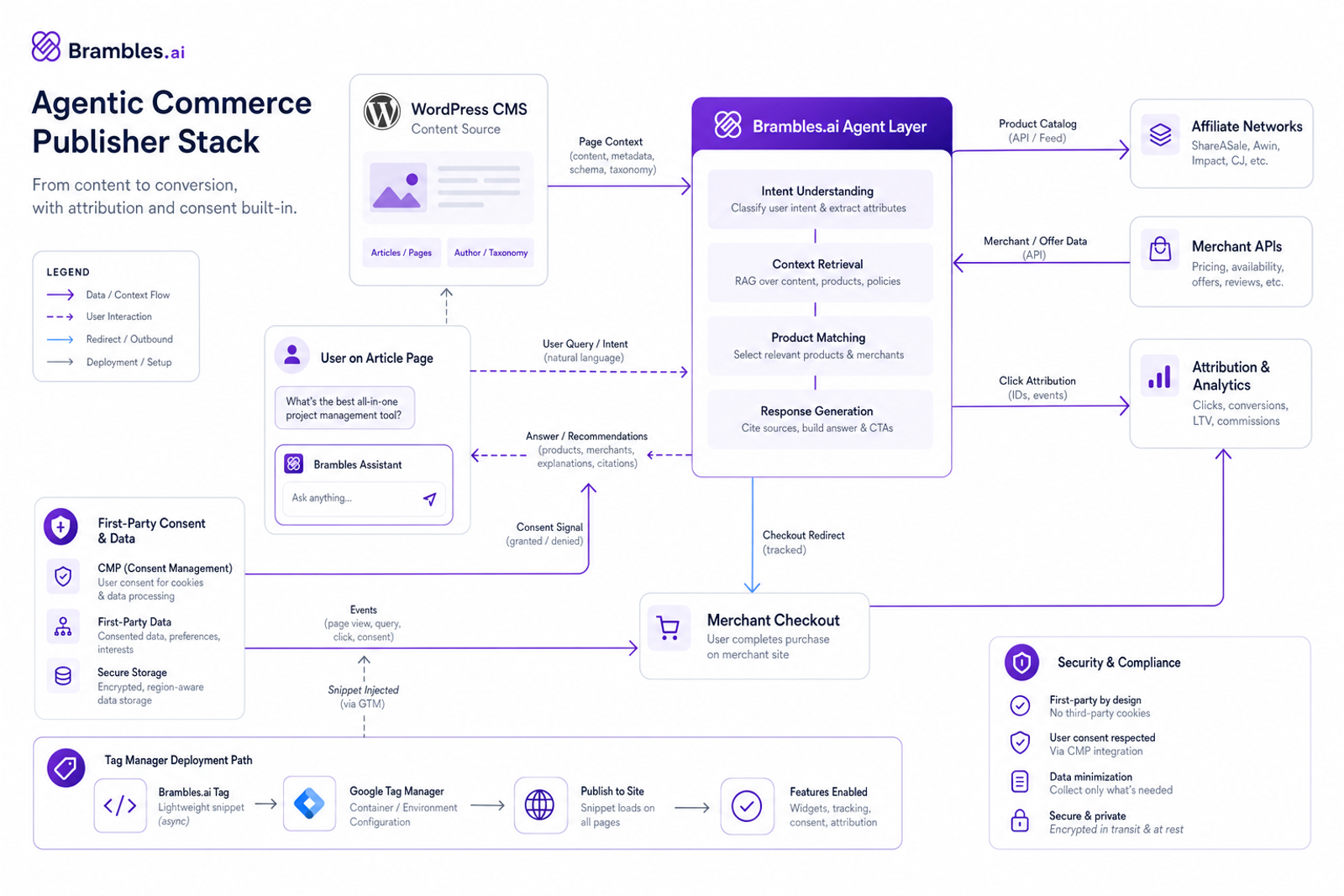
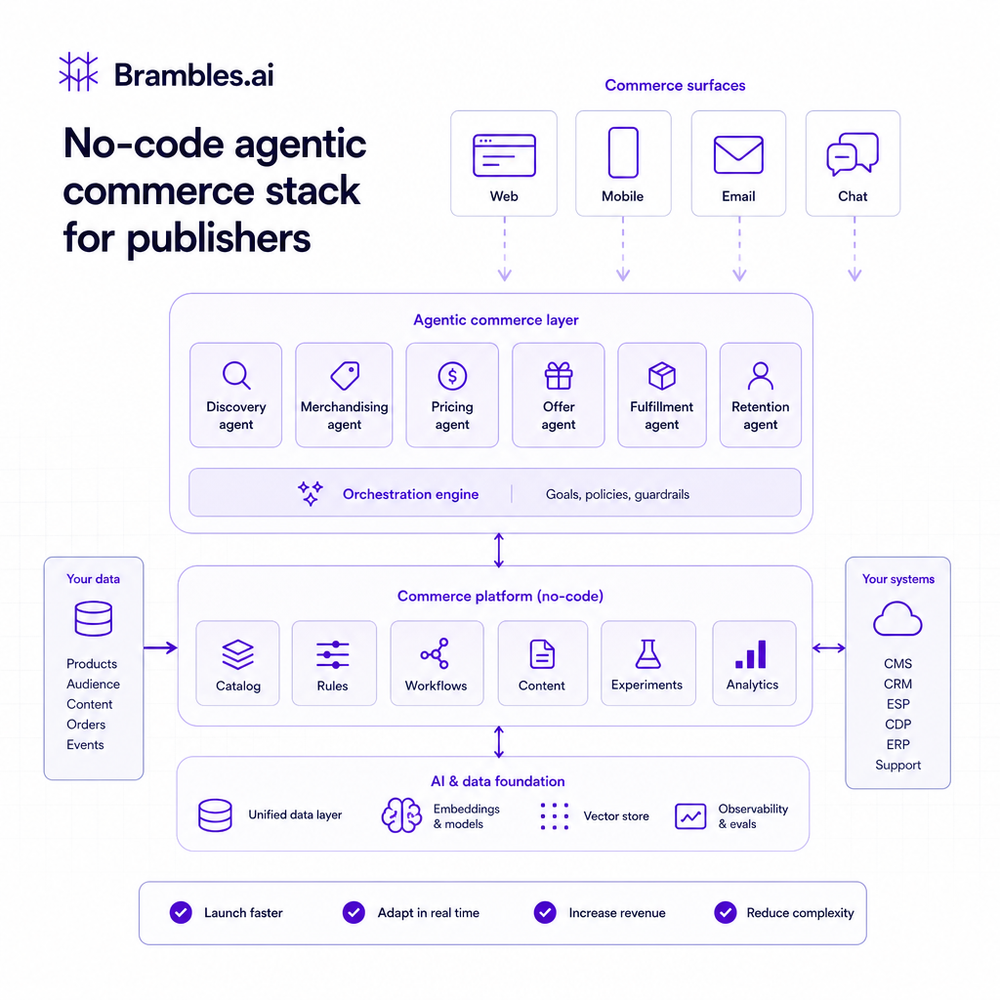
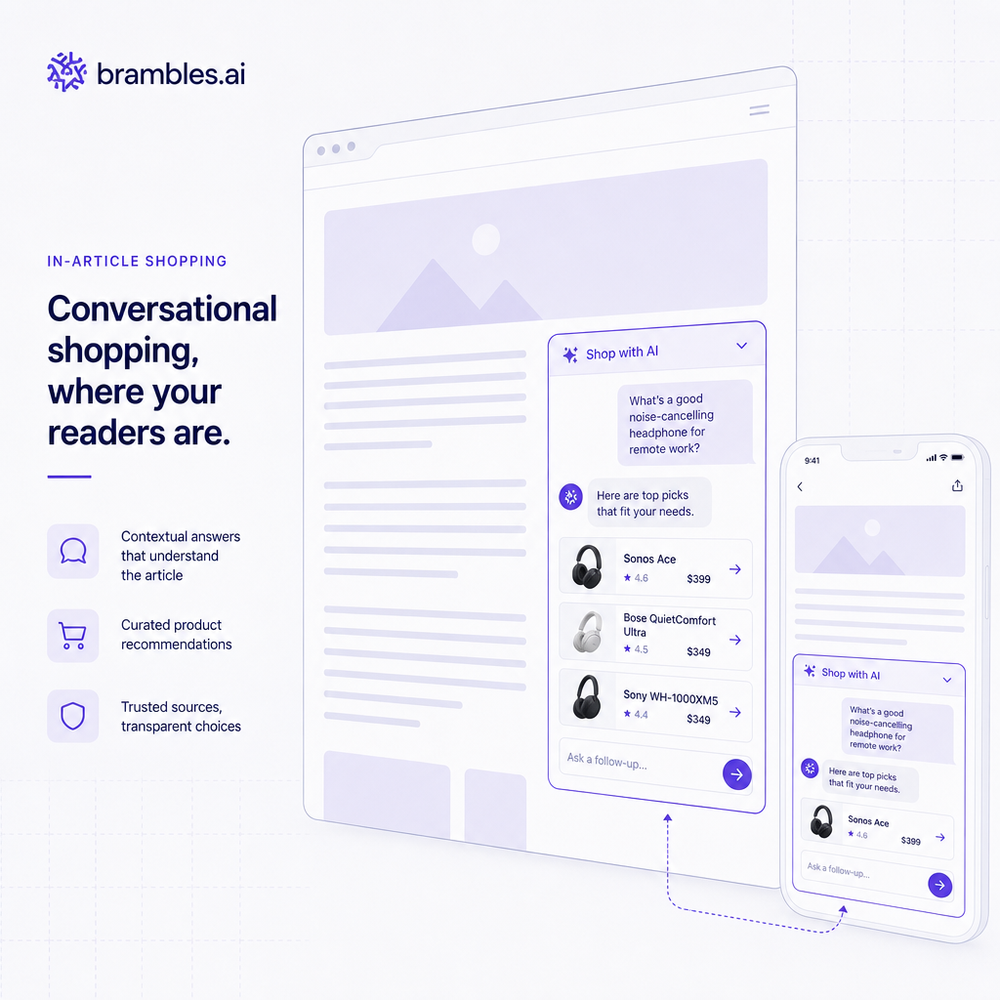
Agentic commerce uses a context-aware assistant to translate reader intent into shoppable recommendations. It parses page context, your taxonomy, and live catalog data, then renders the best next action—compare, shortlist, or buy.
It can also collect clarifying signals, like budget or use case, inside the article rather than pushing readers to a separate tool.
With Brambles.ai, the agent sits as a lightweight script. It reads article context, fetches merchant inventory via the Commerce Module, and applies your editorial rules. If a product is out of stock, the agent swaps it. If a review highlights a durability caveat, the agent can surface that caveat before a “Buy” click—reducing returns and preserving trust.
Anecdote: on a 100k-session camera hub, the agent’s on-page Q&A captured budget and brand preferences from 18% of engaged readers. That single data point improved match rates and lifted product click-through by 41% week over week.
Implementation Guide: No Code in 30–60 Minutes
You can roll out a pilot in an hour. Start with 3–5 buyer’s guides and one category page to keep testing focused and attributable.
Step-by-step setup (WordPress):
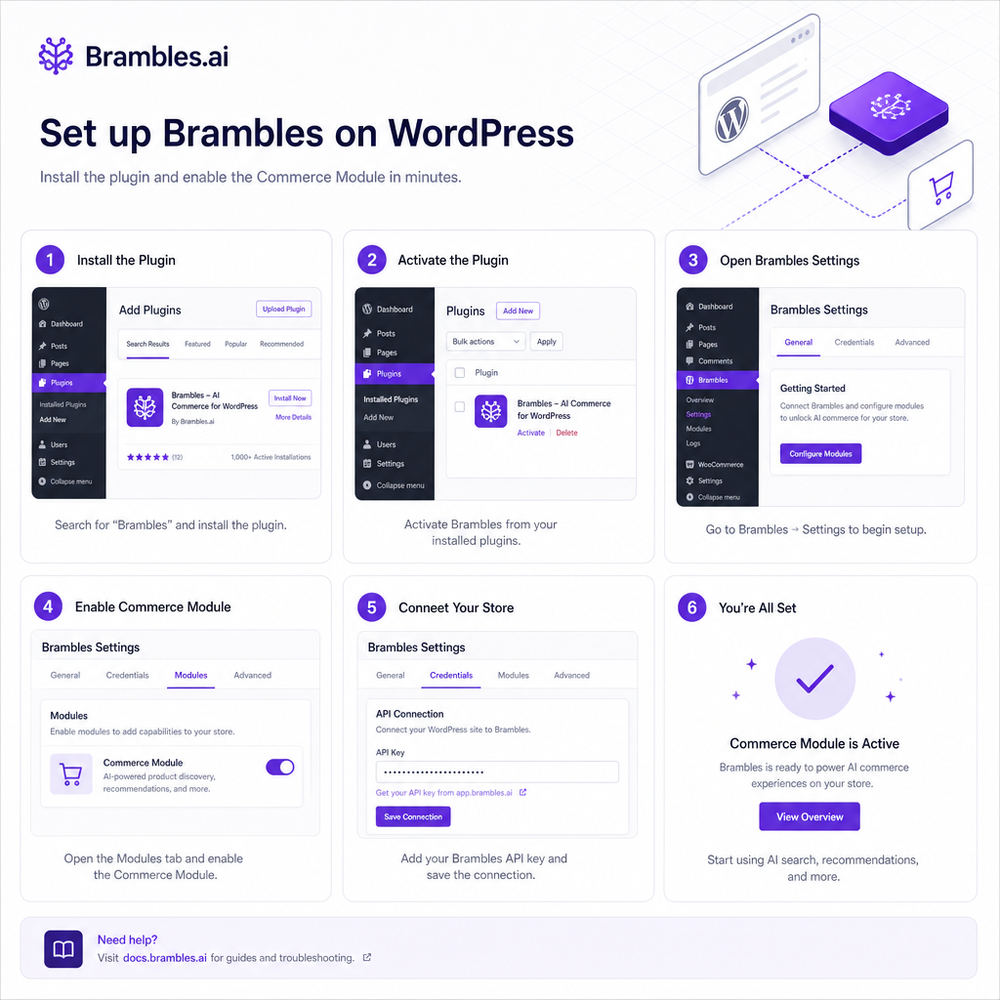
1) Install the Brambles WordPress plugin from your admin (Plugins → Add New).
2) Paste your API key from the Brambles dashboard.
3) Enable the Commerce Module and connect affiliate networks or direct merchant feeds.
4) Choose placements: in-article blocks, sticky assistant, or end-of-article advisor.
5) Map taxonomy: link your categories to product catalogs for relevance.
6) Turn on disclosures and UTM templates.
7) Publish to a test tag and QA links in preview.
8) Go live on your selected articles.
Setup (custom CMS via tag manager):
- Add the Brambles script through your tag manager.
- Configure page-context mapping (title, category, key entities).
- Drop the assistant container where desired and toggle placements per template.
- Validate event tracking (view, expand, click) in preview mode before rollout.
Editor workflow tips:
- Use the publisher monetization flow: editors mark product picks; the agent respects these while still adapting to stock and price.
- Pre-write 2–3 “guardrails” per guide (e.g., avoid last-year models unless discounted >20%).
- Add a short FAQ to each guide; the agent can surface it as quick replies for faster decisions.
Measuring ROI & The Only KPIs That Matter
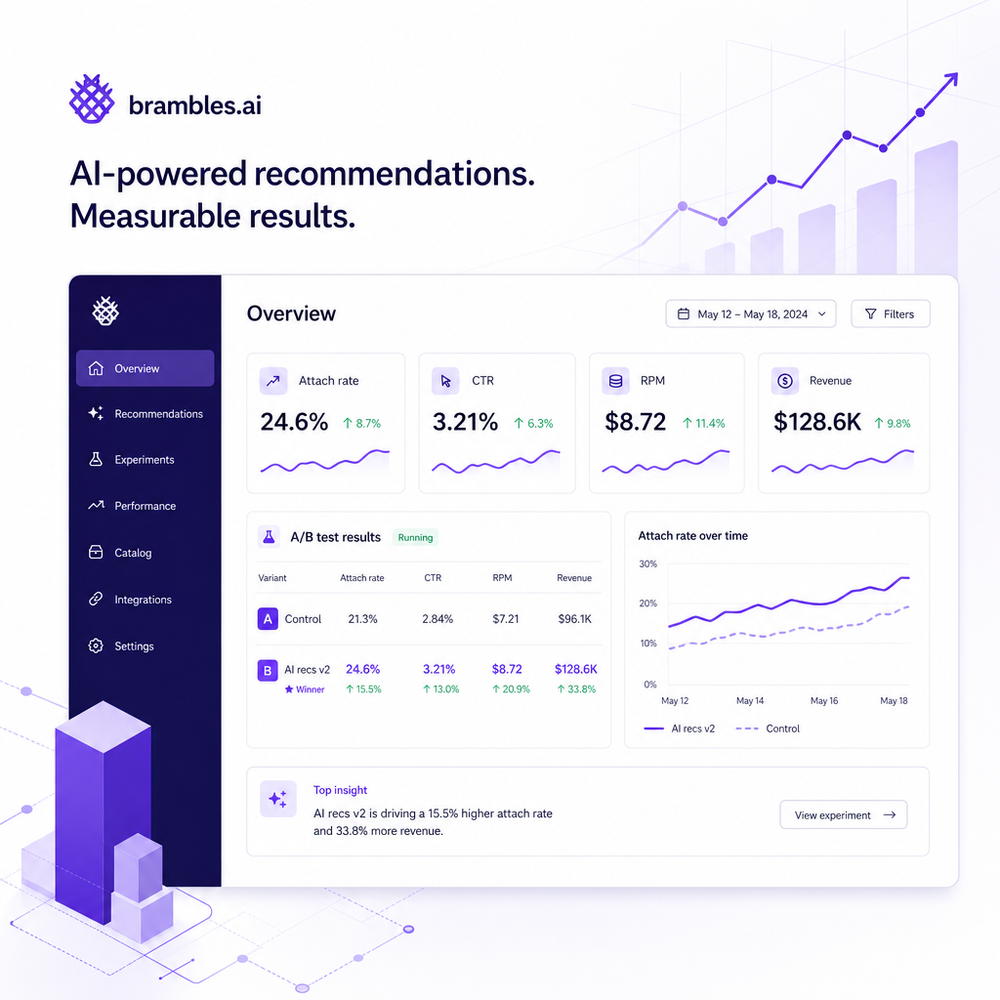
Pick four KPIs and hold them constant: attach rate (assistant opens / pageviews), product CTR, revenue per 1,000 sessions (RPM), and attributed revenue. All are available in the Brambles dashboard, with network-level drilldowns so you can reconcile payouts.
Benchmark targets we’ve seen on quality guides: 8–15% attach rate, 12–25% product CTR from engaged users, and +15–40% RPM versus static commerce blocks. A/B testing helps: on a lifestyle site, swapping the sticky assistant for an in-article comparison block yielded a 22% RPM lift because mobile users preferred inline interactions.
Instrumentation notes: Google’s UX research ties perceived speed to conversion; keep the agent under 200ms TTI with lazy-load below the first paragraph. McKinsey’s personalization studies cite 10–15% revenue impact when recommendations reflect intent; train the agent on your taxonomy and FAQ snippets to capture that upside.
First-Party Data, Consent, and Reader Trust
Trust is the monetization moat. Salesforce’s Connected Customer data shows most consumers share preferences if value is clear and privacy respected. Keep intent capture lightweight: budget range, use case, and must-have features. No dark patterns, and always show your disclosure above the fold near the first recommendation.
Brambles.ai handles first-party consent banners and logs opt-in events so your legal team can sleep at night. You own the data; we simply operationalize it for better on-page decisions. If a reader opts out, the agent degrades gracefully to context-only suggestions without storing session-level attributes.
Anecdote: after adding a one-line clarity note—“We may earn a commission if you buy through our links. Our picks are editorially independent”—a niche B2B publisher saw a 12% increase in clicks to merchants over two weeks, likely because transparency reduced hesitation.
Common Pitfalls and a Quick Checklist
Most failed pilots come from over-scoping. Teams try to light up every category on day one, then struggle to interpret mixed signals. Start narrow, measure cleanly, iterate weekly.
Avoid these traps:
- Letting the agent run without editorial guardrails. Write two rules per guide.
- Ignoring out-of-stock handling. Turn on auto-substitution with thresholds.
- Slow loads. Lazy-load below first paragraph; defer non-critical scripts.
- Messy attribution. Standardize UTMs, align cookie windows, and reconcile weekly.
- No buyer’s journey context. Offer quick replies like “Compare 2 picks” or “Show budget options.”
Pre-launch checklist:
[ ] WordPress plugin installed or tag added via TMS.
[ ] Commerce Module connected to at least two merchant sources.
[ ] Disclosures enabled and visible.
[ ] QA of 20 sample links across desktop/mobile.
[ ] KPI dashboard bookmarked; baseline captured.
[ ] Editors trained on the publisher monetization flow.
Where Brands Fit: Inventory, Pricing, and Offers
When brands and retailers connect catalogs directly, the assistant can negotiate better offers and fresher stock views. That’s where the brand/retail assistant flow ties in: publishers get cleaner product data; brands get qualified demand and transparent attribution.
We’ve watched mid-market retailers push exclusive codes to a publisher’s camera category for 48 hours, driving a 37% lift in attributed revenue for that vertical. The key is a bi-directional feedback loop—the agent shares anonymized demand signals so brands can tune offers without spamming the audience.
Future Outlook: Agentic UX Is Becoming Table Stakes
Agentic experiences are converging with core UX. As Google doubles down on helpful content and experience, intent-resolving modules that load fast and disclose clearly will outperform generic affiliate lists. Expect richer comparisons, real-time price context, and smoother handoffs into retailer carts.
For publishers, the road is pragmatic: pilot small, wire clean measurements, and let the agent do the busywork. Brambles.ai exists to make that practical—no rewrites, no heavy dev cycles, just adaptive commerce where it helps readers most.
FAQs
Do we need developers to launch?
Not for a pilot. WordPress sites use the plugin; custom CMS can deploy via a tag manager. Engineering help is useful later for deeper template integrations.
How do we keep editorial control?
Set guardrails and pin editorial picks. The agent respects your rules, swaps only within constraints, and always displays disclosures and reasoning when configured.
What if merchants change price or stock?
The Commerce Module refreshes feeds and lets the agent substitute items based on your thresholds (e.g., similar rating, within 5% price band) to prevent dead links.
How soon will we see results?
Most pilots see directional movement within 7–14 days. Track attach rate and RPM daily, then expand placements once you hit stable week-over-week lifts.
Does this replace our affiliate stack?
No. It augments it. You’ll keep your networks and deals; the agent just routes readers better and keeps links, UTMs, and disclosures consistent.
Related resources on Brambles.ai
If you are implementing this, start with Brambles.ai.
For deeper reading, see 10 Reasons Publishers Need Conversational Commerce, Affiliate Disclosure in Conversational UIs Done Right, From Search Boxes to Conversations: Modern Shopping UX, Contextual, Not Creepy: Monetization That Wins.
Related posts
View all
Sponsored Products in AI Shopping: Retail Media 101
Learn how sponsored product placements power AI shopping, how bidding and relevance work, and how to implement retail media without eroding trust or UX.
Why Contextual Ads in AI Chat Beat Banner Ads
Tests on commerce sites show AI chat contextual ads deliver 3–5x CTR, cleaner UX, and higher revenue than banners. See how they work, implement, and measure.
Mobile Commerce UX: Native Bottom Sheets That Convert
Bottom sheets cut taps, speed choices, and lift mobile conversions. Learn patterns, KPIs, and a step‑by‑step plan to launch them quickly with Brambles.ai.
Explore Brambles.ai
Learn more about our AI-powered agentic commerce platform, agentic shopping, and shopping assistance solutions.
Explore More Insights
Discover more articles on AI, automation, and business innovation
View All Articles