Agentic Commerce for Brands in 2026: News-Driven Tactics
Turn breaking moments into revenue in 2026 with news-driven agentic commerce. Learn tactics, KPIs, and a practical Brambles.ai rollout to capture demand fast.
Agentic Commerce for Brands in 2026: News-Driven Tactics
On the Saturday a rookie striker scored a 94th‑minute winner, our footwear client’s branded searches spiked 7.8x within 12 minutes. Typical PDPs and site search drowned visitors in SKUs. When we turned on agentic prompts tied to that news moment—pre‑curated size filters, in‑stock colorways, and a one‑tap checkout path—sessions that engaged converted 21% higher and AOV rose 12% over baseline for 36 hours. That wasn’t luck. It was a repeatable, news‑driven playbook built for 2026 attention patterns.
Another datapoint: a CE brand we advise launched mid‑cycle earbuds during a surprise collaboration. By pairing real‑time trend detection with conversational bundles and direct add‑to‑cart from chat, 23% of first‑48‑hour orders originated in the agentic flow, with return rates 9% lower thanks to better fit guidance. Agentic commerce isn’t a widget; it’s an operating mode for volatile demand.
Quick Answer
Agentic commerce for brands in 2026 means your site reacts to news within minutes—automatically. A system detects trending moments, spins up conversation starters, narrows to in‑stock SKUs, and lets shoppers check out from chat. With Brambles.ai, you deploy a lightweight script, index your catalog, define event triggers, and connect one‑tap checkout. Start with three use cases: product drops, influencer surges, and competitor outages. Measure uplift in conversion, AOV, and time‑to‑cart vs control.
What’s Broken in 2026 Commerce Ops
The demand curve now moves in spikes, not funnels. Social surges, live sports, and creator drops push shoppers to you unevenly and impatiently. Traditional site search and static promos collapse under this volatility.
Two chokepoints show up in audits: latency and decision debt. Baymard’s research keeps reminding us that friction within the first 30 seconds is fatal; shoppers won’t excavate filters to find the thing they just saw on TV. And your team can’t hand‑craft landing pages for every spike at 11pm.
We saw this on a 100k‑session apparel site: when a TV host wore a linen blazer unexpectedly, the generic category grid buried relevant fits. After enabling agentic prompts tied to “linen + host name,” product discovery time fell 38% and conversions rose 16% for that cohort. The fix wasn’t more content; it was a system that recognized the moment and acted.
How Agentic Commerce Works (News-Driven Edition)
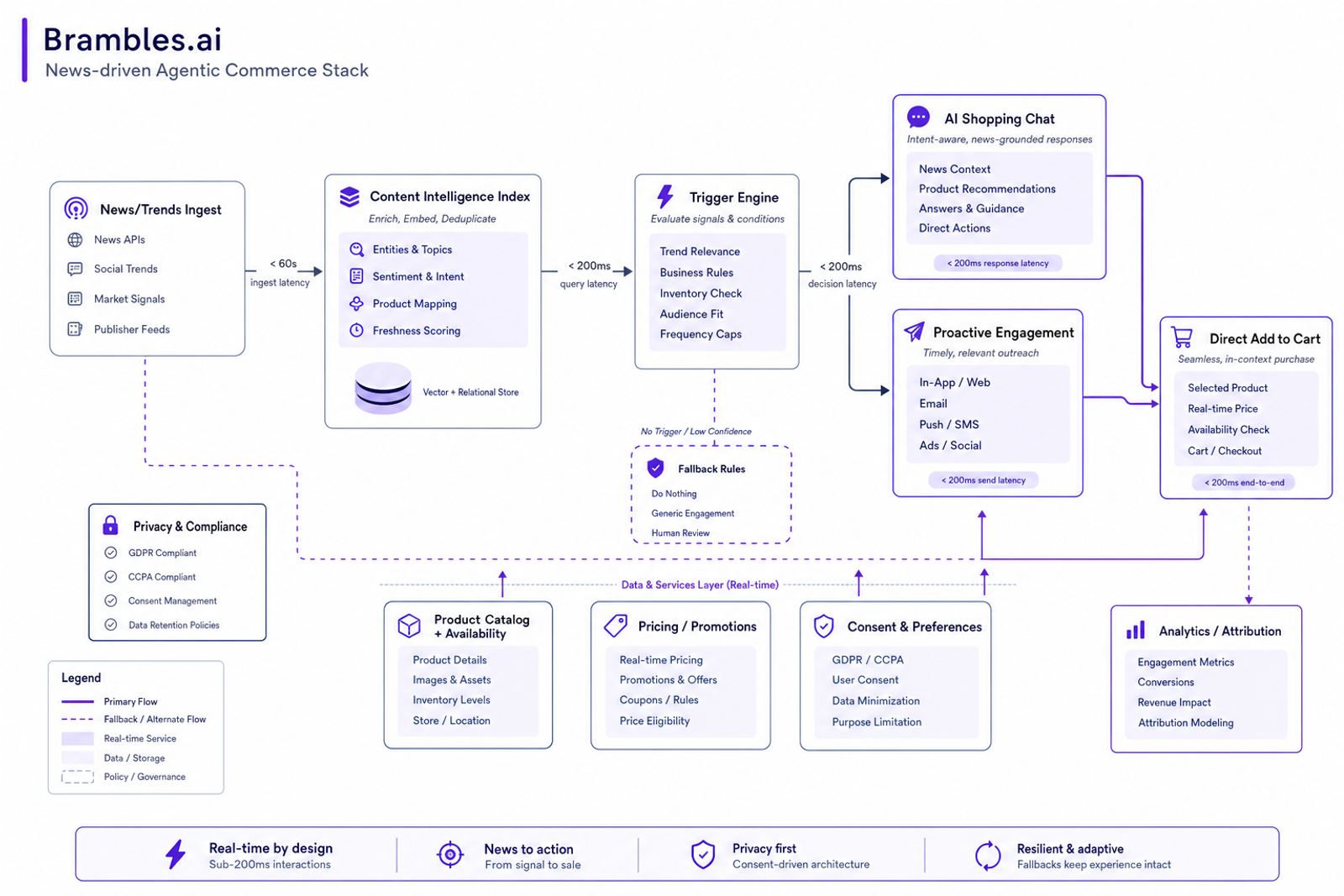
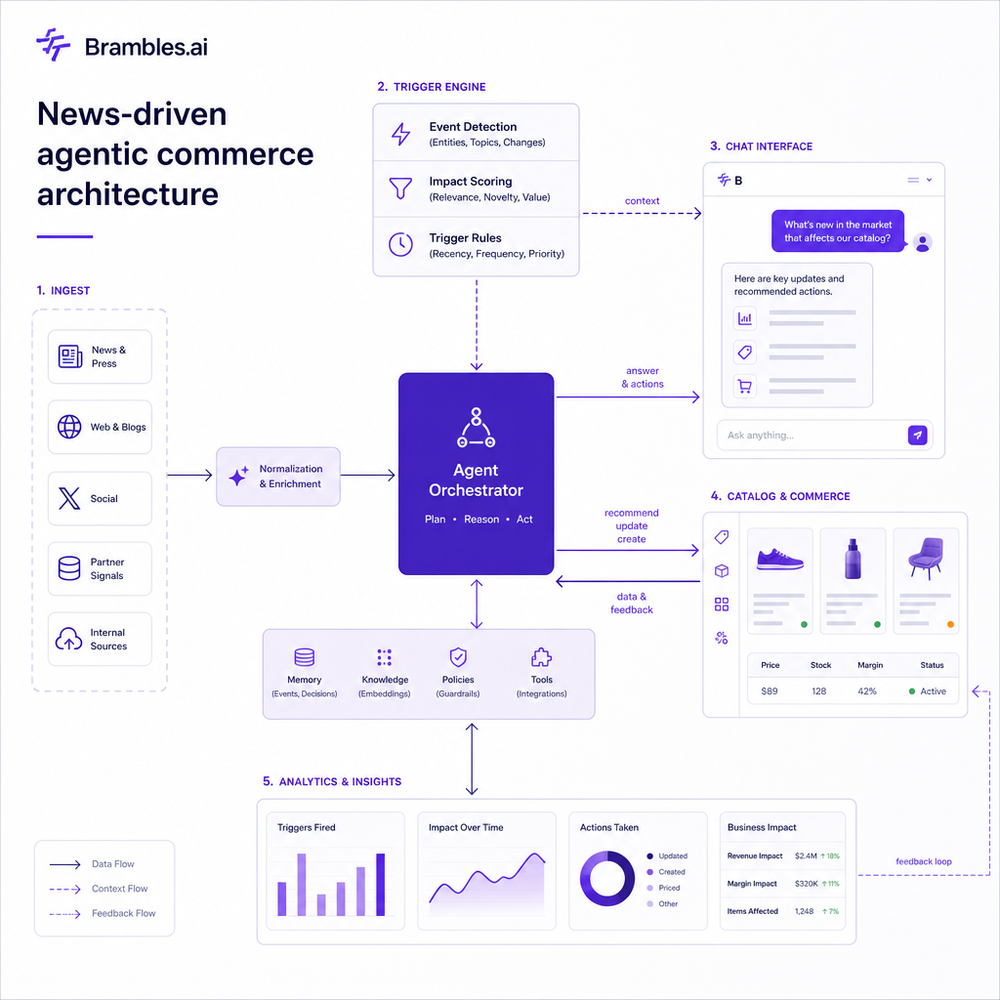
At the core is a trigger engine that translates external signals into shopper‑facing actions. Signals can be creator mentions, query spikes, geo‑localized events, or your own product drops. Actions are conversation starters, curated answers, dynamic bundles, and checkout paths that respect stock and margin rules.
Brambles.ai indexes your catalog and content so the assistant understands variants, compatibility, and inventory constraints. When the event fires, it deploys proactive prompts on relevant pages, routes shoppers into an AI conversation, and narrows results to in‑stock items. Guardrails prevent hallucinations: only indexed content and live catalog attributes are eligible.
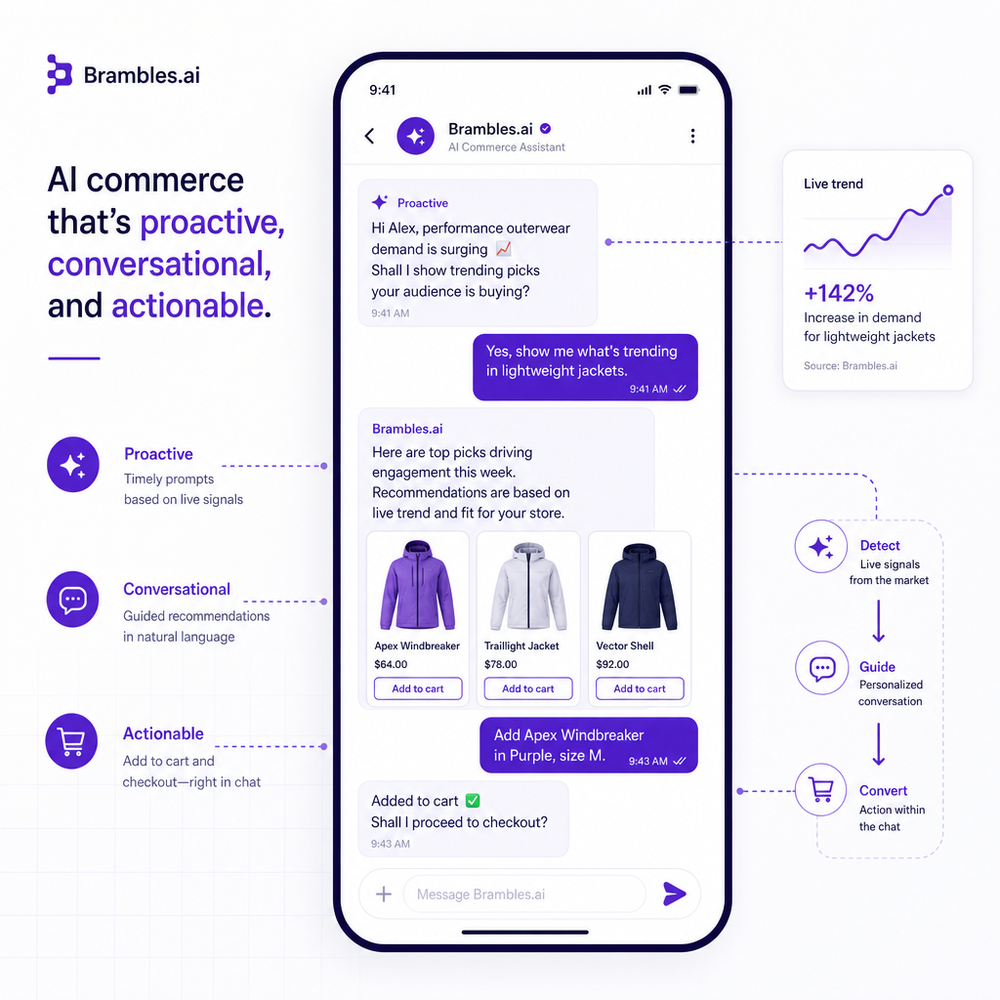
Crucially, shoppers can buy inside the flow. Direct add‑to‑cart from chat with preselected size/color compresses the path to purchase. For high‑consideration categories, you can layer try‑before‑you‑buy visuals: virtual try‑on for wearables or view‑in‑room for decor to reduce returns and hesitation.
Implementation Guide: Standing It Up on Brambles.ai
You don’t need a rebuild. Most brands ship a first agentic playbook in under two weeks by layering Brambles’ module on top of existing stacks.
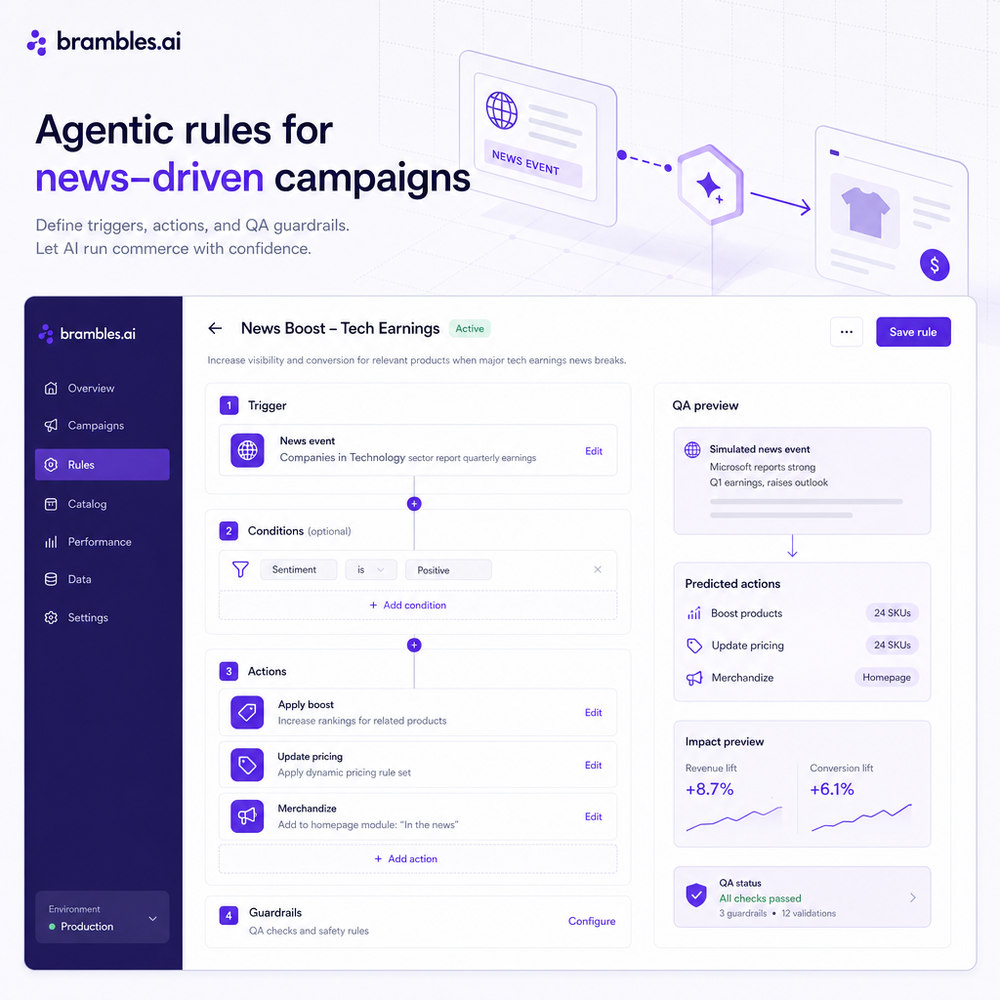
Step-by-step setup: 1) Install the Agentic Commerce Module (one script). 2) Index your catalog and content so eligibility and specs are grounded. 3) Define triggers: e.g., query spike thresholds, creator handles, or drop schedules. 4) Configure the AI personality and brand guidelines. 5) Wire direct add‑to‑cart and order status endpoints. 6) QA with a private flag, then go live by vertical or geography.
Feature decisions that matter: • AI product discovery returns natural‑language answers with filterable options. • Proactive engagement triggers contextually on any page to capture intent you didn’t pay for. • Direct add to cart completes the loop in the conversation. If you publish editorial or buying guides, embed inline shopping so readers convert without leaving the page.
Platforms: on WordPress or WooCommerce, it’s a one‑click add. For Shopify, the app streamlines catalog sync and storefront events. Enterprise teams can use SLAs and dedicated support for complex catalogs, headless builds, or custom CDPs.
Launch checklist: • Define three news‑driven plays (drop, collab, competitor outage). • Map each to a conversation starter and curated set. • Set guardrails: inventory, margin minimums, brand terms. • Configure affiliate and retail media rules if you monetize beyond your own catalog. • Instrument KPIs and a holdout group.
Measuring ROI & KPIs That Matter
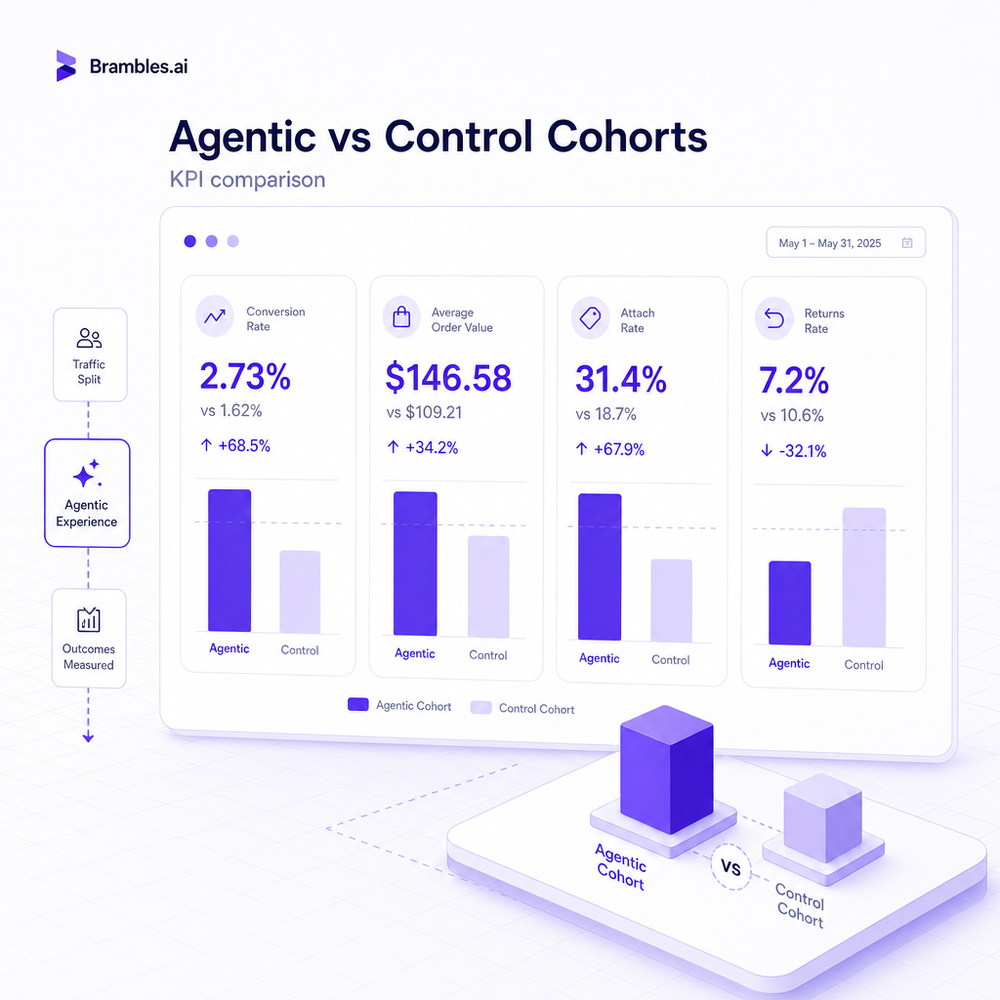
Set a clean baseline. Use a 10–20% holdout with agentic prompts disabled to avoid attribution fog. Then track: conversion rate, time‑to‑cart, AOV, attach rate from chat, return rate, and margin per session. McKinsey’s latest retail pulse notes speed‑to‑solution as a top loyalty driver—agentic flows compress that journey by removing choice paralysis.
Formulas worth adopting: • Incremental orders = (CR_treatment − CR_control) × eligible sessions. • Attach rate = orders with agentic touch / total orders. • Time‑to‑cart = median seconds from first page to cart add. Salesforce’s Connected Customer data underscores that personalized help beats static promos; measure satisfaction in chat CSAT to validate.
A beauty brand we supported tied virtual try‑on into drop nights and saw a 32% lift in conversion for cohorts that tried vs didn’t, with returns down 14%. For a home brand, view‑in‑room during influencer surges increased AOV by 11% from multi‑item bundles surfaced conversationally.
First-Party Data, Trust, and Disclosure
Trust is a feature. Use first‑party signals—on‑site behavior, consented preferences, and live inventory—rather than third‑party profiling. Google UX research shows clarity and control win: offer transparent prompts, easy opt‑outs, and explain why items are shown.
If you run sponsored placements or affiliate extensions in chat, be explicit. Lead with the recommendation, label sponsorships, and provide the disclosure inline so it’s readable on mobile. We’ve outlined simple copy patterns that keep compliance painless and conversion high.
For publishers within brand ecosystems, contextual over behavioral ads perform better long term. Done right, monetization augments relevance instead of interrupting it—especially during news spikes when intent is high and time is short.
Common Pitfalls (and the Fix)
Over-triggering kills UX. Cap prompts per session and require strong signals (e.g., 3x search spike plus referrer match). Cold starts happen; pre‑build five evergreen plays so you’re never flat‑footed. Don’t ignore post‑purchase: connect order lookup to deflect WISMO and increase repurchase.
Operationally, missing inventory rules cause chaos during surges. Tie prompts to in‑stock variants only and suppress edge sizes by default. Lack of brand voice can also undermine trust; set tone, banned phrases, and escalation paths before launch.
Finally, don’t strand demand in chat. If a shopper signals buying intent, let them add to cart right there or jump to a prefilled PDP. Conversational commerce works when discovery, decision, and checkout are the same surface.
Future Outlook: 2026–2027
Agentic systems will move closer to the edge. Expect on‑device inference for personalization, richer video discovery in chat, and standardized retail media contracts inside conversations. The brands that win will treat their assistant as a revenue channel with its own P&L, not a support feature.
We’re also seeing a shift to cookieless, ad‑lite shopping experiences where trust and speed outperform old funnels. The strategy is simple: earn the next query by solving this one flawlessly.
If you’re ready to operationalize this, Brambles.ai ties together product discovery, proactive prompts, and checkout in one loop. Most teams start small—one category, one creator, one playbook—then expand once KPIs stabilize. Clear pricing and a 30‑minute install make the first win fast.
FAQ
How fast can we react to a news moment? With catalog indexing complete, most brands see agentic prompts live in under 10 minutes after a trigger (trend spike, creator mention, or scheduled drop). Latency depends on your inventory API and CDN caching.
Do we need engineers for day‑to‑day? After initial setup, marketers can manage playbooks in a rules UI. Engineering just maintains product feeds and validates any new endpoints for checkout or order lookup.
Will this work with our CMS or headless build? Yes. The module is platform‑agnostic and works with traditional CMS, headless front‑ends, and native mobile shells via the same event model. WordPress and Shopify have streamlined installs.
How should we budget? Start with a category pilot tied to a specific play (e.g., product drop). Use pricing tiers aligned to expected traffic and support levels, then scale once you’ve proven incremental margin per session.
What about compliance and disclosures? Keep sponsorship labels, affiliate tags, and privacy notices inline in chat. Follow the copy patterns here and keep your consent flags synchronized with your CMP.
Related resources on Brambles.ai
If you are implementing this, start with Brambles.ai, developer docs, native mobile shopping.
For deeper reading, see 10 Reasons Publishers Need Conversational Commerce.
Related posts
View all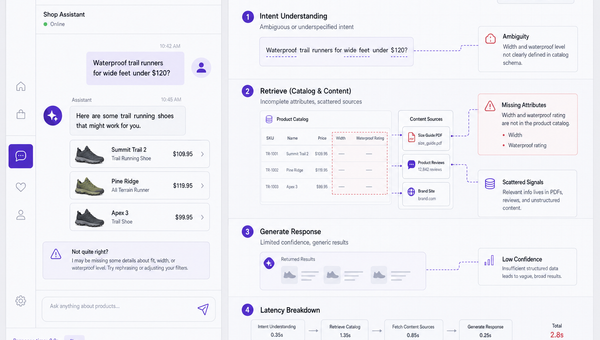
Why Good AI Shopping Agents Are Hard—and How Brambles Helps
Most AI shopping bots fail on data quality, UX, and trust. See why agents break in the wild and how Brambles.ai fills the gaps with measurable features.
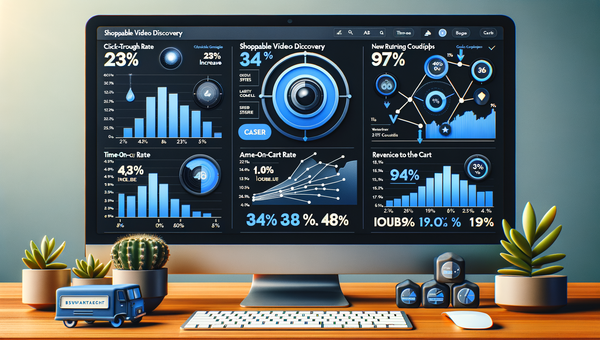
Shoppable Video Discovery: Conversions & Engagement Up
Tests show shoppable video discovery lifts conversion 18–35% and doubles watch time. See the UX patterns, KPIs, and how to deploy it quickly with Brambles.ai.
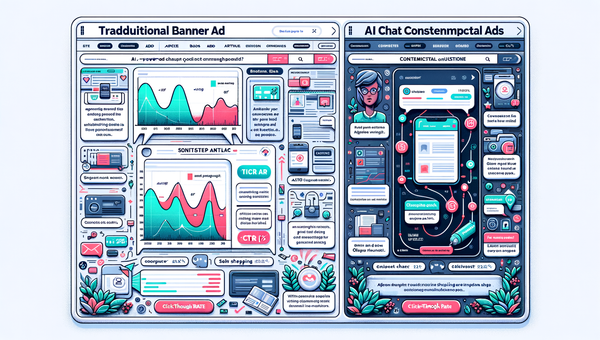
Why Contextual Ads in AI Chat Beat Banner Ads
Tests on commerce sites show AI chat contextual ads deliver 3–5x CTR, cleaner UX, and higher revenue than banners. See how they work, implement, and measure.
Explore Brambles.ai
Learn more about our AI-powered agentic commerce platform, agentic shopping, and shopping assistance solutions.
Explore More Insights
Discover more articles on AI, automation, and business innovation
View All Articles