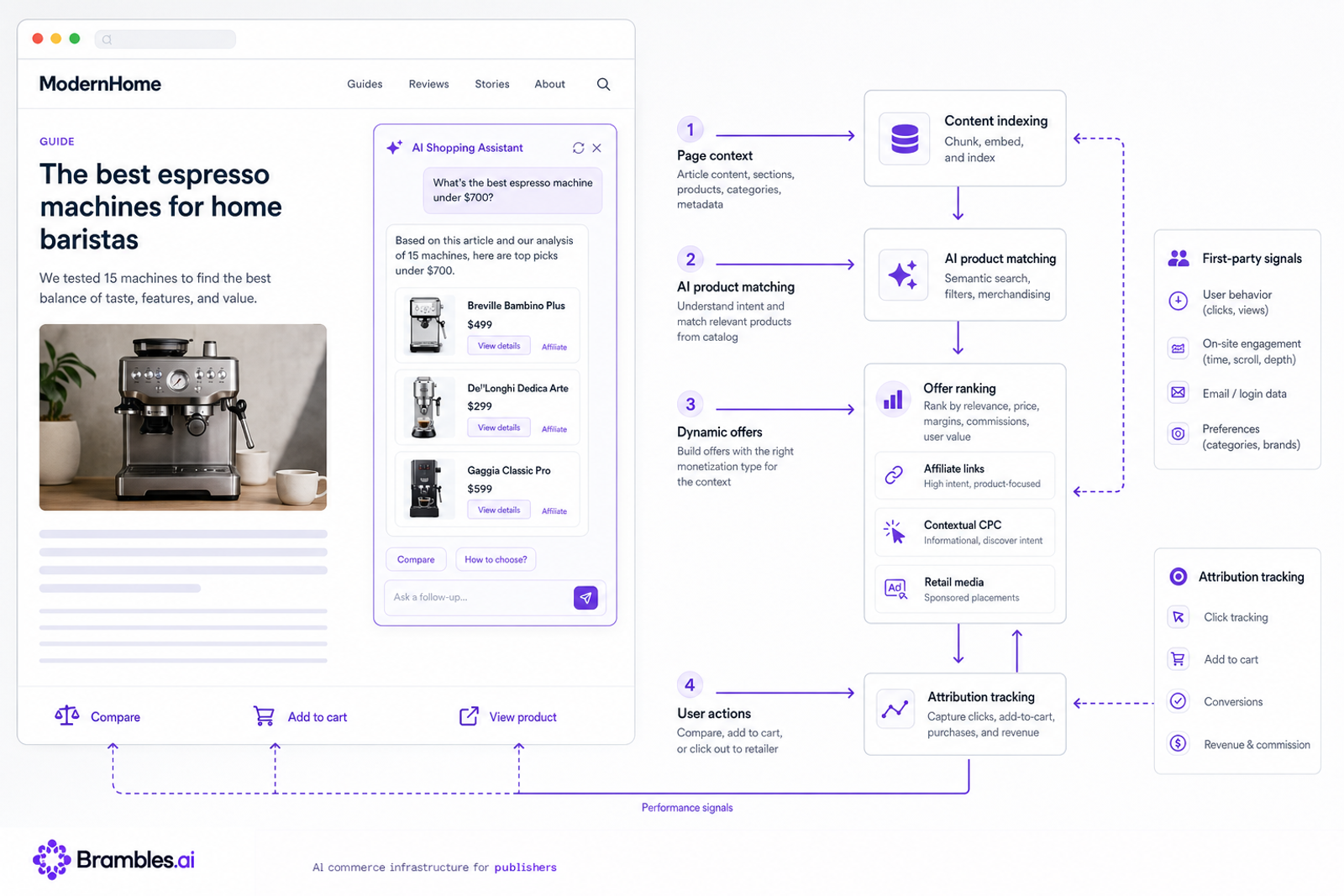
Monetize Agentic Commerce Traffic with Brambles.ai
Publishers are turning intent-rich sessions into revenue with agentic commerce. See how Brambles.ai boosts RPM, AOV, and trust with AI-driven shopping flows.
Monetize Agentic Commerce Traffic with Brambles.ai
Two weeks after turning on agentic commerce for a 1.3M‑session consumer tech site, we watched shopping chats out‑earn static affiliate modules by 38% RPM. The surprise wasn’t the lift—it was who converted. Readers who usually bounce at 45 seconds stayed 2+ minutes, asked three questions, and clicked “add to cart” from chat. That pattern repeated on a home decor blog: fewer outbound links, more qualified clicks, and a 27% higher AOV from bundles suggested mid‑conversation.
This isn’t another sidebar widget. Agentic commerce routes intent into a guided, helpful flow that respects readers and still drives revenue. Below is how Brambles.ai operationalizes it—tools, steps, KPIs, and the gotchas we’ve learned the hard way.
Quick Answer
Brambles.ai helps publishers monetize agentic commerce traffic by turning content pages into shoppable, conversational experiences. An AI shopping layer understands the article context and reader intent, recommends products, compares options, and lets users add to cart or click out via affiliate links—without leaving the page. Publishers earn through affiliate revenue, contextual CPC, and retail media placements. Setup takes days, not months, with prebuilt embeds, plugins, and a lightweight JavaScript module.
What’s Broken in Publisher Monetization Today
Static affiliate carousels and “Top 10” lists assume a single, linear journey. Real users aren’t linear. They skim, compare, toggle price filters, and ask: “Is this compatible with my setup?” Baymard’s usability research shows friction skyrockets when shoppers must leave context to evaluate options, and we see the same on content sites: intent dies in tab‑hopping.
Third‑party cookies fade, ad blockers rise, and RPMs wobble. A publisher CFO told me bluntly after Q4: “Our display RPMs are fine on Black Friday and soft the rest of the year.” Agentic commerce smooths that curve by monetizing the mid‑funnel questions that readers already have—no creepy tracking needed, fully aligned with a cookieless future.
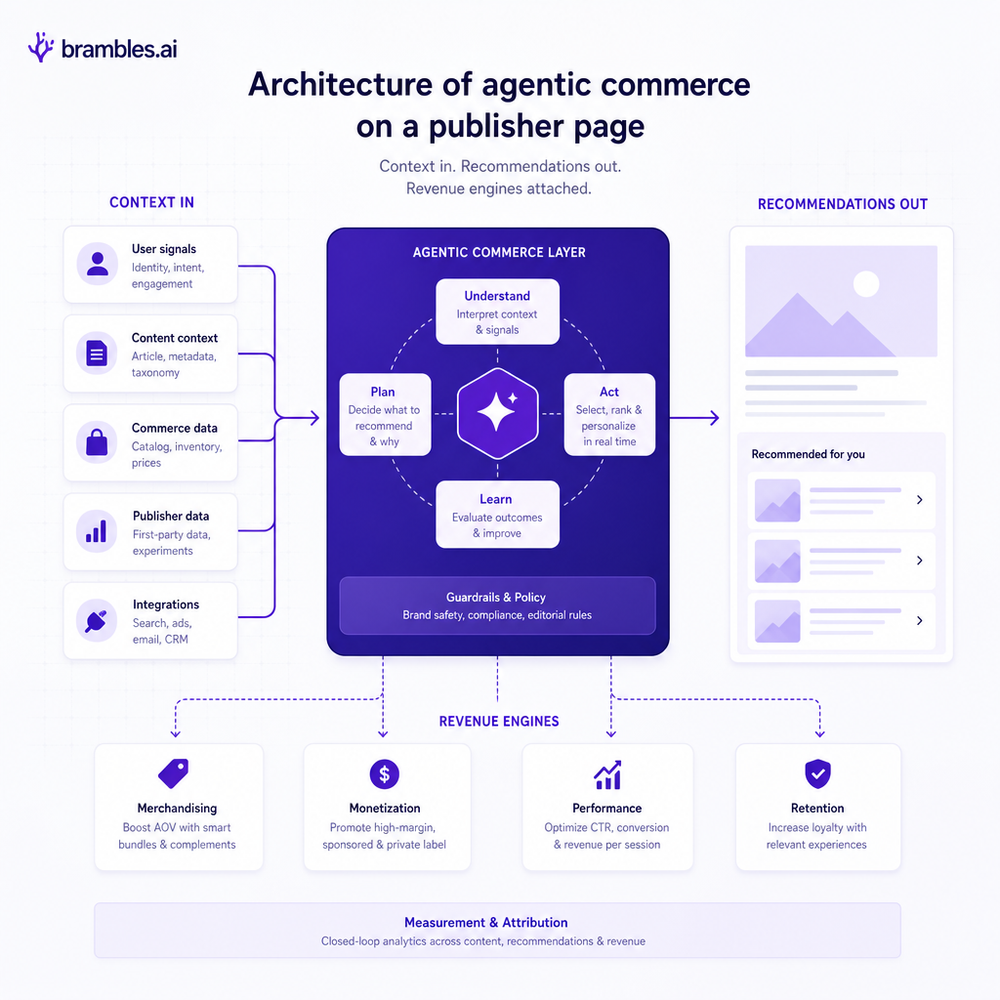
How Agentic Commerce Works on Publisher Sites
Brambles.ai reads the page context, understands the reader’s task, and opens a conversational path. Instead of dumping links, it helps the user decide. Three capabilities do the heavy lifting:
AI product discovery interprets natural language like “I need a carry-on that fits a 22-inch bin and weighs under 6 lbs.” It returns precise matches, alternatives, and side‑by‑side comparisons—powered by your content and catalog coverage.
Proactive engagement detects page intent and suggests a helpful prompt (e.g., on a “best DSLR” guide it offers “Compare low‑light performance across these models”). This increases engagement without being interruptive, typically lifting chat starts and downstream clicks.
Affiliate revenue connects readers to 1B+ products with reliable tracking. You keep your existing networks; we route links cleanly and attribute downstream sales. For SKU‑scarce niches or when you want brand budgets, contextual ads and retail media add CPC and sponsored placements inside the conversation—clearly disclosed and relevance‑scored.
All of this runs inline. Some publishers prefer a fixed embed inside the article body; others float a chat widget sitewide. Both are one‑line installs and fully brandable.
If you’re wondering why conversational flows out‑convert traditional lists, it comes down to UX friction. Conversations let shoppers resolve edge cases in seconds, not clicks. We cover that shift and monetization models here.
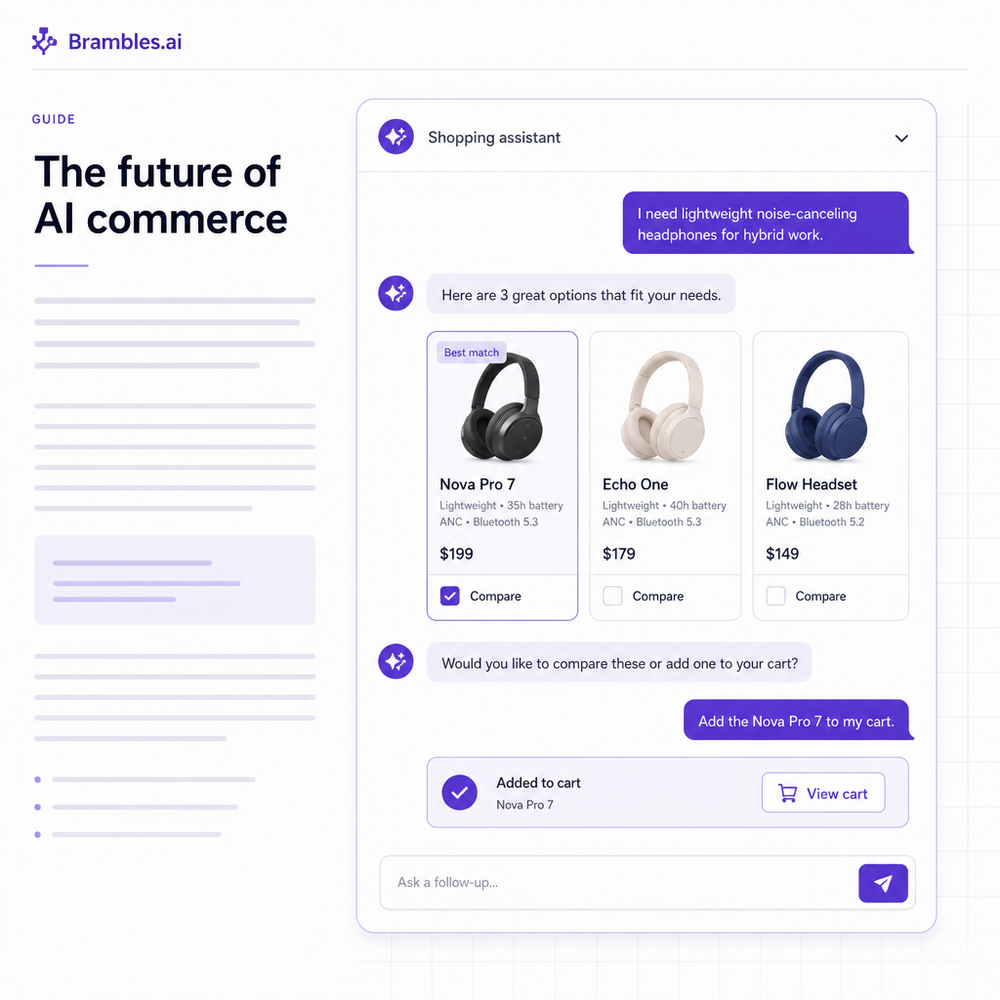
Implementation Guide: Launch in a Week
You can be live in days. Here’s the step‑by‑step we use with midsize publishers and enterprise teams alike:
1) Choose your integration surface. For content sites, start with the floating chat on high‑intent sections and an inline embed on 3‑5 evergreen guides. Both are turnkey installs.
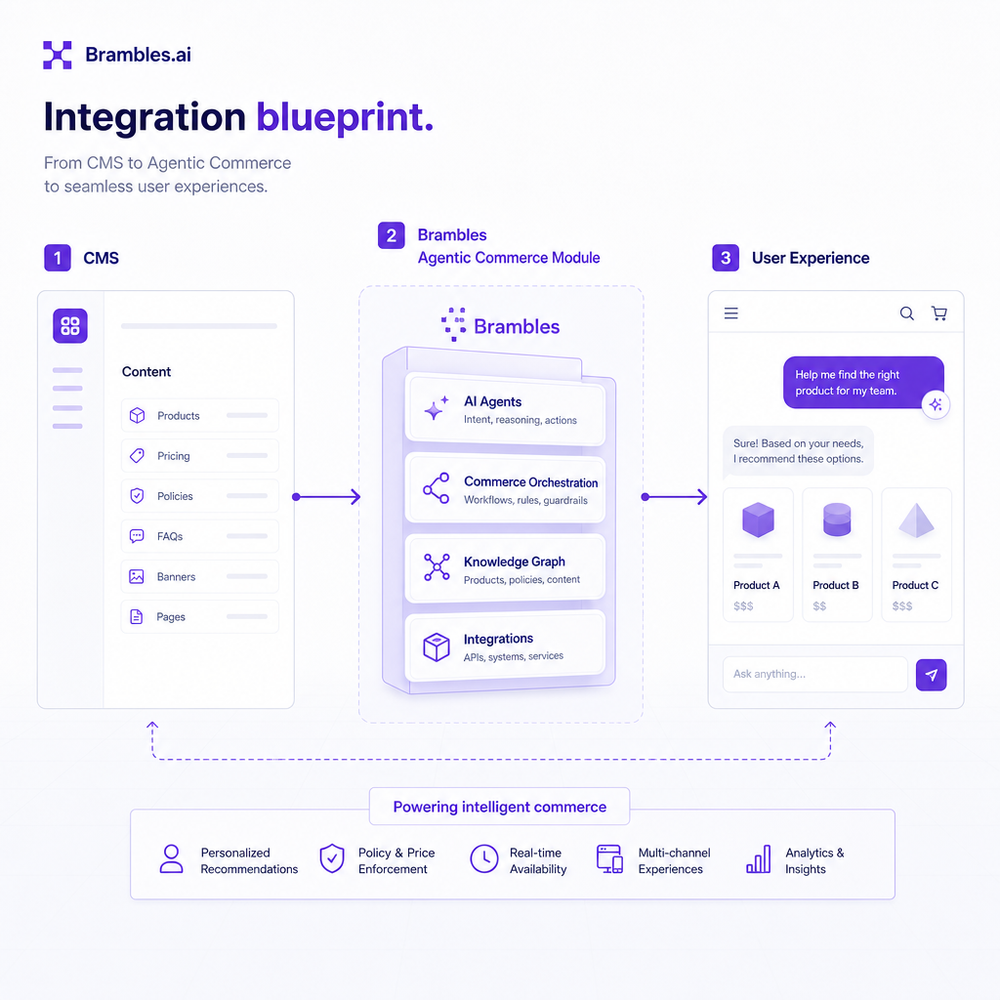
2) Install the JavaScript. The Agentic Commerce Module drops into any CMS or tag manager and automatically indexes your content for contextual prompts and ranking.
3) Or use our plugins. WordPress sites ship in under an hour; Shopify experiences connect your catalog and enable checkout handoff or direct add‑to‑cart from chat where supported.
4) Configure monetization. Map your affiliate networks, enable contextual CPC, and set sponsored product guardrails (brand blocklists, category caps, and relevance thresholds) in the dashboard.
5) Tune the experience. Set tone and prompts, surface helpful quick‑replies, and brand the widget to match your design system. Most teams A/B test one engagement rule per week for the first month.
6) Validate and scale. Launch on 10% of traffic, compare RPM and session value, then expand coverage. Implementation on a 100k‑session apparel site took 3 days and lifted affiliate conversion 42% after week one. A larger home‑improvement publisher rolled out section‑by‑section and added +19% time on page with proactive prompts.
Measuring ROI and the KPIs That Matter
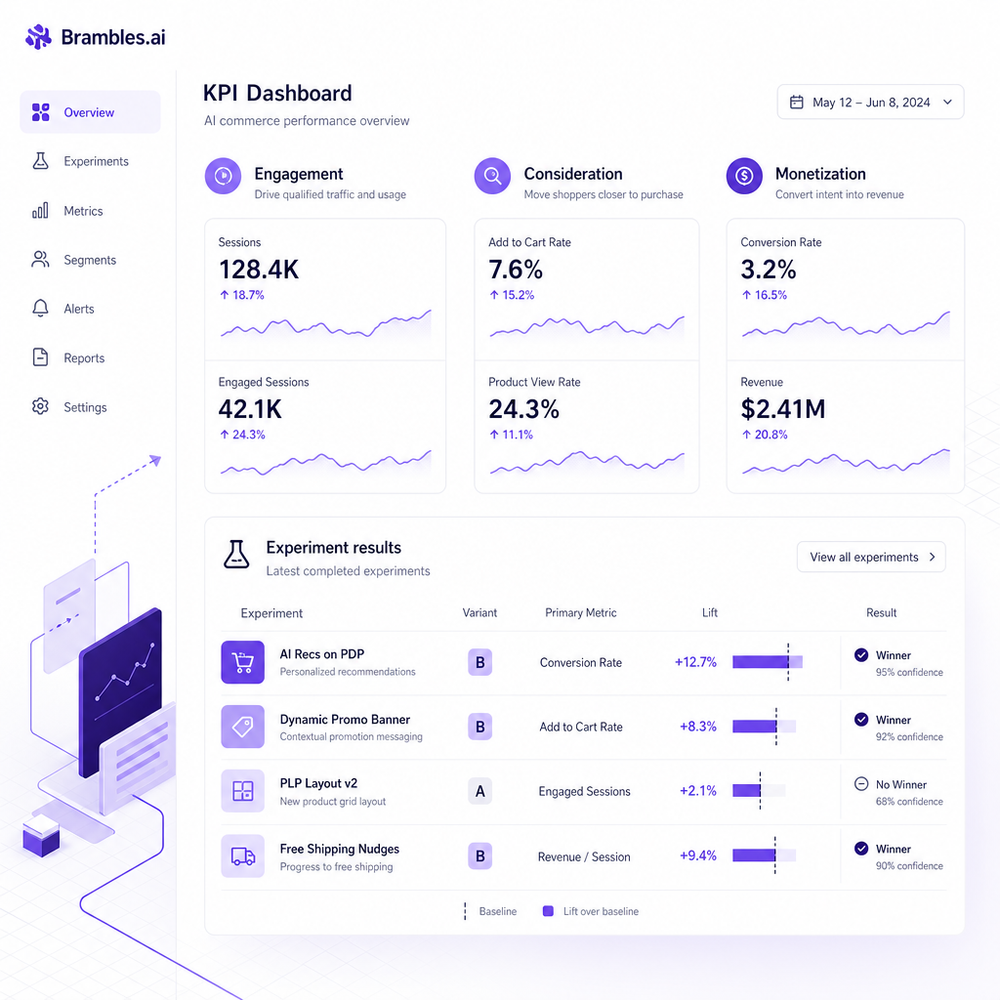
Decide what “good” looks like before you launch. We track a simple chain: engagement → consideration → monetization. Each link in the chain has a metric with a target range you can actually hit.
Engagement: chat starts per 100 sessions and prompt CTR. Benchmarks: 6–12 chat starts per 100 sessions on high‑intent pages with proactive suggestions. Consideration: product card CTR and comparison card opens.
Monetization: affiliate click‑out rate, RPM, and AOV. Publishers often see 20–40% higher AOV when bundles are suggested contextually, aligning with decision‑simplification research from Google UX studies.
Build a weekly scorecard. If chat starts lag, adjust proactive prompts; if CTR lags, review product coverage; if RPM lags, introduce a tasteful sponsored slot. On a gear‑review site, a single “Compare vs your current model?” quick‑reply raised comparison opens by 31% and RPM by 13% week‑over‑week.
Checklist: 1) Define a control group, 2) Set a 2‑week observation window, 3) Track RPM, AOV, and session value, 4) Cap sponsored density, 5) Review affiliate link health, 6) Iterate prompts. Keep disclosure visible at every decision point—trust correlates with higher long‑term session value per Salesforce’s consumer trust research.
First‑Party Data and Reader Trust
Agentic commerce should feel like service, not surveillance. Brambles.ai operates on first‑party context—what’s on the page and what the reader asks—rather than cross‑site tracking. That aligns with a cookieless, ad‑light experience and keeps legal/compliance review straightforward.
Disclose monetization inside the experience, not buried in the footer. A simple “We may earn affiliate commissions” line below the panel, plus a sponsored badge on paid placements, tends to raise trust—counterintuitive, but consistent with Baymard’s findings that clarity reduces drop‑off.
Two practical tips: keep sponsored density under 20% of visible product cards, and require a relevance score threshold so paid placement never derails the task. When in doubt, prioritize the helpful answer over the higher bid; long‑term session value follows trust.
Common Pitfalls and How to Avoid Them
The biggest failure mode is “assistant as billboard.” If the chat simply echoes your article with generic links, users bounce. Make it genuinely useful: comparisons, compatibility checks, and alternatives in stock right now.
Pitfall checklist: 1) No clear prompts on high‑intent pages; 2) Broken or slow affiliate redirects; 3) Overweighting sponsorships; 4) No disclosure; 5) One‑size tone. Fixes: enable proactive prompts, run link‑health checks, cap sponsored density, surface inline disclosures, and set a brand voice that matches your editorial style.
On a DIY tools site, we initially over‑served sponsored placements (30% density). CTR dipped 12%. After we rebalanced to 15% and added a “compare torque vs. weight” quick‑reply, CTR rebounded and RPM rose 9%. Sponsored budgets still spent—just more efficiently.
Future Outlook: Beyond Links to Outcomes
Affiliate links aren’t going away; they’re getting smarter. Expect richer actions inside the assistant—bundling, warranty add‑ons, and loyalty-aware offers—plus direct add‑to‑cart where merchants support it. The net effect: fewer hops, clearer attribution, higher session value.
For publishers, the strategic edge is control. With first‑party context, you can blend affiliate, CPC, and sponsorships in a way that matches your brand. Brambles.ai’s modular approach means you can start light and layer monetization as trust grows—no redesign required.
If you’re ready to test on one section, we’ll share templates for prompts, disclosures, and weekly reporting. Most teams go from zero to statistically clear lift within 21 days. Start with a pilot, prove lift, then scale.
FAQ
How does Brambles.ai earn revenue for publishers?
Three streams: affiliate commissions on qualified click‑outs and purchases, contextual CPC from high‑relevance ads inside the conversation, and retail media (sponsored product placements) with strict relevance and disclosure controls.
Will this conflict with our existing affiliate setup?
No. You keep your networks and IDs. We normalize links, preserve attribution, and run health checks. Most publishers see cleaner tracking and fewer broken redirects after centralizing links in the module.
Can we start without engineering time?
Yes. The WordPress plugin is one‑click, and the embed code can be deployed via your tag manager. Our team can help with initial configuration and A/B setups during the pilot.
What KPIs should we report to leadership?
Report weekly: chat starts per 100 sessions, product card CTR, affiliate click‑out rate, RPM, AOV, and sponsored density. Add a simple note on disclosure placement and trust signals to track qualitative feedback.
How do we maintain brand voice?
You control tone, guardrails, and prompt suggestions. Set voice presets, restrict categories, and apply your color system to keep the assistant feeling native to your editorial brand.
Related resources on Brambles.ai
If you are implementing this, start with Brambles.ai, enterprise solutions, brand pricing, developer docs.
Related posts
View all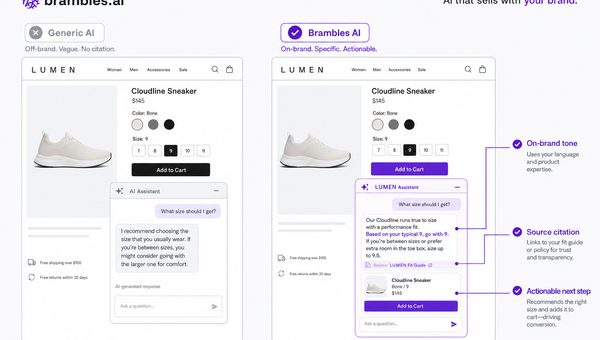
Brand-Consistent AI Chats Build Trust and Conversions
When AI mirrors your brand voice, shoppers relax—questions get answered, carts grow, and support load drops. Learn the playbook to align tone, trust, and ROI.
Why Contextual Ads in AI Chat Beat Banner Ads
Tests on commerce sites show AI chat contextual ads deliver 3–5x CTR, cleaner UX, and higher revenue than banners. See how they work, implement, and measure.
Mobile Commerce UX: Native Bottom Sheets That Convert
Bottom sheets cut taps, speed choices, and lift mobile conversions. Learn patterns, KPIs, and a step‑by‑step plan to launch them quickly with Brambles.ai.
Explore Brambles.ai
Learn more about our AI-powered agentic commerce platform, agentic shopping, and shopping assistance solutions.
Explore More Insights
Discover more articles on AI, automation, and business innovation
View All Articles