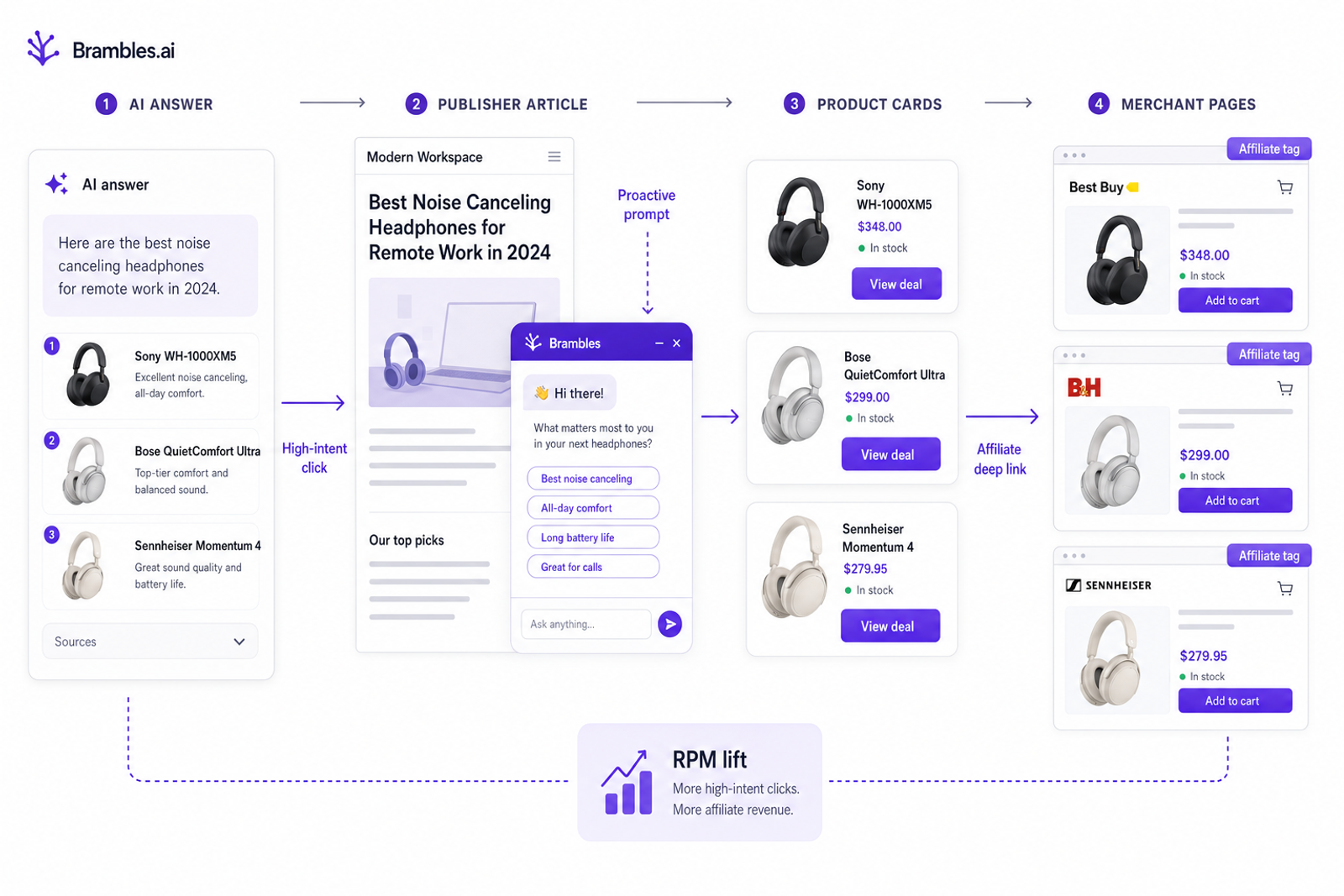
How Brambles.ai Helps Publishers Win AI Shopping Traffic
Publishers are losing product-intent clicks to AI answers. See how Brambles.ai routes discovery traffic to your content with widgets, data, and revenue.
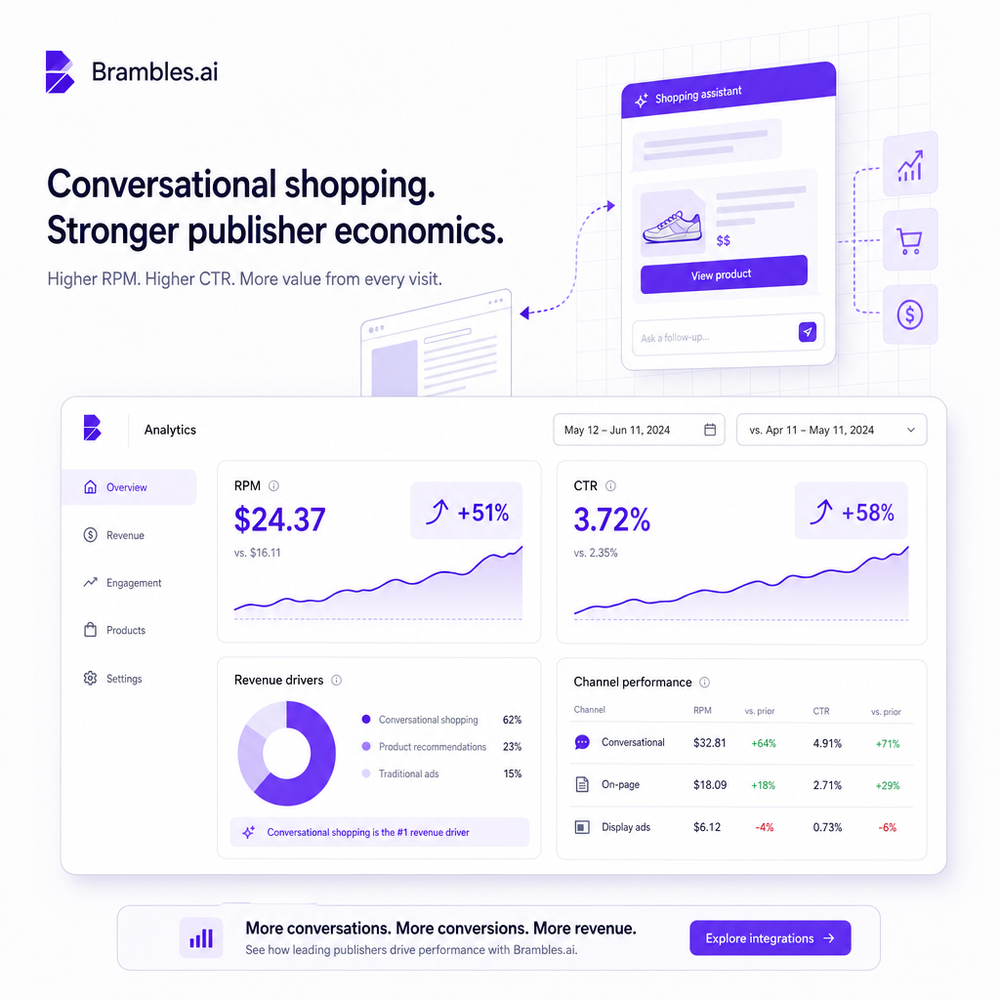
In Q4, a 1.2M‑session review site we advise noticed something odd: traffic from traditional comparison queries fell 11%, yet the visitors who did arrive scrolled deeper and converted faster. When we added a conversational shopping widget that greeted readers with “Looking for a quiet cordless vac under $200?” merchant CTR jumped 39% and RPM rose 28% week over week. The pattern is consistent: AI answers absorb top‑of‑funnel discovery, but the clicks that land are high‑intent and expect instant, product‑savvy guidance. Brambles.ai channels that intent into conversions instead of bounces.
Quick Answer
Brambles.ai helps publishers capture AI shopping discovery traffic by turning arriving readers into product conversations. Its on‑page assistant engages high‑intent visitors, recommends in‑stock items with pricing, and deep‑links via your affiliate IDs. Features like AI product discovery, proactive engagement, and contextual monetization recover lost RPM while preserving trust with clear disclosures and first‑party data controls.
What’s Broken: Discovery Has Moved, UX Hasn’t
Shoppers now ask assistants for “best trail runners for wide feet” and skim synthesized lists. The few who click expect a two‑minute path from intent to a short, defensible pick. Most article templates still assume old‑school browsing: long intros, generic comparison tables, and a “Related posts” box that doesn’t map to the reader’s phrasing or constraints (budget, size, compatibility).
Baymard’s research shows decision friction compounds when users must reformulate preferences across pages; we see it in session replays too: people type brand, price, and must‑haves as if your site were a chat box.
When that cognitive handoff fails, bounce risk spikes. One publisher in our cohort saw a 22% higher exit rate on pages where visitors used site search more than twice—classic symptom of unmet conversational intent.
Monetization also lags. Static affiliate links and disjointed commerce blocks don’t adapt to availability, price drops, or local shipping. Meanwhile, privacy norms are tightening; “creepy” ad tech erodes trust and devalues loyal traffic. Publishers need monetization that’s contextual, not behavioral—and that meets readers where their questions live: inline, conversational, and immediate.
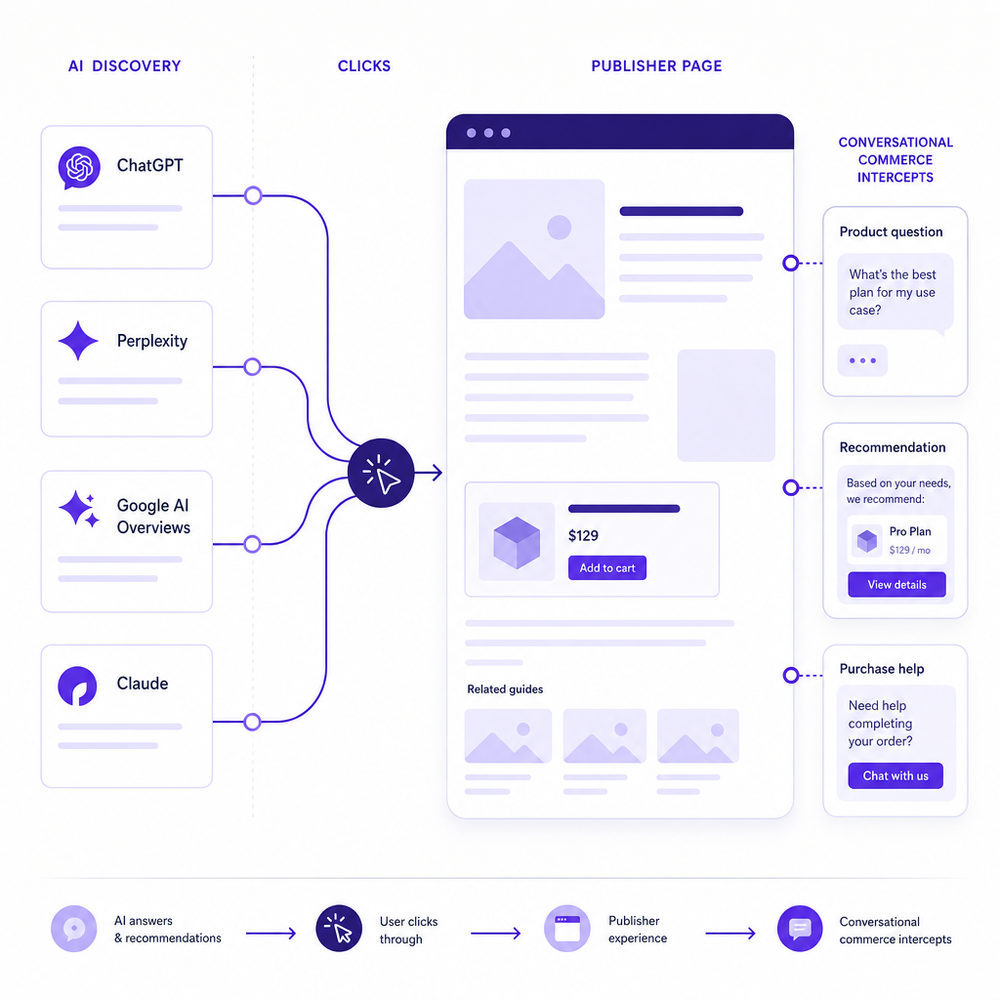
How Brambles Captures AI Discovery Traffic
The playbook is simple: meet readers with a helpful question, surface the right products instantly, and shorten the distance to purchase. Brambles.ai does this with features that work together and respect your editorial voice.
AI product discovery turns natural‑language intent into shoppable results. Readers can ask, “Is this compatible with an iPhone 15?” and get validated picks with specs and price ranges, powered by your indexed content and trusted catalogs.
Proactive engagement looks at page context—title, categories, even the paragraph someone hovers—and offers a precise nudge like “Compare breathable hiking shells under $150?” It typically triggers only on commerce‑intent pages to protect editorial flow and reduce noise.
Affiliate revenue routes 1B+ products and merchants with your IDs applied automatically, while Retail media and Contextual ads offer incremental RPM from sponsored placements that match the conversation topic rather than user identity. Used sparingly, these formats add yield without undermining trust.
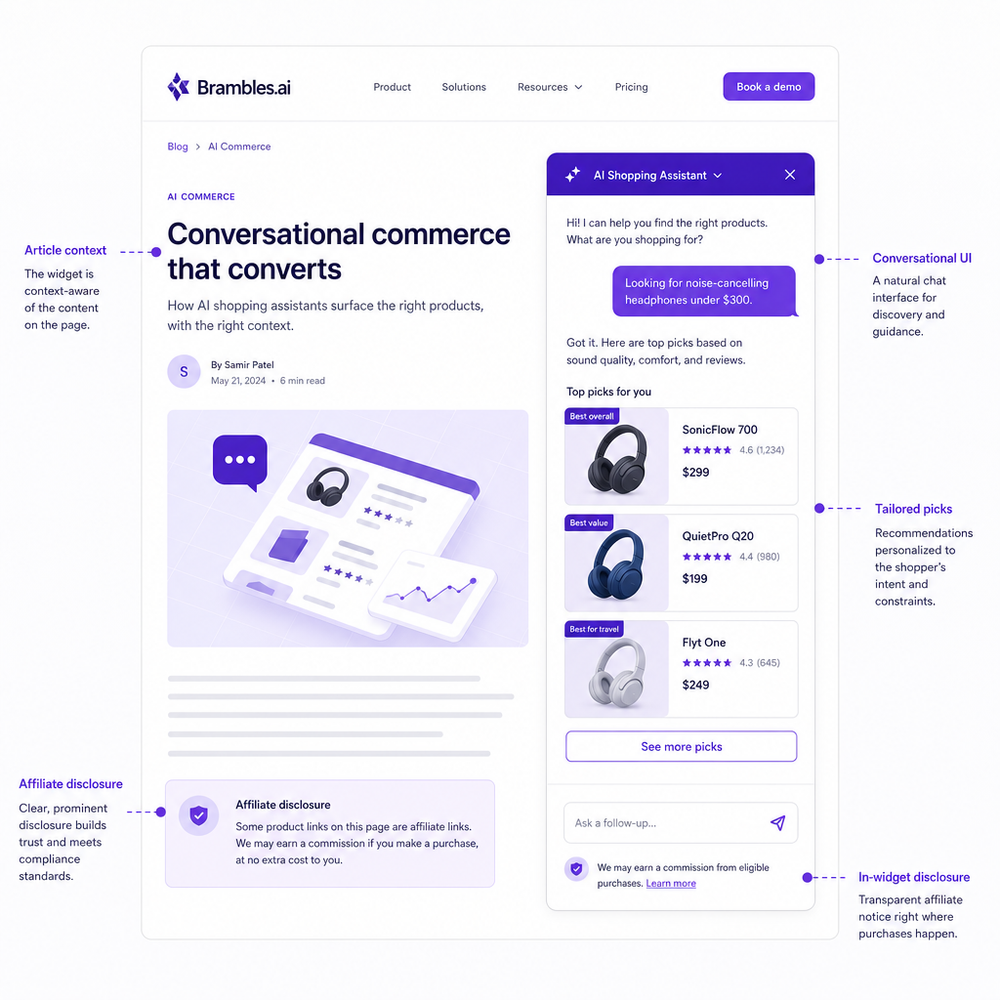
Inline shopping embed lets you place a compact conversation directly inside an article module—perfect between sections of a guide—while the floating AI shopping chat is available site‑wide for quick questions. Some publishers also enable direct add to cart to send readers to a retailer with a prefilled cart and affiliate attribution intact.
Anecdote: On a 600k‑session home goods site, enabling proactive engagement on top 30 buyer’s guides lifted merchant CTR 41% and increased affiliate EPC by 19% over two weeks. The only change was a targeted opening prompt and localized price filters.
Implementation Guide: From Snippet to Lift in 7 Days
Here’s a pragmatic rollout we’ve repeated across publishers. Expect meaningful signal within a week on a subset of pages if you focus on high‑intent templates first.
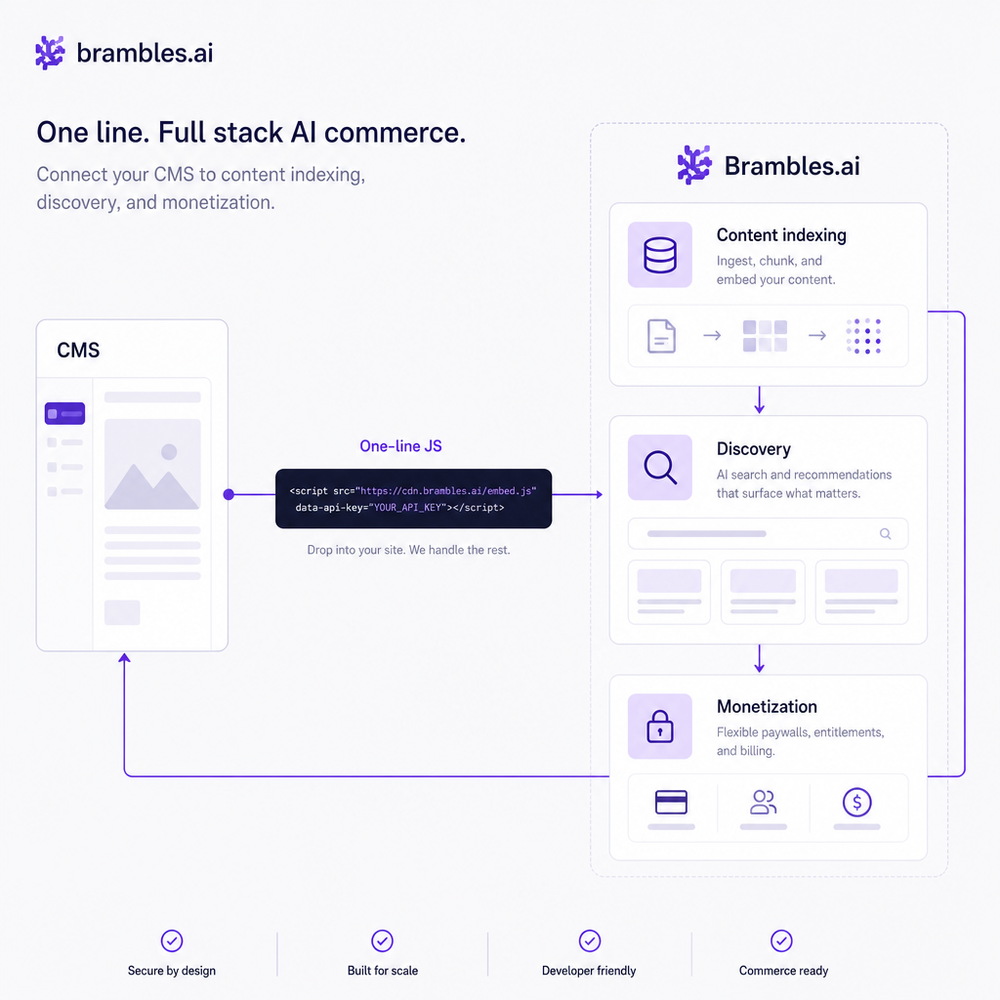
1) Add the JavaScript. Use the Agentic Commerce Module to place Brambles across your site. It’s a single snippet and auto‑detects your CMS. WordPress teams can start even faster with the official plugin; commerce teams can connect retailer catalogs via the Shopify App as it becomes available.
2) Index your content. Flip on Content intelligence to crawl buying guides, FAQs, and comparison tables so the assistant can cite and align with your editorial verdicts. Map categories and attributes you care about (fit, size, compatibility, budget caps).
3) Configure the experience. Set the AI personality to match your tone—direct for tech, empathetic for parenting—and customize colors and placement. Enable proactive engagement only on buyer’s guides, product reviews, and deal hubs at first.
4) Connect monetization. Turn on Affiliate revenue, optionally layer Contextual ads or Retail media for sponsored product slots, and ensure your network IDs are correct. Test direct add to cart only with retailers that support stable cart deep‑links.
5) QA and disclose. Validate price accuracy, availability, and merchant redirects on mobile. Add a clear affiliate disclosure in the widget and inline module, not buried in footers. We’ve found disclosures increase trust without hurting CTR when phrased plainly.
6) Launch an A/B. Split high‑intent pages 50/50 with the inline shopping embed midway through the article. Track merchant CTR, RPM, session depth, and time to first product recommendation.
Anecdote: A parenting publisher added the snippet and a friendly persona (“Busy‑parent energy saver”) across 12 gift guides. In 10 days, sessions with chat saw a 2.1x higher product clickthrough and a 33% RPM lift. Editorial time spent was under four hours total.
Measuring ROI & KPIs That Matter
Treat conversational commerce like a product, not a plugin. Define target uplifts and instrument end‑to‑end. In our tests, the fastest signal comes from “time to first helpful product” and “merchant CTR per 1k sessions,” which both correlate with RPM.
Baseline and track: 1) Merchant CTR, 2) RPM/RPS, 3) Session depth, 4) Chat launch rate, 5) Add‑to‑cart initiations, 6) Revenue per 1k sessions by page template, 7) Satisfaction thumbs‑up rate inside the widget. Baymard and Google UX research both highlight speed and clarity as top drivers; your metrics should reflect them.
Practical setup: pipe widget events into your analytics. Tag sessions with an experiment dimension (variant vs. control). Use post‑click merchant reports to confirm affiliate attribution, then reconcile weekly. Publishers who check price freshness daily and prune underperforming prompts see steadier RPM than those who “set it and forget it.”
Anecdote: On a mid‑market tech publisher (900k sessions/month), moving the inline module above the pros/cons section cut time‑to‑first‑product from 56s to 21s and lifted revenue per 1k sessions by 31%. No new content was published during the test window.
First‑Party Data, Trust, and Common Pitfalls
Trust is a feature. Keep conversations contextual, not behavioral. Brambles’ approach emphasizes first‑party signals—page context, on‑site interactions—so you can increase yield without surveillance. Match your persona to editorial standards and add a prominent disclosure inside the widget and any inline module.
Readiness checklist: 1) Target a small set of buyer’s guides first, 2) Localize price/availability where possible, 3) Keep prompts short and specific, 4) Review product coverage gaps weekly, 5) Confirm affiliate IDs and test direct‑to‑cart, 6) Validate mobile performance, 7) Set feedback rules (e.g., suppress prompts after two dismissals).
Common pitfalls we see: over‑triggering the chat on evergreen news, burying the disclosure, and ignoring taxonomy mapping—if your “headphones” category mixes gaming headsets with earbuds, recommendations will feel off. Another misstep is skipping cadence; a 10‑minute weekly QA catches more revenue‑leaking mismatches than any quarterly review.
If your team prefers no‑code, start with the WordPress plugin and out‑of‑the‑box prompts. If you have dev resources, the Agentic Commerce Module with config files gives fine‑grained control of triggers, sponsor rules, and tone. Either path keeps you independent and cookieless while moving faster than template overhauls.
FAQ
How fast can we see results?
Most publishers see directional lifts within 7–10 days on a pilot set of buyer’s guides. Faster if you already have strong category pages and clear comparison criteria indexed.
Will this conflict with our editorial independence?
No. The assistant cites your content and follows your rules. You control prompts, tone, and sponsor treatment. Many teams route only post‑recommendation links to affiliates and keep editorial copy unchanged.
How does Brambles.ai handle disclosures and privacy?
Disclosures live where the action is: in the widget and inline module. The system relies on first‑party context and avoids behavioral tracking. This keeps you compliant and trusted by readers.
What’s the integration effort and cost?
A one‑line snippet for most sites, or a click‑to‑install plugin for WordPress. Pilot on 10–30 pages, then expand. Pricing is tiered for publishers, with self‑serve and enterprise options.
Which pages benefit the most?
Buyer’s guides, reviews with clear verdicts, and seasonal gift hubs. We’ve also seen strong performance on deal roundups when the prompt narrows to “Best under $X” and stock checks update hourly.
Related resources on Brambles.ai
If you are implementing this, start with Brambles.ai, for brands & retailers, enterprise solutions, brand pricing.
Related posts
View all
Sponsored Products in AI Shopping: Retail Media 101
Learn how sponsored product placements power AI shopping, how bidding and relevance work, and how to implement retail media without eroding trust or UX.
Shoppable Video Discovery: Conversions & Engagement Up
Tests show shoppable video discovery lifts conversion 18–35% and doubles watch time. See the UX patterns, KPIs, and how to deploy it quickly with Brambles.ai.
Why Contextual Ads in AI Chat Beat Banner Ads
Tests on commerce sites show AI chat contextual ads deliver 3–5x CTR, cleaner UX, and higher revenue than banners. See how they work, implement, and measure.
Explore Brambles.ai
Learn more about our AI-powered agentic commerce platform, agentic shopping, and shopping assistance solutions.
Explore More Insights
Discover more articles on AI, automation, and business innovation
View All Articles